Introduction
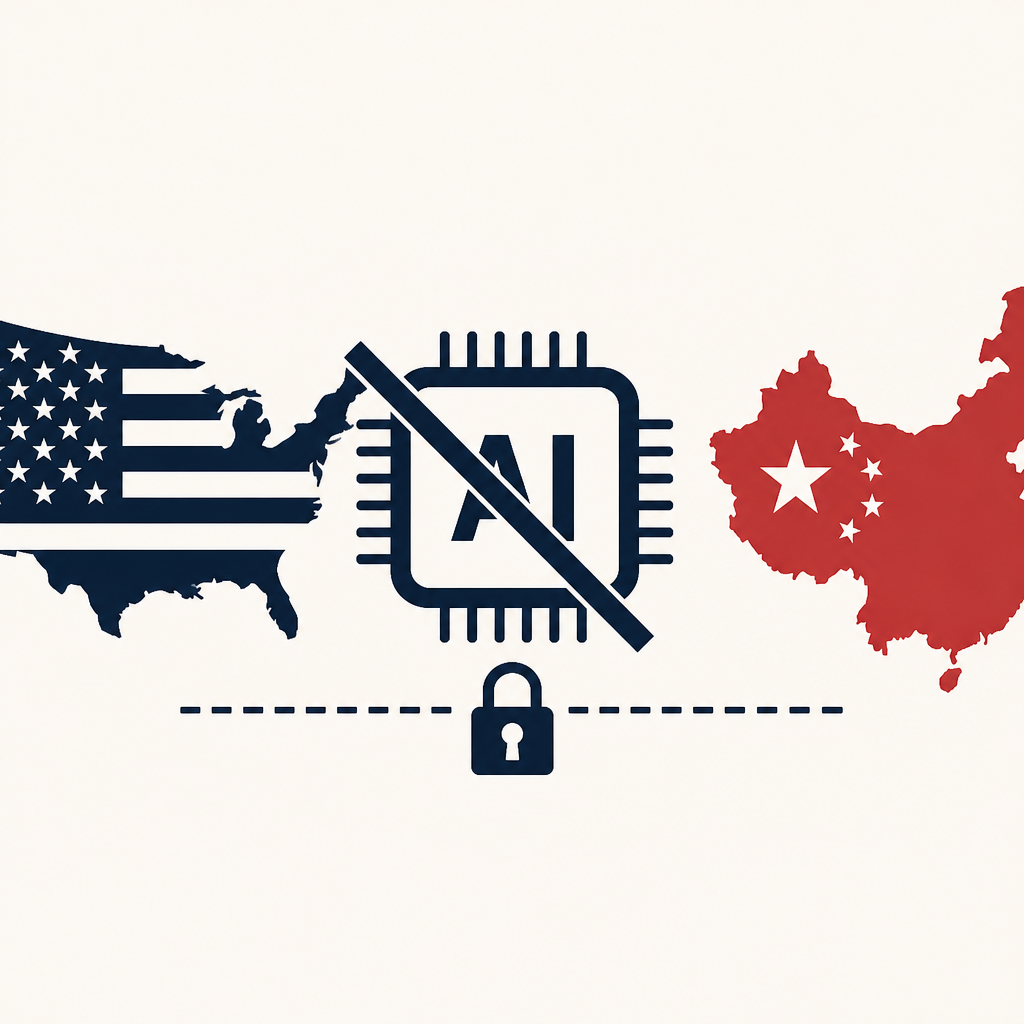
For decades, the global semiconductor supply chain was defined by a relentless pursuit of efficiency and interdependence. Today, that paradigm has shattered. Artificial intelligence has elevated the advanced graphics processing unit from a niche gaming component to the foundational engine of future economic and military power, and the United States has responded by deploying aggressive export controls on AI chips in an attempt to throttle the computational capacity of its principal strategic competitor, China [1]. If twentieth-century geopolitical power flowed through oil pipelines and shipping lanes, twenty-first-century power increasingly flows through silicon [2].
The scale of this intervention is difficult to overstate. Since October 2022, a cascade of export controls has systematically restricted the flow of advanced computing hardware, high-bandwidth memory, and the lithography equipment required to manufacture chips, marking what scholars describe as a decisive departure from market principles toward state-directed intervention on both the supply and demand sides of the AI economy [2][3]. The United States now controls roughly three-quarters of global AI compute, and it has moved decisively to weaponize that concentration [2].
This article examines how the weaponization of compute is redrawing the geopolitical map. It traces the evolution of U.S. export control policy, analyzes China's accelerating push for technological self-sufficiency, explores how middle powers are navigating a landscape of rival technological blocs, and considers the strategic paradoxes that complicate Washington's calculus. What emerges is a picture of compute not merely as a commercial commodity, but as the primary leverage point of twenty-first-century statecraft [1].
From Efficiency to Containment: The Logic of Compute Statecraft
The intellectual foundation of export control policy rests on a simple asymmetry: while China enjoys advantages in data availability, manufacturing capacity, and human capital--all important inputs for AI development--compute remains one of the few inputs in the AI infrastructure stack that is scarce, concentrated, and controllable [4]. As AI systems increasingly shape military power and cyber capabilities, limiting adversaries' access to compute has evolved from an issue of technological competition into a national security priority [4].
This logic has grown only more compelling as frontier AI development has shifted. The rise of reasoning-intensive models--which demand vastly more computational resources during inference than their predecessors--means the gap between nations with compute and those without will continue to widen. By restricting China's access to cutting-edge compute, the United States seeks not merely to slow Chinese labs today, but to prevent them from training frontier models and deploying them at scale as computational demands surge tenfold [3].
The concept of "compute sovereignty" has consequently entered the geopolitical lexicon. Data centers, advanced semiconductors, electricity grids, and cloud computing platforms are now strategic assets through which states exercise regulatory control, economic influence, and national-security power--and the critical distinction lies between surface-level access to AI services and genuine control over the infrastructure beneath them [5].
The Architecture of Containment: Evolution of U.S. Export Controls
The Expanding Regulatory Perimeter
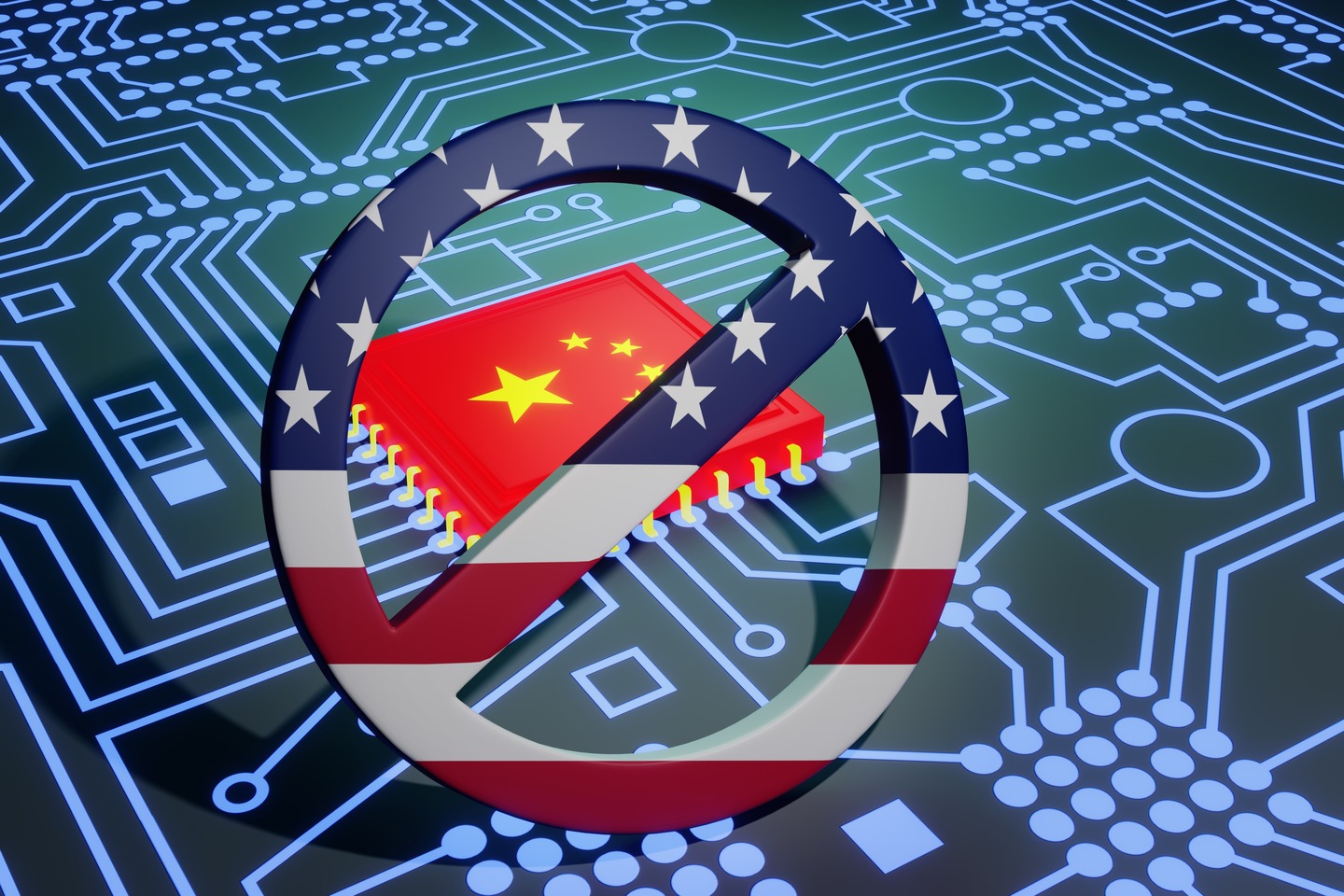
American policy has evolved through successive, progressively broader iterations. In October 2022, ahead of ChatGPT's launch and amid warnings that frontier compute demands were set to surge, the Bureau of Industry and Security imposed export controls on advanced computing items--including Nvidia's cutting-edge GPUs--and restricted U.S. persons from supporting the development or production of integrated circuits at Chinese facilities without a license [3].
In October 2023, Washington tightened the screws: new performance density thresholds required export licenses for high-performance AI chips from NVIDIA, AMD, and Intel; controls on semiconductor manufacturing equipment were expanded to restrict exports of extreme ultraviolet lithography machines from ASML and Applied Materials to China; and multiple Chinese tech firms were added to the BIS Entity List, effectively blocking their access to U.S. technology [6]. Further refinements followed in December 2024, as each iteration reflected shifting assessments of AGI timelines and China's progress toward semiconductor independence [7].
The policy's trajectory has not been linear, however. In late October 2025, Presidents Trump and Xi agreed to a one-year truce on tariffs and rare earths--yet left export controls on AI chips conspicuously untouched. Within days, Trump signaled he would permit limited Nvidia sales to China before reversing course, an episode that revealed the deeper tension in America's strategy: how to balance short-term technological leverage against long-term industrial strength [3]. More recent regulatory shifts, such as moving chips like the Nvidia H200 from a presumption of denial to a highly discretionary, case-by-case licensing process, have formalized the U.S. stack as an "unreliable input" in the eyes of Chinese planners [1].
 Compute as Statecraft: How U.S. AI Chip Export Controls Are Rewiring Sovereign AI Strategies Among Middle Powers | Reducates
Enforcement and the Shifting Politics of Washington
The domestic politics of containment have also grown more complicated. What was once a clear bipartisan consensus around restricting China's access to advanced semiconductors has fractured into a triangular standoff between Congress, the White House, and the chip industry, reshaping U.S. strategy in real time [8]. Nvidia's substantial China revenue gives the industry enormous incentive to lobby for exemptions, while national security hawks press for ever-tighter restrictions--a dynamic that makes the perimeter of containment a moving target rather than a fixed wall [3][8].
China's Answer: Building the Parallel Stack
Breakthroughs and Bottlenecks
The controls have produced genuine constraints. Chinese foundries like SMIC have struggled to achieve consistent 7nm production yields comparable to TSMC, and Beijing's access to top-tier hardware has been meaningfully curtailed [1]. Yet the strategic effect has been paradoxical: rather than making reliance on Western technology attractive, the controls--including the discretionary licensing regime--have made depending on the U.S. tech stack an untenable long-term strategy for Chinese firms. A domestic Chinese stack has become a rational inevitability, driven by state-backed industrial policies such as Made in China 2025 [1].
Chinese AI progress has continued despite the constraints. The development of models like DeepSeek-R1 highlights Beijing's ability to innovate under pressure, demonstrating that restrictions may be accelerating rather than stalling China's push for self-sufficiency through alternative training methods and intensified domestic talent development [9]. China has also intensified investment in semiconductor research, quantum computing, and domestic AI chip production to reduce reliance on Western suppliers [9].
Countermeasures Beyond Chips
Beijing has not limited itself to playing defense. Leveraging its dominance in critical raw materials, China imposed export restrictions in July 2023 on gallium, germanium, antimony, and other superhard materials--key components in high-performance computing and AI chip production--a move that highlighted Chinese leverage over upstream supply chains and sent shortage shocks through global manufacturing, including the automotive sector [6][5]. The message was unmistakable: chokepoints run in both directions.
 The Geopolitics of Compute: How US AI Chip Export Controls Are Reshaping Global Technological Sovereignty | Reducates
Middle Powers and the New Non-Alignment
Sovereign AI on American Terms
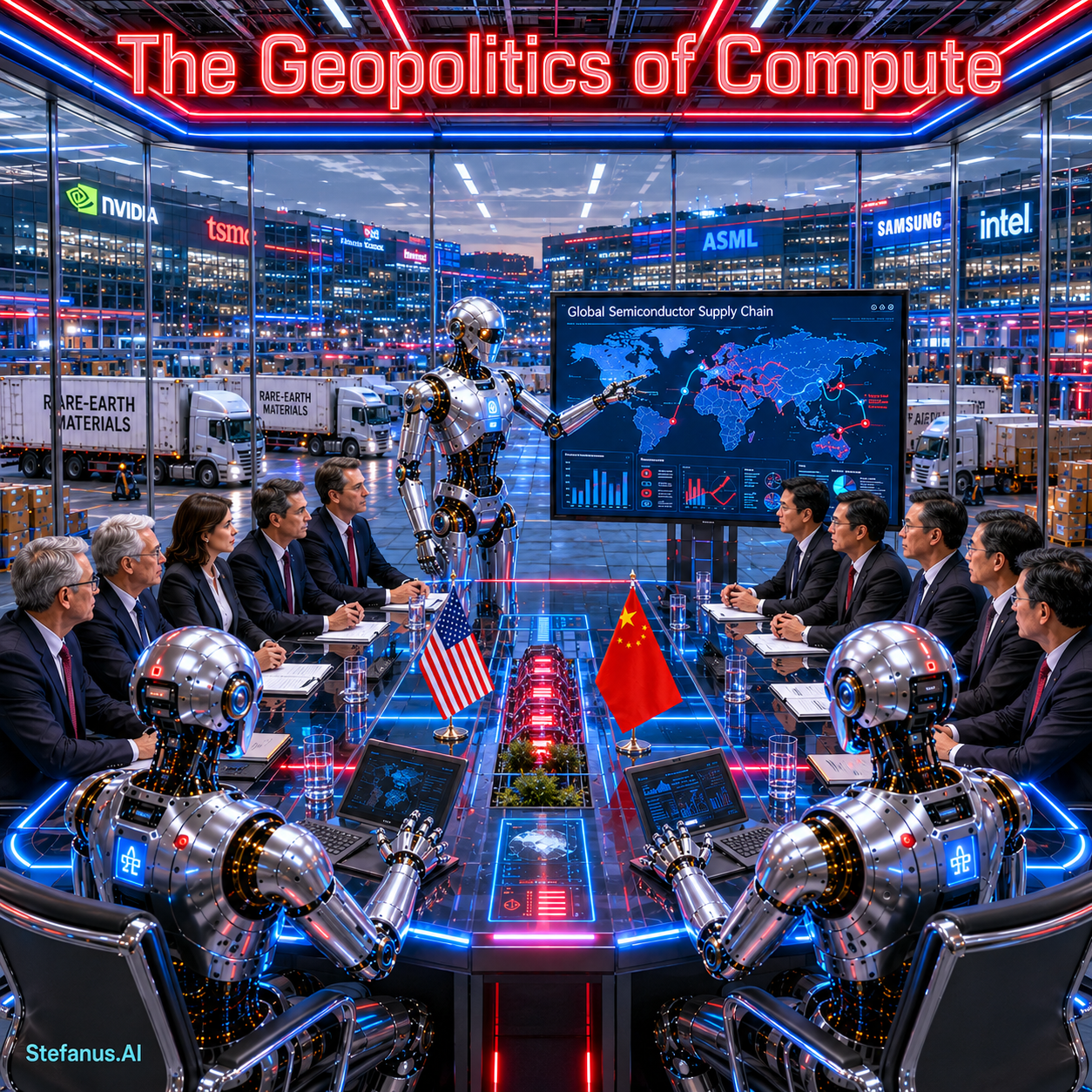
Perhaps the most consequential effects of compute statecraft are playing out among nations that control neither stack. Middle powers--from the Gulf states to Europe, Japan, and Singapore--now navigate a landscape in which the United States controls roughly three-quarters of global AI compute, weighing the benefits of "sovereign AI on American terms" against the strategic risks of deepened dependence [2]. Many pursue "sovereign AI" explicitly to free themselves from dependence on both Washington and Beijing by developing domestic models and uplifting local workforces. Yet the current global structure severely constrains this ambition: U.S. and Chinese companies control the most critical layers of the technological stack--compute, chips, and foundational models--leaving most countries without truly independent options [10].
The Contest for the Compute-Poor World
The geopolitical contest is not merely bilateral. China's Digital Silk Road and the U.S.-aligned OpenAI for Countries initiative are competing for the same pool of compute-poor nations, turning them into geopolitical battlegrounds where infrastructure offers double as instruments of influence [2][10]. The risk, analysts warn, is that countries excluded from American channels may align more closely with Beijing, and that Chinese companies stand ready to fill any vacuum U.S. restrictions leave behind [2]. For these nations, the choice of AI stack is becoming a choice of alignment--compute diplomacy as the new non-alignment.
 The Geopolitics of Compute: How US AI Chip Export Controls Are Reshaping Global Technological Sovereignty | Reducates
The Paradoxes of Containment
The Taiwan Bottleneck
The controls cannot resolve--and may worsen--the system's central fragility: Taiwan. TSMC produces the most advanced chips worldwide, and as analysts note, its foundries sit within easy reach of Chinese missiles, a precarious arrangement for any U.S. military planner [7]. To the extent that export controls reduce China's dependence on Taiwanese manufacturing, they may ironically increase the likelihood of conflict over the island--whose fabs produce not only leading-edge chips for iPhones and Nvidia's top AI products, but trailing-edge chips indispensable to everything from cars to refrigerators [7]. Containment strategy thus sits atop the very vulnerability it seeks to manage.
Innovation Under Pressure
A second paradox is emerging from recent scholarship on what has been called the "paradox of export controls": restrictions risk reducing global demand for U.S. chips, incentivizing non-U.S. computing ecosystems, and weakening America's long-term AI leadership rather than protecting it [2][5]. Each tightened rule converts American hardware from a universal standard into a geopolitical liability, giving Chinese firms a captive domestic market and a compelling export pitch to the non-aligned world. Long-term, robust enforcement may still preserve short-term advantage, but the strategy's success increasingly depends on outpacing an adversary that containment itself has mobilized [6][9].
Conclusion
The weaponization of compute represents the most ambitious attempt since the Cold War to convert technological concentration into durable geopolitical advantage. U.S. export controls have demonstrably constrained China's access to top-tier hardware and preserved a window of American supremacy at the frontier of AI. But they have also fractured the global technology order into rival blocs, accelerated the construction of a self-sufficient Chinese stack, pushed middle powers toward hard choices about alignment, and exposed chokepoints--from Taiwan's fabs to China's rare earth refineries--that no single policy can secure [1][2][7].
The ultimate verdict on compute-as-statecraft remains unwritten. If reasoning-intensive models continue to drive exponential demand for compute, Washington's leverage may prove durable [3]. If Chinese innovation under sanctions--from DeepSeek-style efficiency breakthroughs to maturing domestic chips--continues to narrow the gap, the controls may be remembered less as a shield around American primacy than as the catalyst that built a rival. Either way, one conclusion is already settled: in the twenty-first century, silicon has joined oil and sea power among the essential currencies of statecraft, and the nations that master its geopolitics will shape the balance of technological power for decades to come [2][5].
References
- 1.
- 2.
- 3.
- 4.
- 5.
- 6.
- 7.
- 8.
- 9.
- 10.