Introduction
When the EU AI Act entered into force in August 2024, the reaction on both sides of the Atlantic followed a well-worn script. Silicon Valley executives and Washington policymakers warned that Brussels' command-and-control approach would strangle innovation, drive investment to more permissive jurisdictions, and ultimately cede global AI leadership to China. The transatlantic regulatory divide was framed in familiar binaries: innovation versus precaution, market-driven versus state-directed, American dynamism versus European bureaucratic sclerosis [1].
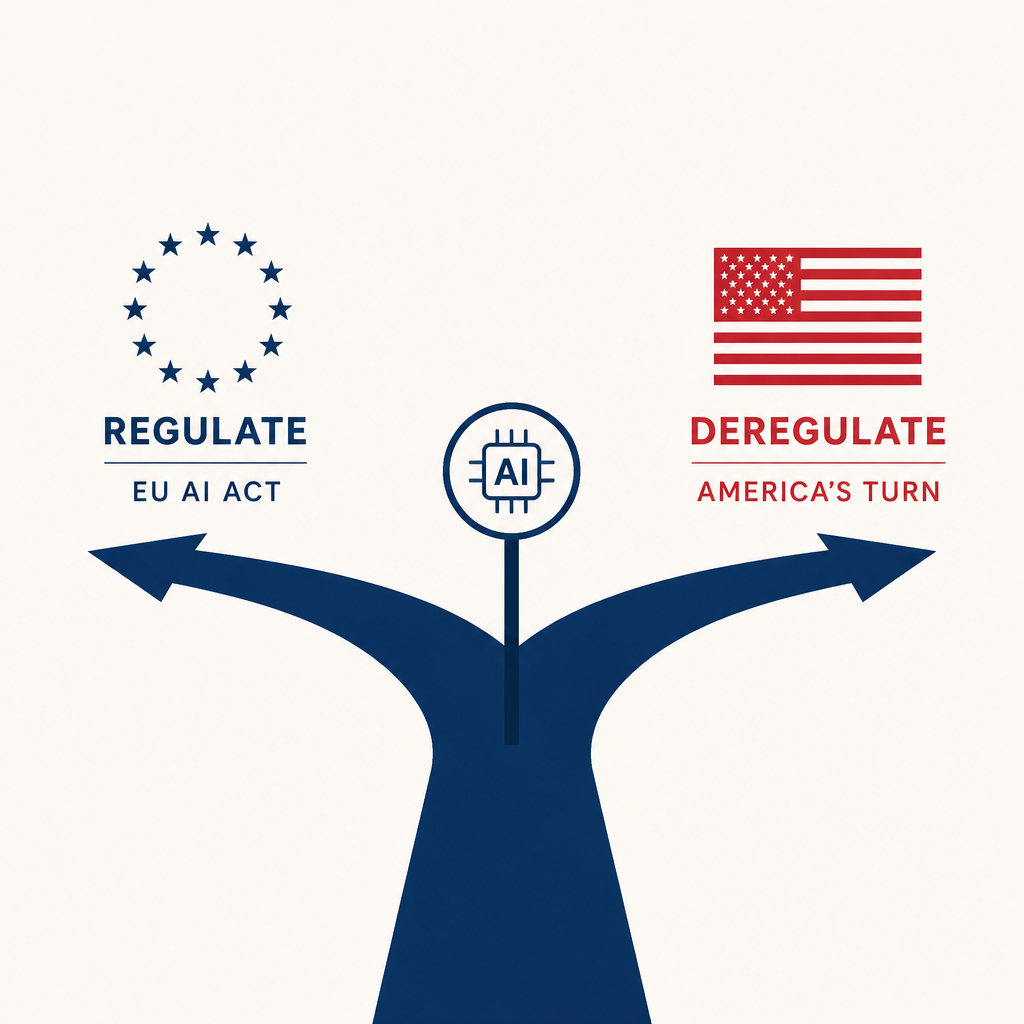
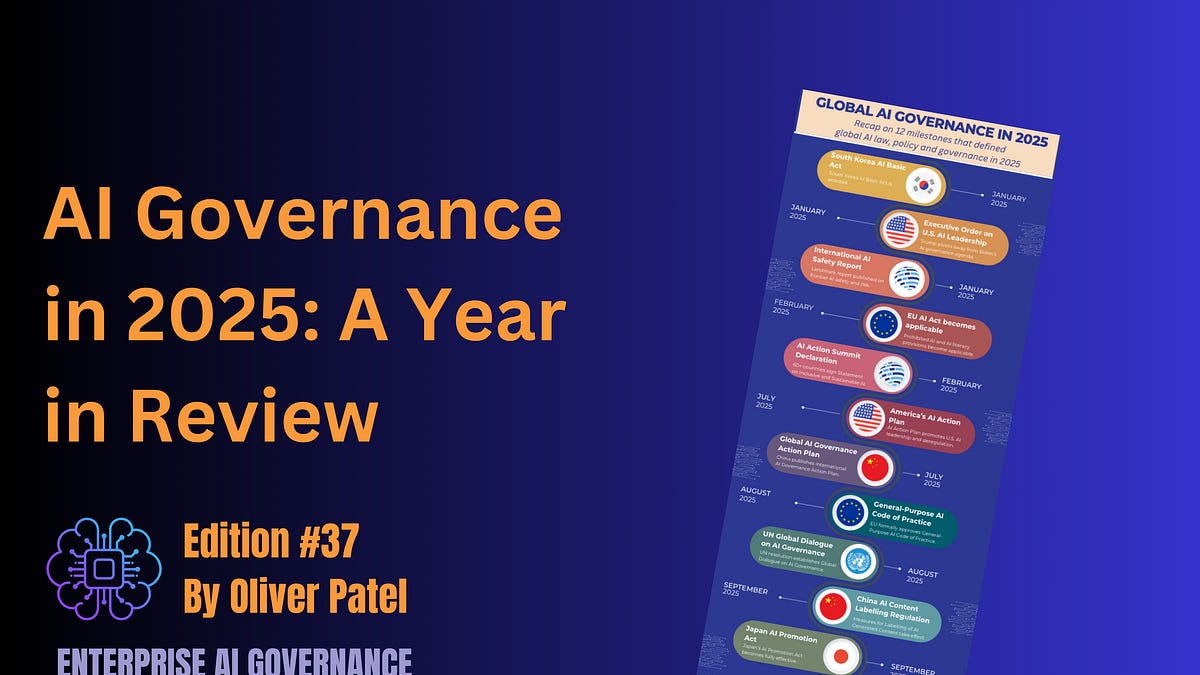
Since then, the divergence has only widened. The European Union has pressed ahead with the phased application of the world's first comprehensive, horizontal AI statute--banning prohibited practices since February 2025, activating obligations for general-purpose AI models since August 2025, and preparing full enforcement against high-risk systems from August 2, 2026, with penalties reaching €35 million or 7% of global annual turnover [2]. The United States, meanwhile, has reversed course almost entirely: President Trump revoked the Biden administration's AI executive order on January 20, 2025, and replaced it with a deregulatory framework emphasizing innovation over oversight. No binding federal AI statute exists, and the NIST AI Risk Management Framework remains entirely voluntary [2].
Yet the real story is more complicated--and more consequential--than a simple tale of Brussels regulating while Washington deregulates. The meaningful divergence is as much architectural as it is philosophical: a single legislative instrument uniform across 27 member states versus a radically decentralized patchwork of state laws, agency guidance, and voluntary frameworks [1]. And paradoxically, even as the EU champions binding rules, its own implementation is being recalibrated under commercial and geopolitical pressure [3], while Washington shows unexpected signs of gravitating toward the very centralization it once derided [1]. The collision of these trajectories is now actively reshaping who writes the rules of global AI governance.
The EU AI Act: A Staggered March into Force
A Risk-Tiered Timeline
Unlike most legislation, the AI Act did not arrive all at once. Its obligations phase in deliberately, tier by tier, giving enterprises a rolling sequence of compliance deadlines: prohibited AI practices have been banned since February 2025; General-Purpose AI (GPAI) obligations entered into force in August 2025; and full enforcement of high-risk AI system requirements begins August 2, 2026 [2]. The penalties attached to the most serious violations--up to €35 million or 7% of global annual turnover--put the Act in the same punitive league as GDPR, signaling that Brussels intends the law to bite [2].
The Act's enforcement architecture is equally distinctive. It operates as a single legislative instrument uniform across all 27 member states, enforced through harmonized national competent authorities coordinated by a central AI Office at the EU level [1]. This centralization is precisely what Brookings analysts identify as the EU's structural advantage: far more centrally coordinated and comprehensive regulatory coverage than the U.S., with clear investigatory powers to enforce its rulemaking on AI applications [4].
Recalibration Under Pressure
The staggered rollout, however, has become a site of contestation in its own right. Implementation complexity is now forcing regulatory recalibration from within the EU itself. The so-called Digital Omnibus initiative--alongside positions adopted by the European Parliament's committees and the Council--points toward a postponement of obligations relating to high-risk AI systems, potentially shifting key deadlines to 2027 and 2028, alongside changes to registration requirements in the EU database for high-risk systems and stricter conditions for processing special categories of personal data [3].
The broader picture is one of a regulator hedging. Enforcement of the Digital Services Act is in limbo, the AI liability directive has been shelved, and new AI codes of practice focus more on help and support than on firm restraints. Less than a year after proudly confirming its regulatory might with the AI Act, Brussels' ambition looks significantly different--raising the question of whether this is pragmatic recalibration or capitulation to Washington's bullish tech stance [5].
 AI Governance in 2025: a year in review - by Oliver Patel
America's Deregulatory Turn--and Its Centralizing Contradiction
From Revocation to Innovation-First
The U.S. pivot was swift and unambiguous. On January 20, 2025, President Trump revoked the Biden administration's AI executive order and replaced it with a deregulatory framework prioritizing national competitiveness, relying on voluntary frameworks and sector-specific guidance in place of broad-based regulation [2]. The philosophical shift is stark: where the EU model is precautionary--assuming AI systems inherently generate risks that must be mitigated before deployment--the U.S. model is permissive, assuming innovation should not be constrained unless and until concrete risks materialize [3].
Even before this turn, American agencies' regulatory capacity was structurally weak. U.S. agencies have begun writing guidelines and considering rulemaking for AI applications within their domains, but their ability to enforce these rules remains unclear; they may need to pursue novel litigation, often without explicit legal authority to regulate algorithms, to attempt to effectuate their own guidance [4].
The State Patchwork
But describing the U.S. as simply "deregulated" misidentifies the actual regulatory landscape. American AI governance is radically decentralized. Individual U.S. states, possessing substantial law-making powers within the federal system, have enacted their own AI regulations: California has imposed disclosure requirements, Colorado has prohibited algorithmic discrimination, and states are legislating on automated decision-making, transparency, and human review [1], [6]. In life sciences, for example, the FDA is developing lifecycle and evidence expectations for AI used in medical devices and drug development, while states simultaneously impose their own requirements--producing a compliance picture of considerable complexity [6].
The Centralizing Counter-Turn
Herein lies the irony that has begun to preoccupy legal commentators. The newly consolidated federal approach has started pushing back against this state-level patchwork, with executive action aimed at consolidating AI governance at the national level [1]. As one analysis puts it, the meaningful difference between U.S. and EU AI governance was never the quantum of regulation--U.S. states were rapidly implementing comprehensive AI requirements that rivaled or exceeded Brussels' mandates in scope. The true distinction was architectural, and on architecture, the American executive order and the EU AI Act converge on the same structural conclusion: sub-national fragmentation is incompatible with credible AI governance [1].
Precaution vs. Permission: The Philosophical Fault Line
The divergence between the two systems extends beyond documentation requirements to substantive questions about which AI applications are permissible at all. The EU has enacted hard prohibitions on specific practices, enforced through severe administrative penalties. There is no U.S. federal equivalent [2].
For globally active companies, this is not a theoretical debate but an operational challenge [3]. An AI provider operating in the EU must integrate compliant processes at the earliest stages of development; the same provider in the U.S. may prioritize speed, scalability, and market penetration, addressing legal risks later [3]. The result is a "dual-stack" compliance burden: a U.S. company that deploys a workplace AI system for behavioral monitoring may face no federal restrictions in the United States while simultaneously triggering high-risk classification, mandatory conformity assessment, and human oversight obligations under the EU AI Act if the system is used by EU-based employees [2].
Enterprises are therefore being forced to build governance systems capable of addressing divergent global requirements without unnecessary duplication of controls, evidence, and oversight [6]. The AI Act's detailed requirements, legal analysis suggests, add significant compliance complexity for providers operating across multiple jurisdictions [7]--complexity that the staggered timeline amplifies, as different obligations crystallize in different years on different sides of the Atlantic.
 AI Regulation Across the Atlantic: EU AI Act vs. U.S. AI Governance | GPI
The Brussels Effect Under Strain
For a decade, EU technology regulation has exported itself globally through the "Brussels Effect"--the process by which companies worldwide produce to European specifications and then push for those same rules elsewhere. Anu Bradford has marshaled the EU's "nearly 450 million relatively wealthy consumers" as the engine of this dynamic, and has argued the AI Act provides significant momentum to the worldwide movement to regulate AI technologies [8], [7].
The AI Act, however, represents a pivotal and stressful test of the Brussels Effect precisely because it combines high regulatory ambition with structural and geopolitical constraints that the original theory may not fully anticipate [8]. Machine learning systems complicate the classic mechanism: large language models, unlike pharmaceuticals or chemicals, can easily be modified--by disallowing particular prompts or checking whether outputs violate local rules--which means companies may comply with EU requirements for European users without globalizing EU standards [8]. If other jurisdictions go their own way in rule-setting, the consequences for EU AI policy would be significant: Brussels could no longer trust that AI development elsewhere would follow normative EU imperatives [8].
The deeper paradox, Carnegie analysts argue, is that the EU's own deregulatory turn might erode the Brussels Effect from within, weakening global standards and the EU's commitments to the rule of law and a risk-based approach to AI safety [5]. The shelving of the AI liability directive is especially consequential: unlike the AI Act, which oversees AI market entry, the liability directive would have addressed accountability after damages occurred. Without it, victims of AI-related harm lose a structural legal recourse and are effectively left with risks without rights--a move that also sidelines the European Parliament and weakens democratic legitimacy [5].
Reshaping Global Governance--For Whom?
The American retreat has materially altered the global governance landscape. As scholars of the U.S. executive order observe, the deregulatory approach may degrade transatlantic cooperation--and, in doing so, creates space for the EU to reshape global AI governance on its own terms [9]. Third countries might gratefully copy the EU's rules to avoid reinventing the wheel, especially for high-risk AI systems [8]. The Act is already described as a likely reference point for companies and regulators outside the EU when they design their own approaches to AI governance [7].
Yet the model being exported is contested from multiple directions. Some tech watchdogs argue the Act contains major loopholes that would allow large tech monopolies to entrench their advantage in AI or to lobby to weaken rules; La Quadrature du Net called it "tailor-made for the tech industry, European police forces as well as other large bureaucracies eager to automate social control," while Amnesty International criticized its failure to protect migrants, refugees, and marginalized groups [7]. Meanwhile, the competitive critique persists: while some startups welcomed the Act's clarification, others argued the additional regulation would make European startups uncompetitive against American and Chinese rivals [7].
The geopolitical stakes compound these pressures. In a global race for AI dominance framed as a contest between the United States and China, Europe risks falling behind if its frameworks are perceived as overly restrictive--potentially triggering a "brain drain" of AI talent to more innovation-friendly regions [10]. The broader environment, including military applications and dual-use technologies, adds complexity the Act's civilian focus does not fully address [10].
 How Europe's AI Act Is Reshaping Global Tech Regulation | Will It Bubble?
Pathways Through the Divergence
Complete convergence is unlikely, and perhaps undesirable. But analysts on both continents have outlined practical steps to manage the divergence before it hardens into permanent separation.
Brookings researchers propose a reciprocal bargain. On the European side, the key intervention is to enable more flexibility in the sectoral implementation of the AI Act--fine-tuning requirements to specific types of high-risk applications, which would both improve the Act's effectiveness and enable future EU-U.S. cooperation--while carefully managing harmonization so that member state regulators do not implement the high-risk requirements differently [4]. On the American side, the U.S. should execute on federal agency AI regulatory plans with an eye toward transatlantic alignment, and, absent a federal platform-governance framework, the two blocs should at minimum pursue shared documentation of recommender systems and network algorithms, along with collaborative research on online platforms [4].
Europe, for its part, is experimenting with softening instruments: regulatory sandboxes as controlled testing environments for AI technologies, multidisciplinary task forces to identify implementation bottlenecks, and multistakeholder forums like the European AI Alliance that demonstrate inclusive deliberation is possible despite complex politics [10].
For enterprises, the near-term imperative is architectural rather than political: building unified governance systems that map a single AI inventory and control framework onto both the EU's ex ante requirements and the U.S. fragmented, ex post landscape [2], [6]. Companies that treat the divergence as a design constraint--rather than an afterthought--will be best positioned as the deadline cascade of 2026 and beyond approaches.
Conclusion
The transatlantic divergence in AI governance is real, widening, and consequential--but its true nature is routinely misdescribed. The familiar framing of Brussels regulating while Washington deregulates captures genuine normative differences in how much protection each system believes AI requires. What it misses is that the most meaningful distinction is structural: a centralized, uniform, staggeringly detailed statutory regime in Europe versus a radically decentralized, voluntary, and now deliberately hands-off arrangement in the United States [1], [4].
Paradoxically, the two systems are converging on a shared insight even as they diverge in substance--both the EU AI Act and America's own recent centralizing impulse accept that sub-national fragmentation is incompatible with credible AI governance [1]. At the same time, the EU's internal recalibration--postponed deadlines, shelved liability rules, softened codes of practice [5], [3]--threatens to dilute precisely the regulatory leadership that its staggered statute was meant to project [8], [9].
What happens next will determine whether global AI governance consolidates around a European risk-based model, fractures into competing regional regimes, or settles into an uneasy transatlantic modus vivendi. The AI Act's phased deadlines in 2026 and beyond, the fate of the Digital Omnibus revisions, and the durability of America's deregulatory turn are the variables to watch. For the enterprises caught between them, the divergence is no longer a debate--it is an operating condition.
---CONTENT-END---
References
- 1.
- 2.
- 3.
- 4.
- 5.
-
6.
Navigating the fragmented US approach to AI governance: What FDA guidance, State legislation, and divergence from the EU AI Act mean for regulatory teams | Journal | Regulatory Rapporteur. (n.d.). Retrieved https://www.regulatoryrapporteur.org/artificial-intelligence/navigating-the-fragmented-us-approach-to-ai-governance-what-fda-guidance-state-legislation-and-divergence-from-the-eu-ai-act-mean-for-regulatory-teams/1185.article
- 7.
- 8.
- 9.
- 10.