Introduction
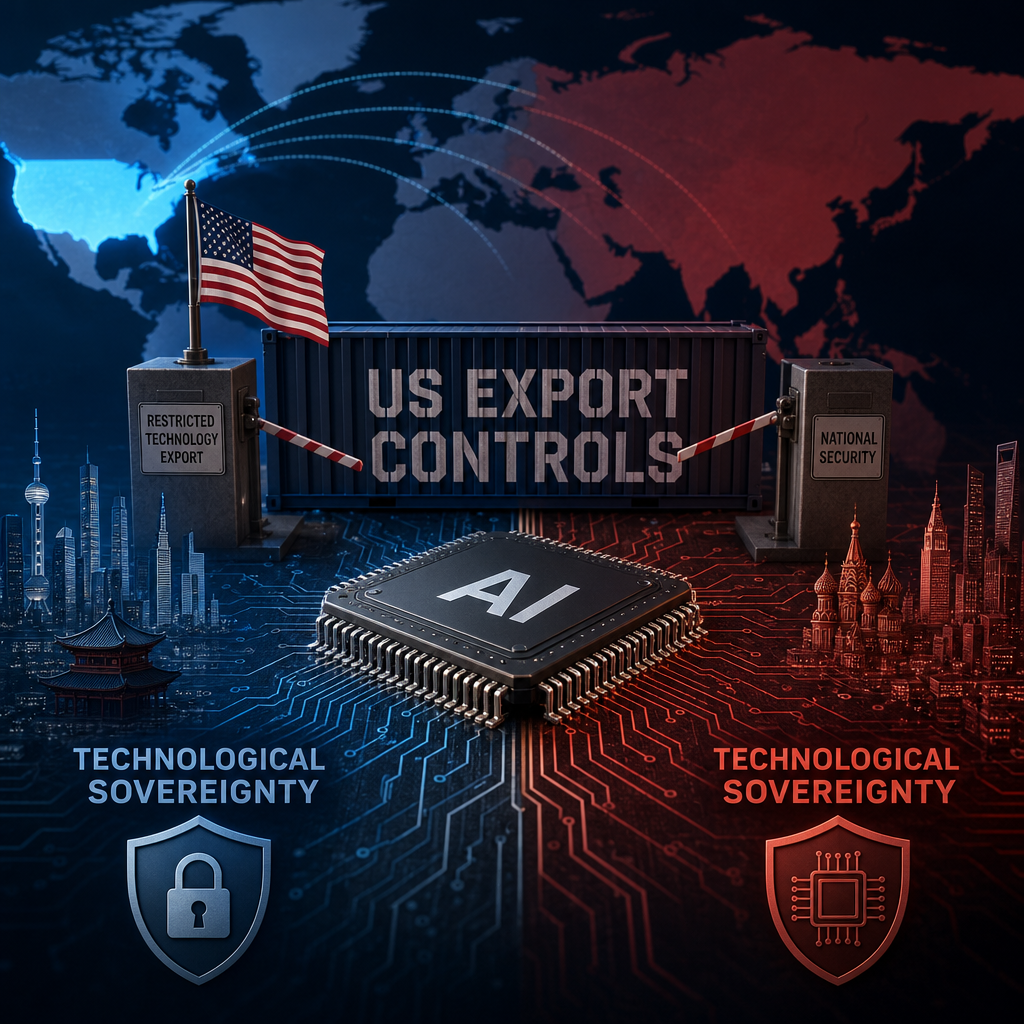
For decades, the global semiconductor supply chain was defined by its relentless pursuit of efficiency and interdependence. Today, that paradigm has shattered. Artificial intelligence has elevated the advanced graphics processing unit (GPU) from a niche gaming component to the foundational engine of future economic and military power. Recognizing this shift, the United States has deployed aggressive export controls on AI chips, attempting to throttle the computational capacity of strategic competitors, most notably China.
However, these restrictions have set off a complex chain reaction that extends far beyond bilateral trade disputes. As barriers to advanced compute rise, the global AI ecosystem is fracturing into rival blocs, triggering a fundamental reassessment of technological sovereignty among nations caught in the crossfire. What began as an effort to deny adversaries access to cutting-edge hardware is rapidly morphing into a sweeping realignment of global power, where the flow of compute dictates geopolitical influence.
The Strategy Behind the Chokehold: Delay, Dominate, and Diplomacy
The current US export control regime is not an ad-hoc protectionist measure, but a highly calculated strategy rooted in historical precedent. As Chris McGuire of the Council on Foreign Relations notes, the United States has always protected its compute advantages for military applications--just as it denied the Soviets advanced supercomputers during the Cold War. Today, advanced AI compute is viewed through the same lens, seen as critical for everything from nuclear stockpile stewardship to next-generation robotics and manufacturing [1]. In an era where other pillars of American industrial dominance have atrophied, advanced compute remains a "singular advantage" that the US is desperate to protect [1].
Yet, the strategy is evolving. Initially focused on outright denial--implementing strict performance thresholds to block the export of chips like Nvidia's A100 and H100, as well as advanced lithography tools from ASML [2]--the US approach is shifting toward "tech stack diplomacy." Recent developments suggest a move from simply restricting access to leveraging it. For instance, a recently withdrawn rule hinted at a new paradigm where countries requesting massive shipments of advanced chips--such as orders of 200,000 units--could be asked to invest in US data centers or provide security guarantees in exchange [3].
This aligns with the White House's broader objective to "export the entire U.S. tech stack" to secure allies and establish global dependency on American technology [4]. Under this framework, access to advanced chips is no longer just a transaction; it is a mechanism for deeper technology alignment and geopolitical influence [3].
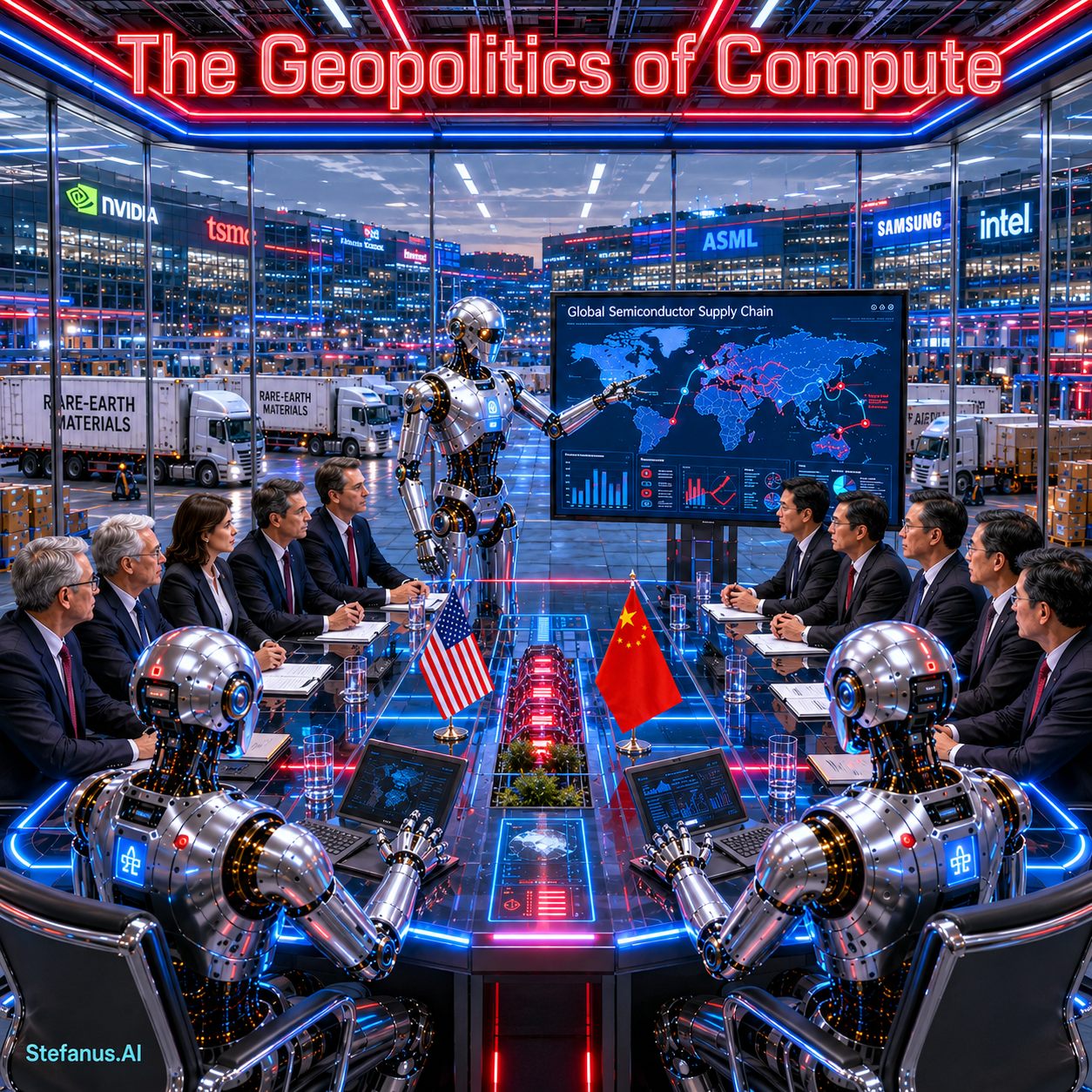 The Geopolitics of Compute: AI GPU Infrastructure, Robotics Supply Chains, and the US-China Bifurcation of the Intelligence Economy - Stefanus.AI
The Bifurcation of Global AI: The Rise of Parallel Stacks
The most profound consequence of these export controls is the fragmentation of the once-unified global AI ecosystem. As controls tighten, the world is splintering into rival compute blocs, a division that raises production costs, slows innovation, and fragments standards and research [5]. Furthermore, this fracturing reduces the economic interdependence that has historically helped maintain stability in the Taiwan Strait, adding a dangerous layer of strategic risk to an already volatile region [5].
In response to US pressure, China is accelerating the creation of a parallel, indigenous AI ecosystem. While US controls have successfully constrained Beijing's access to top-tier hardware--contributing to foundries like SMIC struggling to achieve consistent 7nm production yields comparable to TSMC [6]--they have also made relying on the US tech stack an untenable long-term strategy for Chinese firms. Recent regulatory shifts, such as moving chips like the Nvidia H200 from a presumption of denial to a highly discretionary, case-by-case licensing process, have formalized the US stack as an "unreliable input" [7]. Consequently, a domestic Chinese stack has become a rational inevitability, driven by state-backed industrial policies like Made in China 2025 [7].
We are witnessing the birth of "AI bifurcation": a US-led stack characterized by Nvidia, hyperscalers, and global cloud dominance, existing alongside a China-led stack built on localized chips, sovereign infrastructure, and homegrown firms like Biren and Moore Threads [8][9].
Enforcement Gaps, Unintended Consequences, and the Efficiency Revolution
Despite their sweeping scope, US export controls face severe practical limitations. Comprehensive empirical analyses reveal that while the controls provide a tangible 1- to 3-year delay on Chinese AI development, they are plagued by enforcement gaps [6]. In 2024 alone, an estimated 140,000 GPUs were smuggled into restricted markets, highlighting the sheer futility of physical restrictions when contrasted with the US government's lack of enforcement bandwidth--such as having only one Bureau of Industry and Security (BIS) officer stationed in Southeast Asia [6].
More significantly, the controls are generating unintended consequences that undermine their own purpose. Bereft of limitless top-tier compute, Chinese firms have been forced to innovate radically on efficiency. The most striking example is DeepSeek, which achieved GPT-4 parity using merely one-tenth of the compute typically required [6]. By inadvertently forcing an efficiency revolution, US controls are proving that brute-force compute is not the only path to frontier AI capabilities.
Additionally, a massive loophole remains in cloud computing. Adversaries no longer need to physically import banned chips; they can simply rent high-performance compute from US cloud providers to train frontier models, rendering traditional hardware export restrictions obsolete if cloud-based access is not similarly restricted [9].
 Sovereign AI and the Geopolitics of Compute: Export Controls, National Chip Programs, and the Fracturing Global AI Stack - Vamsi Talks Tech
The Global Quest for Technological Sovereignty
The US-China compute war has left the rest of the world scrambling for technological sovereignty. Many nations aim to free themselves from dependence on either Washington or Beijing by developing their own advanced models and domestic workforces [4]. However, the current global structure severely constrains this ambition, as US and Chinese companies tightly control the most critical sectors of the tech stack [4].
Consequently, countries with limited AI capacity are becoming geopolitical battlegrounds for technological expansion, caught between China's Digital Silk Road and US-aligned initiatives like "OpenAI for Countries" [4]. In response, middle powers are leveraging their specific strengths to carve out autonomy. The European Union acts as a regulatory pole, with France fostering models like Mistral and the Netherlands hosting ASML. Meanwhile, Gulf states like the UAE and Saudi Arabia are leveraging massive sovereign wealth to invest heavily in AI compute infrastructure, actively positioning themselves as regional AI leaders independent of both East and West [4].
Furthermore, as concerns grow over US-imposed compliance hooks and embedded telemetry, governments and firms in Asia, the Middle East, and parts of Europe are increasingly seeking non-US alternatives. This creates lucrative market openings for geopolitically neutral chipmakers in Europe and Israel, who can offer supply chain sovereignty free from the strings attached to American hardware [9].
 Sovereign AI and the Geopolitics of Compute: Export Controls, National Chip Programs, and the Fracturing Global AI Stack - Vamsi Talks Tech
Conclusion
The geopolitics of compute has permanently altered the architecture of global technology. What began as a targeted effort to deny military advantages to strategic competitors has metastasized into a full-scale reordering of global supply chains. US export controls have proven adept at buying time--delaying Chinese AI advancements by a few critical years--but they have fundamentally failed to stop the decentralization of AI capability. Instead, they have accelerated the bifurcation of the global tech ecosystem, forced remarkable efficiency innovations, and pushed nations toward sovereign alternatives.
As the AI race enters its next phase, the conversation is shifting from restricting access to weaponizing it. The ability to manufacture, provision, and distribute advanced compute is no longer just a measure of technological prowess; it is the defining leverage point of international relations. In this new world, technological sovereignty is not merely an aspiration--it is the prerequisite for national survival.
References
- 1.
- 2.
- 3.
- 4.
- 5.
- 6.
- 7.
- 8.
- 9.