Introduction
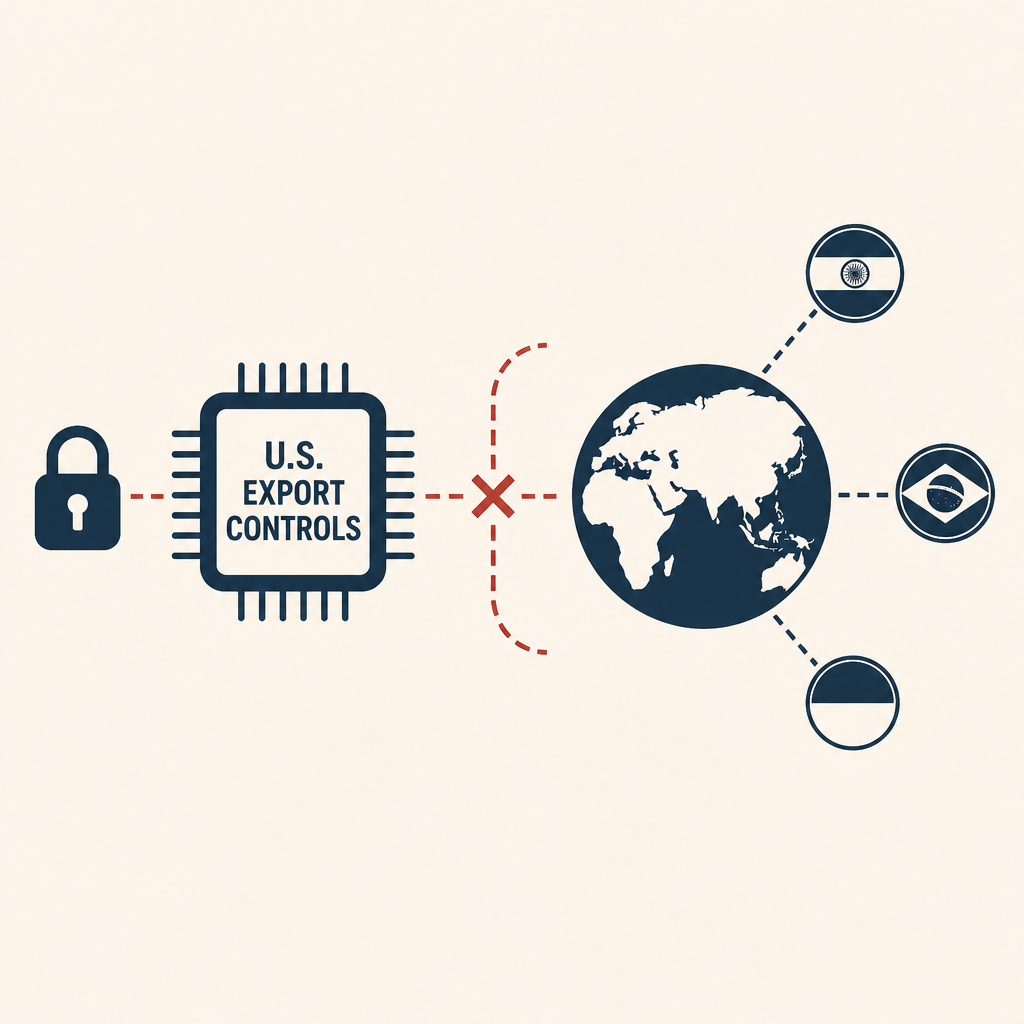
In the twentieth century, geopolitical power flowed through oil pipelines and shipping lanes. In the twenty-first, it increasingly flows through silicon. Advanced AI chips--graphic processing units, high-bandwidth memory, and the lithography equipment required to make them--have become the single most concentrated strategic resource on the planet, and the United States has moved decisively to weaponize that concentration. Since 2022, a cascade of export controls has systematically restricted the flow of advanced computing hardware to adversarial states, most notably China, marking what scholars describe as a decisive departure from market principles toward state-directed intervention on both the supply and demand sides of the AI economy [1].
But export controls aimed at China inevitably reach the rest of the world. The chokepoints that make these controls effective--NVIDIA's dominance in AI accelerators, Taiwan's near-monopoly on advanced chip fabrication, and ASML's exclusive control over extreme ultraviolet lithography--mean that nearly every nation outside the U.S. and China must access frontier AI through infrastructure that Washington can, in principle, switch off [2]. The numbers are stark: according to Carnegie Endowment analysis, nearly three-quarters of all advanced AI compute clusters as of mid-2025 sat within U.S. borders, with China accounting for roughly 14 percent [2]. Only 32 countries worldwide host AI-specific data centers, leaving around 160 nations dependent on foreign infrastructure entirely [3].
For middle powers--nations wealthy and capable enough to aspire to technological sovereignty but unable to build a full AI stack alone--this new geography of compute presents an existential strategic choice. Access to American chips now comes with conditions: restrictions on Chinese collaboration, cybersecurity commitments, and alignment with U.S. export regimes. The result is a profound reshaping of how nations from the UAE to Japan conceive of "sovereign AI," forcing them to balance the promise of American partnership against the perils of what critics call sovereignty on someone else's terms [4].
The Architecture of American Chip Statecraft
From Targeted Embargoes to Global Licensing
The United States' use of compute as an instrument of statecraft did not begin with the AI boom. Executive Order 13859 institutionalized technological control through export bans on high-end computing chips, but between 2022 and 2024, systematic export controls on advanced chips and AI models marked an escalation in both scope and ambition [1]. The U.S. Department of Commerce's Bureau of Industry and Security implemented sweeping restrictions on advanced computing and semiconductor manufacturing items in October 2022, explicitly targeting China's military-civil fusion strategy [2].
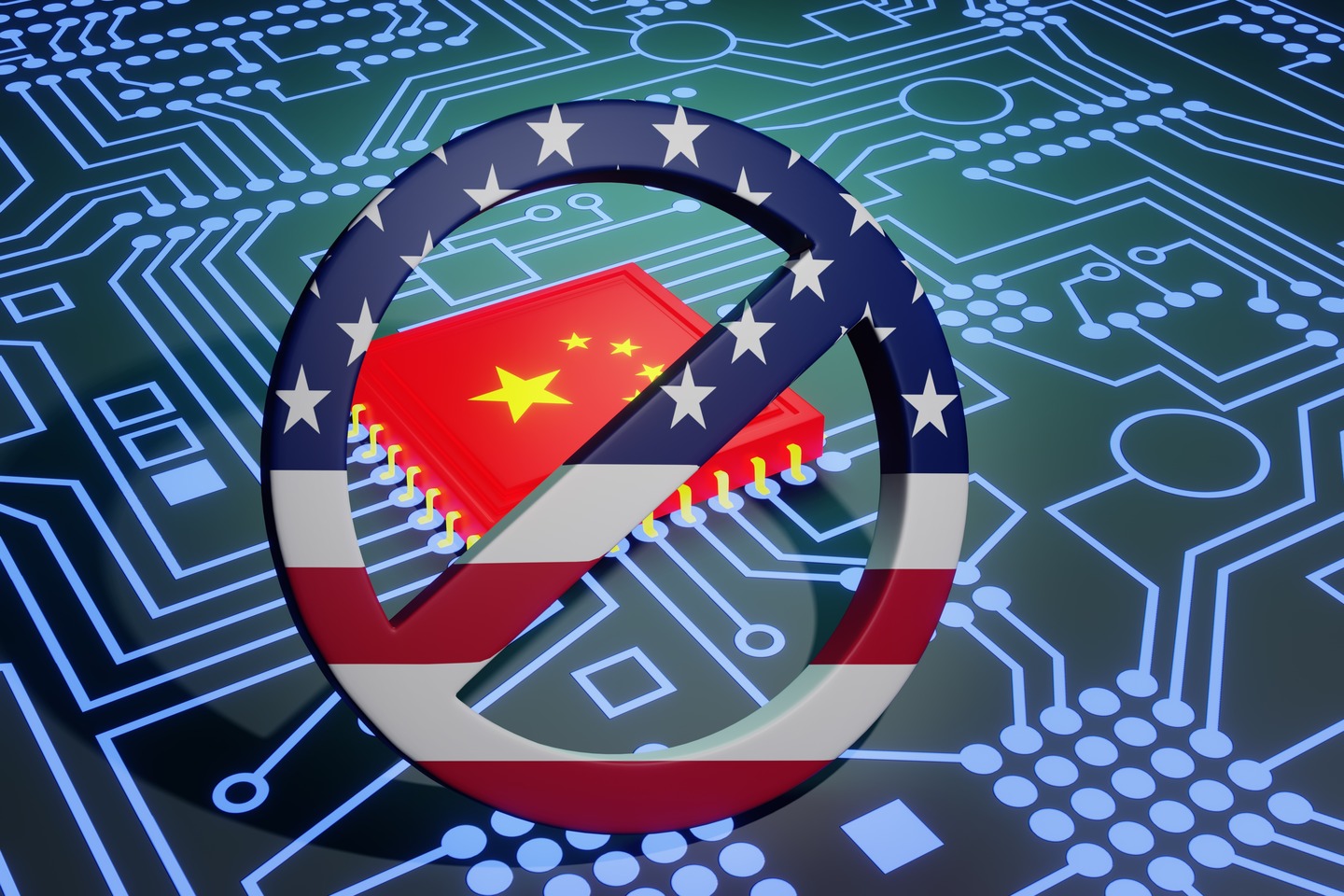
The logic of these controls expanded over time. In its final days, the Biden administration issued an interim final rule seeking to "regulate the global diffusion" of AI by imposing export licensing restrictions on advanced chips to 150 "middle-tier" countries, while maintaining existing embargoes on China, Russia, and Iran [5]. The rule was widely interpreted as an acknowledgment that the original 2022 controls had failed to fully prevent China's access to AI-enabling technologies through third countries--transshipment hubs, cloud intermediaries, and perceived conduits such as the UAE, toward which the U.S. government has at times slowed shipments and proposed restrictive rules [6][5].

The Trump Recalibration: Leverage Over Lockdown
The second Trump administration has recalibrated rather than abandoned compute statecraft. Early actions--rescinding Biden's AI executive order and emphasizing innovation over risk mitigation--signaled a shift toward a more pro-innovation, market-driven approach [5]. Yet the underlying leverage remained, and was quickly monetized: in August 2025, President Trump announced that export licenses for NVIDIA's H20 and AMD's MI308 chips destined for China would be approved on the condition that the companies pay a 15 percent revenue share to the U.S. government--an arrangement analysts warn exemplifies a "pay-to-export" model that dilutes strategic leverage while normalizing advanced technology transfers with limited governance oversight [7].
Simultaneously, Washington has gone on the offensive with an affirmative export strategy. Through the White House Office of Science and Technology Policy and the emerging American AI Exports Program, the administration is positioning the United States as a partner that helps countries build sovereign AI capabilities using American technology. OSTP Director Michael Kratsios has described the goal as enabling U.S. companies to provide "modular AI stack packages," and at the August 2025 APEC Digital and AI Ministerial, officials grouped "AI sovereignty" alongside "data privacy" and "technical customization" as outcomes partners should expect from U.S. export packages [4].
The Geography of Compute: A Radically Concentrated Map
The effectiveness--and the coercive potential--of chip export controls derives from an extraordinary concentration of the AI supply chain. NVIDIA builds the majority of AI chips; a handful of firms, chiefly TSMC and Samsung, fabricate the overwhelming majority of high-end wafers; and ASML sells all the most sophisticated lithography machinery [2]. Taiwan alone manufactures nearly all advanced AI chips, while the U.S. and its allies provide the core funding, software, and hardware that animate the ecosystem [3].
The downstream distribution is similarly lopsided. The Tony Blair Institute estimates the U.S. hosts roughly 75 percent of the world's total AI compute capacity, compared with 15 percent in China and about 10 percent distributed elsewhere, mostly in Europe [3]. Only a handful of nation-states possess the financial resources and energy capacity to build full AI infrastructure at scale--a challenge comparable, analysts suggest, to the space race of the 1960s [2]. Even the physical inputs feed into strategic calculations: data centers consumed an estimated 415 terawatt-hours of electricity in 2024, making grid capacity itself a variable in national AI strategies [2].
This concentration is what transforms export controls from trade policy into statecraft. A country that depends on foreign models, cloud platforms, and compute infrastructure may retain formal sovereignty, but its practical autonomy is contingent on decisions made in Washington, Taipei, and Santa Clara [8]. For the 160 nations without AI-specific data centers, the question is not whether to depend, but on whom [3].
 Biden's final act: US unveils strictest AI chip export controls yet - TechHQ
Middle Powers Respond: Three Strategies of Hedged Sovereignty
The Gulf Bargain: Compute for Alignment
The wealthiest middle powers have pursued the most direct route: buying alignment. The UAE-U.S. AI Acceleration Partnership, alongside parallel multibillion-dollar agreements with Saudi Arabia, provides the Gulf states secure access to U.S. frontier compute in exchange for accepting export controls and limits on Chinese collaboration [7][3]. These deals position major American technology companies--spanning cloud infrastructure, semiconductors, and frontier models--at the center of both nations' AI ambitions [7]. leveraging massive sovereign wealth, Abu Dhabi and Riyadh are investing heavily in compute infrastructure and talent, pursuing their goal of becoming regional and global AI leaders [9].
Yet the bargain is uneasy. Because the U.S. government views Gulf states as potential conduits for Chinese access, shipments have been slowed and additional restrictive rules proposed, injecting uncertainty into partnerships that the UAE regards as strategic commitments [6]. The Gulf case thus encapsulates the core tension of compute statecraft: access is granted, but always provisionally.
Europe: The Regulatory Pole and the Industrial Niche
Europe's response has been differently shaped. The European Union acts as a powerful regulatory pole, while key member states leverage technological strengths within the stack: France contributes frontier models through Mistral, and the Netherlands houses ASML, the indispensable gatekeeper of advanced lithography [9]. This gives Brussels leverage that most middle powers lack--but it also creates friction. The regulatory divergence between America's deregulated AI approach and the EU's AI Act, which prioritizes stringent governance and risk mitigation, is already generating compliance challenges for U.S. companies operating internationally [5], and gives European capitals an interest in tech stack arrangements that are not dictated solely by Washington.
Asia's Balancing Act: Modular Sovereignty and Strategic Hedging
Asian middle powers have emerged as the most sophisticated practitioners of hedged sovereignty. Singapore is experimenting with a balanced strategy, engaging both Western and Chinese ecosystems to diversify risk and preserve market access [3]. Japan, meanwhile, has become the test case for what Brookings analysts call "modular sovereignty"--controlling some layers of the AI stack while depending on others. A Japanese initiative known as Noetra illustrates both the promise and the trap: its planned compute cluster will use approximately 27,500 NVIDIA Rubin GPUs, meaning that despite Japan's formidable strengths in data, robotics, and applications, it remains exposed to U.S. jurisdiction at the compute layer [8].
Japanese and Korean analysts have accordingly proposed coalition-based mitigation: jointly procuring and maintaining strategic inventories of advanced accelerators, supporting Japan's Rapidus and South Korea's Samsung where commercially realistic, developing inference-optimized domestic silicon, and investing in training efficiency and smaller specialized models that reduce dependence on frontier hardware [8]. The underlying premise is agency--not autarky, but the preservation of choice between Washington and Beijing [8].
The Sovereignty Gap: Deployment Without Autonomy
The deepest critique of the emerging order is that American "sovereign AI" offers partners control over deployment while withholding control over dependence. As one Lawfare analysis framed it, Washington is offering partners AI sovereignty on its terms, even as many countries work to reduce their dependence on the United States [4]. The American AI Exports Program is built around exportable deployment packages--but resilience, defined as protection against disruptions in continued access to advanced compute, is a fundamentally different problem, and one the "sovereign AI" framing largely does not address [4].
Recent episodes have made these risks concrete. In 2025, the United States imposed a license requirement on NVIDIA's H20 chips for China, later reversing it--demonstrating that access rules can change with little warning. More striking still, a June 2026 U.S. export-control directive required Anthropic to bar foreign nationals from accessing its Fable 5 and Mythos 5 models; unable to verify nationality in real time, the company suspended the models for all users until the controls were lifted [8]. Commerce Department foreign direct product rules likewise reach semiconductor equipment made abroad using American technology [8]. For allied governments watching these episodes, the lesson is sobering: dependence on American compute means accepting that a single directive can interrupt national AI services overnight.
CSET's two-pronged framework for assessing sovereign AI--examining both what partners gain in capability and what they concede in leverage--captures the analytical challenge now facing every capital contemplating a U.S. compute partnership [10]. Sovereignty, it turns out, is not a binary but a gradient, and the gradient runs through Cupertino, Austin, and Washington.
Unintended Consequences: The China Option and the Flight from U.S. Ecosystems
The strategic paradox at the heart of compute statecraft is that the controls themselves are accelerating the search for alternatives. Huawei is reportedly making rapid progress with its Ascend 910C chips, which DeepSeek research suggests deliver roughly 60 percent of NVIDIA's H100 inference performance, while Chinese cloud companies expand aggressively across Southeast Asia and beyond--Alibaba has broadened AI cloud services in Malaysia and the Philippines [7]. The release of China's DeepSeek R1 chatbot intensified scrutiny of whether U.S. restrictions have meaningfully slowed Chinese progress at all, or merely imposed costs on everyone else [5].
Critics of the controls warn of precisely this dynamic: restrictions risk reducing global demand for U.S. chips and incentivizing non-U.S. computing ecosystems, weakening America's long-term AI leadership rather than protecting national security [5]. Lawfare's analysis reaches a similar conclusion from a different angle--while U.S.-led controls have hampered China's AI development, Chinese companies remain viable alternatives in any vacuum left by the United States, and some countries excluded from American channels might align more closely with Beijing [6]. The geopolitical contest is not merely bilateral, either: China's Digital Silk Road and the U.S.-aligned OpenAI for Countries initiative are competing for the same pool of compute-poor nations, turning them into geopolitical battlegrounds for technological expansion [9].
Yet the emerging world is not a clean bipolar split. Despite framing of the AI race as "democratic versus authoritarian," the structure has not produced purely bifurcated allied blocs. Middle powers have carved out significant room to maneuver by strategically balancing relations with both superpowers while developing sovereign components of their own stacks [9]. That maneuvering room--fragile, contingent, but real--may be the most important strategic resource of all.
Conclusion
Compute has become the currency of a new statecraft, and the United States is spending it deliberately. Export controls have extended American leverage deep into the technology strategies of dozens of nations, converting what was once a commercial relationship into a quasi-alliance structure with explicit political conditions. For the Gulf states, the price of frontier compute is distance from Beijing; for Japan and Singapore, it is the acceptance that sovereignty is modular and partial; for Europe, it is a regulatory rivalry layered atop industrial dependence.
The long-term consequences remain genuinely uncertain, and the evidence points in contradictory directions. Deeper American partnerships may bind partner countries into more trustworthy, rights-respecting AI development tied to cybersecurity commitments and safety guardrails [6]. Or they may catalyze the very exodus they are designed to prevent, as Huawei's improving chips, Chinese cloud expansion, and middle-power coalitions for strategic compute inventories slowly assemble an alternative [7][8]. What is clear is that the roughly 160 nations without AI infrastructure of their own will not simply accept permanent dependency [3]. Sovereignty in the age of AI is being negotiated now--in licensing rules, joint ventures, and the quiet calculus of every foreign ministry forced to choose whose chips to trust. The nations that navigate this negotiation with the greatest skill will not be those with the most compute, but those who best understand that in this new order, access is power--and independence, however partial, is the only reliable hedge.
References
- 1.
- 2.
- 3.
- 4.
- 5.
- 6.
- 7.
- 8.
- 9.
- 10.