Introduction
When the EU AI Act entered into force on 1 August 2024, European policymakers openly framed it as the sequel to one of the most successful stories in regulatory history: the Brussels Effect. Just as the General Data Protection Regulation (GDPR) quietly became the global privacy baseline--because companies found it easier to apply European standards everywhere than to run separate systems for each jurisdiction--the AI Act was expected to make EU rules the world's de facto benchmark for artificial intelligence [1][2]. With penalties reaching €35 million or 7% of global annual revenue, and extraterritorial reach covering any company whose AI outputs are used in the EU, the legislation seemed engineered for global gravity [3][4].
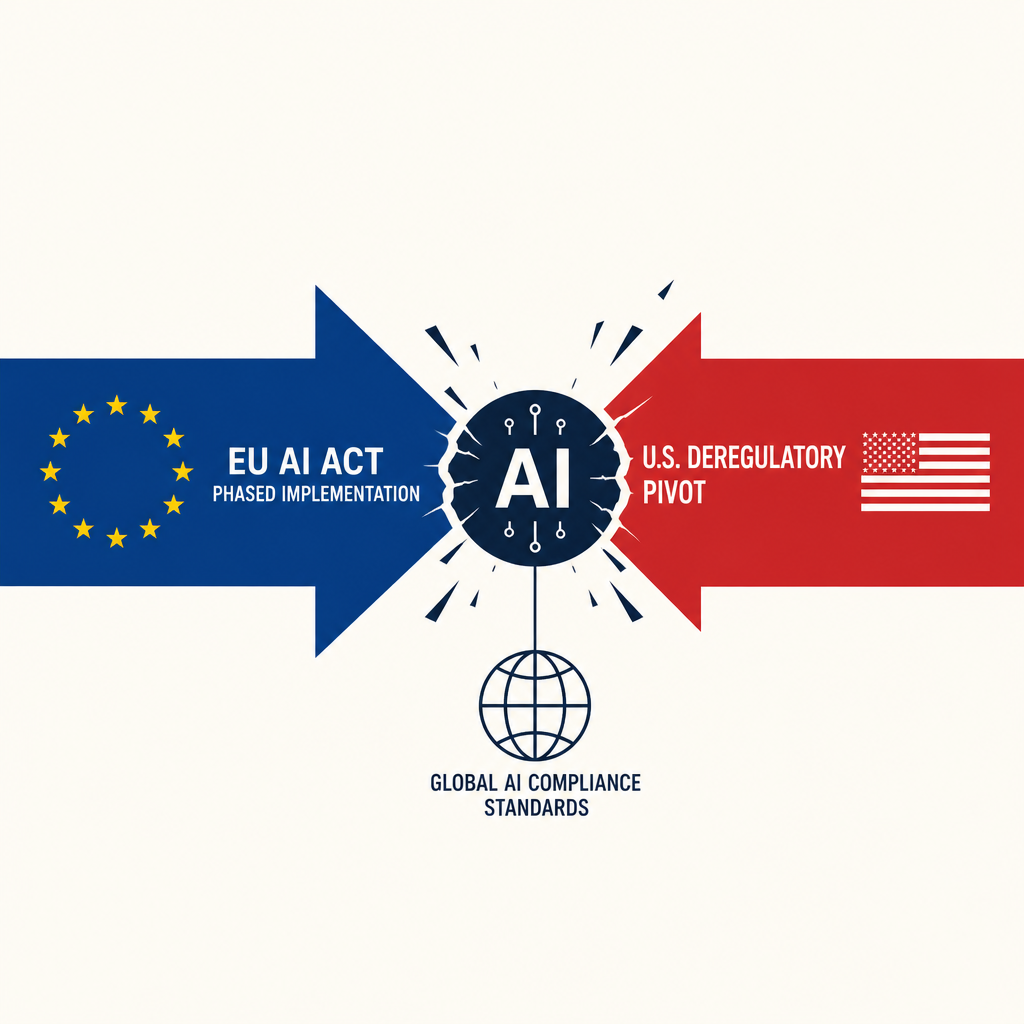
That assumption is now being stress-tested. The Act's provisions are rolling out in phases over two to three years, with core obligations for high-risk systems not due until August 2026 and rules for AI embedded in regulated products arriving in 2027 [3][5]. In the meantime, the United States has pivoted sharply toward a "minimally burdensome" federal framework centered on scale and capital deployment, while the European Commission itself has floated pausing implementation amid political and commercial pressure [6][2]. What was designed as a smooth ramp toward global standard-setting has become a contested, politicized process unfolding in a hostile geopolitical climate.
The stakes extend well beyond Brussels and Washington. Whether the Brussels Effect survives its first real pressure test since the GDPR will determine what global AI compliance looks like for the next decade: a single portable standard anchored in Europe, a fragmented patchwork of national and state regimes, or something in between [1][6].
The Brussels Effect: From GDPR Playbook to AI Stress Test
The theoretical foundation of EU regulatory ambition comes from Anu Bradford's account of the Brussels Effect, which rests on two pillars: the EU's reputation as a serious regulator, which leads other jurisdictions to copy its standards as templates (the de jure effect), and the sheer size of its consumer market, which leads companies to internalize EU rules globally because doing so makes their products compliant everywhere (the de facto effect) [2]. Bradford documented this dynamic across competition policy, environmental standards, health and safety regulation, and data protection--and EU policymakers have self-consciously adopted the logic in how they frame their own legislation [2].
The GDPR remains the canonical example. When it took effect, companies worldwide found it cheaper and simpler to apply EU privacy standards globally than to maintain parallel systems, and privacy laws modeled on the GDPR proliferated across jurisdictions [1]. Many observers simply assumed the AI Act would follow the same script. As one legal comparison notes, the Act's binding character, centralized enforcement through the new EU AI Office, and broad extraterritorial scope create "a powerful regulatory export mechanism" that could make it a de facto global benchmark and encourage other regions to follow [7].
But there are good reasons for skepticism, some of which predate the current political turbulence. Brookings analysis warned as early as 2022 that the Brussels Effect is often assumed to be the default outcome of EU legislation, when a careful reading of the AI Act's provisions actually suggests only a "moderated impact" on some provisions rather than wholesale global adoption [8]. The more fundamental problem is structural: as the AI Policy Bulletin argues, AI compliance is far more divisible than data protection. A company could not easily half-comply with GDPR, but a firm can segment its AI operations--serving European users through one compliant pipeline while running non-compliant systems elsewhere--making segmented compliance a viable alternative to portable global compliance [1].
 The Brussels Effect: What US Enterprises Need to Know About the EU AI Act.
A Timeline Built for a Different World
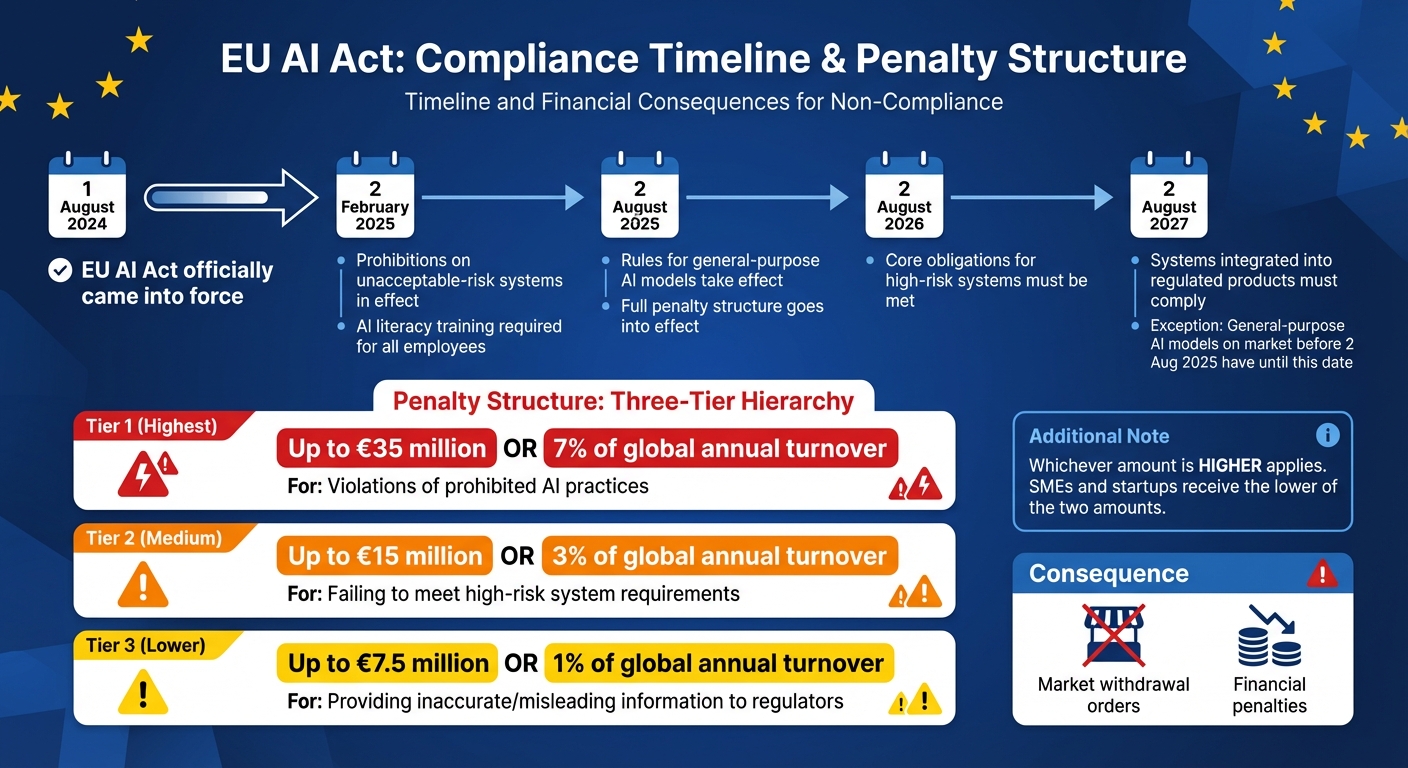
The AI Act's phased implementation was designed to give stakeholders time to adapt, with provisions becoming operational over roughly 6 to 36 months [7][5]. The schedule is tiered by risk:
- 2 February 2025: Prohibitions on "unacceptable-risk" systems take effect, including social scoring and workplace emotion recognition, alongside requirements for AI literacy among staff [3][4].
- 2 August 2025: Obligations for general-purpose AI models and the full penalty structure come into force [3].
- 2 August 2026: Core obligations for high-risk systems must be met [3].
- 2 August 2027: AI systems integrated into regulated products must comply [3].
The Act applies to any company, regardless of location, that markets AI systems in the EU or whose AI outputs are used there--a scope that Harvard's advisory to its own community underscores applies even to non-European institutions in limited circumstances [3][4]. Systems are sorted into four risk categories--minimal, limited, high, and unacceptable--with strict obligations concentrated on the high-risk tier and outright bans at the top [7][3].
The phased design made sense when the primary challenge was technical: helping companies classify systems, build risk-management processes, and prepare documentation. But the long runway has become a strategic vulnerability. As the AI Policy Bulletin puts it, "every month of ambiguity is a month in which firms are more likely to invest in segmented compliance rather than portable global compliance" [1]. The AI Office tasked with shepherding the framework is significantly under-resourced for a mandate spanning every sector of the economy, and the longer implementation guidance remains unclear or unenforced, the less likely companies are to treat European rules as their global baseline [1]. During the implementation period, European standards bodies are also expected to develop the technical standards companies will actually build against--a process that adds yet another layer of waiting [5].
America's Deregulatory Pivot
While Brussels builds its compliance architecture, Washington has moved in the opposite direction. The U.S. AI Action Plan lacks binding legal force, relying instead on existing agencies and laws, a case-by-case approach to risk, and a decentralized enforcement model that critics warn risks fragmentation [7]. Where the EU imposes mandatory bans and tiered obligations oriented toward fundamental rights and safety, U.S. policy primarily addresses domestic concerns and views systemic risk through a security lens [7].
The shift has hardened since Donald Trump's re-election. The current U.S. government closely identifies with the global interests of American tech firms, and pushback against EU digital regulation--including against sanctions for non-compliance--features prominently in its communications [2]. The legislative record reflects this posture: the only major AI-adjacent law enacted recently was the TAKE IT DOWN Act, addressing non-consensual intimate imagery, while a proposed ten-year moratorium on state AI laws was stripped from budget reconciliation by a decisive 99-1 Senate vote [6].
That vote is more consequential than it might appear. By confirming that federal preemption is politically untenable, it locked in the very outcome the deregulatory agenda was meant to eliminate: an expanding patchwork of state AI obligations, some facing federal legal challenges, that national companies must navigate [6]. The result, as one analysis frames it, is a structural realignment of the global regulatory environment--the first genuine test of whether the Brussels Effect still holds when a competing regulatory model of comparable scale and investment momentum exists [6].
 The AI Act's extraterritorial reach - Europe's gamble on the Brussels effect - Chamber
The Collision Course
The transatlantic divergence is now producing tangible friction at multiple levels.
Within Europe, political nerve is faltering. At the Paris AI Action Summit, EU leaders' rhetoric shifted noticeably--from championing regulation to promises of "simplification" and reduced "red tape," with Commission officials and President Macron appearing to downplay the very framework they promoted months earlier [9]. The combination of U.S. pressure and similar signals from European companies and politicians has led the Commission to consider pausing implementation of the AI Act altogether [2].
Geopolitically, the traditional three-way dynamic has shifted. China's interest in regulatory collaboration appears to have diminished following the successful launch of DeepSeek, an exceptionally effective Chinese AI model, reducing the prospect of a multipolar alignment around shared governance norms [2].
For multinational firms, the practical effect is a bifurcated compliance landscape. Organizations operating in both jurisdictions must now account for the EU's centralized, risk-tiered framework alongside a decentralized, rapidly evolving, and litigated U.S. environment [6]. This is precisely the scenario the Brussels Effect logic was supposed to prevent: instead of one global baseline anchored in Brussels, companies face incentives to build segmented compliance--European operations tuned to the AI Act, American operations tuned to state laws and federal ambiguity [1][6]. The longer the EU leaves its guidelines unclear and unenforced, the stronger those incentives become [1].
The Compliance Calculus for Global Enterprises
Against this uncertain backdrop, companies are not waiting--they are building governance structures designed to flex across regimes. Practical guidance for U.S. enterprises emphasizes immediate steps: constructing an AI governance system, revising contracts, and establishing ongoing compliance monitoring, since non-compliance with the Act carries fines of up to €35 million or 7% of global annual revenue [3]. Core compliance work includes thorough risk-management processes, detailed documentation, and systems that meet classification requirements under the Act's risk taxonomy [3][10].
A pragmatic harmonizing layer is emerging around voluntary frameworks. Organizations are increasingly designing AI governance practices with reference to the U.S. National Institute of Standards and Technology's AI Risk Management Framework (NIST AI RMF) and the international ISO/IEC 42001 standard, which can signal products of distinguished quality while providing scaffolding that maps reasonably well onto AI Act obligations [10]. Sophisticated compliance programs also account for synergies with adjacent regimes the Act intersects with--GDPR, the Digital Operational Resilience Act (DORA), and NIS2--treating AI governance as part of a broader regulatory architecture rather than a standalone exercise [10].
The open question is whether these frameworks become bridges between the EU and U.S. models or substitutes for the AI Act itself. If firms discover that NIST-aligned and ISO-certified governance satisfies most commercial counterparties and insurers without full Act conformity, the economic logic that powered the Brussels Effect--conform once, sell everywhere--weakens considerably.
 Burying the Brussels Effect? AI Act Inspires Few Copycats - CEPA
Can the Brussels Effect Survive?
The verdict on the Brussels Effect is not yet in, but the conditions for success are well understood. The AI Policy Bulletin's recommendations are pointed: the AI Office should fast-track implementation guidance and open enforcement dialogues now with major AI companies, focusing on the channels it can most directly influence--market-access requirements and supply-chain pressure [1]. Supply chains matter because even firms that segment their consumer-facing operations often cannot segment their vendors; if major AI developers face EU requirements upstream, European standards can propagate through the infrastructure layer where segmentation is hardest.
Some analysts argue Europe should reframe the goal entirely. Rather than treating the Brussels Effect as the measure of success, Europe's role in global AI governance may lie in transcending the innovation-versus-regulation dichotomy: implementing its framework confidently as a trust-building mechanism while spearheading forms of innovation that are difficult elsewhere [9]. On this view, the AI Act is not a constraint but an opportunity to differentiate European AI--provided Europe does not retreat from its own vision under transatlantic pressure [9]. A complementary scholarly perspective suggests the EU's most realistic contribution may be less about exporting rules and more about experimentalism: generating governance knowledge, standards, and institutional capacity that other jurisdictions adapt selectively [2].
What virtually all analyses share is a recognition that time is not on Brussels's side. The Brussels Effect historically relied on the absence of a competing regulatory model of similar scale; that absence no longer exists [6]. The window for the AI Act to shape global norms is closing, and every month of delayed guidance, contested enforcement, and internal European second-guessing tilts the equilibrium further toward segmented, jurisdiction-by-jurisdiction compliance [1][2].
Conclusion
The collision between the EU AI Act's phased implementation and America's deregulatory pivot represents the first genuine stress test of the Brussels Effect in the digital age. The GDPR succeeded because European rules were simultaneously the world's most demanding and its most portable; the AI Act, for all its ambition, governs a technology whose compliance is far more divisible, in a geopolitical moment when the United States is actively contesting EU regulatory reach and even European leaders are preaching simplification [1][9][6][2].
Yet the outcome remains genuinely open. The Act's extraterritorial scope, its substantial penalties, and its central position in global supply chains give it real leverage--but only if the EU uses it with speed and conviction [1][7][3]. Fast-tracking guidance, resourcing the AI Office, and beginning enforcement dialogues now would signal to global firms that European compliance is portable, durable, and worth building around [1]. Failure to do so risks a world in which AI governance fractures into regional blocs, compliance becomes a costly puzzle rather than a shared baseline, and the most consequential technology of the era develops without any unifying standard at all. The Brussels Effect made Europe the world's accidental regulator once. Whether it can do so again--for AI, under pressure, on a closing timeline--is now the defining question of global technology governance.
---TITLE_END---
References
- 1.
- 2.
- 3.
- 4.
- 5.
- 6.
- 7.
- 8.
- 9.
- 10.