Introduction
When ChatGPT launched in November 2022, higher education responded with what seemed like an obvious fix: if students might use AI to cheat, universities would simply detect it. Within months, a crowded market of detection tools--GPTZero, Turnitin's AI indicator, Copyleaks, and dozens of others--promised to distinguish machine-generated prose from authentic student writing. Adoption was swift and widespread, driven in part by the sheer scale of uptake on the student side, with surveys suggesting at least half of college students have already used AI to write papers, generate ideas, or both [1]. Major institutions from Princeton to Oxford integrated AI detection into their existing plagiarism infrastructure [2].
Three years later, that experiment is quietly unwinding. Universities are retiring AI detectors as arbiters of truth, citing poor accuracy--particularly against newer models--demonstrated bias against non-native English writers, and evasion as simple as running text through a paraphrasing tool [3][1][4]. In some cases, the retreat has been accelerated by painful episodes: students wrongly accused, formal disputes, and even litigation in which detection output played a central role [1][5].
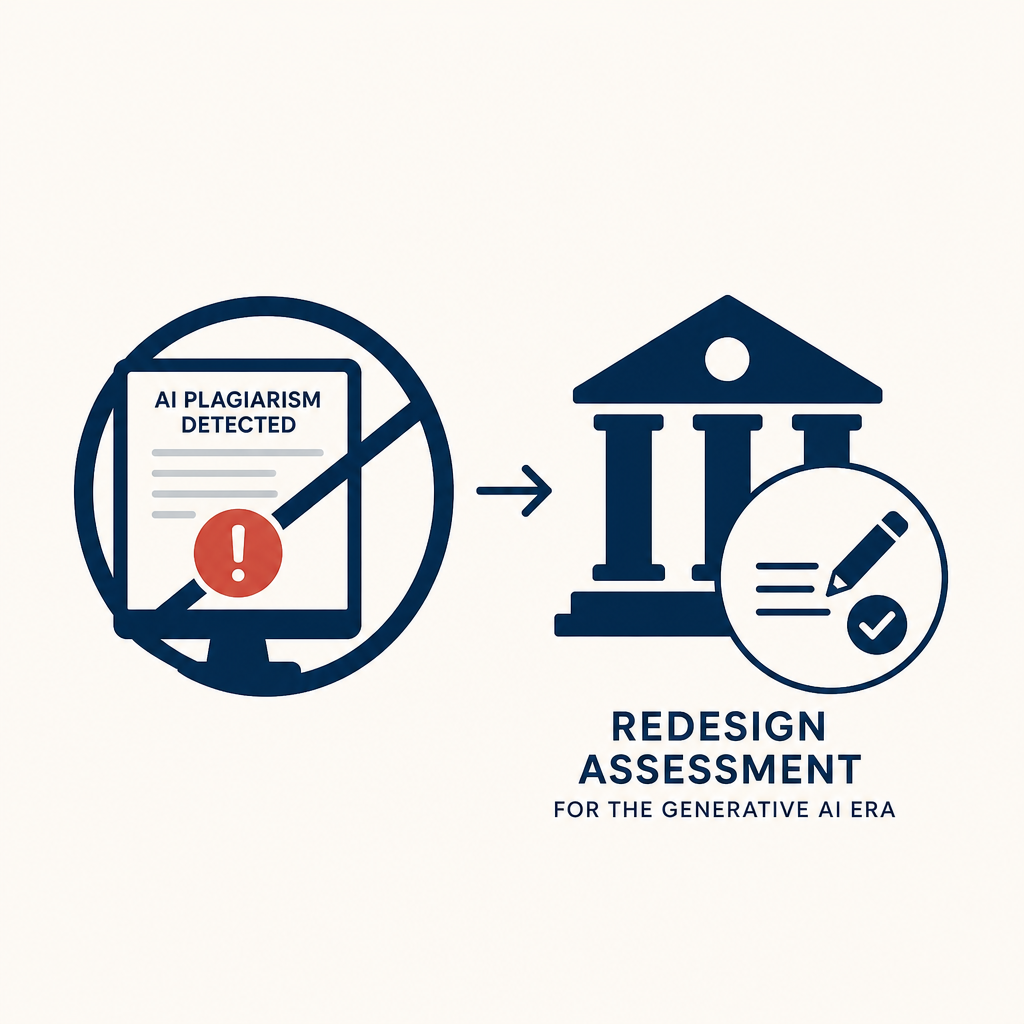
But the more significant story is not what universities are abandoning--it is what they are building. Across institutions, a new consensus is forming around a fundamentally different response: redesign assessment itself so that learning is visible, processes are demonstrable, and integrity is supported by task design rather than automated suspicion. This article traces the arc from detection to redesign, examining why the detector experiment failed, how institutional policy is pivoting, and what the post-detection integrity architecture looks like.
 From Detection to Redesign: How Universities Are Dismantling the AI Detector Experiment and Rebuilding Assessment for the Generative AI Era | Reducates
The Detection Boom and Its Quiet Unraveling
A Technology Built on a Flawed Premise
The first thing to understand is that AI detection is not plagiarism detection, despite the way it was marketed and adopted. Traditional plagiarism checkers worked by comparing a student's paper against a bank of published material and prior student submissions--concrete evidence of matching text [5]. Generative AI broke that model entirely: because AI-generated text is novel, it does not exist in any bank of prior documents. Detection tools instead flag statistical patterns, such as uniform sentence structure and specific syntax indicators, and then offer a percentage score suggesting the likelihood that a paper was machine-generated--an "85% AI" score that looked authoritative but was, in reality, a probabilistic guess [5].
That guess has proven unreliable in exactly the ways critics warned. Accuracy drops measurably on newer models like GPT-4 and its successors [4], meaning the tools that were calibrated for earlier systems grow less dependable as the technology students actually use evolves. The problem is structural, not a matter of tuning: detection is chasing a moving target that is explicitly optimized to produce human-like text.
Bias and Evasion: The Evidence Mounts
Two additional findings turned skepticism into institutional action. First, mounting evidence revealed that detectors are biased against non-native English speakers, whose writing patterns are more likely to be flagged as machine-generated--a fairness problem with profound equity implications for international student populations [3][1]. Second, the tools are trivially evaded: simple paraphrasing tools can rewrite AI-generated text until detectors no longer flag it, meaning the students most committed to cheating face the lowest detection risk while honest students bear the burden of false positives [3][1].
By 2026, the research picture had hardened into a consensus: detection alone cannot sustain academic integrity in the generative AI era [6]. Notably, that consensus does not call for discarding detection entirely. Detection tools retain genuine utility for identifying conventional plagiarism and may deter casual misuse of AI tools--but they must be understood as one imperfect input, not a verdict [6].
From Detection to Redesign: How Universities Are Dismantling the AI Detector Experiment and Rebuilding Assessment for the Generative AI Era | Reducates
The Human Cost: False Accusations and Litigation
The retreat from detection is not merely an academic debate--it has been driven by real harm to real students. A 2026 snapshot of institutional practice documents cases where overreliance on a single tool's output produced demonstrable student harm and formal disputes, prompting some institutions to pause or disable AI detection entirely [1].
The legal system has begun to weigh in as well. Students who were suspended or terminated based on allegations of AI use have resorted to the courts, and in recent cases--Newby and Yang among them--the courts have scrutinized institutions' reliance on detection tools and their adherence to due process. In at least one instance, a student prevailed where the institution had used AI detection tools to help determine guilt [5]. For university counsel and administrators, the lesson has been blunt: institutions that over-rely on AI detection scores, or deny students meaningful due process, expose themselves to litigation risk [5].
These cases have reshaped institutional best practices. Legal guidance now recommends treating AI detection tools as screening tools rather than proof of cheating--if a detector flags an assignment, it should be treated as a lead to follow up on with the student, not grounds for sanction [5][7].
The Policy Pivot: From Verdict to Signal
Detection Demoted, Not Deleted
Faced with this evidence, universities have changed their workflows, not just their rhetoric. The 2026 institutional snapshot reveals a consistent pattern: AI detection scores are now treated as "triage data"--one input among many inside a wider academic integrity process, rather than grounds for accusation on their own [1]. Many institutions continue to license Turnitin, Copyleaks, or GPTZero, but with AI detection disabled, using the platforms solely for conventional similarity checking [2].
This demotion reflects a reframing of the underlying question. The Mississippi Artificial Intelligence Network (MAIN), offering guidance to both K-12 and higher education leaders, puts it concisely: the shift is from detecting the tool to verifying the learning. AI use is not inherently cheating, MAIN argues--it becomes misconduct only when it violates a clear rule, replaces learning a student is required to demonstrate independently, or is misrepresented under the institution's academic integrity standards [8].
Building Evidence Standards That Hold Up
The pivot also involves raising the evidentiary bar for integrity cases. Recommended practices include requiring multiple stages of drafts, favoring experiential assignments that demand personal engagement, and ensuring human review of any detection flags [7]. Institutional policy frameworks now emphasize defining roles and decision rights, setting assignment-level expectations for AI use, separating allowed assistance from misconduct, establishing evidence standards, protecting student data, and creating genuine recourse for accused students [8].
This approach preserves what detection can still do--flag conventional plagiarism, deter casual misuse--while stripping it of the punitive authority it never reliably deserved [6].
Redesigning Assessment: The New Integrity Architecture
Stronger Design, Not Stronger Detection
The most consequential shift is conceptual: the recognition that integrity is a property of assessment design, not of surveillance. Ireland's recently published 2026 Assessment Redesign Framework for higher education--authored by Dr. Hazel Farrell, Academic Lead for GenAI at South East Technological University (SETU), as part of the national N-TUTORR project--states the thesis directly: "the answer is not stronger detection, but stronger design" [3].
The framework calls on institutions to rethink assessment so that learning is visible, valid, fair, transparent, and aligned with intended outcomes. Its central insight is that the response to generative AI "cannot stop at detection, restriction, or isolated changes to individual assessments"--what is needed is assessment better designed from the start, with greater visibility of learning, stronger emphasis on process and reflection, and clearer alignment between tasks and the capabilities they purport to measure [3].

What Redesigned Assessment Looks Like in Practice
Across the sector, several concrete design patterns are emerging:
- Process-based evidence: Requiring drafts, version histories, and documented revision processes so that the path to a final submission is visible, not just the endpoint [1].
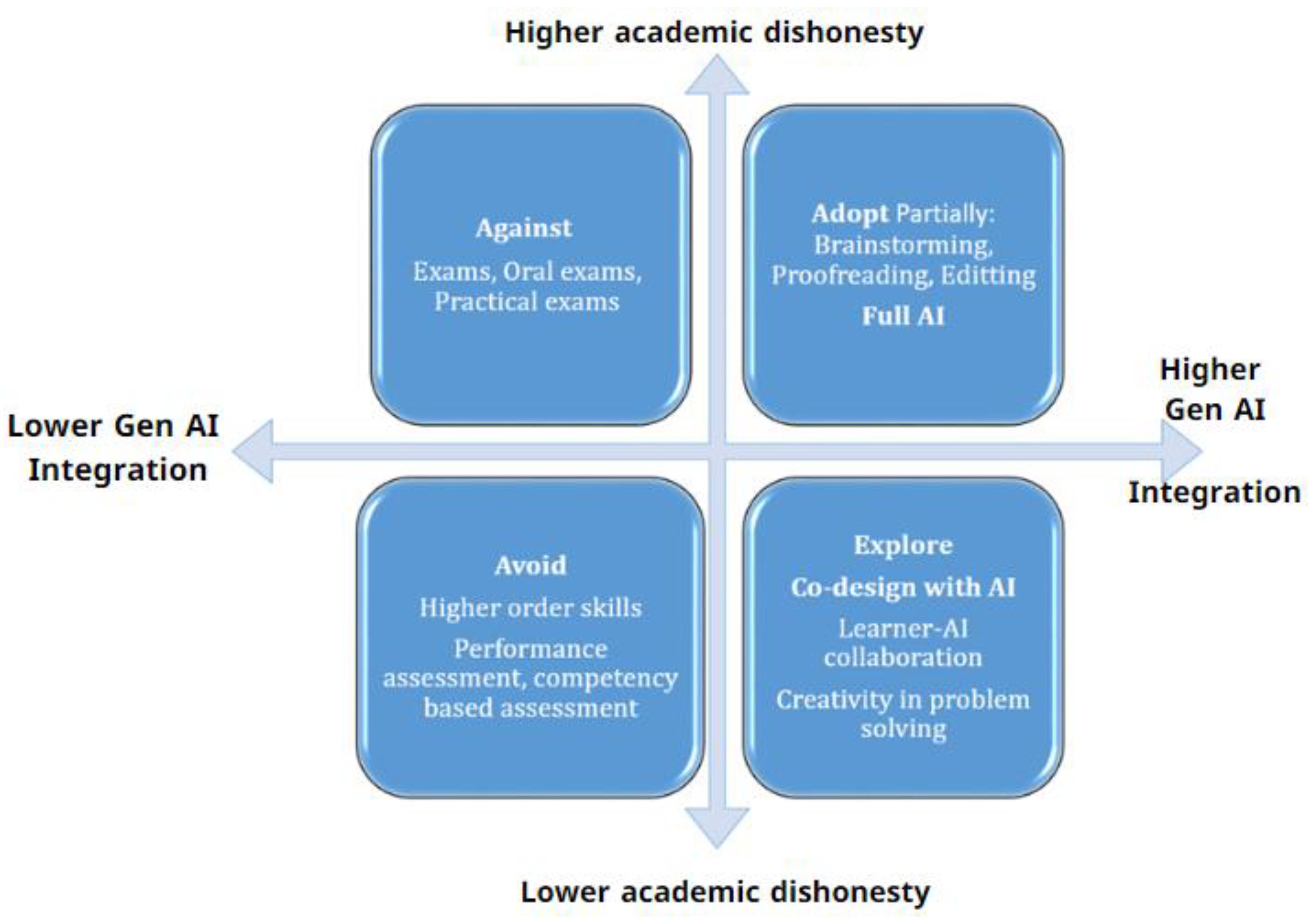
- Transparent AI-use frameworks: Tools such as the AI Assessment Scale make expectations explicit at the assignment level, so students know precisely where AI assistance is permitted, disclosed, or prohibited [1].
- Authentic and experiential tasks: Project-based learning, experiential assignments, and process-focused assessments that require personal engagement and are difficult to satisfy with a generated text [6][7].
- Direct verification: Oral examinations, in-class writing, and supervised assessment for outcomes that must be demonstrated independently. The resurgence of "blue books"--sales of which have increased significantly--along with professors moving examinations into the classroom and adopting oral exams, reflects this return to verifiable performance [5][8].
Notably, redesign advocates insist that AI-free assessment should be preserved where learning objectives genuinely require it, rather than abandoned wholesale. The goal is not to make every assignment AI-permeable, but to be deliberate about which outcomes demand AI-free performance and which should integrate AI transparently [8].
The Educative Turn
Underpinning all of this is a scholarly consensus that reframes academic integrity itself: away from a punitive, detection-focused paradigm and toward an educative approach centered on AI literacy, ethical transparency, and responsible use [6]. This means investing in educator AI literacy, student AI literacy, and the time for genuine course revision--resources that many institutions are finding more valuable than detector licenses [8]. Edtech platforms have followed the signal: newer tools now market process visibility, peer evaluation, oral assessment support, and authorship transparency rather than detection percentages [9].
Unfinished Business: Fragmentation, Vendors, and the Long Redesign
The transition is far from complete. Policy fragmentation remains a significant challenge: fewer than ten per cent of institutions initially provided clear guidance on generative AI use, and coherence across departments and institutions is still the exception rather than the rule [6]. Meanwhile, the detection market persists--dozens of universities still run AI detection within their plagiarism suites, even if disabled by default [2]--and vendor marketing continues to push surveillance-first solutions [9].
There is also an honest acknowledgment of trade-offs. In-class exams and oral assessments carry their own costs in staffing, scheduling, and pedagogical breadth. Process evidence can be gamed. AI literacy initiatives require sustained investment rather than one-off purchases. And the underlying technology continues to evolve faster than assessment frameworks can be revised [8]. The institutions succeeding in this transition treat assessment redesign as recurring work--policies with scheduled review cycles, not one-time fixes [8].
Conclusion
The AI detector era in higher education is ending not with a bang but with a quiet administrative decision: detection scores relabeled as triage data, tools disabled by default, accusations downgraded to follow-up conversations. The reasons are well documented by now--probabilistic scores mistaken for proof, bias against non-native English writers, evasion by anyone motivated enough to paraphrase, and litigation that exposed the fragility of detection-based cases [1][5][4].
What replaces detection is more demanding and, arguably, more honest. It asks institutions to say clearly what each assessment is for, to make the learning process visible through drafts and reflection, to be transparent about where AI fits, and to verify critical outcomes directly when they matter [3][8]. It asks faculty to become designers rather than detectives, and it asks integrity offices to build evidence standards and due process worthy of the stakes.
The deeper lesson extends beyond AI. Generative models did not create the tension between assessment and authentic learning--they exposed it. Institutions that respond by rebuilding assessment around visibility, validity, and fairness are not merely adapting to a new technology; they are correcting a weakness that predates it. The answer, as Ireland's 2026 framework puts it, was never stronger detection. It is stronger design [3].
References
-
1.
Beyond Detection: How Universities Are Abandoning AI-Writing Detectors and Redesigning Assessment for the Generative AI Era | Reducates. (n.d.). Retrieved https://reducates.com/ai-digests/beyond-detection-how-universities-are-abandoning-ai-writing-detectors-and-redesigning-assessment-for-the-generative-ai-era
- 2.
-
3.
From Detection to Redesign: How Universities Are Dismantling the AI Detector Experiment and Rebuilding Assessment for the Generative AI Era | Reducates. (n.d.). Retrieved https://reducates.com/ai-digests/from-detection-to-redesign-how-higher-education-institutions-are-abandoning-ai-detection-tools-and-rebuilding-assessment-models-for-the-generative-ai-era
- 4.
- 5.
-
6.
The impact of generative AI on plagiarism detection and policy evolution in higher education | UK Dissertations. (n.d.). Retrieved https://www.ukdissertations.com/dissertation-examples/education/reframing-academic-integrity-the-impact-of-generative-ai-on-plagiarism-detection-and-policy-evolution-in-higher-education
- 7.
- 8.
- 9.