Introduction
When ChatGPT burst into public consciousness in late 2022, higher education responded with the instinct that has served it before: find a tool that can tell the difference. Within months, platforms like Turnitin AI, GPTZero, Copyleaks, and ZeroGPT were woven into university workflows, promising a scalable technological fix to an unprecedented integrity crisis [1]. Automated scores offered institutions something seductive -- the appearance of control over a rapidly slipping definition of what student work actually means.
That appearance is now collapsing. A growing body of technical, empirical, and pedagogical research has converged on an uncomfortable conclusion: AI detection tools are not merely immature -- they may be fundamentally incapable of doing what institutions asked of them. Studies show inconsistent accuracy across text types and models, systematic false positives that disproportionately harm multilingual and international students, and near-total vulnerability to simple paraphrasing [2][3][1]. Perhaps most damning, even experienced human markers cannot reliably distinguish AI-generated work from student writing in blind conditions [3].
The result is a quiet but consequential institutional pivot. Rather than doubling down on detection regimes, universities are redirecting their energy toward something harder and more durable: redesigning assessment so that academic integrity is supported by the design of the task itself rather than by detection alone [3][4][5]. This article examines why the detection experiment failed, who paid the price for its failures, and what the emerging redesign movement actually looks like in practice.
The Detection Experiment and Its Unraveling
What the Evidence Showed
The academic literature on AI detection tools tells a remarkably consistent story of underperformance. One benchmark study evaluated five prominent detection tools -- including those from OpenAI, Writer, Copyleaks, GPTZero, and CrossPlag -- against paragraphs generated by ChatGPT versions 3.5 and 4, alongside human-written controls. The findings revealed a troubling pattern: the tools were noticeably more accurate at identifying older GPT-3.5 output than GPT-4 content, meaning detector reliability degraded precisely as the underlying generative technology improved. Even more concerning, the tools performed worse when applied to genuinely human-written text, raising the specter of false accusations against innocent students [2].
A qualitative evidence synthesis of peer-reviewed research published between 2021 and 2024 reinforced these findings across the broader detector landscape. While AI detectors offer scalable solutions, the review concluded, they "frequently produce false positives and lack transparency, especially for multilingual or non-native English speakers" [1]. Accuracy deteriorates further when AI-generated content has been manually edited or lightly paraphrased -- a trivially easy workaround available to any student [1].
The Structural Problem
What makes the current moment different from earlier technology controversies is the emerging argument that the problem is not fixable through iteration. A recent discussion paper advances the claim that detection's limitations are "structural rather than temporary" -- that a markedly more reliable detector may be impossible to achieve across diverse, real educational contexts, because the limitation lies not in the maturity of current tools but in the nature of the detection problem itself [3]. Machine-generated and human-generated text increasingly occupy the same statistical space, and no classifier can reliably separate what has ceased to be separable.
This reframing matters enormously for institutional strategy. If the problem is temporary, the rational response is patience and better tools. If it is structural, then effort directed toward detection is effort misdirected -- and should be redirected toward assessment redesign [3].
 Beyond Detection: How Universities Are Redesigning Assessment and Academic Integrity Policies for the Generative AI Era | Reducates
The Human Cost: Bias, Surveillance, and False Accusations
The technical failures of AI detection would be an abstract problem if their consequences were evenly distributed. They are not. The evidence synthesis of detector research places ethical concerns around "surveillance, consent, and fairness" at the center of the debate, highlighting false positive rates that fall hardest on multilingual students and gaps in institutional policies that leave accused students with inconsistent recourse [1].
For international students, the stakes are particularly acute. Research on generative AI's impact on student life emphasizes the "disproportionate impact of GAI on international students, who already face biases and discrimination" -- a population that now faces the added risk of having their writing style, shaped by second-language acquisition, misclassified as machine-generated [6]. The bitter irony noted across the literature is that the same AI systems creating the integrity crisis also hold potential to mitigate these inequities, for example by providing language support that reduces the pressure driving students toward ghostwriting in the first place [6].
Compounding the fairness problem is a broader critique: generative AI models trained on internet data can produce biased and discriminatory outputs, while hallucination in large language models yields confident but fabricated content -- meaning the technology at the heart of both the problem and the proposed solutions carries its own reliability deficits [7].
The cumulative effect has been a loss of institutional nerve. When detector outputs cannot be treated as independent proof of inappropriate AI use, but only as "one signal among several in broader academic integrity processes" [3], the entire enforcement architecture built on automated scores becomes ethically precarious. Accusing a student of misconduct on the basis of a probability score that the evidence cannot support is not a defensible pedagogical position -- and institutions are increasingly acknowledging as much.
The Institutional Pivot: From Policing to Redesign
A "Wicked Problem" Requiring Institutional Permission
The shift away from detection is being articulated at the policy level. The Quality Assurance Agency's advice now emphasizes that institutions need sustainable assessment strategies that "move beyond detection alone" and calls for principled redesign rather than reactive policies [5]. Increasingly, generative AI is described as a "wicked problem" -- one not amenable to simple fixes like prohibition, but requiring institutional permission to innovate, iterate, and even compromise in assessment design [5].
This framing represents a significant rhetorical departure from the early crisis years. Where institutional responses once centered on compliance and risk management -- tightened regulations, expanded scrutiny, mechanistic controls -- reformers now argue that such measures "run the risk of diluting genuine transformation and placing unsustainable pressure on staff and students alike" [5].
Frameworks for Redesign
The redesign agenda is acquiring concrete structure. In Ireland, the recently published 2026 Assessment Redesign Framework for higher education, authored by Dr. Hazel Farrell, Academic Lead for GenAI at SETU, as part of the national N-TUTORR project, argues directly that "the answer is not stronger detection, but stronger design." The framework calls on institutions to rethink assessment in ways that make learning visible, valid, fair, transparent, and aligned with intended outcomes [4]. Its central insight is that the response to generative AI "cannot stop at detection, restriction, or isolated changes to individual assessments" -- what is needed is assessment better designed from the start, with greater visibility of learning, stronger emphasis on process and reflection, and clearer coherence across modules and entire programs [4].
Scholarly work is converging on the same destination from a different direction. Research on supporting assessment redesign documents how rapidly evolving generative models are forcing a fundamental reconsideration of assessment practice in higher education [8], while analyses of assessment in the generative AI era illustrate design considerations that treat AI not merely as a threat to be blocked but as a reality to be designed around [7].
Beyond Detection: How Universities Are Redesigning Assessment and Academic Integrity Policies for the Generative AI Era | Reducates
What Redesign Actually Looks Like in Practice
Making Learning Visible
The emerging redesign playbook shares several core commitments. The first is visibility: assessment should surface the process of learning, not just its polished endpoint. Process evidence -- drafts, reflections, version histories, supervised checkpoints -- makes it possible to see how a piece of work came to be, which is precisely the information a detector cannot provide [4]. Portfolio-style approaches and tools that allow feedback to travel across the process of a program are positioned as infrastructure for this kind of assessment environment [4].
Avoiding the Superficial Swap
A cautionary note runs through the reform literature: redesign is not simply substituting written essays with oral presentations or similar surface-level changes. As one HEPI analysis warns, such substitutions risk "reproduc[ing] the same underlying problems in a different format" -- a viva can be coached, a presentation can be scripted, and neither inherently proves the student learned anything [5]. Meaningful reform requires revisiting "the purpose, design and resourcing of assessment" rather than treating redesign as "a technical fix for reputational anxiety" [5].
This connects to a deeper conceptual shift articulated in recent analysis: moving "from detection to evaluative judgment." Even if detectors worked perfectly, the blind studies showing that experienced human markers cannot reliably identify AI-generated work reveal that the task facing higher education is harder than buying better tools. It requires "designing assessments that reward the learning institutions say they value, so that academic integrity is supported by the design of the task rather than by detection alone" [3].
The Combinations That Work
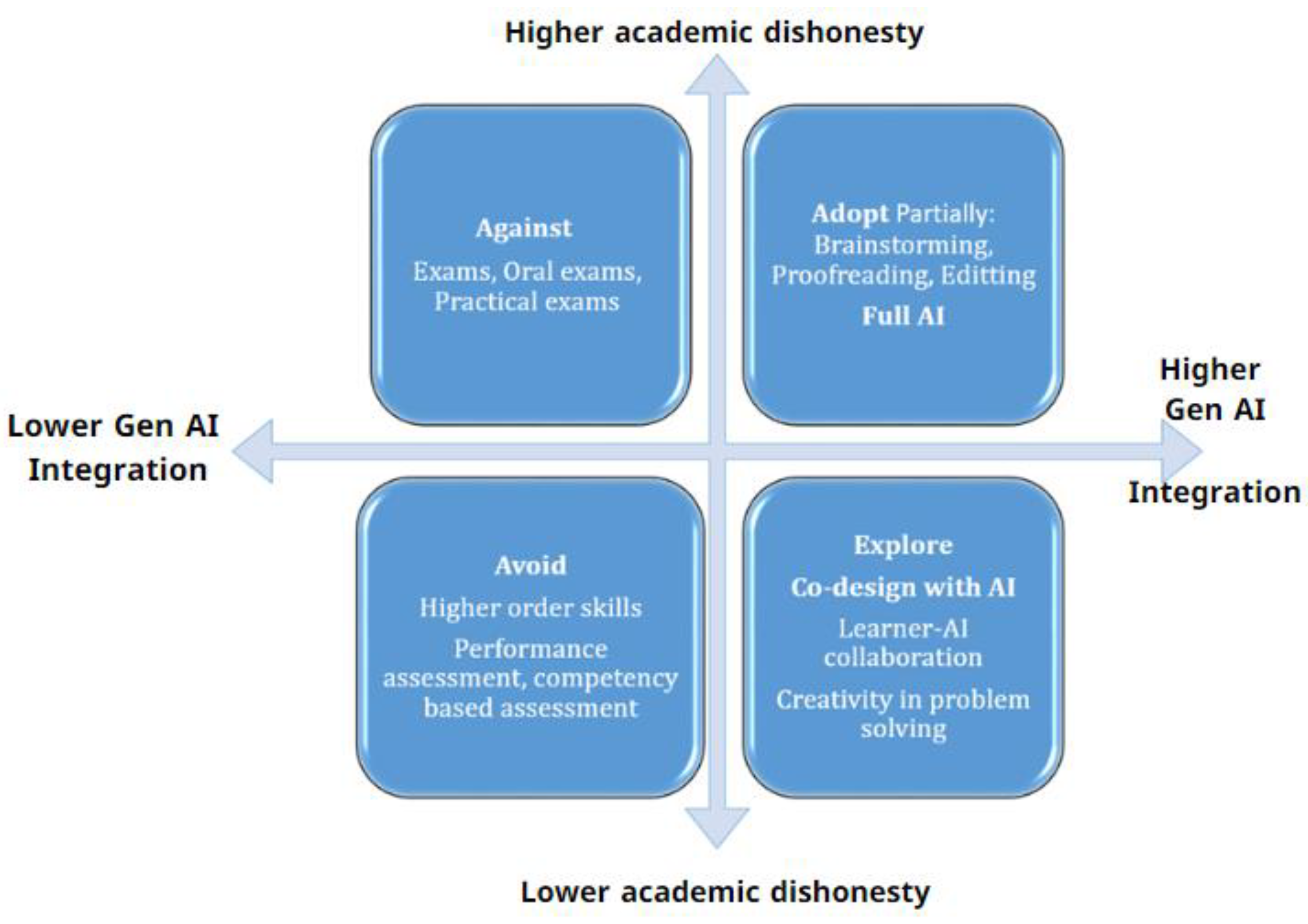
Importantly, the emerging consensus is not that institutions must choose between detection and redesign in absolute terms. The institutions reporting the best outcomes are those combining limited, carefully circumscribed detector use with genuine assessment redesign, process evidence, and student education about AI use [9]. Detection, in this model, is demoted from adjudicator to input -- never treated as independent proof, but potentially useful as context within a broader integrity process [3].
This also implies a pedagogical rather than punitive posture. The evidence synthesis calls for a shift "away from punitive approaches toward AI-integrated pedagogies that emphasize ethical use, student support, and inclusive assessment design," arguing that institutions must adopt balanced, transparent, student-centered strategies aligned with evolving digital realities [1]. When properly integrated and ethically governed, generative AI can itself "substantially improve student learning outcomes" [7] -- a proposition only testable once assessment stops treating every AI interaction as a crime scene.
 Beyond Detection: How Universities Are Redesigning Assessment and Academic Integrity Policies for the Generative AI Era | Reducates
The Risk of Hollow Reform
The redesign movement carries its own failure modes, and experienced observers are already naming them. The Higher Education Policy Institute notes that rising media coverage and regulator warnings have indeed prompted calls for redesign rather than a doubling-down on detection -- but cautions that reform driven by reputational protection, rather than by learning, will be hollow [9][5].
The warning is well-founded. Institutions under public pressure may perform redesign -- rebranding assessments, adding viva requirements, issuing new AI policies -- without changing the underlying pedagogy, and then declare the problem solved. Compliance-based reform of this kind may reassure quality assurance systems while leaving the actual learning enterprise untouched [5]. The costs of getting this wrong fall on both sides of the lectern: staff confronting "unsustainable pressure" to redesign without resourcing, and students caught between assessments that no longer make sense and integrity regimes that no longer command legitimacy [5].
There is also a temporal challenge. Generative models are "rapidly evolving," meaning any redesign calibrated against today's AI capabilities may be obsolete within an assessment cycle [8]. This is an argument for designing for principles -- visibility, validity, fairness, transparency, alignment [4] -- rather than for specific countermeasures against specific tools.
Conclusion
The story of AI detection in higher education is, in retrospect, a story about the limits of technological shortcuts. Detectors promised a simple answer to a hard question, and for a moment, institutions wanted to believe. But the evidence -- technical, empirical, and human -- proved overwhelming: the tools are inaccurate, degrade against newer models, are biased against the very students equity demands that institutions protect, and are trivially evaded by paraphrasing [9][2][1]. Even perfectly functioning detection would not have resolved the underlying dilemma, because human evaluators cannot make the distinction either [3].
What replaces detection will be harder, slower, and more expensive than buying a license -- but it is also the only approach that addresses the actual problem. The pivot from detection to redesign reflects a maturing recognition that assessment must reward the learning institutions claim to value, that process matters as much as product, and that integrity is a property of well-designed educational systems rather than a verdict delivered by an algorithm [3][4][5]. The institutions navigating this transition best are not those that found a better tool, but those that stopped looking for one -- and started rebuilding assessment for the world as it now is [9].
References
- 1.
- 2.
- 3.
- 4.
- 5.
- 6.
- 7.
- 8.
-
9.
Beyond Detection: How Universities Are Abandoning AI-Writing Detectors and Redesigning Assessment for the Generative AI Era | Reducates. (n.d.). Retrieved https://reducates.com/ai-digests/beyond-detection-how-universities-are-abandoning-ai-writing-detectors-and-redesigning-assessment-for-the-generative-ai-era