Introduction
When ChatGPT burst into classrooms in late 2022, universities reached for what seemed like an obvious technological fix: software that could scan a student essay and declare, with apparent confidence, whether a human or a machine had written it. Within months, AI detection tools were embedded in learning management systems across the world, their percentage scores treated by many instructors as near-certain evidence of misconduct. Students were hauled into disciplinary hearings on the strength of a single number.
That confidence is now collapsing. A mounting body of independent research has shown that these tools routinely misclassify genuine human writing as machine-generated -- with the burden falling disproportionately on non-native English speakers and neurodivergent students [1][2]. Courts have begun ruling against institutions that penalized students on detection scores alone [3], and a wave of leading universities -- including Cornell, Vanderbilt, the University of Pittsburgh, and the University of Iowa -- have disabled or withdrawn AI detectors entirely, citing unreliability, equity harms, and the risk of devastating false accusations [4][5].
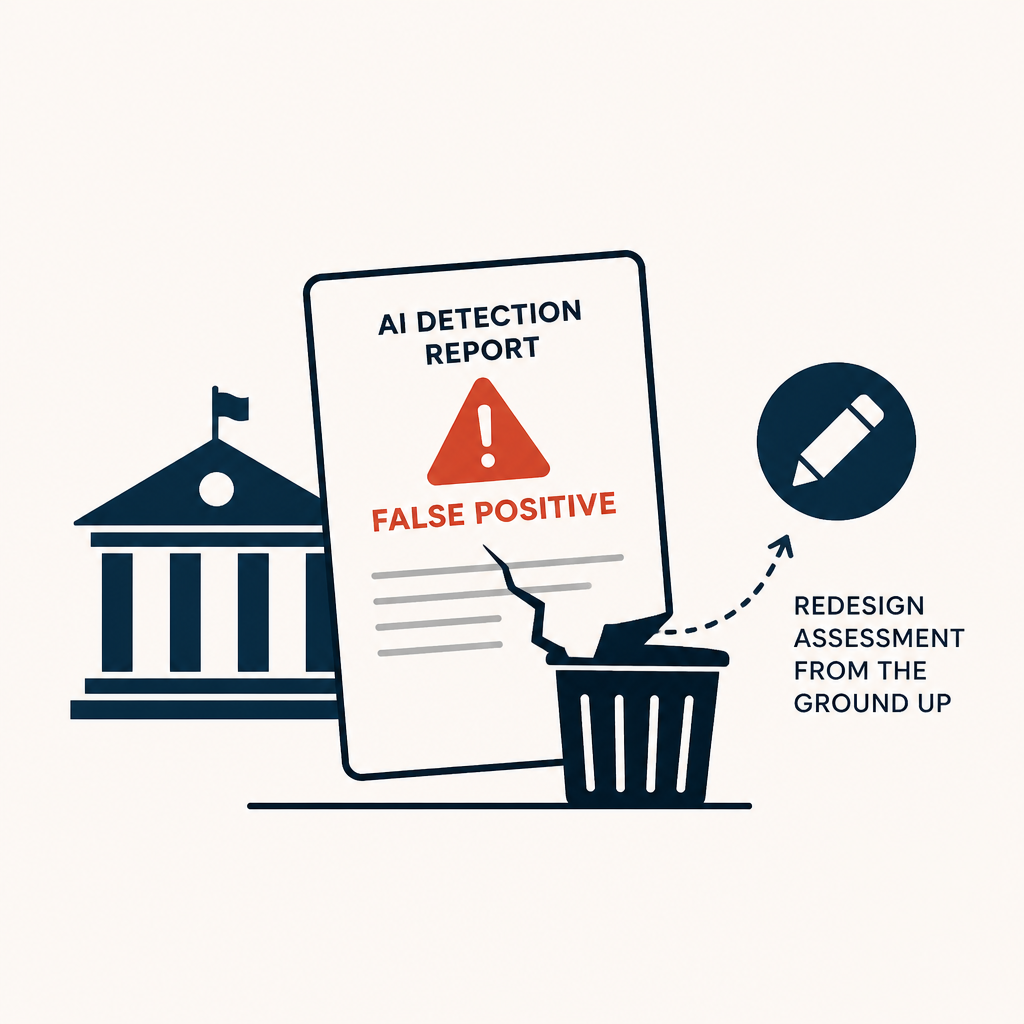
But the story is not simply one of tools being switched off. What is emerging in their place is a far deeper transformation: a movement to redesign assessment from the ground up, so that academic integrity no longer depends on catching cheaters at all. The philosophy could be summed up as "prompt over policing" -- replacing surveillance infrastructure with pedagogy that makes wholesale AI substitution impractical, while teaching students to use these tools responsibly in a world where AI assistance is becoming standard [6][1].
The False Positive Epidemic: What the Evidence Shows
The accuracy problem, in numbers
The most serious flaw of AI detection is not that it misses machine-written text -- it is that it flags human-written text as machine-generated. In an academic context, a false positive can derail a student's academic record, mental health, and career prospects [7].
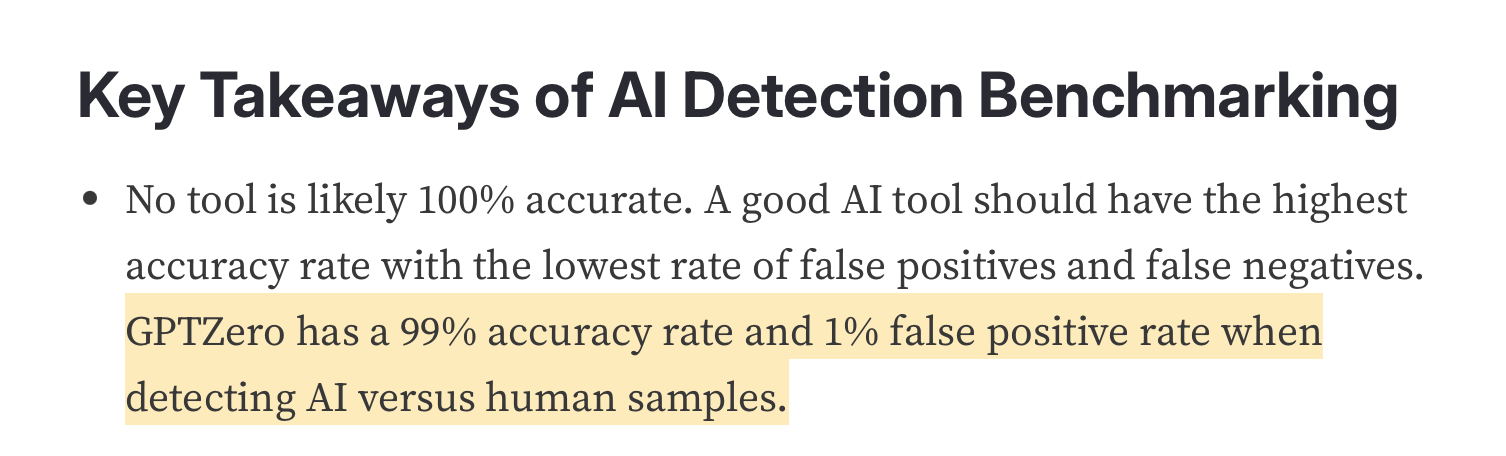
Independent testing consistently places real-world false positive rates between 2% and 20%, depending on the tool and the type of content being analyzed [1]. The consequences of even the most optimistic figure are staggering. Applied to the roughly 22.35 million essays written by first-year U.S. college students annually, a 1% false positive rate would mean approximately 223,500 wrongly flagged essays every single year -- and at the rates independent researchers actually observe, the number climbs far higher [1].
The most widely cited evidence of systematic bias comes from a 2023 Stanford study, which found that AI detectors misclassified 61% of essays written by non-native English speakers as AI-generated [1][2]. The likely reason: detectors often treat formulaic, low-perplexity prose -- precisely the style taught to English language learners -- as a machine signature. The result is a tool that punishes students for writing carefully.
 Artificial Writing and Automated Detection | Becker Friedman Institute
No consistent standard between tools
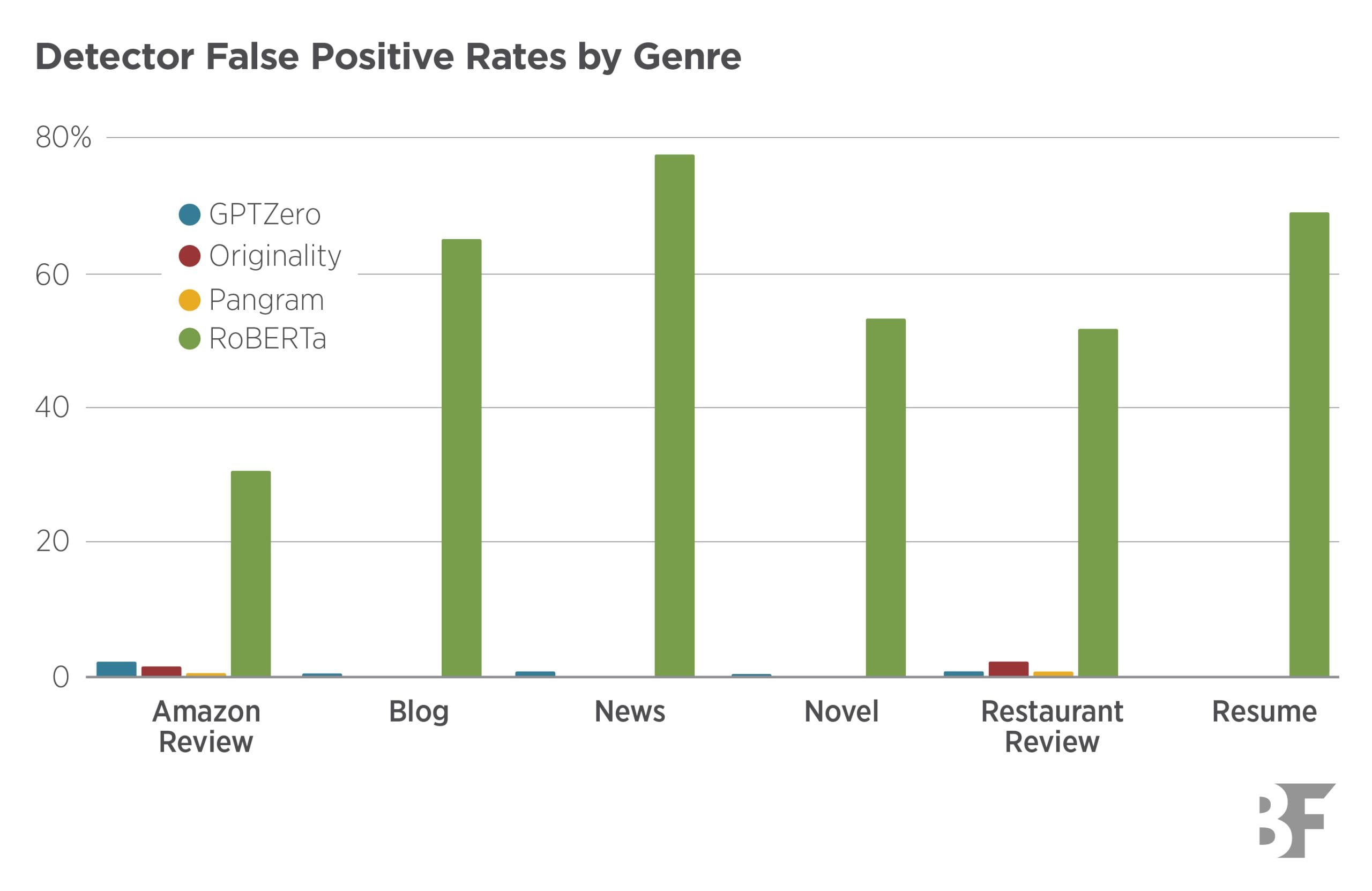
Compounding the problem, there is no agreement even among detectors themselves. One recent study found that the performance of leading tools -- GPTZero, Originality.ai, and Pangram -- varied drastically. Originality.ai's false negative rate soared to 40% in some cases, while Pangram's remained below 4%. The severe discrepancy reveals that the reliability of an "AI detection" claim depends more on which tool is chosen than on the text itself, exposing the absence of any consistent, objective standard [4].
Even the vendors have begun conceding the point. Turnitin's own research acknowledges significant false positive rates [3], and Vanderbilt University cited both high false positives and the tool's opaque methodology when it withdrew its detection software [5]. "These aren't fringe institutions making politically motivated decisions," as one analysis of the exodus noted. "These are major research universities with robust academic integrity systems concluding that the technology fundamentally doesn't work" [8].
When the Detector Becomes the Accuser
Courtrooms and catastrophic accusations
The human cost of false positives has increasingly spilled into court. In one landmark New York case, a court ruled in student Newby's favour after a university relied on a 100% AI-confidence detection score to trigger a misconduct hearing -- and then failed to follow its own disciplinary procedures. As commentators have observed, "a 100 per cent confidence score that sent an innocent student through a misconduct hearing was not a false positive -- it was a system failure" [6].
That ruling changed the conversation. Courts in several countries have since ruled against institutions that penalized students on the basis of AI detection scores alone [3], exposing universities that continue to treat detector output as "smoking gun" proof to genuine legal risk [6]. The challenge, as Joachim Steinberg, a tech-litigation specialist at law firm Crowell & Moring, put it, is that "institutional guidance and disciplinary processes" struggle to keep pace with technological change, "leaving many students and educators operating in an environment of uncertainty" [2].
The exodus begins
Faced with this combination of unreliable technology, biased outcomes, and rising legal exposure, the institutional dam has broken. Cornell, Vanderbilt, Pittsburgh, and Iowa have all disabled or withdrawn AI detection systems, with their decisions reflecting "an emerging recognition that these tools pose more risk than benefit when used in high-stakes academic integrity processes" [4]. Critics describe the dynamic as one in which "the detector becomes the accuser" -- outsourcing a judgment that demands human context to an algorithm incapable of providing it [9].
Crucially, the universities walking away insist they are not abandoning integrity. They are concluding that detection was never the way to secure it [6].
AI Detector False Positives: 2026 Update -- CASRAI
Why Detection Was Structurally Doomed
An asymmetric arms race
Beyond the documented failures lies a more fundamental problem: detection may be unwinnable as a game. AI detection is inherently probabilistic, not definitive [3], and the arms race it creates is starkly asymmetric. Detection requires near-perfect accuracy to be fair; evasion only needs to work once [6]. Simple prompt changes can modify AI text to evade detection [6], and the techniques keep improving. A 2023 analysis by researchers at the University of Maryland demonstrated that post-hoc paraphrasing using freely available tools could reduce detection accuracy to near chance levels on several major platforms -- creating an adversarial dynamic in which "the most sophisticated users of AI are the least likely to be caught" [7].
Meanwhile, the underlying target keeps moving. As large language models evolve and produce increasingly naturalistic output, the gap between human and machine writing narrows, forcing detection systems into perpetual catch-up [7].
A structural limitation, not a maturity problem
This has led researchers to a provocative conclusion: the problem may be structural rather than temporary. A recent discussion paper argues that a markedly more reliable detector may be difficult, if not impossible, to achieve across diverse real educational contexts -- and if the limitation lies in the nature of the detection problem itself, then effort spent on detection would be better redirected toward assessment redesign [10].
That does not mean detection has no value whatsoever. Detector outputs may reasonably prompt closer review when considered alongside other evidence about how a piece of work was produced -- a cautious use consistent with Perkins et al. (2023), who documented both the partial usefulness and the limitations of Turnitin's AI tool in a real assessment setting. The key shift is conceptual: detection as a signal to prompt conversation, never as proof to justify punishment [10].
Prompt Over Policing: The Assessment Redesign Movement
Authentic assessment
The institutions leading the way are not just disabling detectors -- they are building better systems. Cornell has been explicit about the philosophy, stating that "establishing trusting relationships with students and designing authentic assessments will likely be far more effective than policing students" [8]. Authentic assessment means performance tasks meaningful to students' lives: analyzing recent policy proposals, creating data stories about local issues, developing solutions to real-world problems -- assignments AI cannot generate meaningful responses to without access to specific current information or personal context [8].
Documented approaches across Stanford, Harvard, Cornell, MIT, and other leading institutions demonstrate that effective academic integrity does not require surveillance -- and that root-cause approaches improve learning outcomes rather than merely deterring dishonesty [8]. There is also an uncomfortable admission embedded in this shift: the real problem was never the tool. It was assessment design that never required students to demonstrate their own thinking in the first place. An essay prompt asking students to "discuss the causes of the 2008 financial crisis" was already answerable without much original thought -- AI has simply made that visible [3].
Process-based evidence
Perhaps the most practical redesign is staged submission. Instead of collecting one final assignment, instructors break the task into graded checkpoints: a topic proposal, an annotated source list, a rough draft with reflective commentary, and a final version [3]. The logic is compelling -- AI produces polished outputs, not learning trails. A student who genuinely engaged with material will show evolution: ideas developing, arguments shifting, sources being reconsidered. A student who fed a prompt into a language model will show a suspiciously complete draft appearing fully formed at checkpoint three [3].
Even the detection industry has pivoted toward process. Turnitin, responding to universities' concerns about "overuse or misuse," last year launched a product allowing teachers to observe the evolution of a student's writing process rather than relying solely on analysis of the final submission [2].
 All About False Positives in AI Detectors | Pangram
Oral defenses and in-class work
Universities that have disabled detection are also returning to formats that make wholesale AI substitution impractical: in-class writing, oral presentations, oral defenses, and portfolio-based evaluation that assess learning directly [6][1]. These methods have a further virtue -- they rebuild the human relationships that detection software eroded, treating students as partners in learning rather than subjects of suspicion [8].
AI literacy over AI policing
Finally, forward-thinking institutions are replacing AI policing with AI literacy: teaching students how to use AI tools responsibly, when disclosure is appropriate, and how to maintain authentic learning while leveraging technology. This approach prepares students for a professional world where AI assistance is standard, rather than pretending AI doesn't exist [1]. Where detection remains in limited use, transparency is deemed essential -- students should know which tools are being used, what thresholds trigger investigation, what the known false positive rates are, and what the appeals process involves, with institutions publishing this information proactively rather than burying it in policy documents [1]. As Nirmal Thacker, chief executive of application-assistance tool GradPilot, argues: "I would like for universities to rethink assessment, welcome disclosure and be open about policy" [2].
Conclusion
The AI detection era in higher education is ending -- not because AI use has stopped, but because the tools were never good enough to justify the harm they caused [6]. What replaced a false positive with a ruined semester was never a technical glitch; it was a system that asked an unreliable algorithm to make irreversible judgments about students' character and honesty [6][9].
The universities abandoning detection are not surrendering on academic integrity. They are, arguably, taking it seriously for the first time in the generative AI age -- by shifting from "catch the cheater" to "design assessments that make cheating irrelevant," from surveillance infrastructure to faculty-supported pedagogy, from suspicion to trust [6][8]. This transition demands institutional courage: the willingness to forgo the superficial appeal of technological objectivity, to invest in assessment redesign and student relationships, and to define what acceptable AI use actually means rather than merely attempting to detect its violation [8][2]. The universities that make that leap are discovering what the evidence has suggested all along -- the most effective academic integrity policy was never a detector score. It was an assignment worth doing honestly.
References
- 1.
- 2.
- 3.
- 4.
-
5.
The shift in higher education: Universities are stopping AI detection tools and recommending alternatives to improve assessment. | Prof. Ali Abouelnour. (n.d.). Retrieved https://www.linkedin.com/posts/prof-ali-abouelnour-389b673b_highereducation-aiineducation-academicintegrity-activity-7373238802154332160-6CKR
- 6.
- 7.
- 8.
- 9.
- 10.