Introduction
When ChatGPT launched in November 2022, higher education responded with what seemed like an obvious fix: if students might use AI to cheat, universities would simply detect it. Within months, a crowded market of detection tools--GPTZero, Turnitin's AI indicator, Copyleaks, and dozens of others--promised to distinguish machine-generated prose from authentic student writing. Adoption was swift, driven in part by the sheer scale of uptake on the student side: surveys suggest at least half of college students have already used AI to write papers, generate ideas, or both [1].
That confidence has not survived contact with the evidence. OpenAI shut down its own AI-content classifier in 2023 after it correctly identified only 26% of AI-written text while falsely flagging 9% of human writing [1][2]. Detectors famously labeled the U.S. Constitution as fully AI-generated [2], and peer-reviewed benchmarks have repeatedly shown that simple paraphrasing defeats even the most sophisticated classifiers [3]. Meanwhile, students who did nothing wrong found themselves facing misconduct panels on the strength of a percentage score.
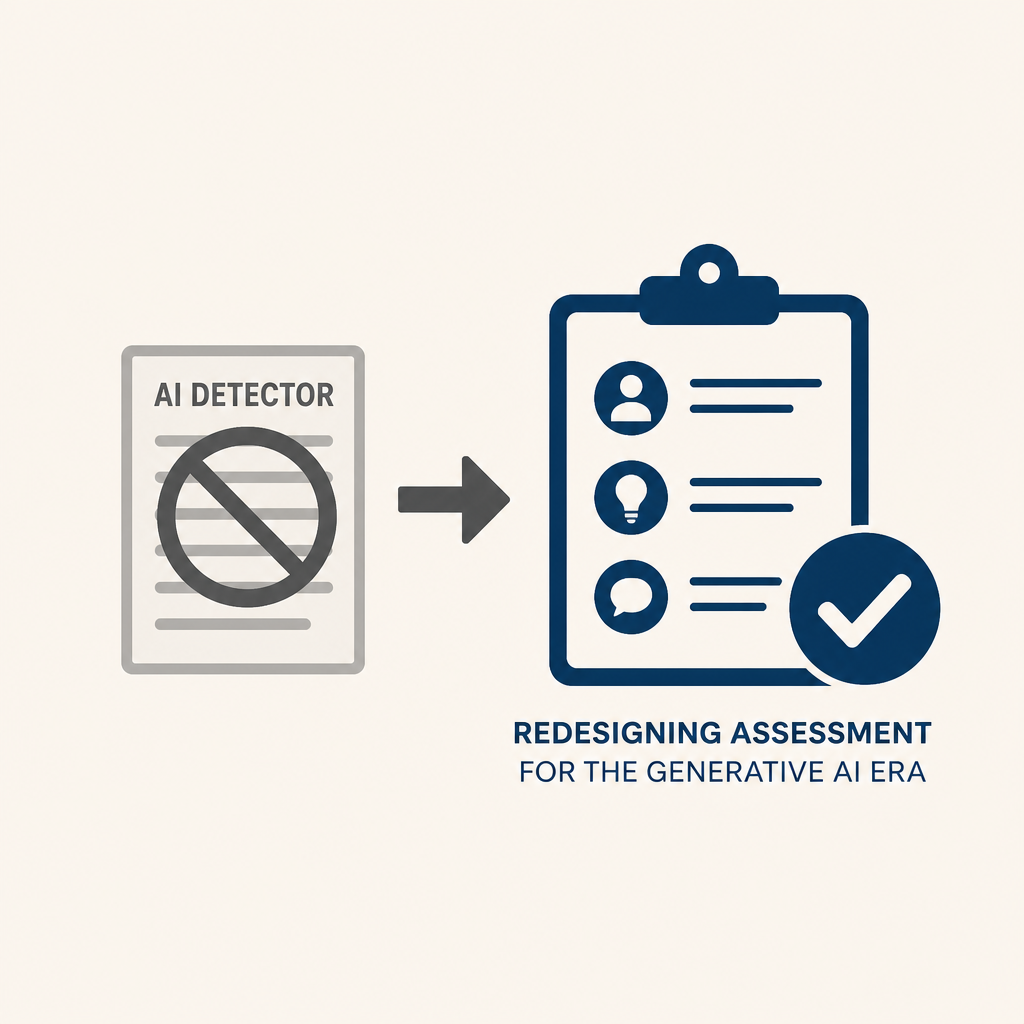
What has emerged in 2025 and 2026 is not the abandonment of academic integrity, but the abandonment of a particular technology of enforcement. Universities across the sector--echoed by guidance from the UK's Quality Assurance Agency, the MLA-CCCC Joint Task Force, and a growing body of scholarly critique--are treating detection as, at best, a weak signal within a much broader process [4][2][5]. The deeper work now underway is something far more consequential: redesigning assessment itself for the generative AI era.
The Crumbling Case for Detection
Accuracy That Couldn't Survive Scrutiny
The technical literature on AI detection has been unflinching. Shared benchmark studies such as the RAID evaluation demonstrated that detector performance degrades sharply under real-world conditions--different domains, adversarial rewrites, and varied decoding strategies [3]. A widely cited theoretical analysis asked the question directly--can AI-generated text be reliably detected?--and concluded that the answer, under realistic conditions, is essentially no [3]. Empirical evaluations of commercially available tools found similarly disappointing results, with performance varying wildly across contexts and text types [3].
The failures have been visible in the most public ways imaginable. Detectors have misclassified foundational American documents as machine output, and OpenAI's decision to quietly retire its own detection tool became a symbol of the field's limits [2]. Perhaps most tellingly, the framing has shifted inside institutions themselves. As the University of Kansas put it in guidance to faculty: "The tool provides information, not an indictment" [6]. When a Turnitin indicator returns a figure like 38%, many universities now treat that number as "the start of a question, not the end of a process" [7]--a score, not a verdict [7].
A Bias Problem With Human Costs
More troubling than raw inaccuracy is who the inaccuracy falls upon. Stanford researchers found that while detectors performed near-perfectly on essays by U.S.-born eighth-graders, they misclassified more than 61% of essays written by non-native English speakers as AI-generated--and 97% of TOEFL essays were flagged by at least one detector [2]. This finding, echoed in peer-reviewed work published in Patterns [3], suggests detectors are not merely unreliable but systematically unfair, penalizing students for the "predictable," structured prose that is a natural feature of writing in a second language.
The MLA-CCCC Joint Task Force on Writing and AI has urged educators to "focus on approaches to academic integrity that support students rather than punish them," cautioning that false accusations may "disproportionately affect marginalized groups" [2]. The human dimension is real: students report intense anxiety about being falsely accused even when they have used nothing more sophisticated than a grammar checker or made basic improvements to their own writing [3].
An Arms Race Detectors Were Built to Lose
Even where detectors work in the lab, they face a motivated and well-equipped opposition. Research presented at NeurIPS showed that simple paraphrasing evades detectors of AI-generated text [3], and a whole commercial ecosystem of "AI humanizers" now markets itself explicitly on the promise of rendering machine-generated text undetectable [1]. Studies of adversarial techniques against GenAI detection tools have documented how easily these systems are manipulated--with significant implications for equity and inclusivity in higher education, since the students most savvy about evasion tools gain an advantage over those who are not [3].
The practical upshot, as education researcher Leon Furze has argued bluntly, is that "AI detection in education is a dead end": the tools simply do not work, and institutions that build policy atop them are building on sand [8]. Recent research testing more than 800 samples of writing against multiple detection tools has only reinforced the point [8].
 Beyond Detection: How Universities Are Redesigning Assessment and Academic Integrity Policies for the Generative AI Era | Reducates
From Verdict to Signal: The Institutional Policy Pivot
Faced with this evidence, universities have not merely adjusted their rhetoric--they have changed their workflows. A 2026 snapshot of institutional practice reveals a consistent pattern: AI detection scores are now treated as "triage data," one input among many inside a wider academic integrity process, rather than as grounds for accusation on their own [4]. Some institutions have paused or disabled AI detection entirely after disputes and demonstrable student harm from overreliance on a single tool's output [4].
The shift has been documented across the sector. The University of Iowa has published "the Case Against AI Detectors"; MIT tells faculty flatly that "AI Detectors Don't Work"; the University of San Diego Law School, the University of Kansas, and the University of Nebraska-Lincoln have all issued guidance urging caution, direct conversation with students, and skepticism toward detector scores as sole evidence [2]. Scholars studying writing pedagogy have argued for moving "beyond policing" altogether, urging universities to encourage innovative approaches to assessment and the ethical use of technology rather than investing further in questionable detection [3]. Recent peer-reviewed work has even compared human experts against AI detectors in catching machine-generated writing--finding that neither is reliable enough to carry the weight institutions once placed on automated scores [9].
Crucially, the pivot does not mean anything goes. Institutions that still use detectors describe what actually triggers a closer look, and it is rarely the score itself. Red flags include a polished essay the student cannot explain when asked to walk through their argument, methods, or sources, and the use of AI to generate citations or quotations that do not exist or do not support the claims made [4]. In practice, this restores judgment, conversation, and evidence to the center of integrity processes. Students, for their part, are being advised to protect themselves by keeping drafts and version history, disclosing AI assistance according to course rules, and verifying citations carefully [4].
 Beyond Detection: How Universities Are Redesigning Assessment and Academic Integrity Policies for the Generative AI Era | Reducates
Redesigning Assessment: From Gotcha to Evidence
The AI Assessment Scale and Structured Permission
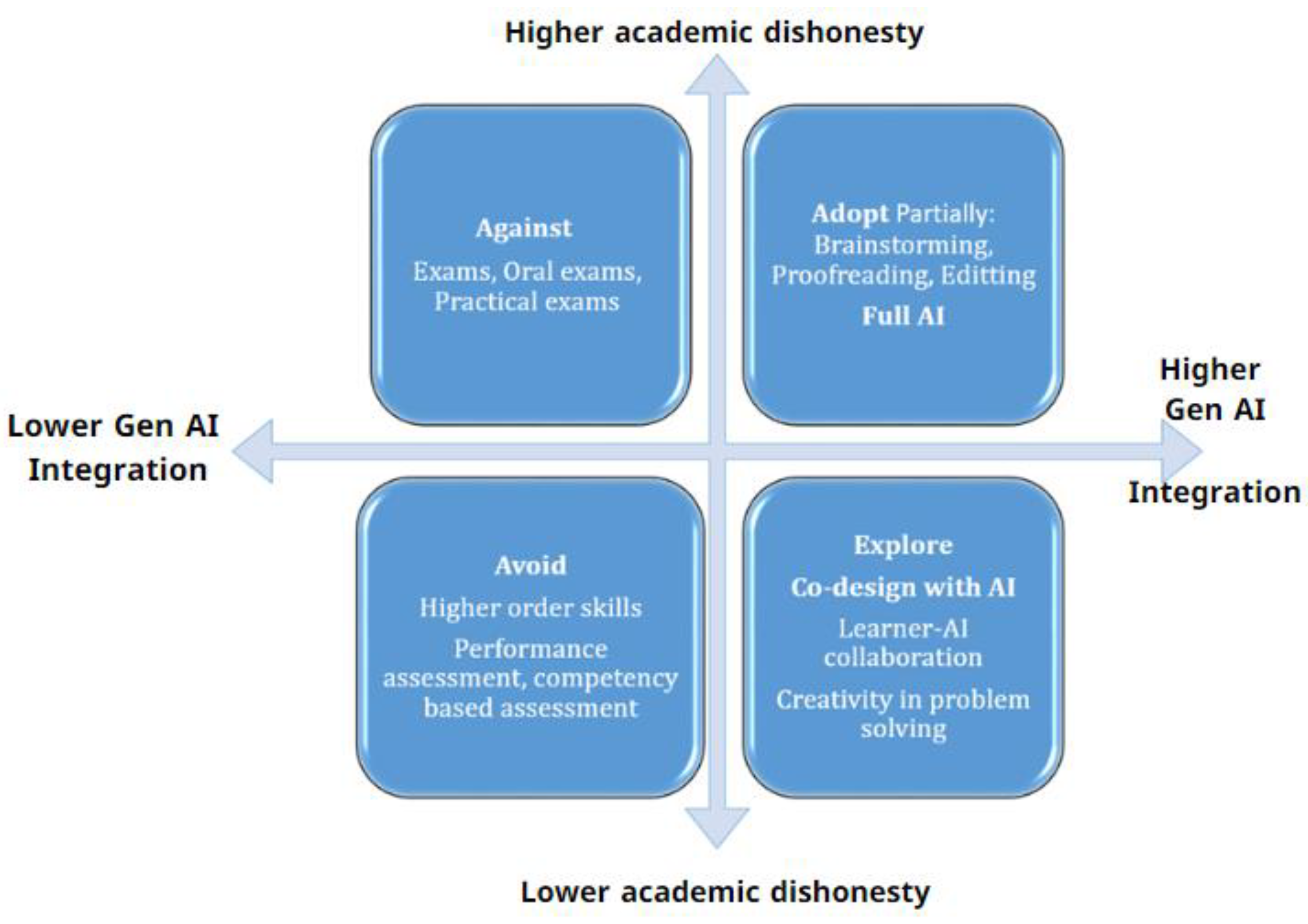
The most influential alternative to detection is not another technology but a framework: the AI Assessment Scale, developed by Mike Perkins, Jasper Roe, Jason MacVaugh, and Leon Furze. Rather than banning or ignoring AI, the scale defines clear levels of permitted use for each assessment--prohibiting it where necessary, allowing it for brainstorming and outlining, or embracing it fully where the skill being taught is AI collaboration itself [8]. Many instructors now explicitly allow limited AI help for idea generation, structure suggestions, and language refinement, with disclosure [4]. The framework's power lies in replacing ambiguity--the fuel of both cheating and false accusation--with transparency.
Process-Based Evidence and Authentic Demonstration
Alongside structured permission, universities are rebuilding the evidentiary base of assessment. Colleges increasingly allow AI use provided students disclose their prompts and can explain their edits [10], and many rely less on detection and more on faculty judgment, draft reviews, and oral assessment methods [10]. Version histories, staged submissions, and in-class verification of learning make the writing process visible in ways a final document never can [4]. The logic is simple: if a student cannot explain their own argument, the detector score is irrelevant--the gap between the student and the submitted work is the real evidence [4].
Assessment as a 'Wicked Problem'
Yet leading sector analysts warn against treating redesign as a simple technical fix. The UK Higher Education Policy Institute (HEPI), drawing on Quality Assurance Agency guidance, argues that generative AI should be understood as a "wicked problem"--one not amenable to simple fixes like prohibition, but requiring institutional permission to innovate, iterate, and even compromise in assessment design [5]. The QAA calls for sustainable assessment strategies that move beyond detection alone and for principled redesign rather than reactive policy [5].
HEPI's sharpest warning concerns superficial change: swapping written essays for oral presentations or similar surface-level substitutions may "reproduce the same underlying problems in a different format." Universities need to revisit the purpose, design, and resourcing of assessment itself, rather than treating redesign as a response to reputational anxiety [5]. Assessment, the argument runs, is not a procedural hurdle but a pivotal experience shaping what students learn and what employers value--if reform is driven merely by compliance, institutions will miss the opportunity to align assessment with the actual needs of graduates entering the AI era [5].
Beyond Detection: How Universities Are Redesigning Assessment and Academic Integrity Policies for the Generative AI Era | Reducates
The Bigger Picture: Equity, Privacy, and the World of Work
The retreat from detection is also being driven by concerns that extend well beyond pedagogy. Privacy advocates raise serious questions about what happens when student work is uploaded to commercial detection platforms: Is consent obtained? Are FERPA protections honored? [2]. There is a further irony that has not been lost on commentators: current detection software relies on older AI models to do its catching, raising the fundamental question of whether AI should be used to catch AI at all [2].
There is also a widening gap between classroom prohibition and workplace reality. AI tools are now embedded in everyday professional software, from Google Drive to Microsoft Office; by banning or penalizing their use in education, critics argue, universities are failing to prepare students for the careers that await them [3]. The question institutions increasingly ask is not "how do we stop AI?" but the one being confronted across the AI economy: when should machine output be accepted, when should it be audited, and how does human accountability remain central? [10]. Educational institutions are, in effect, grappling in miniature with the same trust-and-verification challenges facing every sector transformed by generative AI.
Finally, there is the matter of institutional motive. HEPI notes that rising media coverage and regulator warnings have prompted calls for redesign rather than a doubling-down on detection regimes--but warns that reform driven by reputational protection, rather than by learning, will be hollow [5]. The institutions reporting the best outcomes are those combining limited detector use with genuine assessment redesign, process evidence, and student education [4].
Conclusion
The story of AI detection in higher education is, in retrospect, a story about the limits of technological shortcuts. Detectors promised a simple answer to a hard question, and for a moment, institutions wanted to believe. But the evidence--technical, empirical, and human--proved overwhelming: the tools are inaccurate, biased against the very students equity demands we protect, and trivially evaded by paraphrasing and humanizer tools [3][1][2][8].
What replaces detection is more demanding and, arguably, more honest. It is a model in which detector scores are signals, not sanctions [4][7]; in which students disclose AI use and can defend their work in conversation [10][4]; in which frameworks like the AI Assessment Scale make permissions explicit rather than punitive [8]; and in which assessment itself is redesigned to be worth doing even when a fluent AI assistant is one tab away [5]. The universities leading this transition have concluded that academic integrity was never really a detection problem. It is a design problem--and the institutions willing to do that design work are the ones that will graduate students genuinely prepared for the generative AI era.
References
- 1.
- 2.
- 3.
- 4.
- 5.
- 6.
- 7.
- 8.
- 9.
- 10.