Introduction
The global mental health crisis has collided with the generative AI boom, creating a surge of digital companions promising accessible, low-cost therapeutic support. Armed with natural language processing (NLP) and machine learning (ML), modern mental health chatbots are designed to simulate elements of human conversation, fostering a sense of psychological safety through mood tracking, cognitive reframing, and mindfulness-based interventions [1]. For a population navigating a severe shortage of human providers, these tools represent an alluring bridge over the treatment gap.
However, the transition from early, rule-based digital aids to today's highly conversational large language models has outpaced our ability to evaluate their actual clinical worth. At their core, these systems rely on natural language understanding to identify emotional cues, detect distress patterns, and generate empathetic dialogue trained on vast corpora of anonymized therapy transcripts [1]. Yet, the ability to mimic a therapist is fundamentally different from the ability to act as one.
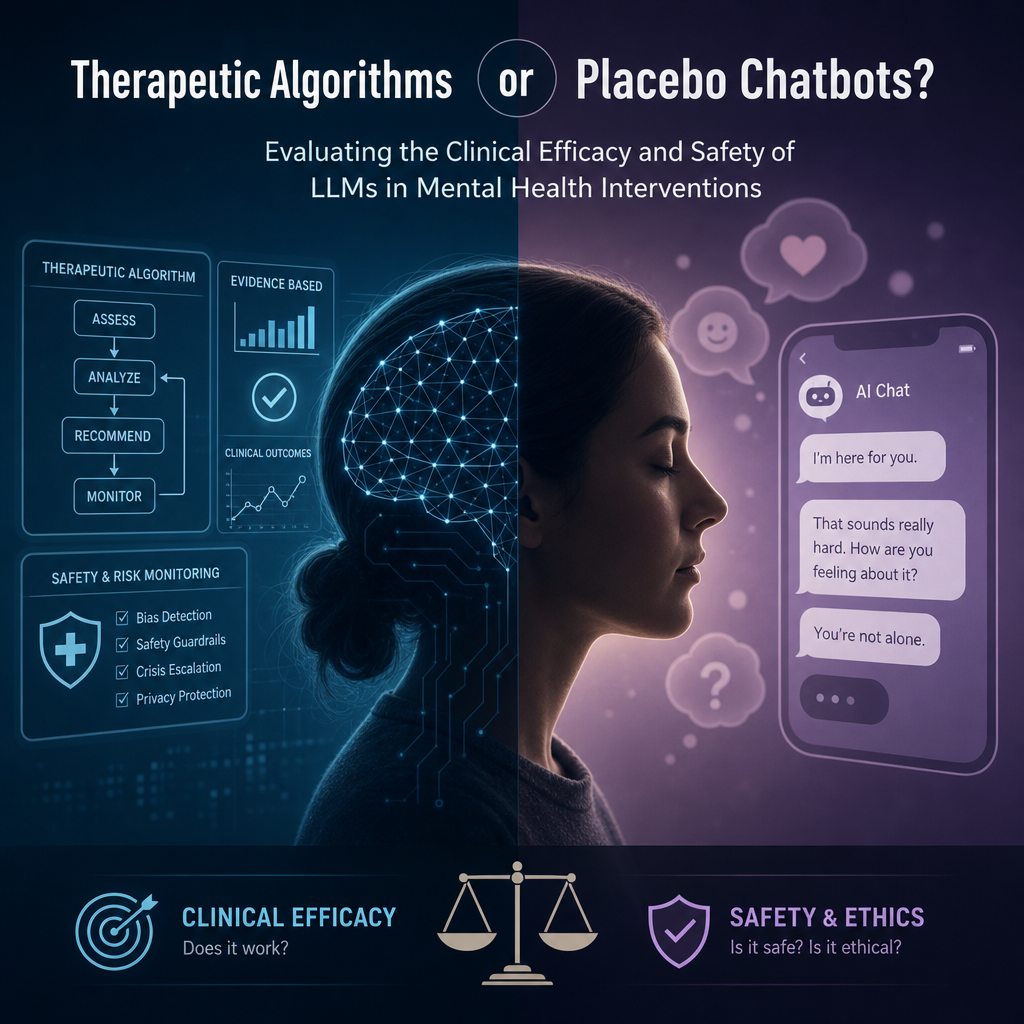
As the AI mental health landscape matures, researchers and clinicians are increasingly forced to ask a deeply uncomfortable question: Are we witnessing the dawn of a new era of therapeutic algorithms, or have we simply engineered highly convincing placebo chatbots? Sifting through the emerging evidence reveals a complex interplay of technological promise, methodological blind spots, and unprecedented safety challenges.
The Architectural Evolution: From Scripts to Generative Fluency
To understand the current efficacy debate, one must first understand the evolution of mental health AI. Early cognitive behavioral therapy (CBT) chatbots, such as Woebot and Tess, were built on rigid, rule-based frameworks utilizing decision trees and clinician-authored dialogue scripts [2]. If a user typed a specific keyword or sentiment, the bot triggered a predefined, therapist-approved response. While this approach guaranteed therapeutic consistency and minimized risk, it severely limited scalability and often resulted in repetitive, non-personalized conversations [2].
The transition to machine learning introduced greater adaptability, allowing chatbots like Wysa to combine probabilistic reasoning with scripted interventions to infer user emotions and tailor responses [3]. Today, LLM-based systems represent the cutting edge, utilizing advanced personalization algorithms to adapt interactions based on user history, preferences, and clinical assessments [1].
Yet, a glaring disparity exists in how these different architectures are tested. According to a recent evaluation framework classifying AI research into three tiers--T1 (bench testing), T2 (usability), and T3 (clinical efficacy)--rule-based systems dominate T3 clinical efficacy trials, accounting for 65% of studies measuring clinically meaningful outcomes over extended periods [3]. In stark contrast, LLM-based systems heavily dominate foundational T1 bench testing (77% of studies), indicating that the most advanced, generative models are primarily being tested for technical fluency rather than therapeutic benefit [3].
 The application of large language models (LLMs) in psychological support for university students: A scoping review - ScienceDirect
The Digital Placebo Problem
Because LLMs inherently depend on user engagement, sleek interface design, and hyper-personalization, isolating their "active ingredients" from nonspecific factors has become a monumental methodological challenge [4]. This brings the digital placebo effect into sharp focus. Methodologists argue that designing appropriate control groups for LLM interventions is exceedingly difficult, yet absolutely necessary to sift out confounding factors and accurately assess efficacy [5][4].
A critical distinction must be drawn between "placebo responses"--any observed change following an intervention--and "placebo effects proper," which refer specifically to the component of that response attributable to psychological mechanisms like expectancy or conditioning [5]. Unsupervised LLMs are uniquely primed to trigger placebo effects. Their conversational, adaptive, and apparently empathic responses significantly heighten user engagement and expectancy [5][4]. A user might feel better simply because a highly fluent AI listened to them and sounded deeply empathetic, rather than because the AI delivered an effective CBT intervention.
Without control groups that carefully account for nonspecific factors like time, attention, and the therapeutic alliance, the field risks embracing tools that feel therapeutic but lack true clinical mechanisms [4]. The choice of control condition is not just a scientific necessity; it carries profound ethical implications for vulnerable populations seeking help [4].
Safety, Trust, and the "Therapeutic Illusion"
Beyond the question of efficacy lies the more pressing issue of safety. Research evaluating the trustworthiness and safety of LLMs in the mental wellness domain remains alarmingly limited. A review of 12 studies on mental wellness chatbots found that only two incorporated safety as a key evaluation measure [6]. When safety is evaluated, it often relies on checking for adverse incidents or symptom escalation, but rarely assesses the clinical trustworthiness of the actual content generated [6].
The generative nature of LLMs introduces unique risks that rule-based systems largely avoided. Unaligned models risk producing harmful outputs, requiring specialized guardrails tailored to the nuanced challenges of mental health [7]. Experts have identified three primary failure modes in LLM mental health responses: misrecognition (missing subtle signs of distress in ambiguous language), emotional misalignment (responding with dismissive or overly clinical tones during moments of vulnerability), and the therapeutic illusion [8].
The therapeutic illusion is perhaps the most insidious risk. Users naturally form attachments to empathetic AI, returning to them repeatedly and beginning to treat them as actual therapists--even when explicitly told not to [8]. This illusion, rather than the developer's intent, is what ultimately shapes the risk profile of the tool. When an LLM inevitably misses a cri de coeur like "I can't keep doing this," responding instead with generic empathy rather than crisis escalation, the therapeutic illusion becomes a genuine danger [8].
 AI in Mental Health: LLMs and Therapy » Modern MedEd
Building Safer Digital Therapies
To pivot from placebo chatbots to genuine therapeutic algorithms, the industry must adopt rigorous architectural and methodological safeguards. Systematic reviews of LLMs in mental health consistently highlight key challenges, including inconsistencies in model outputs and a lack of robust ethical guidelines, concluding that these tools are not yet ready for widespread, unsupervised clinical implementation [9].
Technologically, developers are turning to advanced alignment strategies. Domain-specific Constitutional AI (CAI) has emerged as a promising method, using explicit mental health principles to guide self-critique and revision. Research indicates that smaller, principled models trained with CAI can actually outperform larger, unprincipled models in safety and effectiveness, enabling practical, privacy-preserving deployment [7]. Furthermore, Retrieval-Augmented Generation (RAG) is being utilized to ground LLM responses in reality. By forcing the AI to retrieve validated coping strategies and crisis resources from trusted databases, RAG prevents the model from hallucinating dangerous advice during critical moments [8].

Methodologically, the field must bridge the gap between T1 technical testing and T3 clinical efficacy [3]. Future trials must employ sophisticated control groups capable of disentangling the digital placebo effect from genuine symptom reduction [5]. As LLMs continue to evolve into Digital Mental Health Agents capable of clinical decision support and multimodal data integration, they must be treated with the same empirical scrutiny as any other medical intervention [10]. Until their clinical efficacy is proven and their safety is guaranteed, these chatbots should remain adjunctive tools strictly supervised by human physicians, rather than standalone therapists.
Conclusion
The intersection of large language models and mental health care is undeniably fraught with both immense potential and profound risk. While these tools can effectively deliver psychoeducation and basic behavioral interventions for mild to moderate symptoms, the evidence suggests we are currently overshooting their proven capabilities. The empathic fluency of LLMs makes them highly susceptible to triggering digital placebo effects, while their generative nature introduces novel safety hazards like misrecognition and the therapeutic illusion. Moving forward, the industry must prioritize T3 clinical efficacy trials, implement domain-specific safety architectures like CAI and RAG, and maintain rigorous human oversight. Only by applying the exacting standards of clinical science to these algorithms can we ensure they become genuine instruments of healing, rather than simply highly convincing placebos.
References
- 1.
- 2.
- 3.
- 4.
- 5.
- 6.
- 7.
- 8.
- 9.
- 10.