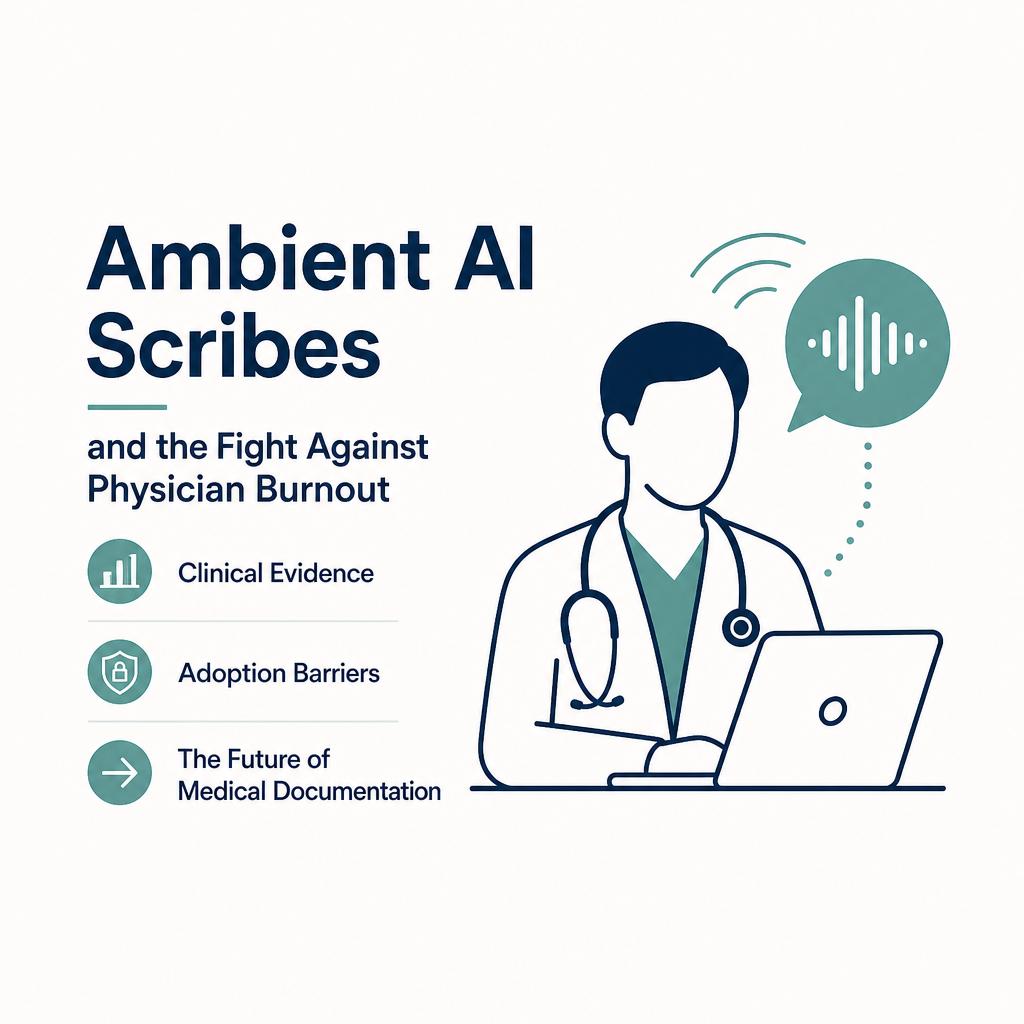
Introduction
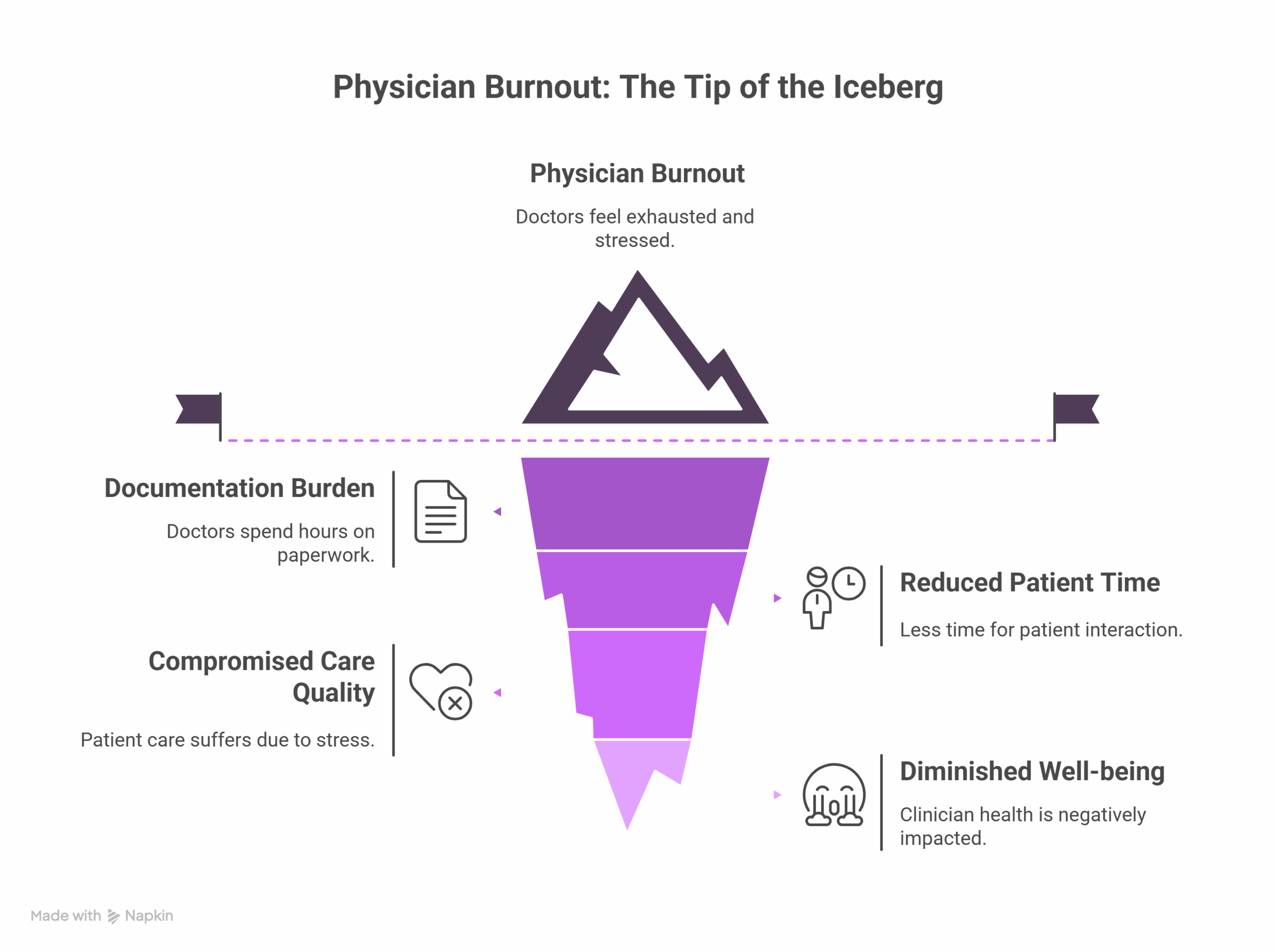
Physician burnout has reached crisis proportions in modern healthcare, and one culprit stands above the rest: documentation. Physicians now spend more than half of their workdays at their computers, recording patient histories, recommendations, and follow-up plans in electronic health records (EHRs) [1]. The hours spent documenting outside of normal working hours--famously dubbed "pajama time"--have steadily eroded physician satisfaction, intruded on personal lives, and interfered with the doctor-patient relationship itself [2]. The consequences are severe: increasing documentation burden is driving physicians out of practice, with the strain falling hardest on primary care [1].
Into this crisis has stepped a new class of technology: ambient AI scribes. Unlike traditional dictation tools, these systems work quietly in the background of clinical encounters, transcribing natural conversation between physicians and patients in real time and generating drafts of structured clinical notes that physicians review and edit [2][3]. Adoption has been remarkably rapid--by some accounts, one of the fastest technology rollouts in recent healthcare history [4]--with major systems like Kaiser Permanente's The Permanente Medical Group (TPMG) logging over 2.5 million uses in a single year [2][5].
But does the technology deliver on its promise? A growing body of clinical evidence suggests ambient AI scribes can meaningfully reduce burnout and documentation burden, while skeptics caution that reclaimed time may simply be refilled with new demands--and that the root causes of burnout run far deeper than the keyboard. This article examines the state of the evidence, the barriers to adoption, the governance challenges, and what the future may hold for medical documentation.
 Ambient AI Scribes: Redefining Clinical Documentation & Burnout - John Snow Labs
The Documentation Crisis: A Driver of Burnout
Clinical documentation in the EHR has become increasingly burdensome and is widely recognized as a major driver of clinician burnout and dissatisfaction [3]. What began as an effort to digitize and standardize medical records has, for many clinicians, become a cognitive and temporal straitjacket--pulling attention away from patients during visits and consuming evenings and weekends afterward [2].
The scale of the problem is difficult to overstate. "Physician burnout is a public health crisis," as the authors of a JAMA Network Open invited commentary put it, adding pointedly that "using new technology to fix burnout created by older technology will require a concerted effort" [6]. The administrative load extends well beyond note-writing to include in-basket messages, prior authorizations, and billing compliance--factors that have compounded over time as healthcare has become more corporatized and less autonomous [7].
Burnout is not merely a matter of professional dissatisfaction; it threatens workforce sustainability, pushing physicians--particularly in primary care--out of practice entirely [1]. Any intervention that meaningfully addresses documentation burden therefore carries implications not just for individual well-being, but for the resilience of the healthcare system as a whole.
Clinical Evidence: What the Studies Show
The Landmark Multicenter Study
The most significant evidence to date comes from a multicenter quality improvement study published in JAMA Network Open, "Use of Ambient AI Scribes to Reduce Administrative Burden and Professional Burnout." The study followed 263 physicians and non-physician providers across six health systems and, according to its authors, represents the first large, multicenter evaluation of AI scribes' effect on clinician experience [1][6].
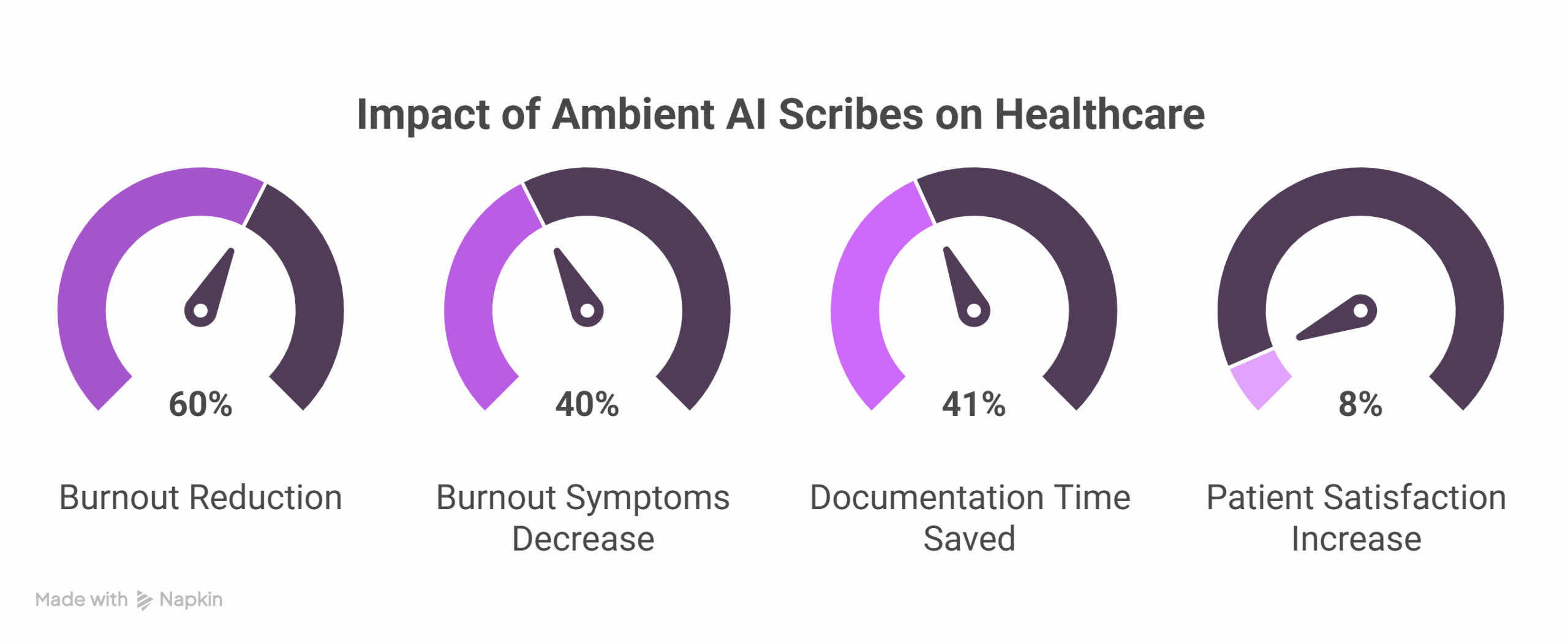
The results were striking. After just 30 days of using an ambient AI scribe, burnout among clinicians working in ambulatory clinics decreased significantly from 51.9% to 38.8%--representing 74% lower odds of experiencing burnout [1][6]. Severe burnout fell as well, with a net reduction of 6.2 percentage points across 186 clinicians; these results remained robust when controlling for demographic and site characteristics [6]. Improvements were also observed in cognitive task load, time spent documenting after hours, focused attention on patients, and urgent access to care [6].
Independent Validation from Mass General Brigham and Emory
A separate quality improvement study spanning Mass General Brigham (MGB) and Emory Healthcare, published in JAMA Network Open in August 2025, followed 1,430 clinicians and reinforced these findings. At MGB, the proportion of clinicians meeting burnout criteria dropped from approximately 51% to 29% at 42 days, and from roughly 53% to 31% at 84 days. At Emory, clinicians reporting a positive documentation-related impact on well-being rose dramatically from 1.6% to 32.3% at around 60 days. Clinicians described more eye contact with patients, better focus, and greater joy in practice [7].
Real-World Scale: The Permanente Medical Group Experience
Perhaps the most compelling real-world data comes from TPMG, whose deployment offers a proof of concept at enterprise scale. The organization launched a limited two-week pilot with 47 physician test users on August 14, 2023, and rapidly expanded from there [3]. Over one year and more than 2.5 million uses, AI scribes produced estimated documentation time savings of more than 15,700 hours for users--equivalent to 1,794 working days--compared with non-users [2][5].
Notably, a majority of physicians reported a highly positive experience, and all surveyed patients reported a positive-to-neutral impact on the quality of their visits. Standard physician characteristics such as age and years since graduation were not associated with likelihood of adoption. Even when TPMG transitioned between AI scribe vendors as part of an enterprise-wide implementation, usage patterns remained consistent, suggesting the value proposition was durable rather than vendor-specific [5].
As Dr. Allen Hsiao, professor of pediatrics and chief health information officer at Yale New Haven Health--where more than 1,000 physicians now regularly use the technology--observed: "Ambient AI is so exciting to me because it allows technology to fade into the background and allows care to come to the foreground. It takes a huge cognitive burden off of physicians so they no longer need to concentrate on computer screens and typing but instead can fully focus on the patient" [1].
 Ambient AI Scribes: Redefining Clinical Documentation & Burnout - John Snow Labs
How Ambient AI Scribes Work--and What They Don't Do
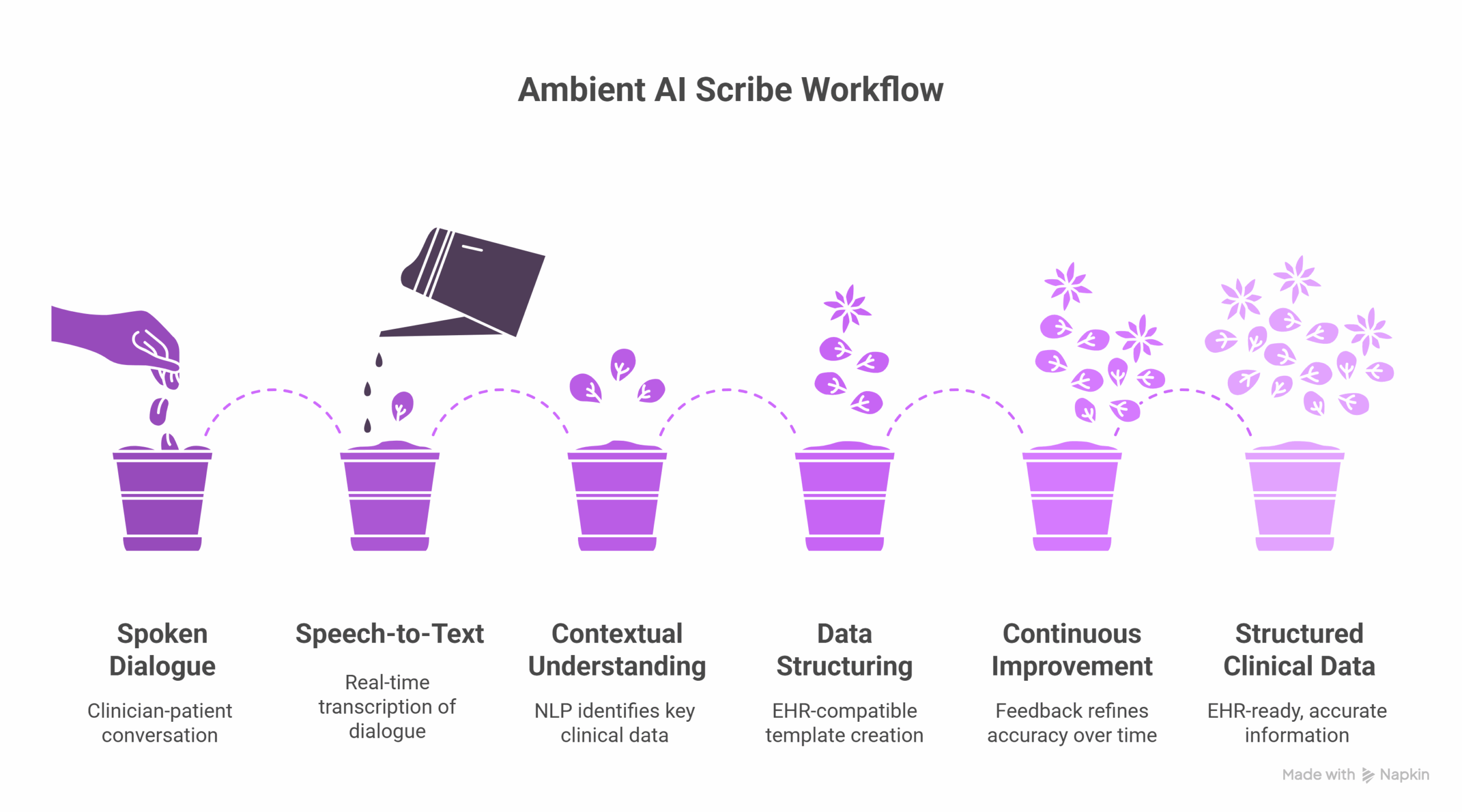
Understanding the technology's boundaries is essential to interpreting the evidence. Ambient AI medical scribes are documentation support tools, not diagnostic or decision-making systems. Unlike clinical decision support tools, they do not provide diagnoses or treatment suggestions. Instead, they passively capture visit conversations and produce drafts of clinical notes--typically in conventional narrative structures such as SOAP format--which physicians must then edit for accuracy [2][8].
Workflow implementation varies across vendors: some systems operate in real time during patient encounters, while others generate documentation after the visit concludes [8]. More sophisticated platforms can extract and populate structured EHR elements, including medications, problem lists, and diagnosis or billing codes. As these capabilities expand from narrative drafting toward structured EHR integration, the technology's role increasingly intersects with core clinical, administrative, and regulatory functions [8].
This framing matters: the clinician retains final responsibility for the note's content and accuracy. The scribe is best understood as a productivity tool that shifts the physician's role from transcriptionist to editor--trading typing time for review time.
Adoption Barriers and Implementation Challenges
Despite the enthusiasm, adoption is far from universal, and the barriers are instructive. Even at TPMG, where the technology was broadly embraced, a subset of physicians used it infrequently or not at all. Among these holdouts, the most commonly cited obstacles were lack of integration with existing note templates and the perception that editing AI-generated notes took more time than simply typing notes from scratch [2]. These findings suggest that adoption hinges not only on a tool's raw effectiveness, but on how seamlessly it fits into established workflows. In response, TPMG has considered strategies including deeper customization and targeted outreach to low-use specialties [2].
The challenge deepens outside the ambulatory settings where most evidence has been generated. High-acuity practice environments--emergency departments, intensive care units--differ significantly from structured, low-acuity ambulatory contexts and require bi-directional, real-time clinical data exchange among multiple simultaneous users. It remains unknown whether benefits observed in clinic settings translate to these environments, and future deployments may require careful evaluation of physician fit, workflow adaptation, and hardware needs. Current tools are also limited in their ability to integrate prior patient history into generated notes, a significant constraint for complex patients [9].
Implementation experience offers a roadmap for organizations considering deployment. The TPMG team emphasized the value of clinical champions to overcome adoption barriers, a phased approach beginning with a limited pilot followed by regional expansion, and continuous feedback loops with both clinicians and patients. Benchmarking and ongoing monitoring were identified as essential from the outset [3].
There are also methodological caveats worth noting. In the MGB/Emory study, response rates were relatively low--around 22% at MGB and just 11% at Emory--raising the potential for response and non-response bias, since enthusiastic users may be more likely to complete surveys [7]. And while standard demographics didn't predict adoption at TPMG, further analyses are needed to understand the impact of AI scribes across various clinical scenarios and physician and patient demographic groups [5].
Governance, Privacy, and the Financial Question
The deployment of AI that records and processes patient conversations raises unresolved issues involving accuracy, patient consent, data privacy, and regulatory compliance [8]. Experts emphasize that ambient AI technologies deliver on their potential only when implemented within appropriate governance and oversight frameworks, with particular attention to workflow optimization, organizational change management, regulatory compliance, patient privacy, and long-term strategic planning [10].
There is also an unresolved financial dimension. The Purchaser Business Group on Health Innovation (PHTI) has found that ambient scribes are potentially effective at reducing clinician documentation time and cognitive load, but health system leaders have identified gaps in evidence regarding impact on productivity and financial performance. PHTI's AI Taskforce suggests savings may materialize over time as the technology and implementation processes mature [4]. For now, the strongest business case rests on clinician retention and experience rather than clearly demonstrated revenue effects [10][4].
Dr. Adam Landman, chief information officer at Mass General Brigham, framed the cautious-but-committed posture many systems are taking: "Ambient documentation has proven to be one of the most effective and impactful methods for enhancing the provider experience. As these technologies continue to evolve and incorporate new features, we remain committed to rigorously evaluating their safety and effectiveness" [4].
The Skeptic's View: Why Scribes Aren't a Cure-All
For all the encouraging data, a compelling counterargument has emerged--articulated candidly even by supporters of the technology. Documentation, critics argue, is a symptom rather than the fundamental pathophysiology of burnout. The deeper drivers are systemic: lost professional autonomy, the corporatization of healthcare, reduced societal trust in physicians, overloaded schedules, surging in-basket message volumes, prior authorization demands, and a fraying sense of professional community [7].
On this view, whatever time ambient scribes save will likely be filled by other demands--more patients, more messages, more prior authorizations and denials. Efficiency gains without deliberate organizational safeguards risk being offset by workload expansion rather than producing lasting relief. If these interventions were followed over longer time horizons, skeptics suggest, we might well see diminishing returns [7][8].
The evidence itself supports a nuanced reading. Early studies consistently show documentation reductions in the range of 20% to 30%, suggesting meaningful relief from EHR burden--but time savings alone do not guarantee sustained reductions in burnout. Reclaimed time may be absorbed by additional clinical or administrative demands rather than translated into genuine cognitive relief. The long-term value of AI scribes will therefore depend less on efficiency gains than on whether implementation is paired with deliberate changes in workflow, governance, and organizational priorities [8]. The JAMA commentary authors echoed this: fixing technology-induced burnout with new technology "will require a concerted effort, including partnerships between health systems and industry" [6].
 Ambient AI Scribes: Redefining Clinical Documentation & Burnout - John Snow Labs
The Road Ahead
Ambient AI scribes have moved decisively beyond pilot programs into mainstream clinical deployment, and their trajectory suggests they will remain a fixture of medical practice. Several developments will shape their long-term impact:
Evidence maturation. Current evidence, while promising, remains concentrated in ambulatory settings with limited follow-up duration. Researchers have called for further analyses across clinical scenarios, demographic groups, and high-acuity environments, along with longer-term studies of sustained effects on burnout and retention [5][9].
Capability expansion. As tools evolve from narrative note drafting toward structured EHR integration--populating medications, problem lists, and billing codes--their footprint in clinical workflows will grow, along with the stakes for accuracy and oversight [8].
Workflow redesign. The central lesson from early deployments is that technology alone is insufficient. Success has hinged on clinical champions, phased pilots, template integration, customization for specialties, and protecting reclaimed time from automatic reassignment to new tasks [2][8][3].
Governance frameworks. Sustainable adoption will require robust frameworks addressing patient consent, data privacy, regulatory compliance, and ongoing quality monitoring--transforming AI scribes from a piecemeal procurement decision into a strategic institutional commitment [10][8].
TPMG's program has been described as a compelling model for other health systems, driven by careful analysis, user-centered implementation, and a commitment to improving both physician well-being and patient care. While more research is needed, the core lesson from that experience is unambiguous: ambient AI scribes are not a futuristic ideal--they are a present-day solution with measurable, human-centered benefits [2].
Conclusion
Ambient AI scribes represent one of the most consequential experiments in healthcare technology in a generation--an attempt to undo, with modern artificial intelligence, the documentation burden created by an earlier era of digitization. The clinical evidence to date is genuinely encouraging: multicenter studies have documented significant reductions in burnout, cognitive load, and after-hours documentation within weeks of deployment, and enterprise-scale implementations have saved tens of thousands of physician hours [1][7][6][5].
Yet the technology's limits are equally clear. Ambient scribes address the most visible symptom of clinician distress, not its systemic roots in autonomy, workload design, and the administrative machinery of modern medicine [7]. The most realistic assessment positions them as powerful productivity tools and a meaningful component of clinician well-being strategy--not a comprehensive burnout solution [8]. Where thoughtful implementation, strong governance, and deliberate protection of reclaimed time converge, ambient AI can help technology fade into the background and allow care to return to the foreground [10][1]. The fight against physician burnout will not be won by documentation tools alone--but it is increasingly difficult to imagine it being won without them.
References
- 1.
- 2.
- 3.
- 4.
- 5.
- 6.
- 7.
- 8.
- 9.
- 10.