Introduction
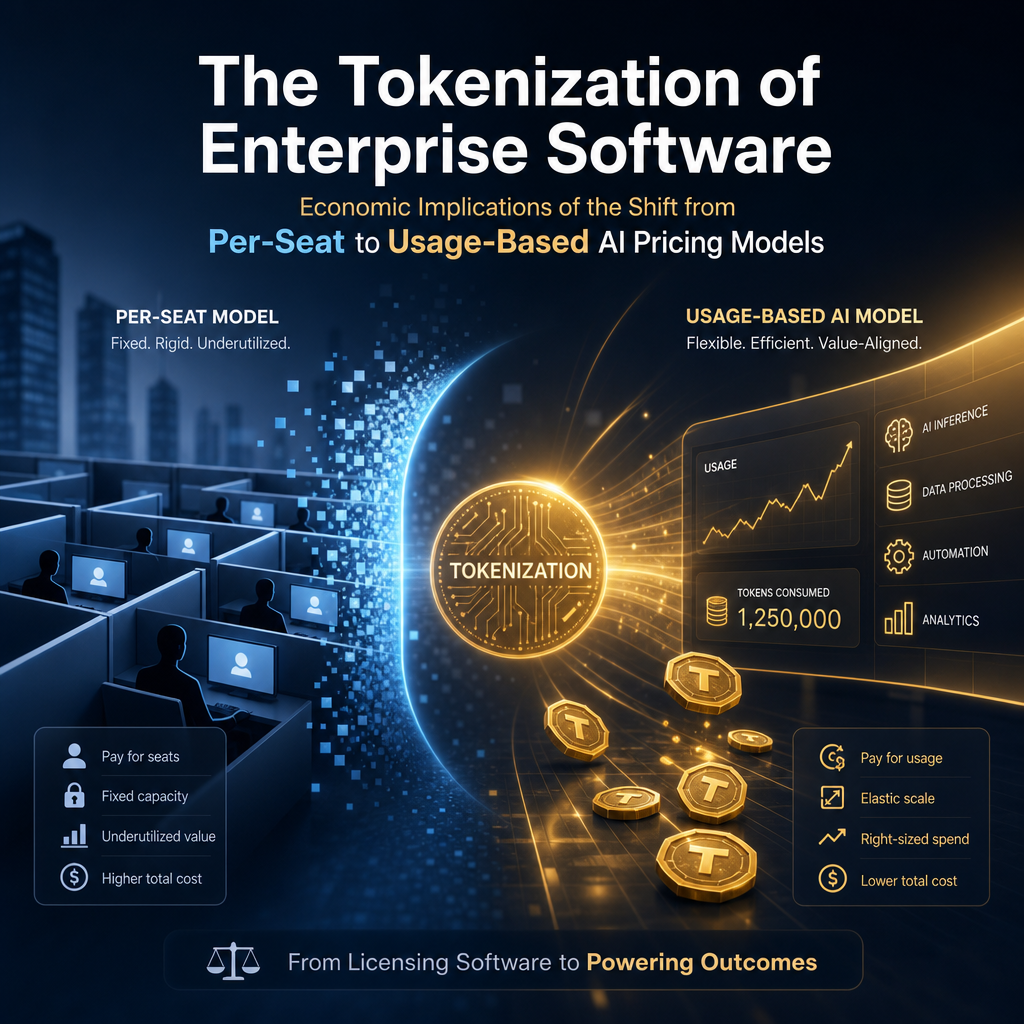
For two decades, the per-seat licensing model served as the bedrock of the Software-as-a-Service (SaaS) revolution. It was elegant in its simplicity: a fixed monthly fee per human user guaranteed predictable revenue for vendors and predictable costs for buyers. However, the rapid proliferation of AI agents is systematically dismantling this paradigm. As autonomous systems take on tasks once reserved for humans, the fundamental metric of software value is shifting from the number of people logged in to the volume of work being computed.
This is not a marginal evolution, but a structural rupture. A recent report from IDC predicts that by 2028, pure seat-based pricing will be obsolete, forcing 70% of vendors to completely reframe their value propositions [1]. Microsoft CEO Satya Nadella has succinctly captured this transition, declaring that "agents are the new seats"--signaling a future where companies pay for automated tasks and outcomes rather than software access for employees [2]. The shift from human-centric to compute-centric economics is rewriting the rules of enterprise software procurement, budgeting, and valuation.
At the heart of this transformation is the "tokenization" of enterprise software. Intelligence is becoming a metered service, much like cloud compute, bandwidth, or electricity [3]. Every prompt, tool call, and agentic reasoning step consumes tokens, turning AI into both an unprecedented driver of productivity and a highly complex cost problem that enterprises must urgently learn to solve.
The Structural Rupture of the Per-Seat Model
The collapse of per-seat pricing is driven by a fundamental mathematical mismatch: AI-enabled features have decoupled value from the number of human users [4]. In the past, a software seat represented a fixed capacity for human work. Today, a single seat armed with AI agents can process dozens of transactions, generate content, or resolve support tickets without additional human involvement. If one seat with an AI assistant handles three times the workload of a standard seat, a per-seat pricing model leaves 67% of the generated value on the table for the vendor [5].
This dynamic also exposes the historical flaws of the per-seat model. Enterprise software adoption typically runs at just 40-60%, resulting in expensive "shelfware" where companies pay for seats that never get used [6]. Conversely, the per-seat model created a "rationing problem," where IT departments could not afford to give everyone access to innovation, often leaving frontline workers who would benefit most from AI automation last in line [6].
As AI moves from simple assistants to autonomous actors, the concept of a seat becomes entirely abstracted. In categories like customer support, where AI can handle the vast majority of queries, charging per human agent no longer makes sense [2]. The business model is fundamentally breaking under the weight of its own assumptions, forcing a pivot to models that can capture the value of synthetic labor.
The Economics of Tokenization
The shift away from seats is not merely a philosophical change in how software is sold; it is a brutal economic necessity driven by the cost structure of artificial intelligence. Traditional SaaS products enjoyed gross margins of 80-90% because the cost of serving an additional user was negligible [7]. AI upends this completely. When a customer runs an AI model, the primary expense is the GPU and CPU cycles required for inference--a cost that scales directly with usage, not with the number of logged-in users [4].
According to recent analyses, enterprises that adopted AI saw a 30% reduction in active seats but a corresponding 45% increase in backend compute spend within the first year [4]. This compute-centric cost structure has compressed AI company gross margins down to 50-60%, leaving little room for the generous margins of the legacy SaaS era [7]. Vendors can no longer afford to offer flat-rate, unlimited AI access under a per-seat fee without watching their margins evaporate.
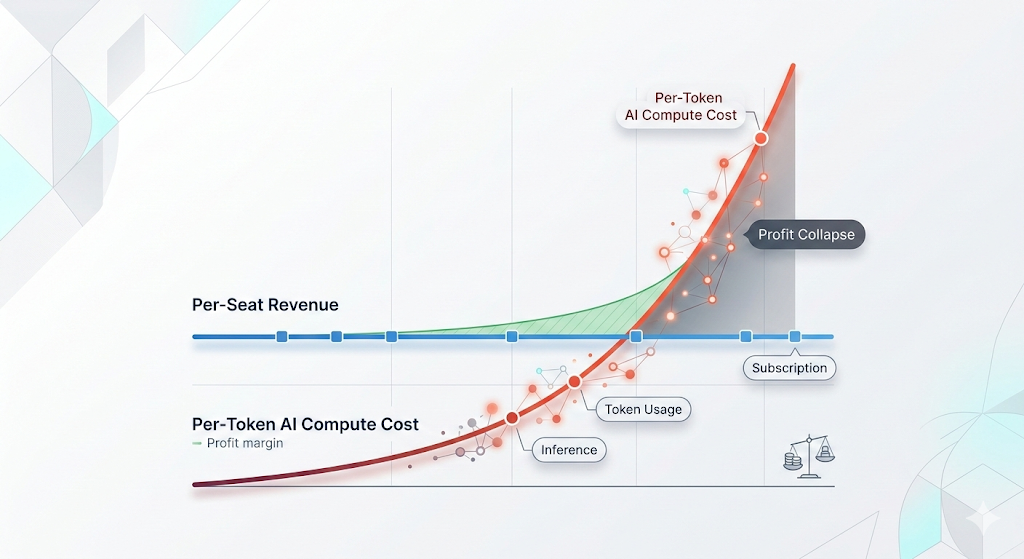 The Right Way To Price An AI Product In 2026 | by Tanmay Bansal | AI Advances
Consequently, the industry has embraced tokenization. Vendors are increasingly charging per API call (e.g., $0.001 per request), per compute minute (e.g., $0.03 per GPU minute), or per token (ranging from $0.0001 to $0.10 per 1,000 tokens) [4][5]. Intelligence has become a metered utility, and the token is its atomic unit. As usage scales, AI vendors are finding they must compete not just on model quality, but on cost-to-serve, latency, and orchestration [3].
The New Pricing Paradigm: From Seats to Outcomes
The transition in enterprise software pricing is following a clear, accelerating progression: Seats → Usage → Outcomes [8]. While pure usage-based pricing (like per-token billing) is currently the most common stepping stone, the ultimate destination is outcome-based pricing, where customers pay exclusively for measurable business results.
This shift is happening faster than most finance and operations teams are prepared for. Salesforce recently went "headless," making its Model Context Protocol (MCP) available without requiring a software seat [8]. ServiceNow announced that a striking 50% of its new business revenue now comes from non-seat fees, driven largely by consumption pricing [8]. Anthropic has lowered enterprise seat prices for Claude while simultaneously pushing aggressively into usage-based billing, offering cheaper access but capturing more upside on consumption [8].
Crucially, this pricing shift is a consequence of a change in the buyer, not an arbitrary vendor decision. Seat pricing worked when the buyer was an IT or operations manager providing access to users. Outcome and consumption pricing work when the buyer is a line-of-business owner paying for results within their own P&L [8]. HubSpot's outcome-based pricing works because the Chief Marketing Officer wants to buy leads, not software [8]. Zendesk defines success through "automated resolutions," tying pricing directly to performance and ROI rather than agent headcount [9].
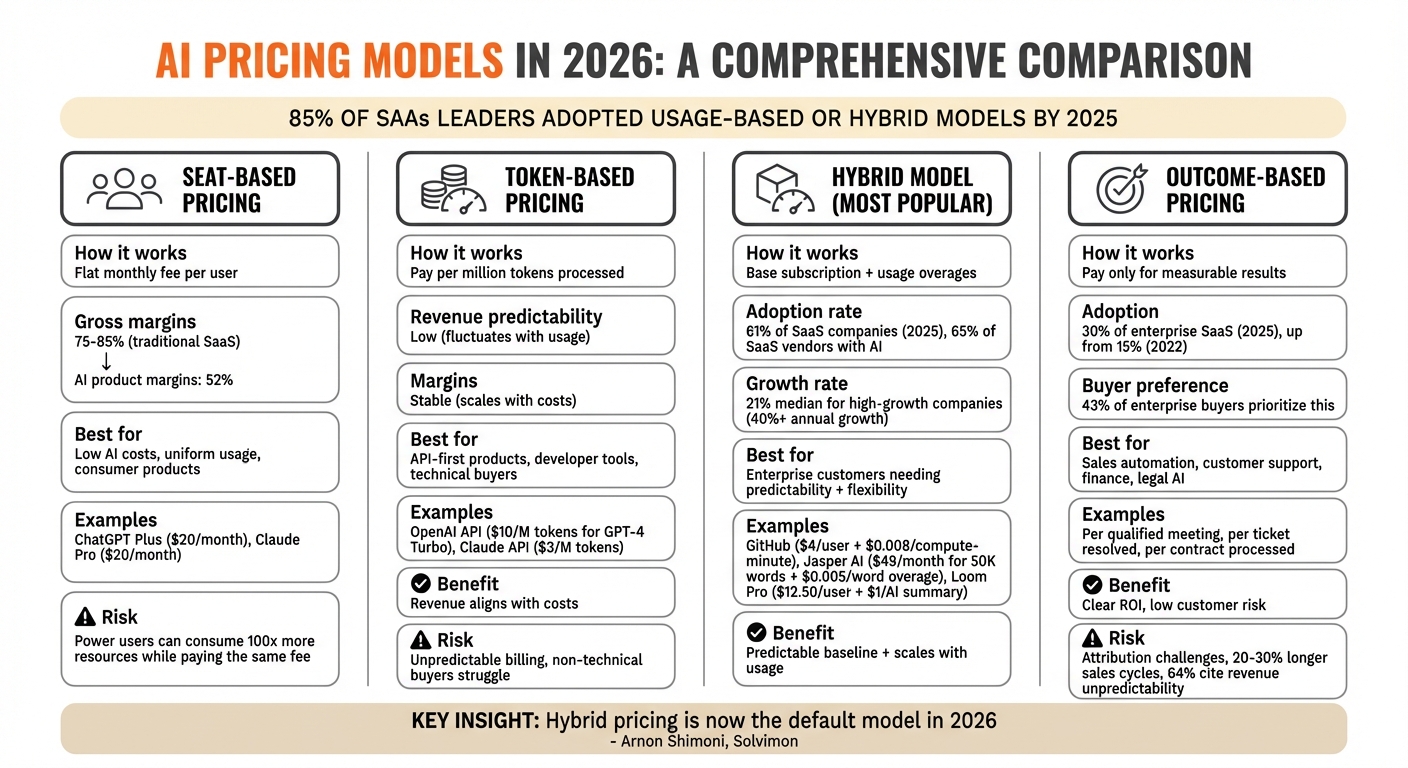 How AI Companies Are Monetizing in 2026: Seats, Tokens, and the Hybrid Models Winning Right Now | Data-Mania, LLC
Hybrid models have emerged as the dominant immediate solution for companies bridging this gap. Research indicates that hybrid pricing models have surged from 27% to 41% of AI companies, while pure per-seat models have fallen from 21% to just 15% [7][5]. These hybrids often feature a base platform fee combined with token consumption overages--balancing the predictability of subscriptions with the scalability of usage meters.
Navigating the Volatility: Risks for the Enterprise
While the new paradigm better aligns price with value, it introduces a dangerous era of financial volatility for enterprise buyers. The transition from predictable, recurring seat fees to usage-driven models creates a direct link between customer activity and revenue, which can swing dramatically based on adoption rates and AI interaction volumes [1].
The risk is shifting heavily to the customer. As some enterprises are discovering, they are consuming AI interactions far faster than anticipated, leading to unexpected in-term increases and significant, unplanned costs [1]. At high volumes, per-token costs can be punishing. For example, a customer support AI handling 100,000 conversations per month on a premium large language model can easily land in the five-figure range monthly without aggressive optimization [5]. As one observer noted, "Per-seat pricing capped the bill at headcount. Usage pricing scales with consumption, and as AI moves from assistants to autonomous coding, code volume outgrows what any architecture team can review. The code itself is a liability you keep paying for" [10].
To survive this "Great Enterprise Pricing Reset," IT leaders must rapidly embrace FinOps practices [10]. CIOs can no longer simply approve an annual software invoice; they must actively track token usage, API calls, and inference minutes to verify that AI features actually deliver more value than they cost [10][3]. Organizations must demand more transparency into AI pricing and build stronger internal governance to manage consumption, ensuring that the tokenization of software empowers the business rather than bankrupting it.
Conclusion
The tokenization of enterprise software marks a pivotal turning point in the technology sector's economic history. The per-seat model, which anchored the SaaS era, is collapsing under the weight of AI agents that decouple work from human headcount. In its place, a complex ecosystem of usage-based, hybrid, and outcome-driven models is emerging, forcing vendors to compete on compute efficiency and buyers to fundamentally rethink software procurement.
For enterprises, this shift offers the tantalizing promise of paying only for value received and eliminating the shelfware of the past. However, it also demands a new rigor. As AI transforms from a novel capability into a metered operating expense, the organizations that thrive will be those that master the economics of tokenization--treating AI not as a static software license, but as a dynamic, highly volatile utility that must be continuously measured, optimized, and managed.
References
- 1.
- 2.
- 3.
- 4.
- 5.
- 6.
- 7.
- 8.
- 9.
- 10.