Introduction
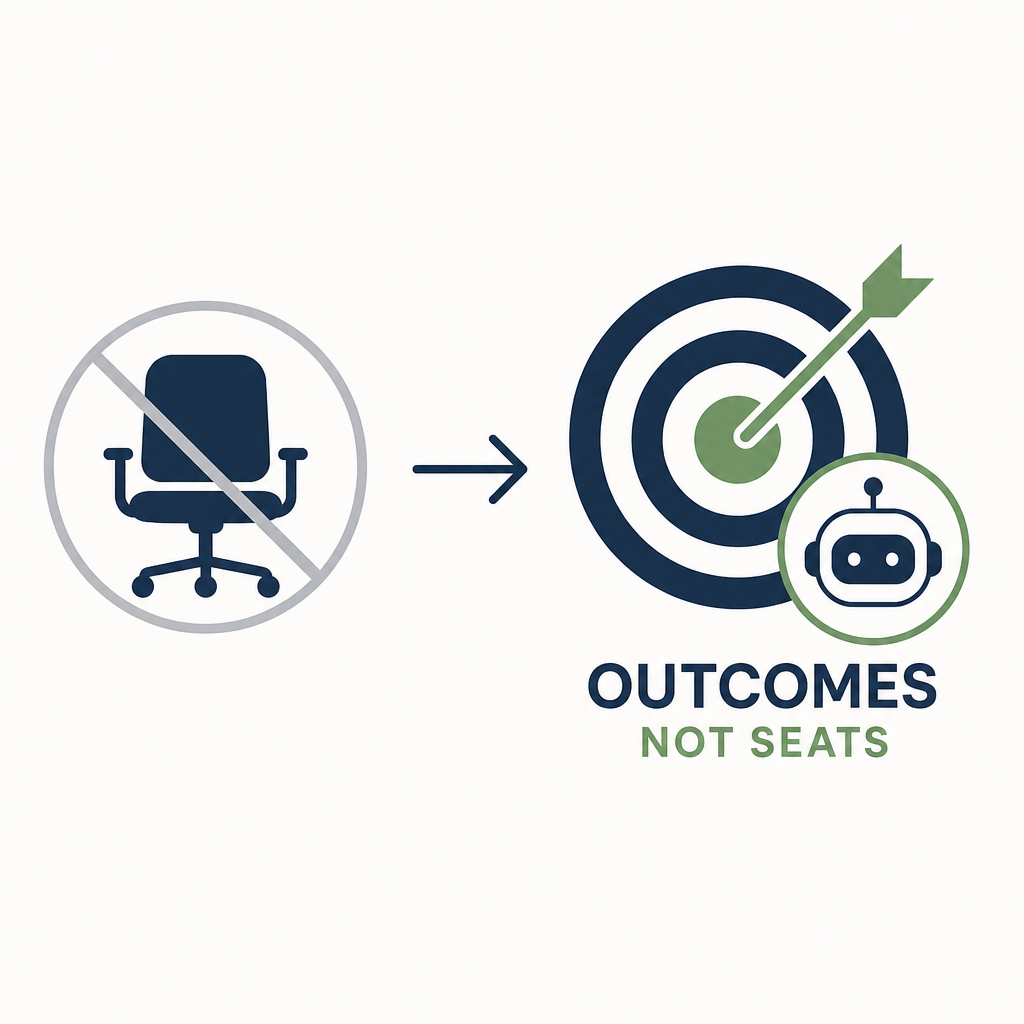
For two decades, the SaaS business model ran on a beautifully simple equation: more employees equals more licenses equals more revenue. Per-seat pricing was predictable for vendors, easy to budget for customers, and gave investors a reliable growth lever--every new hire was a prospective new subscription. That equation is now breaking, and the industry is scrambling to replace it.
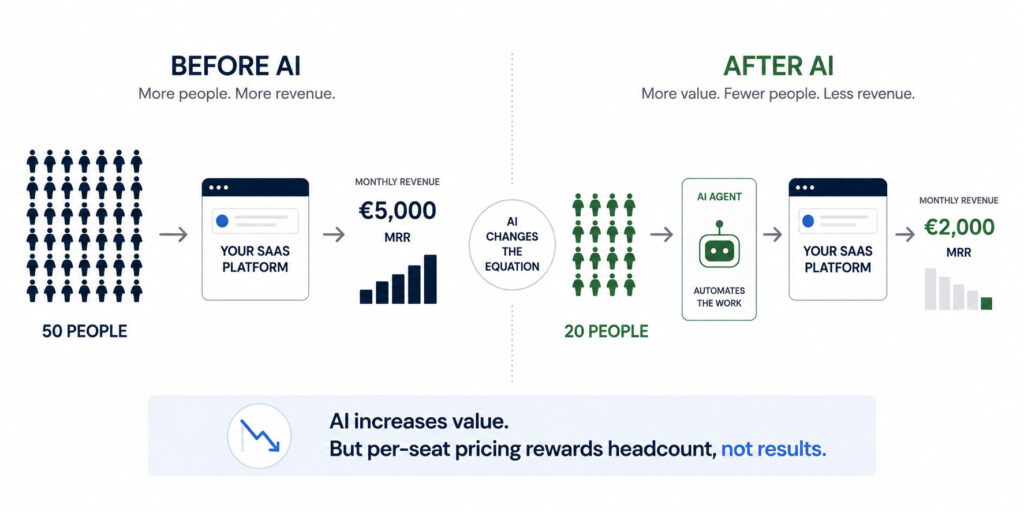
The disruptor is the AI agent. When software stops merely making employees more productive and starts doing the work itself, the number of human "seats" a company needs shrinks--but the value the software delivers does not. A customer support organization that once required 50 licensed agents may need only a handful of humans supervising AI that resolves tickets autonomously. Under per-seat pricing, the vendor's revenue collapses while the customer gets the same or better output. No business model survives that math indefinitely.
The result is a full-scale repricing of enterprise software, complete with a market panic some have dubbed the "SaaSpocalypse" of early 2026 [1]. This article examines the evidence that per-seat pricing is declining, the new models competing to replace it, the formidable practical obstacles to outcome-based billing, and what the transition means for vendors, buyers, and investors alike.
The Seat Compression Problem: Why the Old Math No Longer Works
The Efficiency Penalty
Per-seat pricing rested on a hidden assumption: that every marginal user inside an enterprise represented positive ROI, and that software consumption scaled with human headcount [2]. AI agents broke that assumption in two directions at once. First, existing teams became more productive--the department that needed forty licenses last year runs fine on far fewer because agents now handle a large share of the workload. Second, and more fundamentally, agents themselves became the "users," doing work that previously required a licensed human [2].
This creates what observers call the "efficiency penalty": if an AI agent successfully automates the workload of ten employees, a strictly per-seat vendor can watch revenue contract by roughly 90%--meaning the company is financially punished for making its product dramatically better [2].
The Evidence Is Already Here
This is not a theoretical risk; it is showing up in earnings reports and procurement negotiations:
- Companies that previously licensed 500 seats are renewing for 50 while maintaining the same output through AI agents [3].
- Atlassian reported its first-ever decline in enterprise seat counts in early 2026 [3].
- Salesforce stock fell nearly 40% from its 2025 highs, and even Salesforce's own sales engineers reported a 10% reduction in customer service seats across 90 enterprise accounts--its own AI products cannibalizing its per-seat revenue [3][1].
- Workday cut 8.5% of its workforce and introduced "Flex Credits" as it shifts toward consumption-based pricing [3].
- Klarna's high-profile move away from Salesforce became a cautionary tale for the entire category, demonstrating that large enterprises will replace incumbent SaaS with AI-driven alternatives when the economics demand it [3][4].
Vendor-agnostic case studies reinforce the pattern. A Fortune 500 financial services firm cut its Salesforce seat count by 40% after deploying AI agents for customer service, saving $12 million annually. A mid-market e-commerce company reduced Zendesk seats from 200 to 35 after AI began handling 80% of support tickets. A consulting firm trimmed per-seat software spend by 28% across all categories in 2025 while growing revenue 15% [5].
The Market Has Noticed
Public markets have priced in the risk. Wall Street wiped roughly $2 trillion from software stocks in early 2026 amid fears that agentic AI would structurally compress seat-based revenue, and vendors with heavy per-seat enterprise exposure are experiencing multiple compression and net revenue retention (NRR) pressure [3][6].
 The Death of Per-Seat Pricing --Why AI Agents Are Breaking the SaaS Revenue Model - The SaaS Library
The Data: A Pricing Landscape in Rapid Transition
The macro numbers confirm what the anecdotes suggest. The transition is not gradual--it is happening over quarters, not years.
Forrester Research found that purely per-seat pricing dropped from 21% to 15% of SaaS companies in just twelve months (through September 2025). In the same period, hybrid pricing models--combining a base subscription with usage or outcome components--surged from 27% to 41%. Among AI-native SaaS companies specifically, 83% already offer usage-based pricing [3][7].
Data on AI-first companies shows an even starker break. Among the "AI64" cohort, only 19% price primarily per seat, while 61% tie at least part of their pricing to usage, outcomes, or hybrid structures. Nearly half (47%) anchor pricing on some form of usage, with a platform fee plus usage being the most common configuration [8].
Perhaps most revealing is what SaaS executives themselves are saying. A Cruxy survey of 300 SaaS CEOs in April 2026 found that 97% plan to retire seat-based pricing within two years--yet 94% simultaneously said seat-based pricing currently aligns with their product's value [1]. That tension captures the industry's dilemma: vendors are abandoning a model they still believe in because they can see where the technology is heading.
The sheer velocity of change underscores the point. The PricingSaaS 500 Index tracked more than 1,800 pricing and packaging changes among the top 500 B2B and AI companies in 2025 alone--an average of 3.6 changes per company in a single year [1].
The Contenders: Outcome-Based, Usage-Based, and the Hybrid Reality
Three broad models are competing to replace per-seat pricing: consumption-based, outcome-based, and hybrids. None is perfect, but all are better aligned with agent-driven value than the status quo for companies with high AI exposure [6].
Outcome-Based Pricing: Paying for Results, Not Access
Outcome-based pricing charges for measurable business results rather than users or consumption. The most-cited example is Zendesk, which in August 2024 became the first major incumbent SaaS vendor to launch outcome-based pricing for AI agents, billing per "Automated Resolution"--a support ticket resolved by AI without human intervention, confirmed after 72 hours of inactivity. The pricing: $1.50 per committed resolution, or $2.00 pay-as-you-go [7]. The AI company Sierra has pushed this philosophy furthest, explicitly tying its pricing to customer outcomes [9].
The appeal is obvious: the customer pays only when value is delivered. The challenge is equally obvious--defining, measuring, and attributing those outcomes, which we will address below.
Consumption and Credit Models: Metering the Work
Consumption-based pricing charges for the work agents perform--actions, conversations, tokens, or credits. Salesforce's Agentforce illustrates the direction: it layers Flex Credits, per-conversation pricing, and traditional per-user options into a single portfolio [9]. Workday's Flex Credits follow the same logic [3]. Credits in particular became the defining pricing innovation of 2025, with the number of companies using them growing 126% year-on-year (from 35 to 79). HubSpot, Figma, Adobe, Cursor, and Lovable all added credit models without eliminating seats, with Notion, ClickUp, and Dialpad following in the next quarter [1].
The Hybrid Era: Where Pricing Is Actually Landing
Here is the surprise: despite the headlines, the market is not converging on pure outcome-based pricing. Kyle Poyar's 2026 State of B2B Monetization survey of more than 230 software companies found that 37% use hybrid pricing--a predictable base subscription with variable consumption on top--as their primary structure, the most common option by far [1]. Bain's analysis reaches the same conclusion, calling hybrid models the dominant interim strategy [10].
Credits sit at the center of this hybrid era because they occupy the pragmatic middle ground: more transparent than legacy licenses, more feasible than charging purely for results, and comprehensible to CFOs accustomed to committed spend [1]. Salesforce's Agentic Enterprise License Agreement (AELA)--unlimited use of Agentforce, Data 360, and MuleSoft for a fixed fee on two- to three-year terms--represents the incumbent's version of the same compromise [7].
 The Death of Per-Seat Pricing: What It Means for Your SaaS P&L - The SaaS CFO
The Implementation Gap: Why Outcome-Based Pricing Is Hard
If outcome-based pricing is the ideological endgame, why aren't more companies adopting it? Because, as one industry observer put it, "the real challenge isn't pricing--it's instrumentation. Most SaaS companies don't even measure outcome quality today; they measure login frequency" [2].
The Measurement Problem
Billing on outcomes requires infrastructure most vendors simply do not have. You cannot bill on metrics you cannot track accurately, and customers need dashboards showing exactly what they are consuming and paying for [8]. Billing based on compute, API calls, or tokens creates its own distortion: customers pay more as AI performs more work, regardless of whether that work produces meaningful business value [9]. Programmatically verifying outcomes demands a fundamental rebuild of billing infrastructure [2].
The Definition Problem
Outcome-based models also force uncomfortable contractual conversations. Zendesk's definition of "resolved"--AI confirmed the response was relevant--is Zendesk's definition until the customer negotiates otherwise. Buyers increasingly need a formal "Outcome Measurement Agreement" specifying what counts as a resolved ticket or completed task before signing [7]. Resolution-based pricing carries further trade-offs around cost predictability and attribution: when an AI agent and a human collaborate on a ticket, who gets credit--and who gets billed [9]?
The Predictability Problem
Finally, Wall Street and corporate CFOs both love what per-seat pricing delivered: forecastable revenue. Moving to variable models makes revenue harder to value and exits less predictable, which is precisely why analysts argue that no single pricing model has yet emerged as the clear path forward [4]. As one commentary noted, until vendors can prove an agent's output was actually valuable--not just generated--CFOs will keep anchoring to per-seat because it is the only number they trust [2].
What It Means for Vendors, Buyers, and Investors
For Vendors: Move Early or Be Repriced
Bain's assessment is blunt: while "seats are dead" is an overstatement, the sentiment is not entirely off base--and the transition away from seats is a minefield for the unprepared, requiring new telemetry, internal capabilities, and sales enablement [10]. Vendors that started transitioning early, such as Salesforce and ServiceNow, are better positioned than those still defending per-seat contracts [6]. The strategic insight gaining traction: future revenue comes from agent execution volume, not human headcount. Platforms that become the substrate through which agents operate--and the billing layer that measures their outputs--capture revenue as agent volume grows, even as human seat counts shrink [6]. The deeper reframing is that the unit of value has shifted from "a human with a login" to "a completed workflow" [2], and the future lies in matching the economic unit of pricing to the unit of value, whether that is a user, a conversation, an action, or a successful resolution [9].
For Buyers: A Rare Window of Leverage
Procurement teams hold unusual power right now. Every per-seat contract in the stack suddenly looks bloated, giving buyers leverage at renewal that they have not had in a decade [2]. Maxio's data confirms the supply side is ready--83% of AI-native SaaS companies already offer usage-based pricing--meaning the lag is on the buyer side [7]. Analysts identify 2025-2026 as the negotiating window before pricing models standardize [7]. The tactical advice: demand contractual transition terms reflecting the seat-decline trajectory, negotiate explicit outcome definitions up front [7], and position as a "design partner" for vendors experimenting with new models--a framing that unlocks favorable terms in exchange for early access [7].
For Investors: The End of Easy SaaS Math
The disruption extends well beyond pricing pages. The predictability of SaaS revenue made it a favorite of private equity and venture investors; shifting models and rising customization make revenue harder to value and exits less predictable. Venture funding for new SaaS startups is cooling, fewer SaaS companies are expected to go public, and firms like Stripe are exploring long-term private operation with liquidity through secondary markets [4]. The SaaS playbook that produced a generation of iconic IPOs is being rewritten in real time.
 Per-Seat Pricing Broken. But Did Your AI Feature Break It?
Conclusion
The per-seat model is not dying because it was broken; it is dying because AI agents removed the human headcount that anchored it. The evidence--collapsing seat counts, a $2 trillion market repricing, and 97% of SaaS CEOs planning to retire seat-based pricing--leaves little doubt about the direction of travel [3][1].
But the destination is not what the early headlines promised. Pure outcome-based pricing, for all its conceptual elegance, remains gated by measurement infrastructure, contractual complexity, and revenue unpredictability [4][2]. Instead, the industry is landing on a pragmatic hybrid era: base subscriptions for predictability, credits and consumption meters for agent-driven work, and outcome components where value can be cleanly measured [1][10]. Gartner's projection that at least 40% of enterprise SaaS spend will shift to usage-, agent-, or outcome-based models by 2030 now looks conservative rather than aggressive [7].
The companies that thrive in this transition will be those that internalize the core insight early: in an agentic world, software revenue must track the work software performs and the value that work creates--not the number of humans logged in [9]. The seat is not dead yet. But it is no longer the future of how software gets bought.
References
- 1.
- 2.
- 3.
- 4.
- 5.
- 6.
- 7.
- 8.
- 9.
- 10.