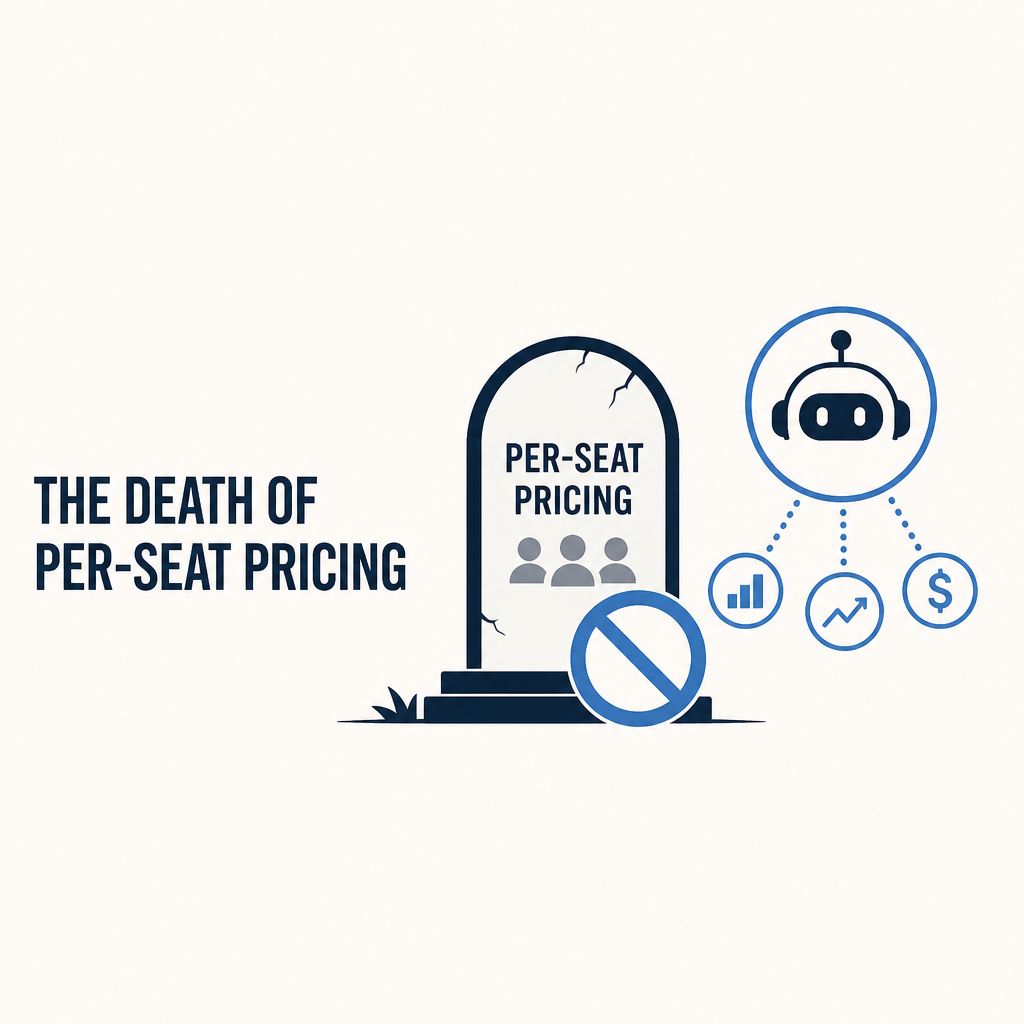
Introduction
For two decades, the per-seat license has been the economic engine of the software industry. From Salesforce's early days charging per user per month to the modern "land and expand" playbook, SaaS companies have operated on a simple assumption: as customers hire more people, they buy more software. Revenue scales with headcount, Wall Street rewards predictable recurring revenue, and everything from valuation multiples to go-to-market strategies has been built on that foundation [1].
In 2026, that assumption is breaking. AI agents -- autonomous software that performs work previously done by human employees -- are decoupling software consumption from headcount entirely [2][3]. When an agent can handle the workload of dozens of support representatives or generate hundreds of qualified leads without ever logging into a CRM, the number of seats a customer needs collapses even as the value delivered grows. The result is not a cyclical downturn but a structural crisis for the SaaS business model, and markets, vendors, and buyers are already reacting.
This article examines why per-seat pricing is failing, how investors have repriced seat-heavy software businesses, which alternative models are emerging to replace it, and what the transition means for both vendors and the enterprises that buy from them.
The Math That Ran SaaS for 30 Years -- and Why It Stopped Working
Per-seat pricing worked because of a deceptively simple equation: more employees meant more software licenses. Hire 50 salespeople, buy 50 CRM seats. Grow headcount, grow software spend. SaaS vendors built their entire revenue models, valuation multiples, and go-to-market motions around this relationship between human workers and software consumption [3].
Consider the arithmetic now terrifying SaaS executives. A sales team of 100 representatives, each with a Salesforce licence at roughly $300 per month, generates $360,000 in annual recurring revenue for a single customer. Now imagine that customer deploys AI agents to handle lead qualification, data entry, follow-up scheduling, and CRM updates, allowing the same pipeline to be managed by 20 AI-augmented human sellers. Seat count drops from 100 to 20. Revenue drops from $360,000 to $72,000 -- an 80% reduction for the same business outcome [1]. Multiply that across thousands of enterprise customers and the scale of the problem becomes clear. The same dynamic applies in customer support: a company using an AI agent to handle tickets that previously required 50 human agents no longer needs 50 seats, leaving the vendor's revenue down 90% while the customer receives the same or better output [4].
The root cause is mechanical: AI agents don't occupy seats. They don't log in with credentials, don't accumulate usage history in a user profile, and don't show up in an admin's license dashboard. They execute work -- sometimes thousands of tasks -- without occupying a single license in the systems they operate through [3]. As Deloitte's 2026 TMT Predictions explicitly flagged, the work performed by agents simply does not map to the pricing unit at all [5]. Microsoft CEO Satya Nadella captured the shift bluntly: seats are becoming "just entitlement to some consumption" [5].
The Seat Paradox: When Success Punishes the Vendor
The most damaging feature of the legacy model is a perverse incentive inversion that analysts have dubbed the Seat Paradox: the better an AI deployment performs, the steeper the seat reduction -- and the steeper the drop in the vendor's annual recurring revenue [6]. Under per-seat pricing, the vendor is financially penalized for enabling customer success, the exact opposite of healthy incentive alignment [4].
This creates an impossible tension for vendors in AI-exposed categories. No business model survives rewarding its customers' efficiency gains with its own revenue collapse. As one analysis put it, every SaaS founder in a "human-replacement category" must redesign their pricing before the paradox reaches their net revenue retention [6]. The model also distorts product strategy: vendors have a rational incentive to make their AI features just good enough to market, but not so good that customers cancel seats en masse -- a conflict that competitors willing to price on outcomes will inevitably exploit.
A Market Already Repricing
Investors have not waited for the arithmetic to play out in earnings reports. The repricing of seat-heavy software has arrived in force, and remarkably quickly.
The panic began after mixed late-January 2026 earnings reports from SAP and ServiceNow, which triggered a "brief but sharp" market reaction: U.S. software companies lost over $70 billion in market capitalization [7][5]. Matters escalated in February with OpenAI's launch of Frontier, a platform enabling autonomous agents to function as "digital coworkers" across enterprise systems like CRM and ERP without requiring individual user licenses -- a model Fortune described as a potential "semantic layer" that could circumvent traditional vendors altogether [7]. Then came the event analysts dubbed the "SaaSpocalypse": a 48-hour window in which $285 billion was wiped from SaaS valuations, widely characterized not as a panic but as a reclassification event -- the market repricing per-seat software as structurally overvalued in categories where AI agents replace human workers [6].
Beneath the headlines, the structural data confirms the transition is underway rather than hypothetical:
- Pure per-seat pricing has fallen from 21% to 15% of SaaS companies in just twelve months [6][8].
- Hybrid models (seats plus usage/credits) have surged from 27% to 41% over the same period [6][8], with a median growth rate of 21% [8].
- Churn rates are 2.3x higher for companies sticking with seat-only models [8].
- Industry analysts estimate AI agent deployments will eliminate the need for 20-35% of enterprise SaaS seats by the end of 2027 -- meaning a company spending $50 million annually faces $10-17.5 million in potential savings, or the same amount in revenue loss for vendors who fail to adapt [4].
- By 2030, 40% of enterprise SaaS spending is projected to shift to usage-, agent-, or outcome-based pricing [8].
Perhaps the most revealing data point comes from a Cruxy survey of 300 SaaS CEOs conducted in April 2026: 97% plan to retire seat-based pricing within two years -- yet 94% said seat-based pricing currently aligns with their product's value [5]. That gap between conviction and action captures the industry's core dilemma: nearly everyone agrees the model is structurally broken, but few have figured out what replaces it profitably.
 The Death of Per-Seat Pricing: What It Means for Your SaaS P&L - The SaaS CFO
The Successors: Consumption, Outcomes, and Hybrids
Three pricing models are competing to replace the seat, and none is perfect -- but all are better than the status quo for companies with high agent exposure [3].
Consumption-based pricing charges for what is actually used -- tokens, tasks, API calls, compute. This is the model most consistent with Nadella's "seats as entitlements to consumption" framing, and it allows vendors to capture a margin on the compute agents consume rather than a fixed seat fee [3][5]. Its weakness is predictability: revenue becomes variable, and buyers lose budgeting certainty [9].
Outcome-based pricing charges for tangible business results: qualified leads generated, tickets resolved, tasks completed, time saved, or revenue growth delivered [10]. The logic is compelling. If an AI agent generates 500 qualified leads per month, the vendor charges for those leads -- not for the "seats" once occupied by the SDRs who did that work [2]. Some analysts frame this as software transitioning from a fixed-cost capital expenditure into a dynamic "Agentic Wage," where companies pay for the specific computational tasks and outcomes delivered by their digital workforce [2]. Andreessen Horowitz has noted the same movement toward value-based structures that reflect real business impact [10]. The practical challenge is attribution: defining, measuring, and reliably billing for "outcomes" is far harder than counting logins, which is why one analysis argues outcome-based pricing is not the endgame for most vendors [5].
Hybrid models -- seat-based pricing complemented by usage-based or credit-based billing for AI features -- are currently the fastest-growing compromise [5]. This structure lets customers use AI to optimize seat counts without gutting vendor revenue, since AI consumption becomes a new monetization surface [8][5]. It is also the model that most naturally treats AI agents as what some analysts call "Digital Colleagues" -- entities with their own capacity requirements and performance metrics, entirely distinct from the human workforce [2].
The New Unit Economics Problem
The successor models solve the incentive alignment problem but create a fresh set of unit-economics challenges that vendors are only beginning to grapple with.
The first is the token pricing paradox. BetterCloud's 2026 SaaS Industry Report documents a counterintuitive dynamic: even as token prices fell 80% year over year, total AI-driven spending grew 320%. Consumption volume is dramatically outpacing unit price declines [6]. This is treacherous for vendors who bundle unlimited AI into flat per-seat fees -- they end up subsidizing their heaviest users. Simon-Kucher has documented cases where heavy AI users generated compute costs several multiples above their subscription price, making specific products outright loss-making under flat-fee models [6].
The second is cost volatility cascading down the stack. Model providers are themselves experimenting with pricing innovations that flow into SaaS economics -- flat-rate long-context pricing from providers like Anthropic, for example, changes the cost structure for applications doing heavy document processing. As inference costs drop and capabilities improve, the economics of running agents increasingly favor consumption-based models where the vendor captures margin on compute rather than a fixed seat fee [3]. But for buyers, this means software costs become variable and harder to budget, which is driving the rise of "FinOps for SaaS" -- the discipline of tracking usage and tokens to ensure AI features deliver more value than they cost [9].
The third is the revenue-predictability trade-off. For years, SaaS companies promised Wall Street "predictable, recurring, per-seat revenue." They must now shift toward "variable, outcome-based revenue" -- harder to model and value, but far more sustainable in an agentic world [2]. How quickly investors learn to underwrite variable software revenue may determine how brutal this transition becomes for public vendors.
 The Death of Per-Seat Pricing --Why AI Agents Are Breaking the SaaS Revenue Model - The SaaS Library
Strategic Implications for Vendors and Buyers
For vendors, the message from the market is unambiguous: multiple compression and net revenue retention pressure are already concentrated in companies with heavy per-seat enterprise exposure [3]. The winners so far are early movers -- Salesforce and ServiceNow among them -- that began transitioning pricing before the crisis hit, and are therefore better positioned than incumbents still defending the seat [3]. The go-to-market motion must change in parallel: sales teams that once sold "seats per department" now need to sell "outcomes per dollar spent," and marketing must shift from emphasizing user productivity to showcasing the tangible results agents deliver [8]. Vendors in defensible positions -- where human users remain the primary value creators -- have more time, but should not mistake a reprieve for safety.
For buyers, the transition cuts both ways. The risk is overpaying under legacy per-seat contracts while AI steadily reduces the value of each seat [4]. The opportunity is leverage: enterprise customers negotiating renewals in seat-heavy categories where agents are already competent hold unusual power right now and should use it [3]. That means pushing for consumption- or outcome-aligned structures, scrutinizing bundled "unlimited AI" offers that vendors may be subsidizing at a loss (and likely to reprice later) [6], and evaluating vendors on the depth of AI integration and real business impact rather than the mere presence of AI features -- which, by 2026, are table stakes across the industry [9]. Careful usage governance and token tracking should accompany any consumption-based contract to keep the new cost variability under control [9].
Conclusion
Per-seat SaaS pricing is not going to disappear overnight. It will persist in software categories where human users are the primary value creators and AI agents play a supporting role. But for any category where agents can work autonomously -- customer service, data processing, sales development, IT operations, content creation -- per-seat pricing is economically indefensible [4]. The shift from 21% to 15% pure-seat adoption in a single year, and from 27% to 41% hybrid adoption, signals a structural displacement rather than a passing correction [6].
The transition creates both risk and opportunity on every side of the market. Vendors face the Seat Paradox -- punished financially for their customers' success -- and must redesign pricing before the math reaches their retention metrics. Investors are learning to price variable, outcome-based revenue in place of the predictable seat ARR they long favored. And enterprise buyers sit at a rare moment of leverage: the chance to renegotiate structures that align cost with outcomes and unlock the full financial benefit of AI agent deployments [4]. The seat defined software economics for two decades. The agent will define the next era -- and the companies that reprice first, rather than last, will decide who survives the transition.
References
- 1.
- 2.
- 3.
- 4.
- 5.
- 6.
- 7.
- 8.
- 9.
- 10.