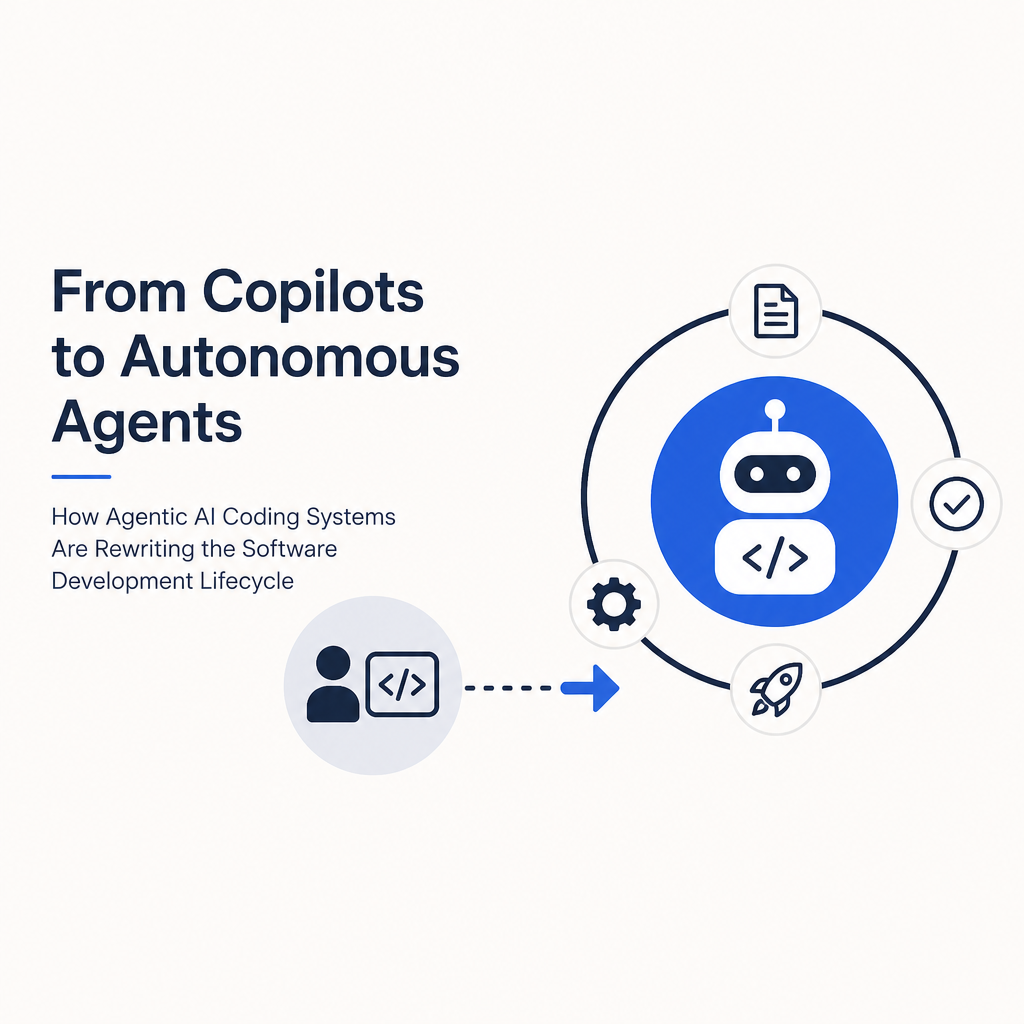
Introduction
For nearly a decade, the story of AI in software engineering was one of assistance: tools that autocompleted a line of code, suggested a function name, or answered a question in a chat window. That story is over. Over the past 24 months, the industry has undergone what analysts describe as a tectonic shift--from simple code completion to full-scale autonomous engineering, in which AI agents navigate complex codebases, manage terminal environments, and resolve high-level tickets with minimal human intervention [1]. Tools like Anysphere's Cursor have achieved record-breaking adoption, while systems such as Cognition's Devin 2.0 now operate as "virtual teammates" rather than typists' assistants [1].
This shift is more than a tooling upgrade; it is a fundamental reimagining of digital engineering itself. Agentic AI systems are moving from assisting individual tasks to independently executing complex, multi-step workflows, reshaping how teams plan, build, test, and ship software [2]. EPAM's Agentic Development Lifecycle framework captures the paradigm succinctly: the move from "humans code everything" to "humans express intent and agents execute" [3]. Meanwhile, PwC predicts that more than half of engineering teams will run a fully agentic SDLC by 2027 [3].
This article examines the technical foundations of this transformation, traces how each phase of the software development lifecycle is being rebuilt around autonomous collaborators, explores the changing role of the engineer, and assesses the very real challenges--trust, verification, and the stubborn complexity of legacy systems--that will determine how quickly the agentic era arrives.
From Autocomplete to Autonomy: The Evolution of AI Coding Assistants
The copilot era was defined by a reactive loop: the developer writes code, and the AI suggests the next few tokens. The new agentic model inverts this relationship. Modern AI agents can take a high-level task--"implement user authentication with OAuth2 and refresh tokens"--break it into a plan, read the relevant files, write the code, run the tests, observe the failures, and iterate until the task is complete, all autonomously [4]. Where copilots responded to prompts, agents take initiative: they perceive their environment, act on goals, maintain memory and context between interactions, learn from previous outcomes, and self-correct based on feedback [5].
The technical advancements powering today's AI engineers rest on three major breakthroughs: agentic planning, dynamic context discovery, and tool-use mastery [1]. Together, these capabilities allow an agent to decompose an ambiguous ticket into concrete steps, locate the relevant parts of a sprawling repository without being told where to look, and orchestrate external tools--compilers, test runners, terminals, APIs--to complete its work. This has given rise to a new class of CLI-native coding agents that operate directly inside the developer's terminal, a departure from the IDE-bound assistants of the copilot era [4].
This evolution has also produced a cultural phenomenon: "vibe coding," a paradigm in which developers focus on high-level architectural intent and system "vibes" while AI agents handle the grueling minutiae of implementation and debugging [1]. The industry's maturity is often framed in three phases: Phase 1, manual engineering, where people wrote every line and tools merely formatted and linted; Phase 2, AI-assisted engineering, where copilots suggest while humans still drive; and Phase 3, AI-led engineering, where agents do the work across the lifecycle while people set intent and govern. Most teams today sit in Phase 2; only a few operate in Phase 3, and almost none do so org-wide [6].
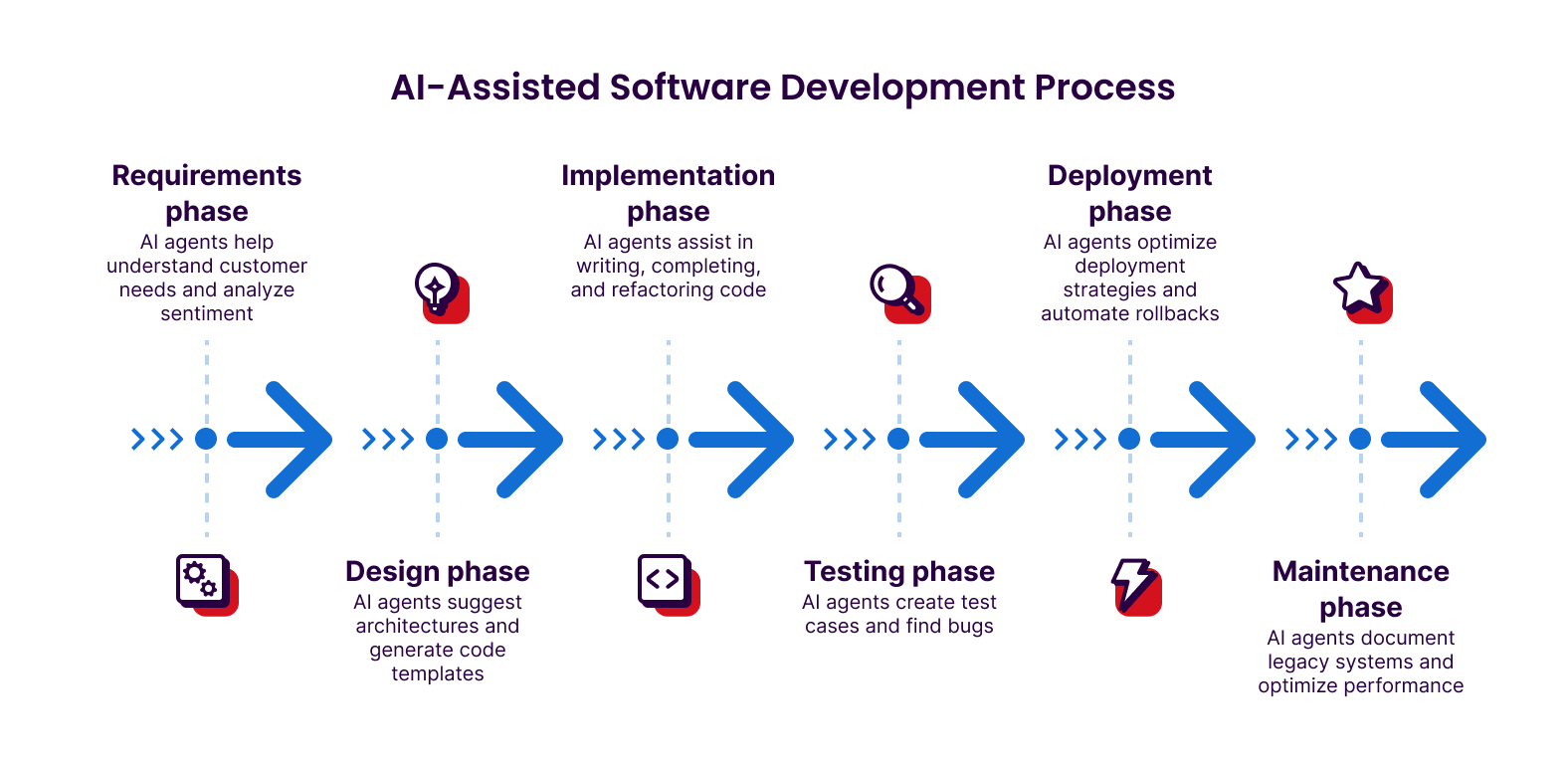 The Algorithmic Reformation: AI Agents are Rewriting the SDLC Playbook | Sonar
The Agentic SDLC: Rebuilding Every Phase of Development
The traditional Software Development Life Cycle--requirements, design, development, testing, deployment, maintenance--assumes humans execute each phase. The agentic software development lifecycle (ASDLC) delegates that execution to AI agents that can reason, plan, use tools, call APIs, write and run code, and self-correct based on feedback. Humans shift from doing to directing: setting intent, reviewing outputs, and validating decisions [3]. Deloitte frames the same transition as the evolution from the SDLC to an "agent orchestrated development life cycle" (AO-DLC), an evolution that will reshape how work flows, how teams collaborate, and how quality is governed [7].
Planning and Requirements Analysis
Requirements gathering has traditionally been a notorious bottleneck--endless meetings, fragmented documentation, and misaligned expectations. AI agents are dismantling these barriers by analyzing requirements, generating structured specifications, and surfacing ambiguities before a single line of code is written [2]. Because agents can hold and cross-reference vast context, the friction between what product teams intend and what engineering teams build is shrinking.
Development and Coding
This is where the transformation is most visible. Code agents can now implement entire features across frontend and backend, while autonomous refactoring systems continuously improve code quality in the background [5]. Intent-based programming allows developers to express goals rather than implementation details, with agents translating intent into working software [5]. The single-agent flow--one agent taking a task from ticket to pull request--is already real and demonstrable today [6]. At Microsoft Build 2025, GitHub Copilot was demonstrated as a collaborative coding agent capable of end-to-end task completion from natural language prompts, a signal that the agentic model is now central to the world's largest developer platforms [8].
Testing and Quality Assurance
Traditional QA depends on labor-intensive manual test case creation, execution, and maintenance. Agentic testing automates this pipeline: agents generate test suites, execute them, diagnose failures, and feed results back into the development loop without waiting for human prompting [5]. This turns testing from a downstream bottleneck into a continuous, parallel activity woven through the entire lifecycle.
Deployment and Operations
Autonomy increasingly extends past the merge. Startups are deploying multi-agent AI systems to build self-healing infrastructure that can detect and resolve bugs in production without human input, while enterprises embed agentic AI into legacy systems to optimize performance and scale with minimal developer intervention [8]. The lifecycle, in effect, is collapsing into a continuous loop in which agents plan, code, test, review, ship, and operate--while engineers supervise across stages [6].
 The Agentic Coding Era Is Here: How Autonomous AI Coding Agents Are Rewriting the SDLC - DEV Community
The New Engineering Workforce: Orchestrators, Architects, and Verifiers
Perhaps the most profound consequence of agentic AI is what it does to the role of the software engineer. The developer's job is shifting from "code writer" to "code reviewer and orchestrator"--engineers spend more time defining intent, reviewing outputs, and guiding an agent's strategy than typing boilerplate or wrestling with syntax [4]. In the agentic model, an engineer spends less time writing code and more time deciding what "good" looks like and checking that the agents got there [6].
Senior engineers are already evolving into "Agent Architects," spending their days designing system prompts, auditing agentic plans, and managing the orchestration of multiple AI agents working in parallel [1]. Industry analysts describe a broader set of emerging role archetypes [2]:
- AI Agent Architects -- design agent workflows and responsibilities
- Verification Specialists -- ensure the quality of AI-generated outputs
- Integration Engineers -- connect agents with existing systems and infrastructure
- Governance Managers -- oversee AI agent compliance, security, and ethics
This redistribution of labor changes team structure, not just individual tasks. As founders of frontier developer tooling companies have observed, developers are becoming orchestrators rather than implementers, and engineering organizations must build the infrastructure--observability, review pipelines, security controls--required to support reliable, autonomous code generation at scale [9]. McKinsey's research on the agentic organization echoes the point: the most forward-thinking teams are redesigning their workflows around AI agency, not simply bolting AI tools onto existing processes [3].
By early 2026, the question is no longer whether AI can write code, but how many AI agents a single human can effectively manage [1].
Challenges: Trust, Verification, and the Legacy Code Problem
For all the momentum, the agentic era's limits are sharply defined. Resolution rates on demanding "Pro" benchmarks currently hover around 25%--a figure that reveals a crucial asymmetry. AI agents handle modern, well-documented frameworks with ease, but the "spaghetti code" of legacy enterprise systems still requires deep human intuition and historical context that agents do not possess [1]. The benchmarks prove the AI has arrived for modern development; the open question is agent reliability in the chaotic, real-world environments where most enterprise software actually lives.
Trust and verification are the second great challenge. Panelists from companies building agentic tooling emphasize that trust, verification, and observability in autonomous code generation are unsolved infrastructure problems: teams need ways to observe what agents did, validate why, and roll back confidently when they are wrong [9]. Many enterprises have already deployed AI agents but lack the operating model, review structure, and architectural ownership needed to capture the full value of the shift [7].
There are also unresolved questions of accountability. Responsibility for AI-generated code remains murky--when an autonomous agent introduces a security flaw or a production outage, ethical and legal ownership is far from clear [8]. This is why practitioners consistently warn that organizations which approach the transition with strong governance, clear expectations, and a human-AI collaboration mindset are the ones gaining a decisive edge; technology alone does not make the agentic model work [2]. Deloitte goes further: the enterprises that move deliberately in the next 12 months will likely set the terms of the new standards, while the rest spend the following years adapting to them [7].
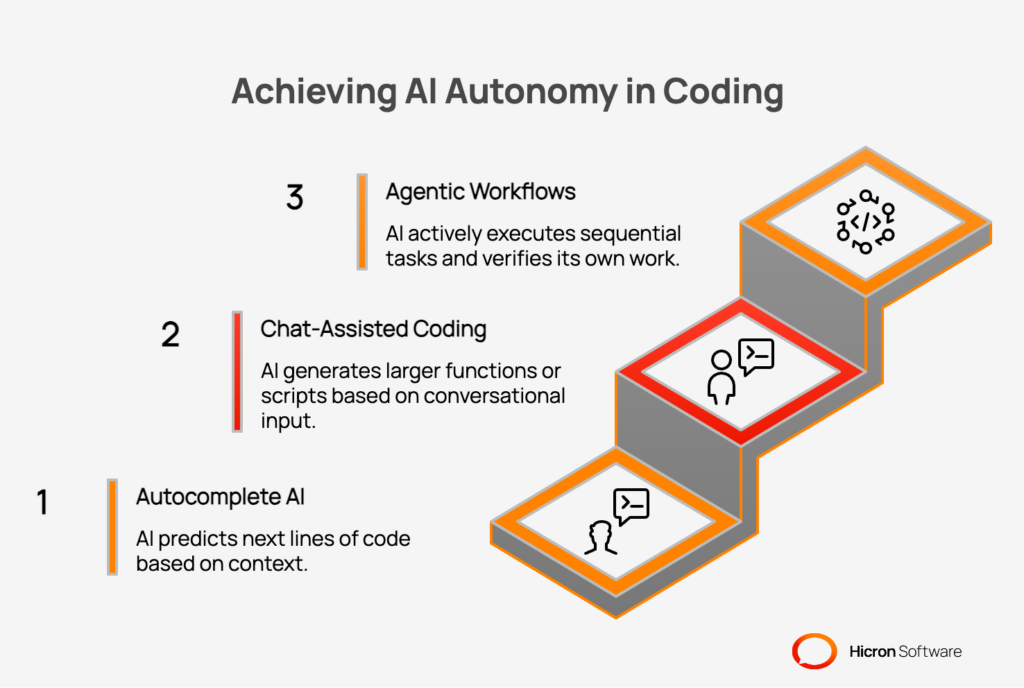 How AI is Changing the Software Development Life Cycle (SDLC) | Hicron Software
The Road Ahead: Multi-Agent Orchestration and Agentic Density
If the current era belongs to the single agent taking a ticket to a pull request, the next frontier is multi-agent orchestration. Industry observers expect systems in which a "Manager Agent" coordinates a "UI Agent," a "Database Agent," and a "Security Agent" to build entire applications from a single product requirement document [1]. The hard problem is no longer demonstrating the single-agent flow--it is making agents work reliably at scale across a real organization, which is what will determine whether an agentic SDLC genuinely helps or quietly turns into a mess [6].
The emerging metric for competitive success is "agentic density": the ratio of AI agents to human engineers, and a company's ability to harness this new hybrid workforce effectively [1]. Anthropic's 2026 Agentic Coding report suggests we are entering an era in which agents perform complex engineering tasks with minimal human intervention [3], and the economics are already visible--higher productivity as developers offload repetitive work, and greater accessibility as low-code and agentic platforms allow non-developers to build functioning software [8].
For engineering leaders, the practical playbook is taking shape: redesign workflows around agent execution rather than human keystrokes, invest in verification and observability infrastructure before scaling agent fleets, define clear governance for accountability, and deliberately develop the orchestrator-level skills their senior engineers will increasingly need [3][7]. The competitive window for doing this deliberately, rather than reactively, is measured in months [7].
Conclusion
The shift from copilots to autonomous agents is not an incremental improvement in developer tooling--it is a redefinition of what it means to be a software engineer. The reactive loop of human typing and AI suggesting has given way to agents that plan, execute, test, and self-correct across every phase of the development lifecycle, while humans move up the stack to set intent, design agent systems, and validate outcomes [4][3]. Every stage of the SDLC--from requirements analysis to production operations--is being rebuilt around autonomous collaborators [5][7].
Yet the transformation is uneven. With benchmark resolution rates still hovering near 25%, and with legacy enterprise systems remaining stubbornly resistant to agent autonomy, the gap between demo and dependable production workflow remains wide [1]. The organizations that thrive in this new era will be those that treat agentic AI not as a plug-in productivity boost but as an occasion to redesign their entire engineering operating model--complete with governance, verification infrastructure, and newly architected human roles [2][7]. The copilot era is ending. The question that replaces it is no longer whether AI can write code, but how effectively an organization can orchestrate the agents that now do [1].
References
- 1.
- 2.
- 3.
-
4.
From Copilots to Autonomous Agents: How AI is Revolutionizing SDLC Phase 4 – Development & Coding - AI Agents, Knowledge Systems & AI Consulting for Enterprises | Cirtra. (n.d.). Retrieved https://cirtra.com/from-copilots-to-autonomous-agents-how-ai-is-revolutionizing-sdlc-phase-4-development-coding
- 5.
- 6.
- 7.
- 8.
- 9.