Introduction
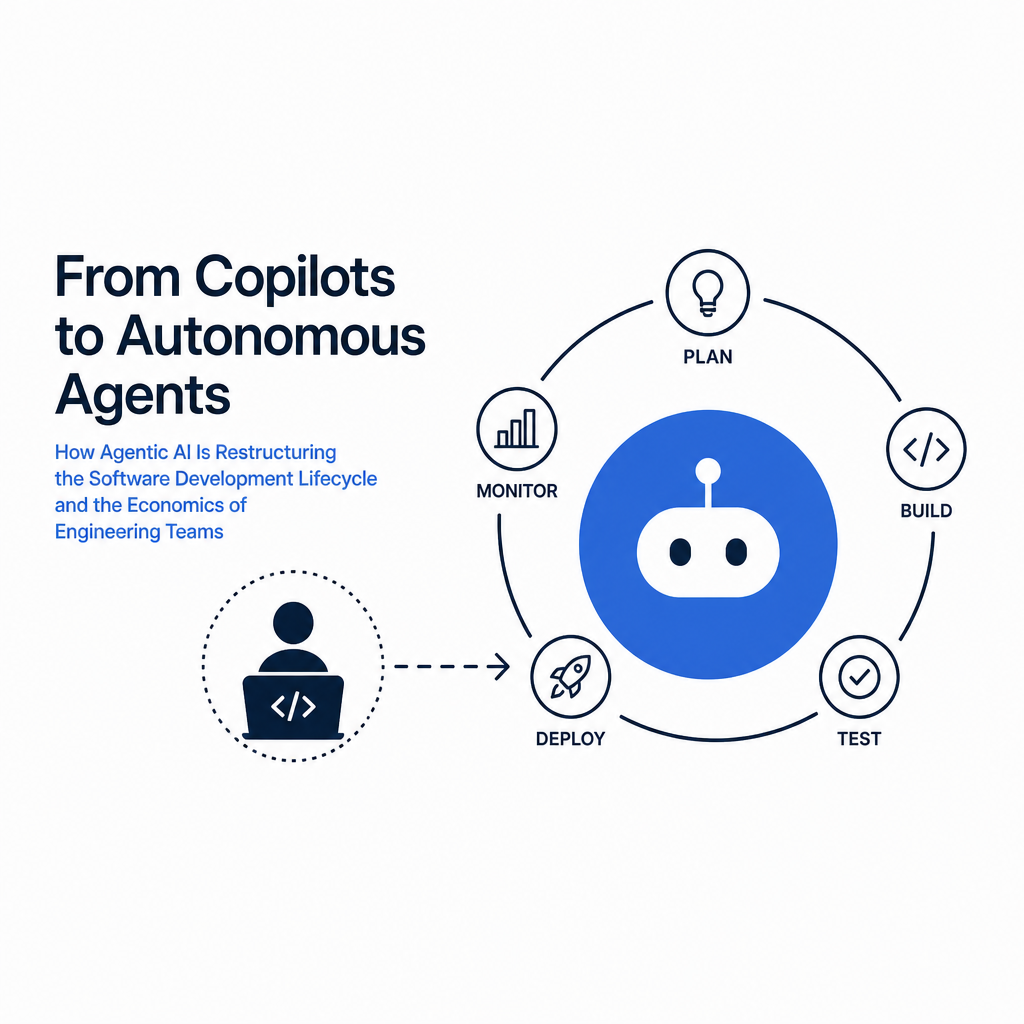
Software engineering has reached a turning point. For the past several years, AI's role in development was largely assistive: copilots and chat-based tools suggested code while humans remained firmly in control of the work. That shape is changing now. Engineering teams are deploying coding agents that complete entire workflows autonomously--taking a ticket, writing the code, generating tests, opening a pull request, and even monitoring the result in production--and the software development lifecycle is reorganizing around them in ways that the tooling, the processes, and in many cases the mental models haven't fully caught up with yet [1].
This shift is more than a tooling upgrade. Deloitte describes it as a move from the traditional software development life cycle (SDLC) to an "agent orchestrated development life cycle" (AO-DLC), in which coordinated agents execute work across requirements, development, testing, deployment, and maintenance, while engineers shift from hands-on builders to human-in-the-loop supervisors [2]. The implications cascade through everything: how teams are sized, who holds decision authority, how quality is governed, and ultimately what an engineering organization costs and produces.
This article examines what the agentic SDLC actually is, how it differs from the AI-assisted development most teams practice today, where it creates new problems--particularly the widening gap between code generation and code verification--and how leading organizations are restructuring themselves around it. It closes with the governance and economic questions that will determine whether the agentic transition delivers compounding returns or quietly turns into an expensive mess.
From Copilot to Colleague: Three Phases of AI in Engineering
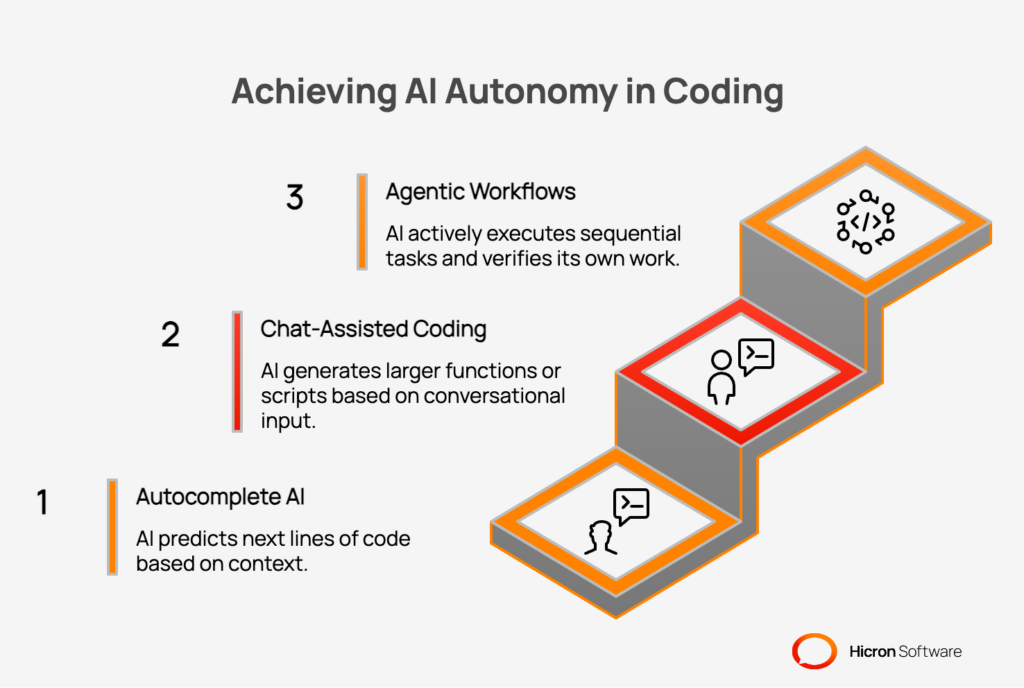
To understand where the industry is going, it helps to map where it has been. Industry analyses commonly break the evolution of AI coding into three distinct phases [3]:
- Phase 1 -- Manual engineering. People wrote every line of code, and tools only formatted and linted. Almost no one works this way anymore.
- Phase 2 -- AI-assisted engineering. Copilots and chat tools suggest while people still drive, making individual developers faster. Most teams are here today.
- Phase 3 -- AI-led engineering. Agents do the work across the lifecycle while people set intent and govern. A few teams are here in pockets, but almost none org-wide.
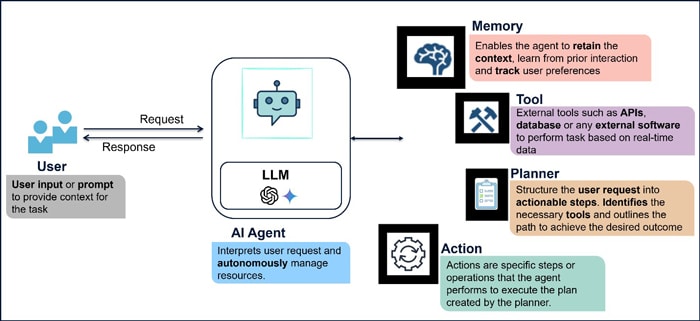
Academic work characterizes this same trajectory as an evolution from single-line code completion to multi-step agentic systems, with emerging proposals for layered architectures to orchestrate them [4]. The defining distinction is not the underlying model but the unit of work. In AI-assisted development, the AI contributes to a step; in agentic development, the AI pursues a goal across many steps without a human directing each one. The developer sets the intent and reviews the result, while the agent handles everything in between [1].
That change in the unit of work is what makes this shift structurally significant rather than incremental. When AI evolved from autocomplete-style copilots into autonomous agents, it began reshaping not just individual workflows but team structures and the economics of code production itself [5]. A copilot makes a developer faster; an agent changes what a developer is.
 AI Agents in Software Development: From Copilots to Co-Workers | Nitor Infotech
Inside the Agentic SDLC: Every Phase, Rebuilt
The agentic software development lifecycle is a software delivery practice in which AI agents participate meaningfully across the full lifecycle--planning, coding, reviewing, deploying, and operating--pursuing goals across multiple steps while engineers set direction and approve outcomes [1][3]. It is easy to underestimate the scope of this. Many practitioners equate agentic engineering with AI coding, but code generation is only part of the picture; AI that can write, refactor, and test code addresses perhaps a fifth of what the full SDLC actually involves. The rest--ticketing, specification, environment setup, review, release management, monitoring--is where agentic platforms are now pushing [6].
Each traditional stage is being rebuilt in parallel [7]:
| Traditional SDLC Stage | Agentic AI Enhancement |
|---|---|
| 1. Requirement Gathering | Copilots generate specs from historical data, feedback loops, and usage telemetry |
| 2. Design | Design agents create wireframes, schema drafts, and UI mockups instantly |
| 3. Development | Code agents build and refactor code from intent |
| 4. Testing | QA bots write, execute, and self-heal test cases |
| 5. Deployment | AI-enhanced CI/CD suggests rollbacks, improves performance |
| 6. Maintenance | Autonomous monitors patch systems, optimize infrastructure, and reduce downtime |
The single-agent flow--one agent taking a task from ticket to pull request--is already real and can be demonstrated today. The harder problem is what happens when agents run at scale across a real organization, and that is what will decide whether an agentic SDLC helps or quietly turns into chaos [3]. Iteration cycles compress dramatically in this model: work that once took months to ship can now be shipped in hours, marking an evolution as profound as the industry's move from waterfall to agile [6].
But speed without structure is dangerous. Deloitte's analysis is blunt on this point: many enterprises already have AI agents in place but lack the operating model, review structure, and architectural ownership needed to capture the full value of the shift. Governance gaps, the firm warns, can erase productivity gains entirely [2].
 The End of the Copilot Era: How Agentic AI Is Rewriting the Software Development Lifecycle | Reducates
The Verification Gap: Why Review Becomes the Bottleneck
The first teams to feel the sharp edges of the agentic transition discovered a predictable problem: when agents produce most of the code, human review becomes the constraint. The earliest organizations to hit this wall were small engineering teams shipping mostly AI-generated code, where the verification gap--the distance between how much code agents could produce and how much humans could meaningfully validate--got sharp enough to force a fix before it broke the release schedule [1].
The experience of Mastra, a 16-person team shipping a TypeScript agent framework with over 300,000 weekly downloads, is illustrative. The team had no AI review tool it trusted before adopting CodeRabbit. After switching, engineers resolved 70 to 85% of critical comments before any pull request was merged, and follow-up PRs stopped. CTO Abhi Aiyer described the resulting posture shift: "We just listen to it as if it's always correct. And so far it has been" [1].
The Mastra case reveals something counterintuitive about the agentic SDLC: AI is being deployed to verify AI. The review layer that emerges is itself increasingly automated, with human attention reserved for the highest-stakes approvals. This creates a subtle but consequential trust question--when engineers treat an automated reviewer "as if it's always correct," the review layer inherits the same failure modes the agents it supervises might exhibit. Teams that hit these problems first are already building the verification stack, but the discipline of agent-auditing-agent review is still young, and the industry's processes and mental models are lagging behind its tooling [1].
Restructuring the Engineering Organization
The deeper transformation is organizational. An agentic engineering operating model reorganizes software companies around small human teams that coordinate large groups of specialized AI agents across the development lifecycle--moving from "humans execute, tools assist" to "humans steer, agents execute." This changes how teams are sized, who holds decision authority, how governance works, and how everyday workflows get coordinated. It is, in effect, the structural backbone of an AI-native engineering organization [8].
Several structural patterns are already visible:
- Stream-aligned teams with wider scope and fewer people. Teams now cover broader domains with fewer people doing direct execution work. Agents take on implementation tasks, while humans spend more time on architecture, review, and boundary management [8].
- Small cross-functional pods. Team boundaries shift from large specialized groups to smaller pods that define intent, review output, and govern autonomous agent execution throughout the lifecycle [8].
- Agent infrastructure as a first-class platform. LinkedIn stood up a fully funded agent platform team structured like its storage or ML infrastructure teams, centralizing prompt orchestration, data access, safety evaluations, and deployment. Red Hat organized SDLC tiger teams mapped to requirements, architecture, security, quality engineering, documentation, and release automation across a 500-plus-engineer organization. Google disclosed at Cloud Next 2026 that AI-assisted delivery is now part of its software delivery process, including a complex code migration completed faster than would have been possible with engineers alone [8].
In each case, orchestration, governance, and approval move from informal team practice to explicit organizational design. The individual engineer's role changes accordingly: less time writing code, more time deciding what "good" looks like and checking that the agents got there [3]. Deloitte frames this as engineers moving from code writers to agent orchestrators, with value coming from speed, coordination, and governed quality--and with roles, skills, and team models changing fast [2]. The cultural shift is significant: teams must learn to partner with--not merely direct--AI agents, with the human role shifting "from writing and reviewing code to defining intent, constraints, and policies and then validating the work of machines" [7].
 Accelerating Software Development - Harnessing Agentic AI
The New Economics of Engineering Teams
The restructuring of teams is, at bottom, a restructuring of cost and output. The traditional economics of software--headcount roughly proportional to throughput--is being replaced by a model in which a small number of engineers supervise a large volume of agent-executed work. Software that once took months to ship now ships in hours [6], and stream-aligned teams cover wider domains with fewer people [8]. For engineering leaders, this changes the fundamental calculus of team sizing, budgeting, and capacity planning: the marginal cost of additional implementation work falls toward the cost of compute, while the scarce resources become review capacity, architectural judgment, and governance attention.
But the economics are not automatically favorable. Deloitte's key findings emphasize that value comes from speed, coordination, and governed quality--and that governance gaps can erase productivity gains [2]. An organization that deploys agents without redesigning its review structures, ownership boundaries, and quality controls may simply generate defects faster than it can find them. There is also a strategic timing dimension: Deloitte argues that every enterprise will be affected by this shift, and that organizations moving deliberately in the next 12 months will likely set the terms while the rest spend time adapting to standards others established [2].
The skills premium is shifting as well. As execution commoditizes, the human value concentrates in the capabilities agents lack: setting intent and constraints, designing system architecture, evaluating trade-offs, and validating machine output [3][7]. Talent strategies, career ladders, and hiring rubrics built around lines of code and implementation velocity are due for a rewrite.
Risks, Governance, and the Road Ahead
The agentic transition carries a distinct risk profile that most engineering organizations are only beginning to operationalize. Deloitte identifies drift, security, and compliance exposure as primary risks--concerns that intensify when autonomous agents act across multiple lifecycle stages with limited human direction [2]. Static SDLC models built around human-paced checkpoints are breaking down precisely because agents compress the time between decision and consequence [7].
The governance challenge is compounded by the field's immaturity. The tooling exists, early adopters are demonstrating results, but the processes and mental models for supervising fleets of agents have not caught up [1]. Researchers are responding with proposals for formal architectures--including multi-layer frameworks for orchestrating agentic systems across the lifecycle [4]--while practitioners debate how far "vibe coding" and subjective evaluation can stretch before consistency, security, and measurable outcomes suffer [7]. Open questions remain about how fundamentally the lifecycle itself will be redesigned over the coming years, beyond simply accelerating each existing phase [9].
What seems clear is that the winning organizations will treat governance not as a brake on agent adoption but as its enabler: explicit approval structures, automated verification layers, centralized agent platforms, and clearly mapped ownership between human pods and agent scope [1][8]. The shift from SDLC to AO-DLC will reshape how work flows, how teams collaborate, and how quality is governed--whether or not an organization is ready for it [2].
Conclusion
The move from copilots to autonomous agents is not an incremental productivity story; it is a restructuring of how software is conceived, built, verified, and operated. The agentic SDLC is already real at the level of the single agent taking a ticket to a pull request [3], and early adopters like Mastra show that the verification gap--the first great bottleneck of the agentic era--can be addressed, albeit with new tools and new trust assumptions [1]. Around that core, a new operating model is crystallizing: small human pods steering large fleets of specialized agents, backed by platform teams and explicit governance [8].
The engineer's job is changing from writing code to deciding what good looks like and validating that the machines got there [3]. The economics are changing from headcount-proportional throughput to a model where review capacity, architectural judgment, and governance discipline are the scarce inputs. And the strategic window is narrow: organizations that redesign deliberately now--on operating model, talent, and controls--will likely set the terms of the next era of software engineering, while the rest adapt to standards they did not choose [2]. The lifecycle is being rebuilt around agents. The only open question is whether each organization rebuilds it intentionally.
References
- 1.
- 2.
- 3.
- 4.
- 5.
- 6.
- 7.
- 8.
- 9.