Introduction
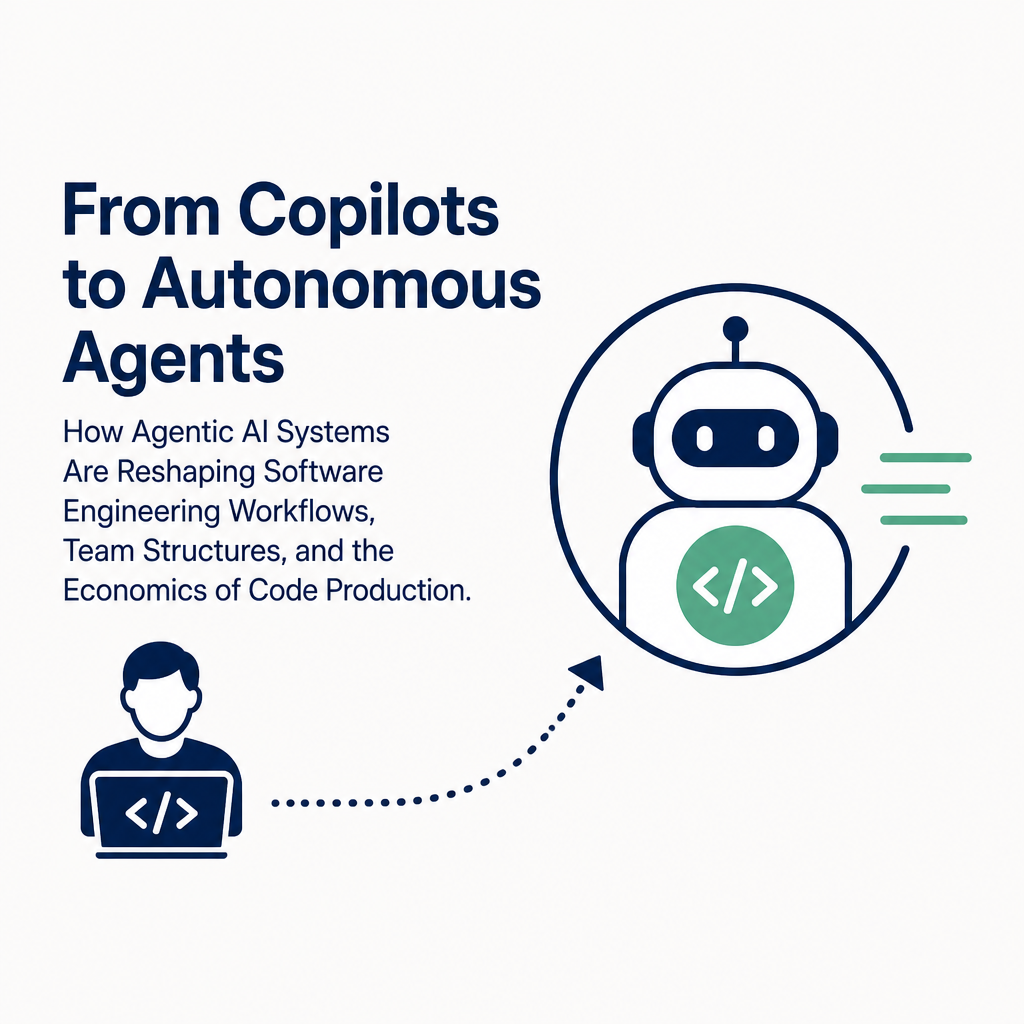
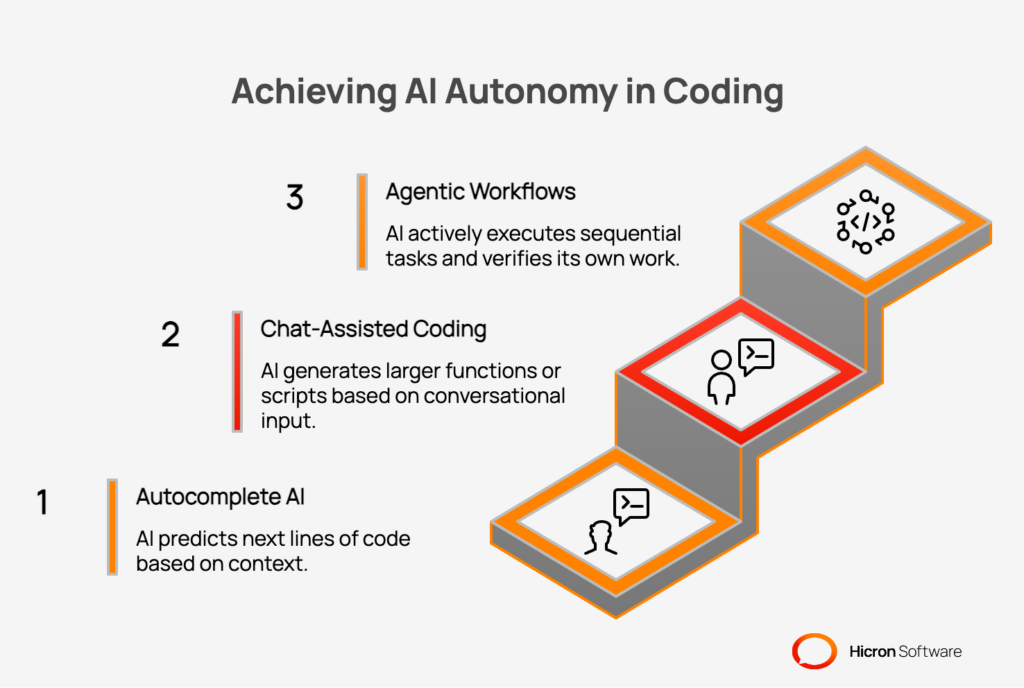
For the past several years, AI's role in software engineering was largely assistive: autocomplete on steroids. Copilot-style tools suggested the next line of code, accelerated boilerplate generation, and shaved minutes off routine tasks -- but the human developer remained the sole author, architect, and operator of the build. That era is closing. A new class of agentic AI systems can now plan multi-step tasks, execute multi-file changes, run tests, create pull requests, and manage deployment pipelines with only human oversight at the boundaries [1].
This shift is more than an incremental productivity gain. Autonomous coding agents have moved from experimental novelties to foundational components of modern software engineering, compressing development cycles from months to days and enabling product features to move from concept to production with minimal manual coding [2]. In the process, they are forcing a rethinking of what "software development" even means -- transforming engineering teams into hybrid human-AI organizations and redefining the economics of producing code [2].
The transformation unfolds in layers. First-order impacts hit the individual engineer's daily workflow: using agents to generate code, automate testing, and retrieve information. Second-order impacts reshape teams, methodologies, and system architecture itself. Third-order impacts reach further still, reworking the economics, business models, and philosophical underpinnings of the entire software industry [3]. This article traces the trajectory through all three layers -- from the tools now reshaping daily work, to the collapse and reformation of team structures, to the emerging "coding agent economy" and the trust frameworks it demands.

From Assistant to Agent: A New Generation of Tooling
Five Categories Reshaping How We Build
The agentic tooling landscape has rapidly stratified into distinct categories, each addressing a different point in the development lifecycle. Industry observers now identify five major classes of agentic tools: command-line agents (such as Claude Code, Gemini CLI, and OpenCode), multi-agent orchestrators (like Claude Squad and Conductor), asynchronous background coders (Google's Jules, OpenAI's Codex), AI-assisted testing and self-healing CI/CD pipelines, and integrated AI-first development environments [1].
What distinguishes these systems from their copilot predecessors is autonomy. Autonomous coding agents are capable of planning, writing, testing, and refining code while requiring minimal human intervention -- independent execution of an entire development loop rather than fragmentary assistance within one [2]. Under the hood, much of this capability is enabled by a maturing ecosystem of agent management frameworks -- including LangGraph, AutoGen, CrewAI, and the OpenAI Agents SDK -- that coordinate multiple collaborating agents, replicating aspects of a human workforce through orchestrated division of labor [2].
From SDLC to AO-DLC
Consulting analysts describe this as a fundamental shift in the software development life cycle itself: from the traditional SDLC toward an "agent-orchestrated" development life cycle, in which autonomous agents execute work across requirements, development, testing, deployment, and maintenance rather than merely accelerating isolated steps [4]. Where earlier generative AI moved code from the IDE toward production, agentic systems now collapse the distance between how code looks in development and how it actually behaves when deployed autonomously [5].
The most advanced implementations go beyond single-agent automation. Emerging "agentic engineering" systems are explicitly designed to behave like loosely coupled engineering teams -- swarms of agents, each with defined roles, shared memory, and a common observability layer, that move software through the full delivery pipeline rather than just generating code faster [6]. Unlike conventional coding agents, which operate within bounded, user-driven interaction loops, these systems orchestrate cross-team workflows, chaining different workflow types across organizational boundaries [6].
Workflow Transformation: Measured Gains and New Modes of Work
The Numbers Behind the Hype
Early empirical results from multi-agent deployments suggest the productivity story is real, though with a counterintuitive twist. In a pilot spanning more than 20 debugging workflows, coordinated agent execution produced a 93% reduction in time-to-root-cause compared to historical baselines, saving over 200 engineering hours across 512 sessions in a single month. Development workflows saw a 65% reduction in execution time -- with the largest gains coming not from code generation, but from compressing downstream testing [6].
That detail matters. It suggests the near-term value of agentic AI lies less in writing code faster and more in eliminating the coordination overhead, handoffs, and waiting states that dominate the space between writing code and shipping it. Boilerplate and repetitive code may soon be overwhelmingly AI-generated [2], but the deeper transformation is the automation of the pipeline itself: agents writing and executing tests, managing CI/CD, and updating documentation as continuous activities rather than discrete human tasks [3].
Vibe Coding and the Discipline Spectrum
The accessibility of agentic tools has also popularized more casual development styles -- so-called "vibe coding," where developers describe their vision and accept agent output with light review. Practitioners argue both approaches have merit, and that the skill of the coming era is knowing when to use which: vibe-coding for prototypes and experiments, rigorous line-by-line review for customer-facing production systems [1]. The risk profile of getting this wrong is significant -- security holes can hide undetected in AI-generated code [1], meaning the new velocity demands a corresponding discipline in verification.
 How AI is Changing the Software Development Life Cycle (SDLC) | Hicron Software
Team Structures and the Engineer's Evolving Role
From Coder to Conductor
The rise of agentic AI is not merely adding tools to the engineer's kit; it is reshaping the profession itself. The essential skillset is evolving "from coder to conductor" -- away from line-by-line implementation and toward specifying, directing, and validating the work of autonomous systems [7]. In this framing, writing a formal specification for an agent's behavior becomes as important as writing the agent's code [7]. Research on AI adoption in engineering describes the same trajectory as a shift "from code production to code orchestration," with AI reshaping team dynamics, review processes, and organizational structures in the process [8].
Deloitte's analysis reaches a parallel conclusion: as more of the life cycle is automated, the engineer's role shifts from hands-on builder to human-in-the-loop supervisor -- guiding outcomes, validating quality, and providing strategic oversight. Organizations that succeed in this era, the firm argues, will need to redesign engineering functions around orchestration, quality assurance, and trust at scale [4].
The Hybrid Team
The long-term vision is a software team as a true hybrid entity. AI agents handle the bulk of the automatable work -- generating code, writing and executing tests, managing CI/CD pipelines, updating documentation -- while human engineers concentrate on what remains distinctly human: complex system architecture, creative problem-solving, understanding stakeholder needs, and setting the strategic and ethical direction of the products they build [3]. Engineering teams effectively evolve into AI managers and system architects [2].
Yet the second-order restructuring may go further than simply reassigning tasks. Researchers at UC Berkeley's Center for Responsible, Decentralized Intelligence argue that today's multi-agent systems largely inherit human organizational patterns out of habit -- and that over time, agent teams will develop communication, delegation, consensus, and conflict-resolution mechanisms designed around machine capabilities rather than human managerial constraints, enabling collaboration at scales impractical for human teams [9]. In that future, coordination itself stops being modeled on the org chart. The same analysis points to a subtle but consequential inversion: as agents do more of the producing, project context becomes the durable asset -- the accumulated specifications, decisions, and institutional knowledge that outlast any individual contributor, human or machine [9].
 From Copilots to Agentic Workflows: How AI in R&D Changes in 2026 - Causaly
The Economics of Code Production
An Emerging Coding Agent Economy
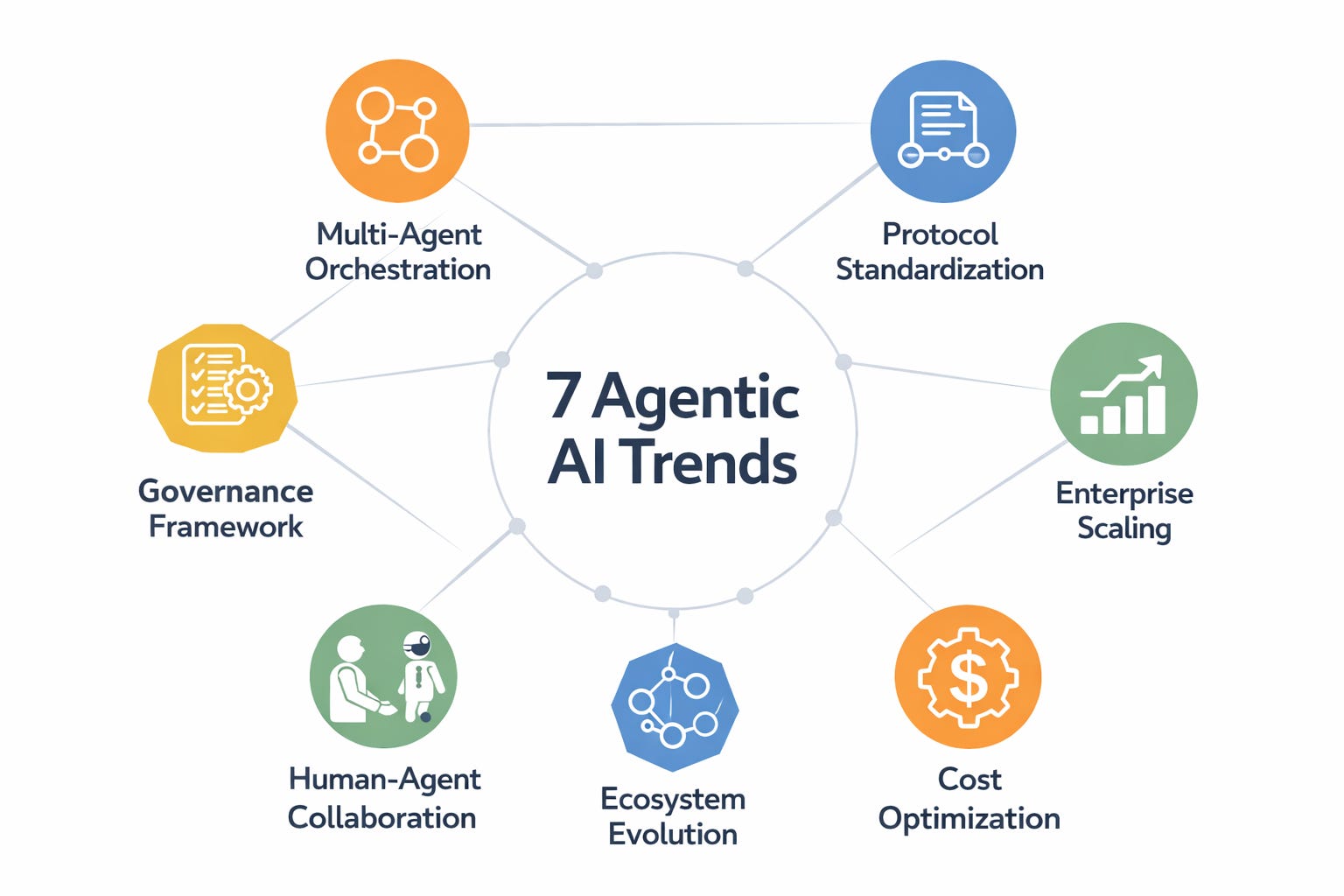
As agentic systems move into production, they are generating a distinct economic layer of their own -- what one analysis calls "the coding agent economy." Empirical data remains scarce, but longitudinal study of production usage reveals meaningful trends: per-call costs are compressing even as context windows grow fourfold, driven by intense competition among model providers [10]. These dynamics carry direct implications for model providers, agent developers, and infrastructure operators navigating the economics of autonomous coding workflows -- and they hint at a future where the marginal cost of code production continues to fall as usage intensity rises [10].
The macro-level consequences are already visible. Autonomous agents are reducing development life cycles, improving code quality, and increasing team throughput through independent planning, writing, testing, and execution -- a shift that, by industry accounts, will "redefine software development economics, team structures, and productivity benchmarks" [2]. When development timelines collapse from months to days, the unit of economic competition changes: advantage accrues to organizations that can most effectively orchestrate fleets of agents, not merely those with the largest engineering headcount [2]. For the labor market, the long-term picture suggests a rebalancing rather than simple displacement -- with demand concentrating on engineers who can architect systems, direct agents, and exercise judgment over what gets built and why [3][7].
 7 Agentic AI Trends Redefining the "Year of the Proof" in 2026 | by ML Point | Towards AI
Trust, Governance, and the New Assurance Problem
The most underappreciated dimension of the agentic transition may be assurance. When human engineers wrote code, code review of the artifact was a sufficient quality gate. When autonomous agents produce software, that logic inverts: trust in the production process becomes as important as trust in the produced artifact [9]. Code review remains important, but assurance will increasingly focus on the agents themselves -- with organizations inspecting agent specifications, permissions, memories, execution traces, provenance, evaluation results, and governance controls [9].
This creates an entirely new discipline at the intersection of security, compliance, and engineering management. The practitioner dilemma between speed and scrutiny -- vibe coding versus reviewing everything [1] -- is ultimately resolved not by individual heroics but by systemic controls: permissioned agent environments, auditable execution logs, and evaluation pipelines that continuously validate agent behavior. Organizations will also need to invest in the observability infrastructure that agentic engineering systems presuppose -- global traceability and auditability across agent-executed workflows, shared memory that supports knowledge transfer and onboarding, and workflows that can move across team boundaries without losing accountability [6].
Conclusion
The journey from copilots to autonomous agents is best understood not as a story about better autocomplete, but as the restructuring of software production around a new kind of labor. First-order effects have already arrived: agents planning, coding, testing, and deploying with minimal intervention, delivering dramatic measured gains in debugging and pipeline efficiency [6]. Second-order effects are underway: engineers becoming conductors and supervisors rather than builders [7][4], hybrid human-AI teams replacing conventional org structures [3], and specifications becoming artifacts as important as code itself [7]. Third-order effects -- the redefinition of development economics, productivity benchmarks, and industry business models [3][2] -- are only beginning to come into focus as per-call costs compress and agent usage intensifies [10].
None of this eliminates the human role; it relocates it. Complex architecture, creative problem-solving, stakeholder empathy, and ethical direction remain firmly human territory [3] -- but they now sit atop a machine-executed delivery pipeline whose behavior must be specified, monitored, and governed with the same rigor once reserved for the code itself [9]. The organizations that thrive in the agentic era will be those that treat this not as a tooling upgrade but as an organizational redesign: rebuilding workflows around orchestration, assurance around process as much as product, and teams around a genuine partnership between human judgment and machine execution.
References
- 1.
- 2.
- 3.
- 4.
- 5.
- 6.
- 7.
- 8.
- 9.
- 10.