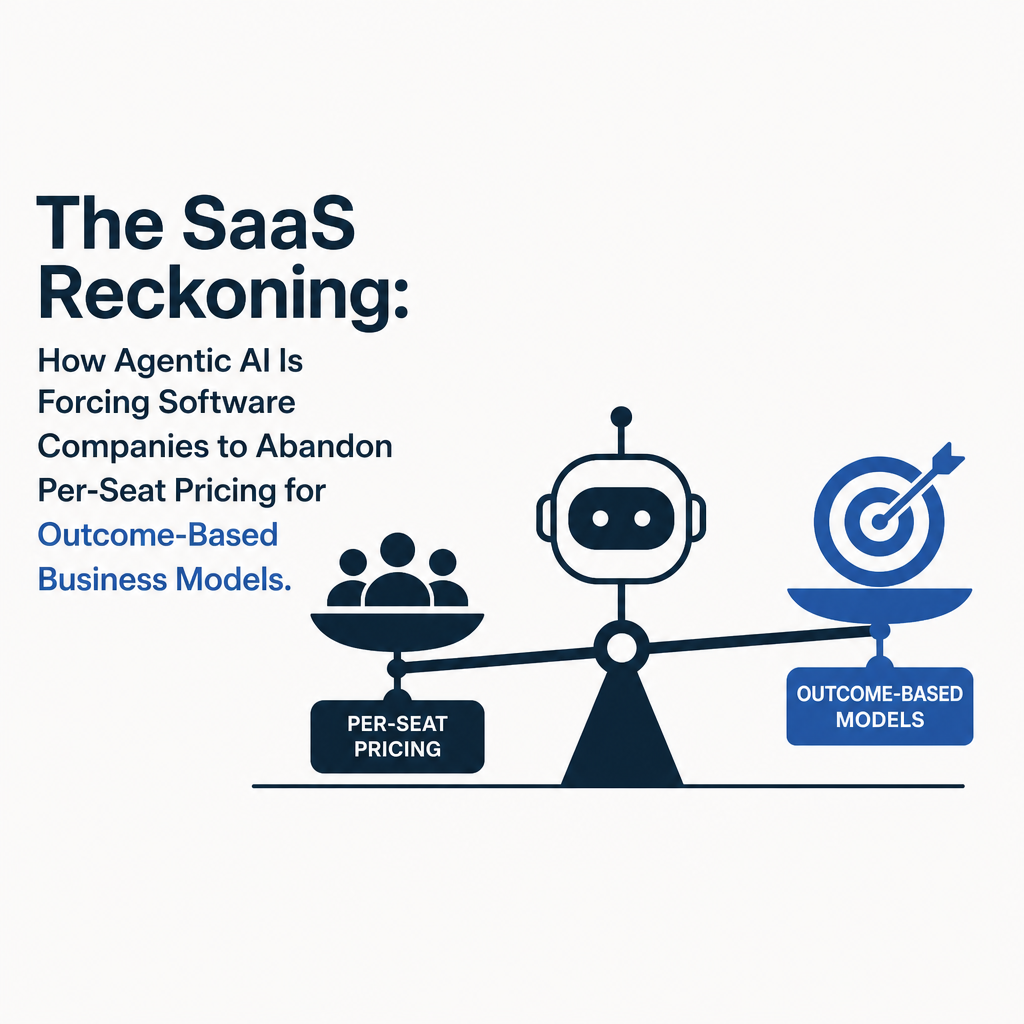
Introduction
For two decades, the SaaS business model ran on a beautifully simple equation: more employees equals more licenses equals more revenue. Per-seat pricing was predictable for vendors, easy to budget for customers, and gave investors a reliable growth lever--every new hire was a prospective new subscription. From Salesforce's early days charging per user per month to the modern playbook of "land and expand," the assumption was straightforward: as companies grow, their software spend grows with them [1].
That equation is now breaking. Agentic AI platforms from Anthropic, OpenAI, and others have demonstrated the ability to autonomously execute enterprise workflows that previously required dozens of software subscriptions--and the human operators who sat in the seats those subscriptions billed [2]. When an AI agent can qualify leads, process invoices, resolve support tickets, and update CRM records without a human ever logging in, charging per human user becomes not just misaligned with value delivered, but economically incoherent [3].
The result is what industry analysts are calling "seat compression"--a structural, not cyclical, disruption that is forcing software companies to reinvent how they price, package, and sell their products [4]. This article examines why per-seat economics are failing, how the market is reacting, what the emerging pricing models look like in practice, and why the transition is proving far messier than the hype suggests.
The Breaking Point: Why Per-Seat Economics No Longer Compute
The traditional B2B SaaS playbook was remarkably predictable: build a system of record, create a user interface, and sell per-seat licenses. Revenue growth was effectively a proxy for enterprise headcount adoption [5]. The first cracks appeared not with agents, but with "Copilots" in 2023 and 2024. These AI assistants initially seemed to validate the seat model by adding an AI premium on top of existing licenses--but they were ultimately a transitional bridge, fundamentally constrained by the speed and bandwidth of the human operator validating their outputs [5]. Agentic AI removes that constraint entirely: software that acts autonomously, executing multi-step processes and making decisions independently, has no meaningful connection to the number of humans with login credentials [3].
The arithmetic is stark. Consider a sales organization where 200 human sellers manage the pipeline through per-seat CRM licenses. Deploy AI agents for lead qualification, data entry, follow-up scheduling, and CRM updates, and the same pipeline can be run by 20 human sellers augmented by AI--while the vendor watches 90% of its seat revenue evaporate [1]. Meanwhile, those AI agents generate massive new workloads of API calls, data processing, and task execution that per-seat contracts never anticipated monetizing [6].
Two forces are compounding the pressure. First, the cost side: a roughly 900-fold drop in AI computing costs has made high-margin monthly seat subscriptions increasingly unjustifiable, as the marginal cost of delivering software value collapses toward the cost of inference [6]. Second, the usage side: as AI agents become the primary "users" of enterprise software, companies like Salesforce are building "headless" versions where the API is the UI--and an API cannot be billed per seat [7]. In this world, the traditional per-seat model starts to look less like a pricing strategy and more like what critics call a "tax on productivity" [7].
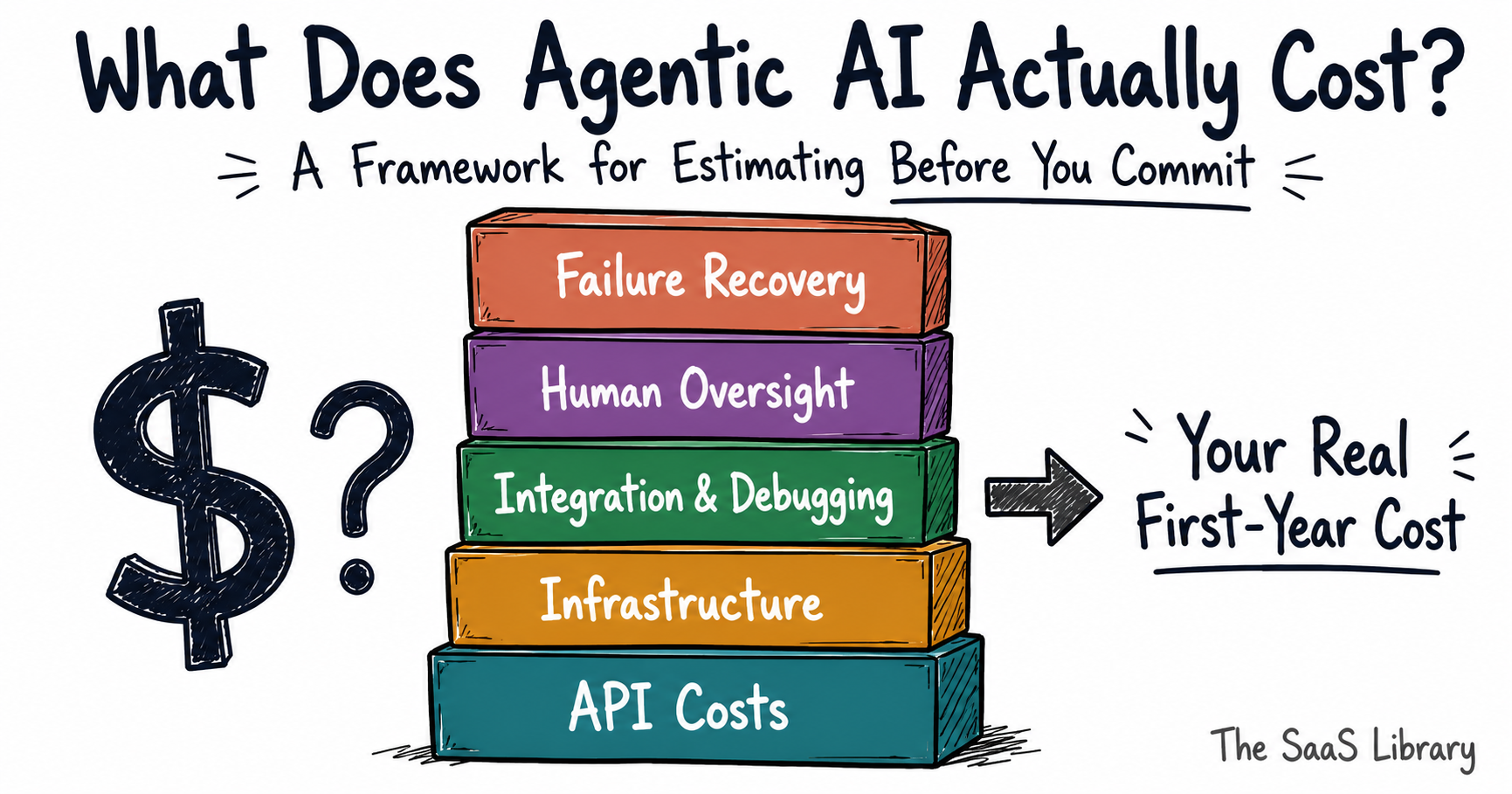 From Seats to Outcomes: How Agentic AI Is Disrupting SaaS Pricing Models and Forcing a Reckoning in Software Unit Economics | Reducates
A Market Priced for Panic
Public markets have not waited for the transition to play out. The catalyst was a moment of unusual candor: Palantir's CEO declared on an earnings call that AI is now capable of writing and managing enterprise software, making entire categories of SaaS vendors potentially irrelevant. The market reacted with a single, violent conclusion--if AI agents can perform the work of human operators, companies need fewer operators, and if they need fewer operators, they need fewer seats [2].
The bear thesis rests on precisely that premise: AI agents replace human software users, reducing seat count and therefore revenue [2]. Investors are already segmenting SaaS companies into perceived winners and losers based on their exposure to seat compression and their ability to transition pricing models, with guidance language on AI monetization and pricing transitions now determining whether valuation multiples stabilize or contract further [2]. Importantly, analysts argue the catalyst is structural rather than cyclical--this is not a temporary downturn but a permanent reallocation of how enterprises buy software [2].
The data suggests the direction of travel was already established before agentic AI accelerated it. Usage-based pricing adoption surged from 34% of SaaS companies in 2020 to approximately 60% by 2023 [8], and by 2022, 61% of SaaS companies were already using some form of usage-based model, up from roughly half that a few years prior [9]. Gartner now forecasts that by 2030, at least 40% of enterprise SaaS spend will shift toward usage-based, agent-based, or outcome-based pricing--away from the per-seat model that has defined the industry for two decades [2]. The open question, analysts note, is whether this budget rotation is a temporary reallocation during the AI build-out phase or a permanent structural shift in enterprise technology spend [2].
From Seats to Outcomes: The New Pricing Playbook
The emerging pricing landscape is not converging on a single model but fragmenting into several archetypes, each with different implications for revenue and risk.
Per-task and consumption-based pricing is the most immediately visible shift, billing for discrete units of automated work rather than human access. The examples are already in production [8]:
- Salesforce Agentforce charges $2 per AI agent conversation instead of per seat
- Zendesk AI charges $0.99-$2.00 per successful customer inquiry resolution
- Microsoft Copilot offers consumption-based pricing at $0.01 per message alongside its $30/month subscription
- Adobe Firefly implemented a "generative credits" system for AI image generation
- Atlassian Intelligence charges for Virtual Service Agent conversations after a free threshold
- GitHub Copilot uses tiered plans with premium request allocations for advanced AI models
Outcome-based pricing is the most radical alternative: customers pay only when a measurable business result is achieved, effectively making the vendor share in the value created [1]. This transforms software from a licensed product into something closer to a services business--priced per resolved ticket or per successful interaction rather than per user [7]. Analysts describe this as a shift from Annual Recurring Revenue (ARR) to "Outcome Recurring Revenue" (ORR), a fundamental redefinition of the recurring revenue concept that underpins SaaS valuations [5].
Commitment-based hybrids represent the enterprise-friendly middle ground. Salesforce has pioneered an Agentic Enterprise License Agreement offering fixed-price access to its Agentforce platform, while ServiceNow is moving to consumption-based and value-based pricing for its AI agent offerings [1]. The analogy many analysts draw is to utilities: software metered and billed like electricity, predictable in rate but variable in volume [7].
 How Agentic AI Is Squeezing SaaS Margins and Growth | Medium
The Hard Part: Why the Transition Is Messier Than the Headlines Suggest
For all the urgency, a growing chorus of strategists is urging caution. BCG's analysis is blunt: SaaS players should not abandon traditional pricing models and start charging only for usage or outcomes, because a complete reset carries significant risk. For most SaaS providers, the downside of an abrupt shift to usage- or outcome-based pricing is greater than the worst-case scenario of sticking with existing models--even for those facing aggressive seat compression. Moreover, most SaaS companies simply lack the organizational capacity--billing systems, revenue recognition processes, go-to-market structures--to implement outcome-based pricing at all [10]. Notably, SaaS revenue growth appears resilient according to Stripe data, suggesting the panic may be outrunning the fundamentals [10].
The practical challenges are substantial:
- Revenue unpredictability. Consumption and outcome models make revenue a function of customer usage patterns rather than contracted seats, complicating forecasting, Wall Street guidance, and valuation [4][8]. Companies leading this transition report higher growth rates and stronger retention, but face persistent challenges in revenue predictability and customer adoption [8].
- Measurement disputes. Defining what counts as a "successful outcome"--and attributing it to the software rather than the customer's own efforts--creates novel contractual and analytical problems that the industry has not yet solved [4].
- Cost misalignment. Consumption-based costs in agentic AI are less predictable and often higher than traditional SaaS delivery. Model inference costs, data processing volumes, and autonomous task execution create variable expenses that don't align neatly with any fixed pricing structure--per-seat or otherwise [3].
This is why most observers expect hybrid pricing to dominate the transitional era: base subscriptions with usage allowances, per-seat plans with "fair use" limits, and tiered credits rather than pure metered or purely outcome-based arrangements. The monetization strategy becomes a balancing act--aligning with value without alienating customers or complicating the sale [9]. Even vendors committed to the new models are hedging: Microsoft's dual structure of a $30/month subscription plus per-message consumption charges shows that the seat and the task can coexist, at least for now [8].
Winners, Losers, and How to Tell Them Apart
As the market segments SaaS companies into perceived winners and losers, a more disciplined framework is emerging for assessing exposure to the disruption. One research effort proposes mapping each SaaS sub-sector against three dimensions of AI disruption risk: workflow replaceability (how easily AI agents can automate the core use case), pricing model vulnerability (degree of dependence on per-seat revenue), and data moat depth (proprietary data and regulatory embeddedness) [2].
The qualitative dividing line is equally clear: companies whose products become infrastructure that AI agents use will thrive, while companies whose products replicate work that AI agents can perform natively--basic workflow automation, scheduling tools, simple data entry applications--face existential risk [1]. A deep proprietary dataset embedded in regulated workflows is a far stronger position than a standalone to-do app, regardless of pricing model.
For companies navigating the transition, practical frameworks are proliferating. A collaboration between AWS, Zuora, and Simon-Kucher & Partners offers a "COMPASS" framework for systematically reimagining customer engagement, packaging, pricing, go-to-market, value measurement, and monetization for the agentic era [3]. BCG's counsel is less about revolution and more about readiness: SaaS providers should urgently become "pivot-ready"--able to shift pricing models quickly if seat compression accelerates--without betting the company on an unproven model prematurely [10]. Veteran executives note the historical parallel: the SaaS model itself was a highly disruptive force in the early 2000s, when software was a "buy once" purchase, and traditional vendors that were not pivot-ready faced a crisis [10].
 The Death of Per-Seat Pricing: What It Means for Your SaaS P&L - The SaaS CFO
Conclusion: The Seat's Long Goodbye
The SaaS reckoning is not a forecast--it is an ongoing repricing of an entire industry. Agentic AI has severed the link between human headcount and software spend, and no pricing innovation can fully restore it. The companies that thrive in this transition will be those that internalize the core insight early: in an agentic world, software revenue must track the work software performs and the value that work creates--not the number of humans logged in [4].
Yet the destination remains contested. Outcome-based pricing is the most philosophically aligned with agentic value creation, consumption pricing is the most operationally tractable, and hybrid models are the most commercially pragmatic. Measurement challenges, revenue unpredictability, and organizational inertia mean no clear winner has emerged--and may not for years [4]. BCG's warning deserves equal weight with the disruption narrative: for most incumbents, a botched pricing reset is a bigger risk than gradual seat erosion [10].
The most honest summary may be the simplest: the seat is not dead yet. But it is no longer the future of how software gets bought [4]. For vendors, the mandate is to become pivot-ready--to build the billing infrastructure, value measurement capabilities, and organizational flexibility to shift models as the market demands. For buyers, the shift promises software priced like a services business, with vendors sharing the risk of automation actually working. And for investors, the task is to distinguish between companies being disrupted and companies doing the disrupting--a distinction that, in this reckoning, will increasingly be written into the pricing page.
References
- 1.
- 2.
- 3.
- 4.
- 5.
- 6.
- 7.
- 8.
- 9.
- 10.