Introduction
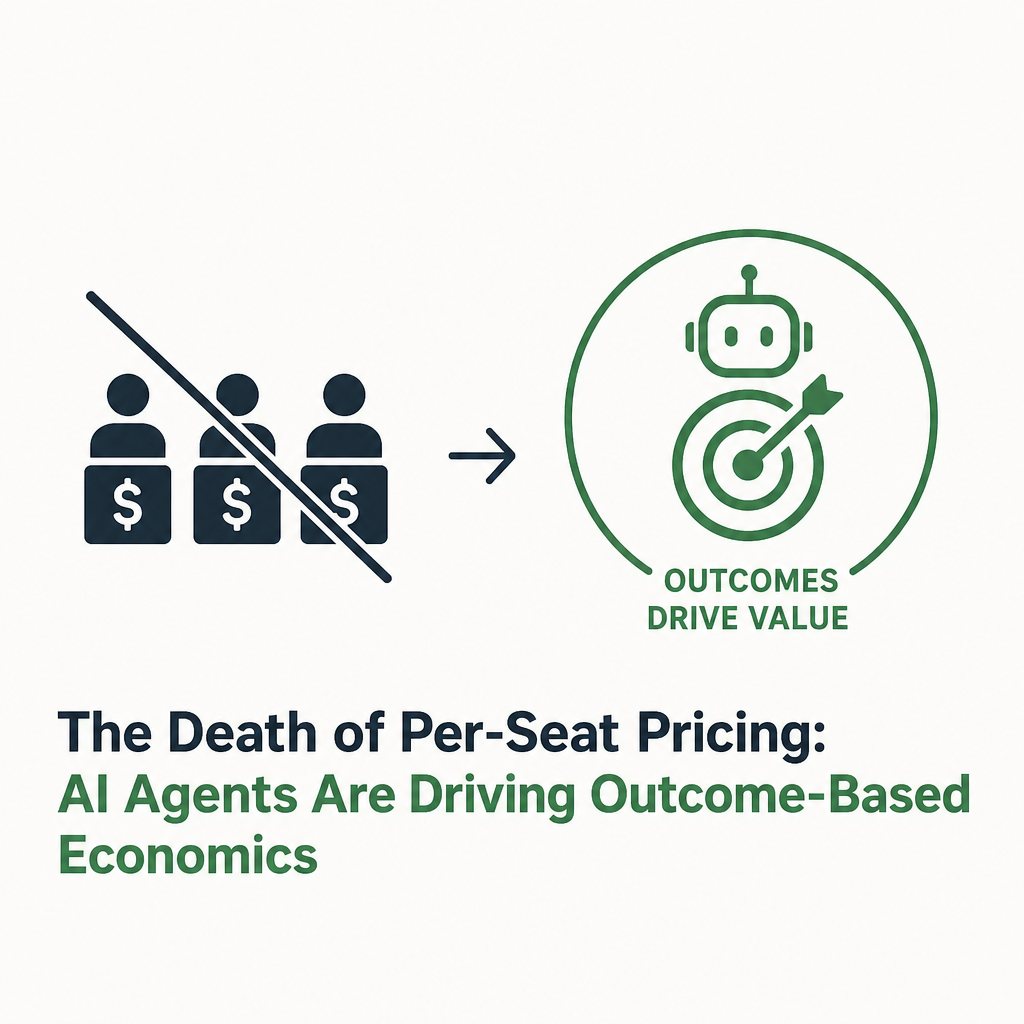
For roughly two decades, the economics of the software industry rested on a deceptively simple proxy: count the humans who log in, charge per head, and grow the list. That model powered the $250 billion SaaS industry, gave venture capitalists a predictable basis for valuing companies on ARR multiples, and made budgeting painless for customers. But that proxy has now broken in a specific and irreversible way. When a single AI agent can do the work of ten employees, the seat count shrinks even as the value delivered grows--and the pricing model simply cannot survive that arithmetic [1].
The evidence is no longer anecdotal. Seat-based pricing fell from 21% to 15% of SaaS companies in just twelve months, and IDC projects that 70% of vendors will move away from pure per-seat models by 2028 [2]. Bloomberg goes further, forecasting that subscription-based pricing will drop from 60% to 30% of SaaS models over the next decade while outcome-based pricing rises from 10% to 60%--a full inversion of the model that defined SaaS finance for twenty years [3]. This is not a forecast of some distant future. As analysts tracking the shift put it, the transition is already in progress, and the data proves it [1].
This article examines why the seat model is structurally failing, what the companies that have already moved--Intercom, Salesforce, Zendesk, Sierra AI, and others--are teaching the market, and what both vendors and enterprise buyers must do during the 2025-2026 window before the new pricing norms solidify.
Why Per-Seat Pricing Ruled--and What Made It Elegant
The per-seat model succeeded because it aligned three things perfectly in an era when software merely made human workers faster. One user, one monthly fee meant revenue scaled naturally as customers grew their headcounts [4]. The marginal cost of serving an additional user was close to zero, so vendors could sell access like an American buffet: pay a flat fee, use as much as you want, no metering, no surprises on the invoice [2]. That removed adoption friction, simplified customer budgeting, and produced the predictable recurring revenue that underpinned SaaS valuations [4].
The model's weakness was always visible in the data, even before AI arrived. Zylo's 2025 SaaS Management Index found that the average enterprise now wastes $21 million per year on unused SaaS licenses--a 14.2% increase from the prior year--and that 66% of provisioned licenses are never used [1]. The industry's own derisive term for this, "shelfware," dates back years and described a structural misalignment: once you bought a seat, you paid for it annually regardless of usage [5]. Infrastructure providers like AWS and Snowflake had already introduced consumption-based pricing at the bottom of the stack, charging only for what was actually used [5]. What AI agents have done is push that logic up into the application layer--where it collides head-on with the seat model.
 Death of Per-Seat Pricing: 73% of SaaS Rebuilding
The Mechanics of Disruption: Why Agents Break the Seat Model
The Counting Problem
Traditional SaaS pricing relied on two levers: per-user access and feature-based bundles. That worked in a world where people initiated tasks and software made those tasks faster or easier. AI agents shatter that foundation in three ways, according to Simon-Kucher's analysis: a single user can now command dozens of autonomous agents, agents create value continuously rather than only when a human clicks, and costs no longer scale with seats [6].
The arithmetic is unforgiving. A company that once required 50 Salesforce logins might now need 15, with AI handling the rest [2]. As the buyer-side question now being asked in renewal meetings puts it: "If an AI agent can do the work of three support reps, why would you keep paying for three seats?" [2]. For vendors, this creates what RSM US calls an existential challenge: a provider that sticks to per-seat pricing while its product successfully automates the tasks of human users is effectively engineering its own revenue decline [7].
Salesforce itself illustrates the paradox. Its Agentforce product is growing at over 100% year-over-year while simultaneously cannibalizing the company's seat-based revenue--the irony of building AI that helps customers need less of your product [2].
The Cost Structure Inversion
The second disruption is economic rather than behavioral. Unlike traditional software, agentic AI carries significant variable costs: every task an agent performs requires computational power, API calls, and token processing [7]. Costs now scale with agent activity, not user counts [6]. Simon-Kucher documents the predictable failure mode: a flat per-user fee with unlimited AI usage can quickly become loss-making, with one company finding that heavy users generated compute costs several multiples above their subscription price until the pricing model was redesigned [6]. The SaaS CFO community has a blunter term for this trend: AI COGS--cost of goods sold--are already eating into gross margins [3].
The Alignment Failure
Under the subscription model, revenue is artificially capped by the customer's head count, no matter how much work the software performs [7]. When usage grows faster than revenue and the most successful customers become the most expensive to serve, providers end up subsidizing their best accounts [6]. Simon-Kucher's Global Software Study found that 76% of companies have launched AI features in the past two years, yet many set only modest revenue expectations because they lacked confidence in their monetization approach [6]. The problem, as they frame it, is not that AI is complex--it is that the monetization strategy linking value created to value captured needs to change [6].
 The Death of Per-Seat Pricing --Why AI Agents Are Breaking the SaaS Revenue Model - The SaaS Library
The New Pricing Playbook: Outcome-Based Economics in Practice
Per-Resolution Pioneers
In August 2024, Zendesk became the first major incumbent SaaS vendor to launch outcome-based pricing for AI agents, billing per "Automated Resolution"--a support ticket resolved by AI without human intervention, confirmed after 72 hours of customer inactivity. Pricing is $1.50 per committed resolution or $2.00 pay-as-you-go [8]. The principle is stark: you pay when the outcome happens [3]. Intercom Fin followed the same logic at $0.99 per resolution--the product earns revenue when it works [3].
Salesforce's Multi-Model Experiment
Salesforce Agentforce launched at $2 per AI conversation, then expanded to multiple billing options after enterprise pushback: flex credits at $0.10 per action, per-user licensing at $125/month for unlimited internal use, and pure pay-as-you-go consumption [3]. The company has since introduced the most visible large-incumbent template for enterprise transition--the Agentic Enterprise License Agreement (AELA), which gives customers unlimited use of Agentforce, Data 360, and MuleSoft for a fixed fee on two- to three-year terms [8].
Credits, Hybrids, and the Emerging Taxonomy
The shift extends well beyond customer support. Figma, HubSpot, Airtable, and Monday.com all adopted credit-based models in 2025, and credit model adoption surged 126% year-over-year across the top 500 SaaS companies [3]. Maxio's data shows the supply side is already there: 83% of AI-native SaaS companies offer usage-based pricing [8].
Bessemer Venture Partners offers a useful taxonomy for understanding how pricing maps to product type. Copilots--AI sidekicks that enhance human productivity without replacing the person, like GitHub Copilot or Abridge--typically retain per-seat or consumption pricing. Agents--autonomous actors that execute entire workflows and decouple output from headcount--are increasingly priced on tangible ROI: workflow completion, cost savings, or output equivalent to a human's work. AI-enabled services blend automation with human oversight, charging for results faster and cheaper than traditional providers could deliver [9].
Crucially, the endgame is not pure outcome billing. Bain's research makes clear that hybrid models are winning--not pure outcome-based pricing [3]. The prevailing wisdom among operators is that not all software is meant for outcome-based pricing or agentic AI workflows, but the direction of travel is set [3].
 The Death of Per-Seat Pricing: What It Means for Your SaaS P&L - The SaaS CFO
The Hard Problems: Attribution, Predictability, and the Bridge Gap
Outcome-based economics is compelling in theory and difficult in practice. Three challenges dominate.
Attribution and definition. Outcome attribution is technically hard, customers are skeptical of vendor-defined outcomes, and accounting complexity increases [4]. The most commonly missed trap is contractual: buyers need to agree on what counts as "resolved" before signing. Zendesk's definition of an automated resolution is Zendesk's definition until a customer contractualizes its own--an "Outcome Measurement Agreement" is the prerequisite most teams have not yet worked through [8]. Simple, clear definitions of outcomes are also the primary defense against billing disputes, a point Bain emphasizes for vendors designing flexible pricing [10].
Predictability. Usage-based revenue is harder to forecast than seat-based revenue, and customers worry about runaway costs--a fear that makes budget approvals harder and sales motions that close on estimated usage more difficult to execute [4]. Customers citing unpredictability is now one of the predictable symptoms of a misaligned pricing architecture [6].
The bridge gap. The toughest commercial challenge may be asking customers to spend more before they see savings. Consider a vendor pitching a $40,000 AI agent that could eventually replace an $80,000 sales development rep: in the short term, the customer still needs both the employee and the agent, raising costs by 50% for an undefined evaluation period [10]. Unless vendors bridge that gap with delayed payments, flexible contracts, or performance guarantees linked directly to P&L outcomes, the sale may stall [10].
What This Means for Vendors: Reinventing the Revenue Engine
For SaaS operators, the strategic agenda is becoming clear. RSM US recommends running "shadow pricing" models now--sensitivity analyses showing how revenue flows would change if current users were billed on outcomes rather than seats. This exercise identifies customers who receive high value from automation but pay low subscription fees, the accounts most at risk in a repricing [7]. The metrics themselves must evolve: user retention alone can no longer measure business health, and outcome success rates must become a primary KPI [7].
Financial leadership should treat this as a board-level issue rather than a pricing-team detail. The guidance from SaaS finance practitioners is direct: come to the next board meeting with a pricing model audit and scenario analysis, proactively, before investors flag the drift between legacy metrics and new economic reality [3]. On the design side, Bain recommends building for flexibility--allowing customer spending to move across AI agents, use cases, and outcomes, and between seat-based and usage-based spending, so customers can manage the transition at their own pace [10].
The upside justifies the effort. Outcome-based pricing removes the headcount ceiling on revenue, allowing it to scale with the volume of work--invoices processed, tickets resolved, code generated--while aligning revenue with the rising variable costs of inference [7].
What This Means for Buyers: The Renewal Is the Battleground
Enterprise buyers hold unusual leverage right now. Gartner predicts at least 40% of enterprise SaaS spend will shift to usage-, agent-, or outcome-based models by 2030, and analysts identify 2025-2026 as the transition window in which to act [8]. As one summary of the market moment puts it: everything is up for negotiation, startups are experimenting mightily with all sorts of models, and until new norms are figured out, enterprises have significant power to push for terms that work for them [5].
The negotiating posture that works is trajectory-based rather than discount-based. Since the analyst consensus already says seat-based pricing is declining, buyers can reasonably ask for contracts that reflect that trajectory, with transition terms written in now [8]. There is also a design-partner opportunity: vendors in transition are often looking for customers willing to commit on favorable terms in exchange for early access--a fundamentally different conversation from asking for a discount [8]. The immediate hygiene step remains unchanged: audit unused licenses now, because with 66% of provisioned licenses going unused and $21 million per year wasted at the average enterprise, the seat model is already overcharging most organizations for value they never consumed [1].
Conclusion
The per-seat model is not dying overnight, and "seats are dead" remains an overstatement--Bain's research and practitioner experience alike point to hybrids, not purist outcome billing, as the winning near-term architecture [10][3]. But the direction is unambiguous. Enterprise buyers are already making decisions that compress seat counts, AI costs are already eroding gross margins, and the metrics that defined SaaS finance for a decade are drifting out of alignment with the new reality [3].
The deeper lesson is that pricing is ultimately a proxy for value, and the proxy has changed. The SaaS industry was built on counting humans; AI agents made that the wrong number to count. Outcome-based economics--pricing the work done and the results achieved rather than the access granted--produces faster revenue growth, better customer alignment, and more defensible contracts, and the early data from Intercom, Salesforce, Zendesk, and Sierra AI supports all three claims [1]. For vendors, the choice is no longer whether to engage with this shift but whether to lead it or be repriced by it. For buyers, the window to lock in favorable terms is open now--and it is closing as the new norms standardize. The outcome, in every sense, is the unit of value [1].
References
- 1.
- 2.
- 3.
- 4.
- 5.
- 6.
- 7.
- 8.
- 9.
- 10.