Introduction
For centuries, the engine of scientific progress has been the human mind: a researcher reads the literature, notices a gap, formulates a hypothesis, and designs an experiment to test it. That process is now being fundamentally reimagined. A new generation of AI systems--dubbed "AI co-scientists"--aims to automate or augment each stage of this loop, from scouring thousands of papers to proposing novel, testable research hypotheses and even designing the experiments that would validate them [1].
The most prominent example is Co-Scientist, a multi-agent artificial intelligence system built on Google's Gemini models, introduced to accelerate scientific discovery by formulating demonstrably novel research hypotheses conditioned on a scientist's objectives and prior evidence [2]. Rather than a single model answering questions, these systems deploy teams of specialized agents that generate, critique, debate, and rank ideas--an approach that mirrors the social dynamics of a real research laboratory [3]. Early demonstrations have been striking: AI-generated hypotheses have matched or even preceded human-led discoveries in drug repurposing, epigenetics, and antimicrobial resistance [4].
But can these systems genuinely match human expertise, or are they impressive mimics that stumble when research moves from idea to rigorous execution? Recent benchmarks evaluating autonomous agents on complete research experiments reveal a more nuanced picture--one of remarkable capabilities coexisting with substantial gaps in domain knowledge, experimental rigor, and autonomy [5][6]. This article examines the architecture driving AI co-scientists, the evidence for and against their scientific competence, and the profound questions they raise about the future of research itself.
Inside the Machine: How AI Co-Scientist Architectures Work
At the heart of the AI co-scientist is a multi-agent architecture with an asynchronous task execution framework, allowing multiple specialized agents to work concurrently rather than in rigid sequence [2]. The system's design incorporates a "generate, debate, and evolve" approach to hypothesis generation, inspired by the scientific method itself and accelerated by scaling test-time compute--the practice of dedicating more computational effort to reasoning at inference time [5][2].
Some agents take the research goal provided by a scientist and scour the literature, generating initial hypotheses and creative ideas. Others act as critics, extracting new insights that emerge from comparing competing ideas against one another. Additional agents then evolve the most promising hypotheses, refining them iteratively [3]. The result is something akin to a digital research team: brainstorming, peer review, and revision happen continuously and at machine speed, rather than across the weeks or months of a typical academic feedback cycle [4].
Ranking is where the system becomes particularly sophisticated. Because generating thousands of plausible hypotheses is computationally feasible, the challenge lies in ordering them by quality. Co-Scientist borrows the ELO rating system from competitive games--adjusted for scientific output--to measure hypothesis quality, and the Ranking agent conducts tournament-style matches in which hypotheses face off pairwise [4][2]. Top-ranked hypotheses are compared through multi-turn scientific debates that mitigate ordering bias and focus on novelty, correctness, and testability, while lower-ranked candidates receive faster single-turn comparisons [2].
Critically, these systems are not designed to replace scientists but to collaborate with them through an expert-in-the-loop design. Scientists steer the system, provide research objectives, inject domain insight, and evaluate outputs--while the AI runs thousands of refinements in parallel, functioning, as one commentator put it, like "a tireless scientific orchestra" [4][2].
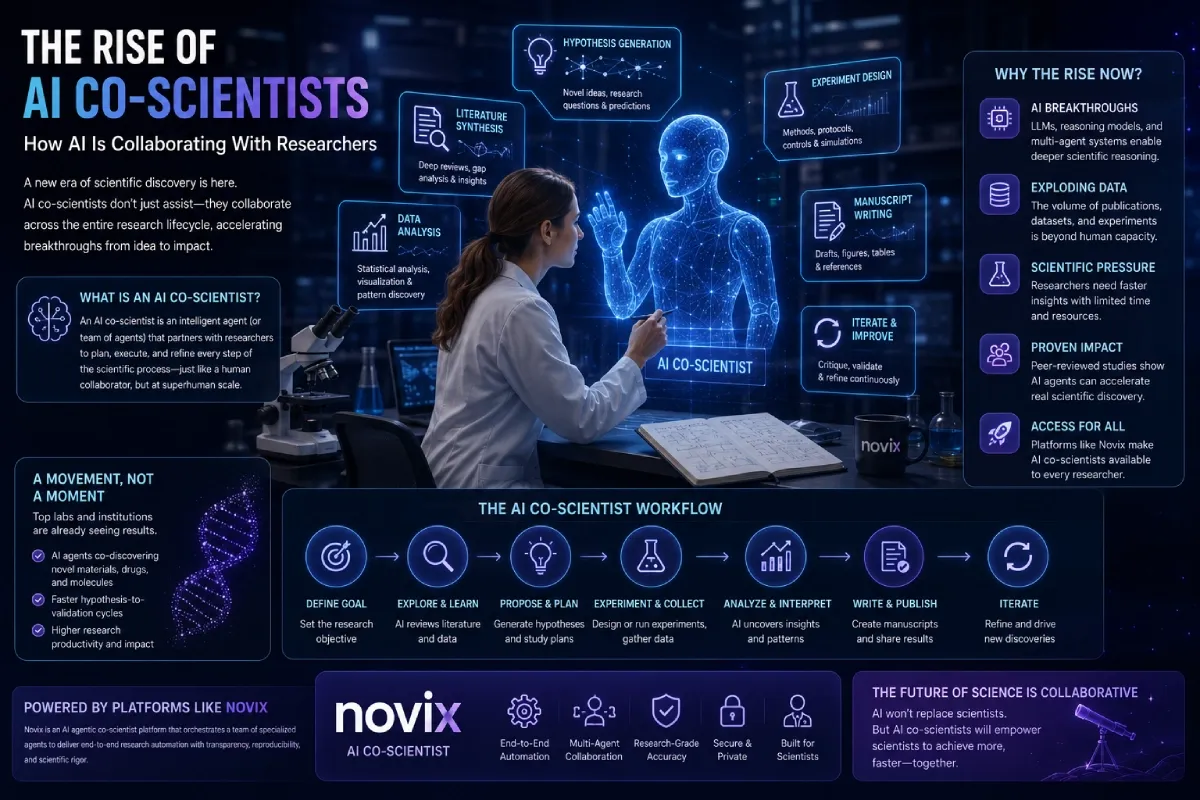 The Rise of AI Co-Scientists: How AI Is Collaborating With Researchers
From Benchmarks to Breakthroughs: The Evidence So Far
Real-World Validation
The most compelling evidence for AI co-scientists comes from cases where their hypotheses were tested against laboratory reality. In one reported example, the system identified epigenetic regulators capable of reversing disease markers in human organoids. In the domain of antimicrobial resistance, it independently rediscovered a complex interaction involving CF-PICIs and bacteriophages that human researchers had already validated--and went further, inferring that CF-PICIs co-opt phage tails for horizontal gene transfer, a conclusion matching unpublished laboratory results [4]. Observers compared the feat to "an AI astronomer independently discovering a new planet while the telescope team was still preparing their manuscript" [4].
These cases suggest that, at least in hypothesis generation, AI systems can match or even precede human-led discovery--cross-referencing findings across disciplines and spotting patterns no single researcher has the bandwidth to notice [7][4].
Measuring Rigor: The Benchmark Landscape
Hypothesis generation, however, is only the beginning of science. To assess whether AI agents can handle complete research workflows, researchers have developed demanding evaluation suites. EXP-Bench, a benchmark built from influential AI publications, challenges agents to do everything a real scientist must: given a research question and incomplete starter code, the agent must formulate hypotheses, design and implement experimental procedures, execute them, and analyze the results. A semi-autonomous pipeline extracts and structures crucial experimental details from the original papers to create high-fidelity tasks [5].
Other benchmarks probe specific research skills. AblationBench evaluates agents on ablation planning--a cornerstone of empirical AI research--through two tasks: AuthorAblation, where agents propose ablation experiments from a method section (83 instances), and ReviewerAblation, where agents identify missing ablations in full papers (350 instances), with language-model-based judges providing automated assessment [5]. Meanwhile, the AI-Researcher system has been tested on open-ended research tasks in which it receives only reference literature and must independently identify promising directions, formulate hypotheses, and execute the complete scientific workflow from conceptualization through implementation and documentation [6].
The trajectory is clear: the field is moving from asking "can AI write plausible-sounding papers?" to "can AI do rigorous, reproducible science?"--and the benchmarks suggest genuine but incomplete progress [5][6].
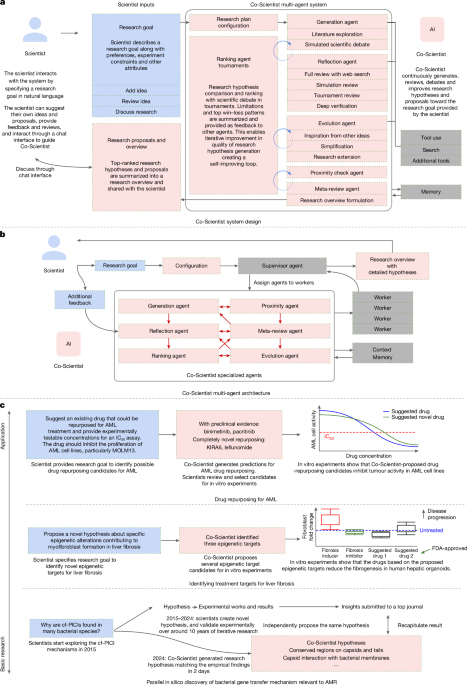 Accelerating scientific discovery with Co-Scientist | Nature
The Expertise Gap: Where Autonomous Agents Still Fall Short
Despite impressive demonstrations, the evidence reveals persistent and sobering limitations. Evaluations of AI-Researcher on autonomous research identified what its authors call "Domain Knowledge Deficiencies: The Expertise Gap"--despite sophisticated research methodologies, large language models demonstrate substantial knowledge limitations compared to human domain experts, undermining performance across multiple critical research dimensions [6].
A more fundamental challenge involves autonomy itself. As analysts of autonomous research agents note, even closed-loop research automation represents only a stride toward autonomy, and full automation of all research processes remains an unrealized goal. The problem becomes especially acute when machines must independently formulate research objectives and questions--a task requiring versatile approaches to hypothesis generation and validation adaptable to a vast range of unknowns [8]. Humans generate countless implicit questions and hypotheses while contemplating a single problem; replicating that generative, open-ended cognitive fluidity in machines remains largely unsolved [8].
Benchmarks quantify the gap from another angle: current AI agents, according to EXP-Bench's designers, still "struggle with the complexities of rigorous, end-to-end experimentation"--the unglamorous but essential work of implementing procedures correctly, debugging experiments, and interpreting messy results [5]. Integrating large language models with robotic laboratory systems is posited as essential for realizing fully autonomous, adaptable scientific discovery cycles--overcoming what one analysis wryly describes as the "sleep cycles" and expertise limitations of purely human science, but such integrated systems remain at an early stage [1].
In short: AI co-scientists excel at breadth--synthesizing literature, proposing creative directions, and generating plausible mechanisms--but human experts still hold the edge in depth, tacit knowledge, and experimental judgment [7][6].
Transforming the Research Workflow
Even with these limitations, AI co-scientists are already reshaping how research gets done. In the hypothesis-generation phase, they analyze enormous datasets, scientific papers, and experimental records to highlight underexplored questions, proposing ideas that may not be immediately apparent to human researchers--such as linking a recent advance in protein folding to a potential drug target in oncology [7]. This accelerates early-stage discovery, reduces redundant work, and lets scientists pursue more ambitious ideas [7].
In experiment design, these systems automate one of research's most tedious stages: translating standard operating procedures and literature methods into structured, executable protocols--a process that is traditionally laborious and error-prone [7]. Beyond biomedicine, AI co-scientists are contributing in materials science, optimizing experimental designs and uncovering promising directions in complex datasets [7].
Perhaps most intriguingly, researchers are beginning to frame the future not as AI replacing scientists but as a co-evolving ecosystem of human and AI scientists, in which each side's strengths complement the other's and both improve through interaction [9]. In this vision, AI transforms the slow loop of reading, hypothesizing, and testing into a fluid dialogue between human and machine--with humans contributing creativity, context, and ethical judgment while machines contribute scale, speed, and tireless synthesis [4][9].
/filters:no_upscale()/news/2025/03/google-co-scientist/en/resources/1AICoScientist-2-Overview.width-1250-1741191714553.png) Google Introduces AI Co-Scientist System to Aid Scientific Research - InfoQ
Google Introduces AI Co-Scientist System to Aid Scientific Research - InfoQ
New Bottlenecks: Evaluation, Ethics, and Governance
As AI co-scientists mature, the debate is shifting from capability to consequence. One of the least discussed effects of systems like Co-Scientist, as Google DeepMind commentary notes, is that they may change the architecture of scientific judgment itself. For centuries, the bottleneck in science was generating hypotheses; the bottleneck is now becoming evaluation. An AI system can generate thousands of plausible research directions, surface supporting literature, and rank alternatives in hours--scale no human research team can match. The governance question is no longer whether machines can assist discovery, but whether scientific institutions are prepared for a world where machines generate possibilities faster than humans can meaningfully scrutinize them [3].
Ethical questions compound this challenge. AI capable of autonomously formulating hypotheses, running experiments, and making discoveries raises profound concerns about machines rapidly unlocking new knowledge without human oversight--with implications ranging from dual-use research risks to the very definition of scientific authorship and accountability [10]. Freed from some human biases, artificial researchers could objectively tackle problems from quantum physics to medicine; but proceeding thoughtfully down the path toward fully autonomous research agents, most experts argue, is essential [10].
There are also structural risks: the automated paper-review agents being developed to evaluate AI-generated research must themselves be validated against expert peer review, raising a recursive quality-control problem--if machines generate and machines evaluate, where does human scientific judgment enter the loop? [6][3]. The likely near-term answer is the expert-in-the-loop model: scientists actively steering, filtering, and validating AI outputs, ensuring that deciding which ideas matter remains, for now, a fundamentally human responsibility [3][2].
Conclusion
The rise of AI co-scientists represents one of the most consequential developments in modern science. Systems like Google's Co-Scientist have demonstrated that multi-agent AI can generate, debate, and rank hypotheses with enough sophistication to match--and occasionally anticipate--human discoveries in drug repurposing, epigenetics, and antimicrobial resistance [4][2]. Benchmarks like EXP-Bench and AblationBench show the community taking rigor seriously, pushing agents beyond plausible prose toward complete, executable research experiments [5].
Yet the honest answer to the question of whether these systems match human expertise is: not yet, and perhaps not in the same way. The expertise gap is real--LLM-based agents still lack the deep domain knowledge, experimental intuition, and autonomous judgment of trained scientists [6][8]. The most realistic and promising future is symbiotic: a co-evolving ecosystem in which AI handles scale, synthesis, and tireless iteration, while humans supply creativity, contextual wisdom, and ethical oversight [9][4].
What is no longer hypothetical is the disruption. As the cost of generating hypotheses collapses toward zero, the scarce resources of science become evaluation, validation, and institutional judgment [3]. The institutions that thrive will be those that learn to integrate AI co-scientists into their workflows--harnessing their generative power while keeping human expertise firmly in the loop where it matters most.
References
- 1.
- 2.
- 3.
- 4.
- 5.
- 6.
- 7.
- 8.
- 9.
- 10.