Introduction
Scientific research has long been constrained by a stubborn bottleneck: the physical act of experimentation. Even the most brilliant hypothesis must wait on pipettes, reagents, instruments, and the finite hours of human researchers. Now, a convergence of artificial intelligence, robotics, and laboratory automation is challenging that constraint. "Self-driving laboratories" (SDLs)--named by analogy to autonomous vehicles--combine AI, robotics, automation, and real-time analytics to design experiments, run tests, analyze results, and iteratively improve outcomes with minimal human intervention [1]. The movement has grown from isolated demonstrations into what researchers describe as "a veritable movement of autonomous science," spanning chemistry, materials science, and the biological sciences [2].
Today's most capable SDLs automate nearly the entire scientific method: hypothesis generation, experimental design, experiment execution, data analysis, drawing conclusions, and updating hypotheses for subsequent rounds of optimization or discovery [2]. Meanwhile, a complementary development is occurring on the intellectual side of research. Google's AI co-scientist, a multi-agent system built on Gemini, generates novel, testable research hypotheses across biomedical domains--with some already validated experimentally [3]. Together, these systems raise a provocative question: can autonomous experimental systems reproducibly accelerate scientific discovery, or are the headline results isolated demonstrations that will not survive scaling?
The evidence so far suggests both genuine acceleration and important caveats. This article examines how SDLs work, what the AI co-scientist adds to the equation, what the validation record actually shows, and whether the field's governance and policy frameworks can keep pace with its technical ambition.
From Automation to Autonomy: How Self-Driving Laboratories Work
The Closed Discovery Loop
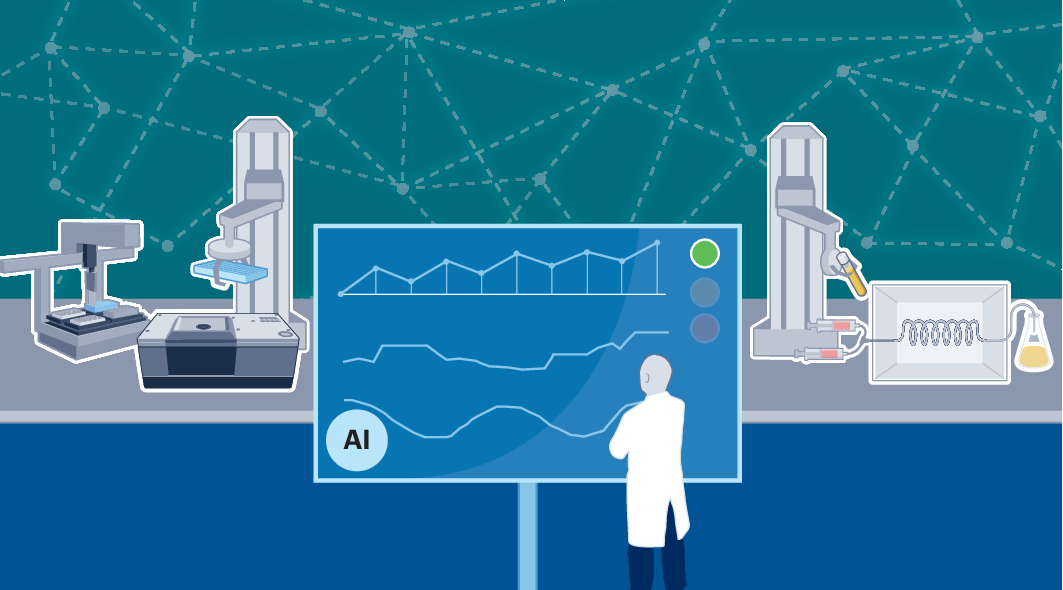
The defining feature of a self-driving laboratory is not the robots themselves but the closed feedback loop that connects them. At Oak Ridge National Laboratory (ORNL), researchers describe the operating model as follows: AI models propose experimental conditions, automated instruments synthesize materials or prepare samples, characterization tools measure the results, and machine learning algorithms analyze the data to determine the most promising next experiments [4]. This creates a continuous design-build-test-learn cycle that links AI-driven modeling with real-world experimentation, allowing researchers to rapidly explore complex scientific spaces that would be prohibitively slow to traverse manually [4].
Critically, the loop is where the "self-driving" character lives. The Aspuru-Guzik group at the University of Toronto identifies "closing the loop between experiments and computational modeling" as the key element in designing autonomous laboratories--bridging machine learning methods that predict material properties and suggest new experiments with the robotics, computer vision, and automated characterization systems that execute and measure them [5].
 The past, present and future of self-driving laboratories | Nature Reviews Chemistry
A Fundamentally Multidisciplinary Undertaking
Building a fully autonomous laboratory is not simply an automation project; it is a multidisciplinary synthesis of machine learning, robotics, computer vision, automated characterization, and domain science [5]. ORNL's vision extends further, envisioning interconnected "Labs of the Future" that combine AI, leadership-class computing, and cutting-edge instrumentation into an ecosystem of self-driving labs [4]. Argonne National Laboratory has launched a parallel Autonomous Discovery initiative premised on the idea that self-driving labs can streamline processes, save resources, and accelerate the pace of discovery by aiding in the planning, execution, and analysis of experiments [6].
Cloud Labs and the Democratization Question
A parallel infrastructure trend amplifies the SDL movement: "cloud labs" that offer subscription-based, remote-control access to experimental capabilities. Reports of AI-directed experiments executed in cloud labs are already appearing in the literature--what the Royal Society Open Science review describes as a "preview of a democratization of science that intrigues but inspires concern" [2]. A researcher without a wet lab could, in principle, direct a full experimental campaign from a laptop. That same accessibility, however, raises questions about oversight, safety, and who bears responsibility when autonomous systems perform consequential experiments.
The AI Co-Scientist: Intelligence at the Hypothesis Stage
A Multi-Agent Architecture Built for Scientific Thinking
While SDLs automate the physical cycle of experimentation, the AI co-scientist targets its intellectual core. Co-Scientist, introduced by Google and collaborators, is a multi-agent AI system built on Gemini for structured scientific thinking and hypothesis generation. Conditioned on a researcher's objectives and prior scientific evidence, it formulates demonstrably novel research hypotheses for experimental verification [7]. Its architecture features two key innovations: an asynchronous task execution framework that allows flexible scaling of test-time compute, and a "tournament evolution" process in which agents continuously generate, critique, and refine hypotheses, enabling self-improving hypothesis generation [7]. Automated evaluations show continued benefits from test-time compute scaling--hypothesis quality improves as more computational effort is invested, and the system exhibits "recursive self-improvement with increasing compute" [8][7].
From In Silico Hypothesis to Wet-Lab Validation
The system's validation record is what elevates it from a curiosity to a serious research tool. Across three biomedical domains--drug repurposing, novel target discovery, and mechanisms of antimicrobial resistance--Co-Scientist produced hypotheses that stood up to experimental scrutiny [7]. Most notably, it helped identify new drug repurposing candidates and synergistic combination therapies for acute myeloid leukemia, which were subsequently validated through in vitro experiments [7].
An even more striking demonstration involved capsid-forming phage-inducible chromosomal islands (cf-PICIs), mobile genetic elements that carry virulence and antibiotic-resistance genes across bacterial species. Given minimal background information, Co-Scientist independently proposed, as its top-ranked hypothesis, that cf-PICIs interact with diverse phage tails to expand their host range--a finding generated in just two days that precisely matched the primary discovery of an independent, co-timed genomic and experimental study conducted by collaborators at the Fleming Initiative and Imperial College London, prior to that work completing peer review [8][3]. In other words, the AI recapitulated a genuine novel discovery it had no access to.
 Self-Driving Labs: AI and Robotics Accelerating Materials Innovation | Perspectives on Innovation | CSIS
The Complementarity Thesis
Neither SDLs nor AI co-scientists are positioned as replacements for human researchers. ORNL emphasizes that "scientists remain central to the process, empowered to attend to the highest-impact aspects of their work while AI and automation accelerate experimental workflows" [4]. The Royal Society review goes further, arguing that the "intellectual complementarity of AI and human scientists" is the strongest ground for optimism: AI systems process information and solve problems differently than humans--as demonstrated in protein design and structure prediction--and a synergistic, symbiotic partnership could capitalize on the unique strengths of each [2][9]. The question, then, is not whether machines will replace scientists, but whether the combined system can reliably outperform either alone.
The Reproducibility Question: Evidence and Caveats
The Case for Acceleration
The raw throughput numbers are compelling. Unlike traditional labs reliant on manual processes and human intuition, self-driving labs can execute hundreds of experiments per day, adjusting parameters in real time based on outcomes--compressing years of research into weeks or months [10]. Combined with AI co-scientist systems that can generate and rank novel hypotheses in days, the pipeline from question to validated result is shrinking on both ends. The Foundation for American Innovation argues this is now strategically urgent: without autonomous experimentation, human-done science "will not be able to keep up with a deluge of new AI-generated material hypotheses" [10].
Reproducibility as Promise and Peril
Reproducibility is where the story becomes genuinely double-edged. On the promise side, autonomous systems offer an underappreciated gift: machine-executed protocols with comprehensive, automatically logged parameters are inherently more standardized than human-performed experiments, and observers note that SDLs can "improve reproducibility" and enable scalable experimentation as a core benefit [1]. If an SDL discovers a new compound, its robot-logged recipe is potentially trivially replayable by an identical system elsewhere.
On the peril side, reproducibility of the hardware does not guarantee reproducibility of the reasoning. Skeptics and developers alike flag persistent challenges of data quality and model reliability in autonomous research environments [1]. The Co-Scientist team itself candidly catalogues limitations requiring further work: enhanced literature reviews, factuality checking, cross-checks with external tools, auto-evaluation techniques, and larger-scale evaluations involving more subject matter experts with varied research goals [3]. An AI that confidently generates a plausible-but-wrong hypothesis is arguably more dangerous than no AI at all, because it can waste scarce experimental capacity in an automated pipeline optimized for throughput. Acceleration without validation discipline is not acceleration--it is the industrialized production of error.
 Self-driving lab accelerates discovery process for materials with multiple applications | PME | The University of Chicago
Governance, Security, and the Human in the Loop
Safeguards for Trustworthy Autonomy
The research community is not blind to these risks. ORNL identifies ensuring that AI systems and self-driving labs "are operated securely and transparently" as a central priority, with active development of safeguards for data governance, cybersecurity, and responsible use of artificial intelligence to ensure autonomous platforms operate reliably and generate valid results [4]. The SDL review similarly stresses that the technology must be "judiciously shepherded" if it is to realize its transformative potential [2], and broader analyses emphasize the continued need for human oversight in critical research environments [1].
The Policy Dimension
Acceleration is also becoming a matter of national strategy. Policy analysts argue that "closing the gap between AI design and physical discovery is now a national imperative," noting that American leadership in foundational AI will only translate into strategic advantage if paired with the capacity to rapidly test and iterate in the physical world [10]. Concrete proposals include having the White House Office of Science and Technology Policy coordinate through the Materials Genome Initiative to create a self-driving lab consortium--uniting equipment providers, robotics manufacturers, scientists, and AI developers--around a roadmap for "Grand Challenges in Autonomous Scientific Discovery," leveraging the Department of Energy's recent Request for Information on autonomous experimentation [10]. Such coordination would mirror consortia other countries have already formed [10].
Governance questions extend beyond national competitiveness. The democratizing potential of cloud labs cuts both ways: broader access to experimental capability is a scientific good, but it complicates accountability for experimental safety and dual-use research [2]. The Co-Scientist team explicitly frames its own path forward in these terms, advocating an "empiric and responsible approach" to exploring how collaborative, human-centred AI systems can safely augment human ingenuity [8][3].
Conclusion
Can autonomous experimental systems reproducibly accelerate scientific discovery? The evidence assembled across national laboratories, academic groups, and industrial AI teams suggests a qualified but genuine yes--in specific, well-instrumented domains. Self-driving labs have demonstrated the ability to run closed-loop experimentation at superhuman throughput, compressing years of search into weeks [10], while the AI co-scientist has independently recapitulated a real, unpublished discovery in two days [8] and produced in vitro-validated drug repurposing candidates for acute myeloid leukemia [7]. These are not speculative projections; they are documented results.
The qualifications matter, however. Reproducible acceleration requires that the automated reasoning layer be as trustworthy as the automated physical layer--demanding rigorous factuality checking, external cross-validation, and expanded expert evaluation that developers themselves acknowledge is incomplete [3]. It requires data governance, cybersecurity, and transparency safeguards that national labs are actively building but the broader ecosystem has not yet standardized [4]. And it requires policy frameworks that treat autonomous science as strategic infrastructure rather than a boutique academic curiosity [10].
The most defensible reading of the current landscape is that SDLs and AI co-scientists are reshaping where scientists spend their time rather than replacing them: away from routine execution and toward interpretation, collaboration, and priority-setting [4]. If the movement is shepherded judiciously, the symbiosis of autonomous experimentation and AI-driven hypothesis generation could indeed "profoundly and qualitatively transform science" [2]. The acceleration is real. Whether it remains reproducible at scale is now the central question--and it will be answered less by the speed of the robots than by the rigor of the humans overseeing them.
References
- 1.
- 2.
- 3.
- 4.
- 5.
- 6.
- 7.
- 8.
- 9.
- 10.