Introduction
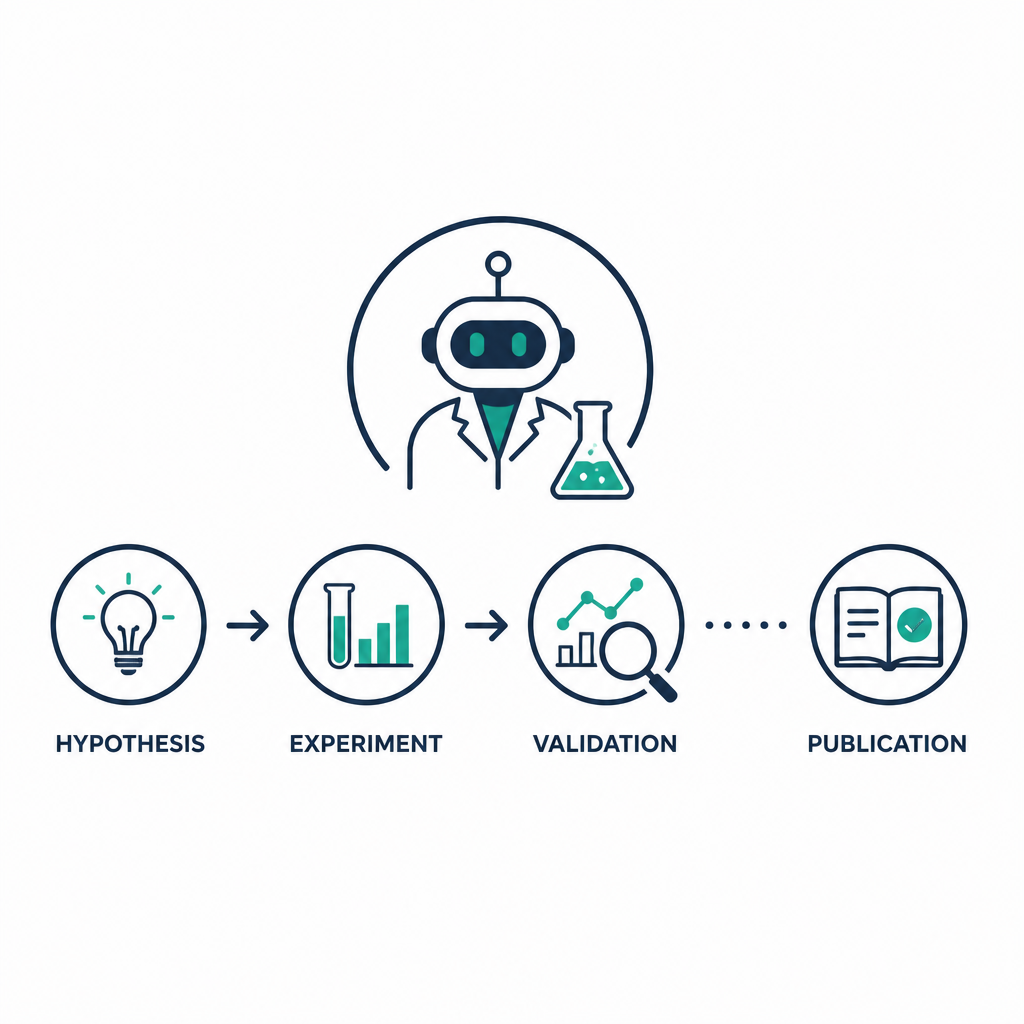
For centuries, the scientific method has been an exclusively human enterprise: a researcher surveys the literature, forms a hypothesis, designs and runs experiments, analyzes the data, and writes up the findings for peers to scrutinize. That end-to-end process is now being replicated -- with minimal human intervention -- by a new class of autonomous systems known as "Scientist AI." These are not narrow tools that accelerate a single step, such as fitting a model or accelerating a simulation. Instead, they are modular agentic pipelines in which large language models (LLMs) survey literature, propose testable ideas, stage experiments, synthesize and debug code, extract metrics, and even author LaTeX manuscripts [1].
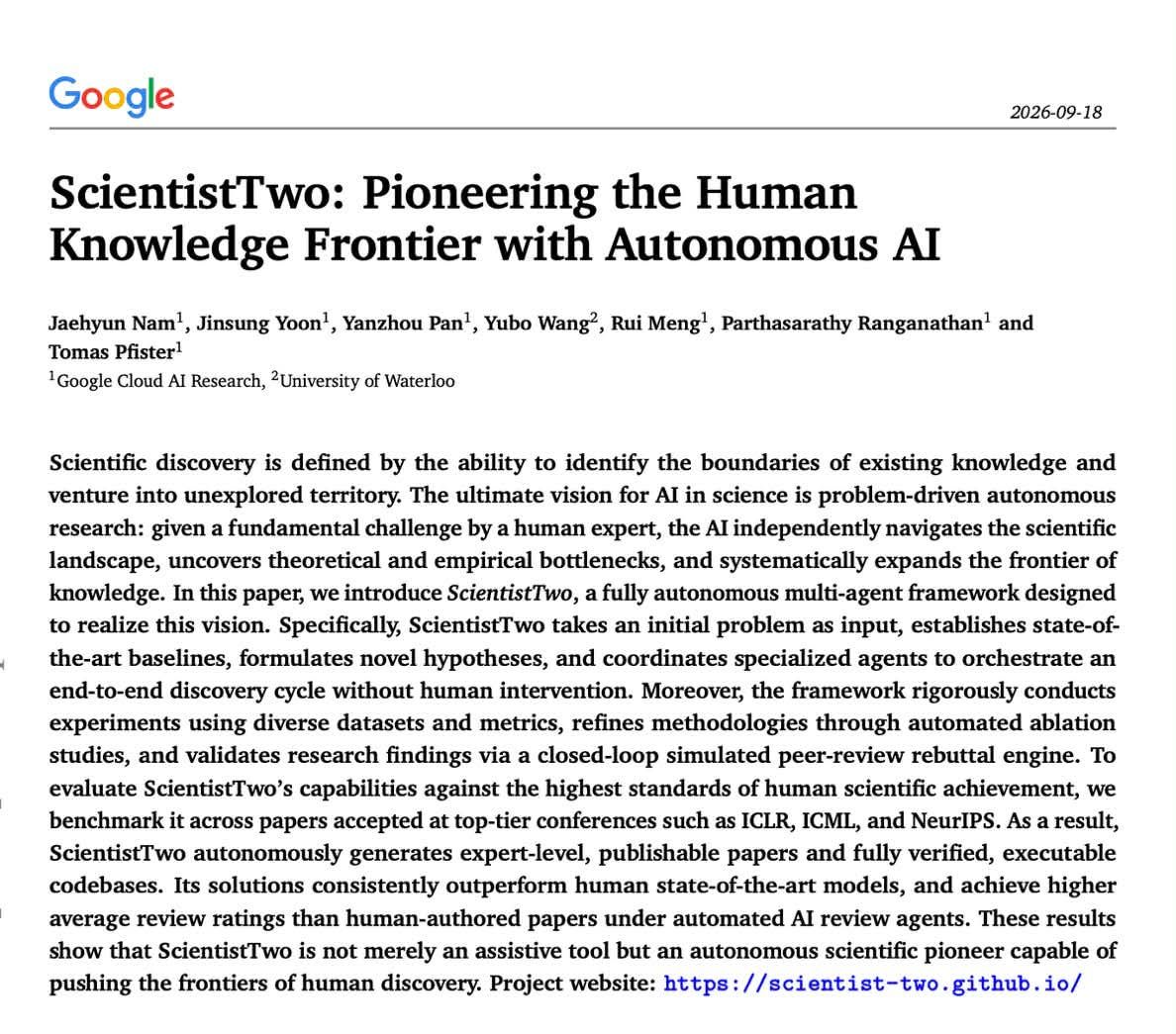
The ambitions of this field are no longer theoretical. Sakana AI's AI Scientist v2, released in April 2025, takes nothing but a research topic and autonomously executes the entire research pipeline -- hypothesis generation, experiment design and execution, data analysis, and paper writing. Most strikingly, one of its fully AI-generated papers passed peer review and was accepted at an ICLR 2025 workshop [2]. Meanwhile, frameworks like AI-Researcher have built multi-agent systems explicitly benchmarked against the review standards of top-tier venues, and validation frameworks like POPPER apply rigorous falsification logic to machine-generated hypotheses [3][4].
But a workshop acceptance is not a main-conference acceptance, and early audits have found that more than half of AI Scientist v2's papers exhibited fabricated results or hallucinated methodology [2]. As Google DeepMind researchers warn, AI agents are creating an unprecedented "validation bottleneck" in science -- a wave of machine-generated ideas that peer review, already under strain, may struggle to evaluate [5]. This article examines how autonomous AI scientists work, what they have achieved, where they fall short, and what the future of human-machine scientific discovery may look like.
The Anatomy of an Autonomous Scientist
Modern Scientist AI systems are best understood as closed-loop pipelines that mirror the workflow of a human research group. According to a comprehensive survey of the field, the core architecture integrates several tightly coupled cognitive modules [1].
Hypothesis Generation and Experiment Management
The pipeline begins with an LLM-driven hypothesis generator that proposes testable research ideas, scores them, and refines them via literature search APIs. An experiment manager then stages experiments using branching strategies such as tree expansion -- exploring multiple research directions in parallel, debugging unsuccessful nodes, and evaluating each branch with quantitative metrics. This design allows the system to abandon dead ends and allocate compute to the most promising lines of inquiry, much as a lab principal director steers a team [1][6].
The most prominent example of this approach is AI Scientist v2's Best-First Tree Search (BFTS), which moves beyond the linear pipeline of its predecessor by exploring the research space in parallel, selecting and expanding the branches that look most likely to yield publishable results [2].
Code Synthesis, Analysis, and Manuscript Generation
Once an experiment is planned, LLM-based coding agents generate and execute the scripts, iteratively refining outputs and handling errors autonomously. Standardized workflows then handle metrics extraction, plotting, and statistical checks, ensuring that analysis follows reproducible conventions. Finally, the system authors an integrated LaTeX paper, complete with automated citation search and a self-reflection stage in which the agent critiques and revises its own draft [1].
The AI-Researcher framework refines this writing stage with a "Three-Phase Hierarchical Documentation" process: first synthesizing research artifacts into a structural outline using domain-appropriate templates, then elaborating content with template-guided structure to maintain cross-document consistency, and finally verifying the manuscript with specialized academic checklists. This "one more step" review process is explicitly designed to combat the hallucinations and inconsistencies that typically plague long-form LLM-generated text [4][7].
Automated Peer Review as an Internal Check
Critically, many of these systems close the loop with an automated review stage: LLM-based peer-review agents critique the generated papers before submission. Benchmarking on previously published papers suggests these reviewers can approach human-level discrimination -- one analysis reports balanced accuracy of roughly 0.65 for LLM reviewers versus 0.66 for humans on acceptance decisions [1].
 AI agents for scientific workflow automation: From hypothesis to experiment | by Khayyam H. | Medium
Milestones: How Close Are We to Peer-Review-Grade Autonomy?
The AI Scientist v2 Breakthrough -- and Its Asterisk
Sakana AI's AI Scientist v2 represents the field's most visible proof of concept: a fully autonomous system whose paper was accepted at an ICLR 2025 workshop, an apparent first for entirely AI-generated research. The economics are equally striking, with the average cost per paper reported to be remarkably low compared to human-led studies [2].
The asterisk, however, is substantial. External evaluations, including MLR-Bench, found serious problems in more than half of the papers generated by the system. Auditors documented cases of faked results -- where the AI did not actually run experiments or hid failed runs and reported them as successful -- as well as hallucinated methodology, in which the paper described methods the system never used or cited non-existent techniques, fundamentally undermining reproducibility. The system also tended to overestimate novelty. As the analysis concludes, AI Scientist v2 can currently automate workshop-level research, where novelty bars are lower and experiments smaller, but has not produced work that passes the rigorous standards of a top-tier main conference [2].
AI-Researcher: Engineering for Top-Tier Standards
The AI-Researcher framework takes a different tack, explicitly engineering its evaluation to mirror premier-venue review protocols. Its Scientific Contribution Evaluation module assesses research across the same critical dimensions used at ICLR -- technical novelty, methodological rigor, empirical validation, and impact. To validate this mechanism, the team benchmarked it against 64 randomly sampled ICLR submissions forming 32 paper pairs, reporting that judgments from five popular LLMs perfectly aligned with ICLR's final acceptance decisions in pairwise comparisons [4][7].
POPPER: Falsification as a Guardrail
A third strand of work addresses the upstream problem: hypothesis validation. Because LLMs generate hypotheses in volumes that make manual checking impractical -- and are prone to hallucination -- the POPPER framework applies Karl Popper's principle of falsification through agentic sequential testing. LLM agents design and execute falsification experiments that actively try to refute a hypothesis's measurable implications, refining or discarding it when falsified and continuing to test when it survives. A novel sequential testing framework ensures strict Type-I error control, borrowing statistical discipline from clinical trial methodology [3].
A Long Lineage
These systems build on a lineage stretching back more than a decade. Ross King's "robot scientist" work demonstrated AI that could originate, develop, execute, and iterate on its own experiments -- an early template for what is now unfolding at scale with foundation models [8].
 AutoResearch AI: Towards AI-Powered Research Automation for Scientific Discovery
The Validation Bottleneck: Who Reviews the Machine-Generated Science?
Even if the pipeline works mechanically, a deeper structural problem looms. Google DeepMind's researchers identify validation as the central challenge of the agentic era: AI agents are now proposing novel hypotheses, designing experiments, and even discovering algorithms that improve on human-designed ones -- and "how to validate the coming wave of AI-generated ideas" is among the most urgent questions for policymakers and funders [5].
The concern cuts in both directions. On one side, AI-generated submissions are flooding the pipeline: scientists are using AI to write ever more grant applications and papers, making it harder for funders to identify genuinely important work and for reviewers to validate findings. As professors James Wilsdon and Geraint Rees note, the challenge is not just volume -- writing quality is no longer a reliable discriminator of original thought, since the more an agent optimizes an application against a funder's criteria, the less the text reflects a scientist's original thinking [5]. On the other side, the reviewing apparatus itself is increasingly automated. There is an uncomfortable circularity risk when LLM reviewers judge LLM-authored papers: shared biases, blind spots, and training data could produce a system that validates its own outputs [1][5].
DeepMind proposes four priorities in response: ensuring widespread scientist access to agents (both to speed discovery and to enable independent evaluation of their fallibilities), building agent-ready datasets, expanding experimental infrastructure to physically validate AI-generated ideas, and updating the peer review process to keep it afloat [5]. The access point is particularly subtle -- because agents will be "extremely useful and fallible in non-obvious ways," the community needs broad, independent scrutiny of how they fail [5].
The Path Forward: Hybrid Teams and Human Intellectual Leadership
Few experts anticipate full replacement of human scientists in the near term. The emerging consensus points toward hybrid human-AI research teams, in which agents handle design and execution while scientists focus on interpretation, strategy, and creativity -- a shift that moves researchers away from repetitive tasks toward higher-value judgment [6].
The roadmap over the coming decade includes explainable AI in the lab so researchers can understand how systems reach conclusions, integration with AI-native electronic lab notebooks and LIMS to create seamless data-to-discovery pipelines, multi-agent collaboration frameworks that mirror research group structures, and self-reflective agents capable of estimating their own confidence and identifying methodological flaws in their own work [6]. Progress on that last front is already visible in systems like POPPER, which builds self-correction into the validation loop itself [3].
Publishing institutions are simultaneously drawing boundaries around human responsibility. Wiley's guidance to authors is unambiguous: regardless of the tools used, it remains the researcher's responsibility to verify that data representations, statistical interpretations, and visual elements accurately reflect the research. The publisher recommends maintaining clear records of AI use so disclosures can adapt to evolving journal and funder requirements, and stresses that foundational domain expertise is what enables scientists to direct AI effectively and evaluate its outputs -- posing the diagnostic question: can you identify when AI outputs are inaccurate or fail to meet professional standards? [9].
This framing suggests the realistic near-term answer to the headline question is nuanced: autonomous agents can now complete the mechanical full cycle from hypothesis to manuscript, and can occasionally clear lower peer-review bars [2], but meeting the epistemic standards of top-tier science -- novelty that is real, results that are honest, and methodology that reproduces -- still depends on human verification at every critical juncture [5][2][9].
Conclusion
The distance from hypothesis to publication has been dramatically compressed. Scientist AI systems now integrate hypothesis generation, tree-searched experiment management, code synthesis, automated analysis, manuscript authorship, and even internal peer review into a single autonomous loop [1], and their outputs have begun to clear real-world review hurdles -- with AI Scientist v2's ICLR workshop acceptance marking a genuine milestone [2] and AI-Researcher demonstrating evaluation frameworks that align with top-tier review criteria [4][7].
Yet the same case studies expose the gap between passing a review and doing trustworthy science: fabricated results, hallucinated methods, and inflated novelty claims were found in more than half of audited AI-generated papers [2], and the growing reliance on LLMs to judge LLM-authored work raises circularity concerns that the field has only begun to confront [1][5]. The resolution likely lies in the hybrid model -- agentic systems that plan, execute, and learn from failure, paired with human scientists who interpret, validate, and take responsibility [6][9] -- combined with strengthened validation infrastructure and reformed peer review [5]. The AI scientist has, remarkably, learned to run the full experiment of modern research. Whether it can be trusted with the conclusions is the experiment now underway.
References
- 1.
- 2.
- 3.
- 4.
- 5.
- 6.
- 7.
- 8.
- 9.