Introduction
For decades, the scientific method has remained stubbornly resistant to automation. Computers have accelerated calculations, simulations, and data analysis, but the creative core of science -- formulating a novel, testable hypothesis -- has remained a deeply human endeavor. That boundary is now under pressure. A wave of "AI co-scientist" systems, built on large language models (LLMs) and orchestrated as autonomous multi-agent frameworks, claims to do more than summarize literature: they aim to generate original research hypotheses, design experiments, and accelerate discovery in fields as demanding as biomedicine and materials science [1][2].
The most prominent of these systems, Google's AI co-scientist, is built on Gemini 2.0 and was unveiled as an assistive tool designed to synthesize vast scientific literature, propose novel research directions, and structure experimental plans -- with early tests reportedly spanning drug repurposing, antimicrobial resistance, and liver fibrosis treatment [2]. Meanwhile, academic teams have developed specialized benchmarks and agent frameworks for materials discovery, testing whether LLMs can generate viable hypotheses under real-world constraints that go far beyond graduate-level exam questions [3][4].
The stakes of this debate are high. If autonomous agents can reliably generate hypotheses that are genuinely novel and experimentally validated, the pace of discovery across entire disciplines could transform. If they merely repackage known information in fluent prose, the "AI scientist" risks becoming an expensive elaboration engine. This article examines the architecture, the early evidence, the rigorous new evaluation efforts, and the pointed criticisms shaping our understanding of what AI co-scientists can -- and cannot -- yet do.
 Accelerating scientific discovery with Co-Scientist | Nature
The Architecture of Machine Scientific Reasoning
What distinguishes an AI co-scientist from a chatbot is not raw model capability but orchestration. The defining design pattern is the multi-agent system, in which specialized LLM-driven agents interact in structured workflows that mirror the scientific method itself.
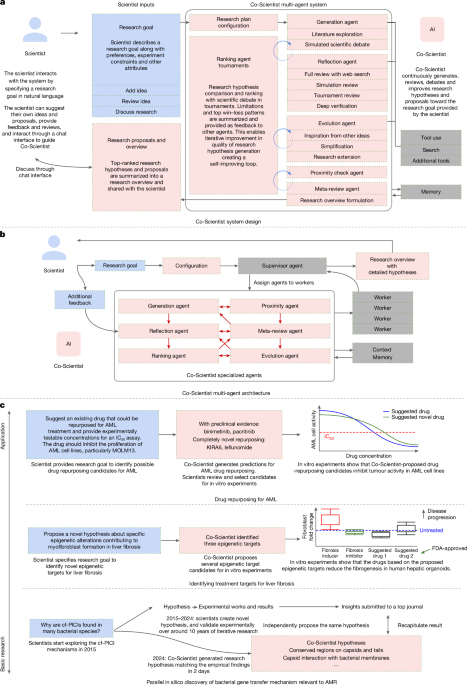
Google's AI co-scientist exemplifies this approach. Given a research goal specified in natural language by a scientist, the system deploys a coalition of specialized agents -- Generation, Reflection, Ranking, Evolution, Proximity, and Meta-review -- that iteratively generate, evaluate, and refine hypotheses in a self-improving cycle of increasingly high-quality outputs [1]. This is not a one-shot answer generator: the agents engage in automated feedback loops, with evolutionary processes that tournament-select and mutate promising hypotheses over time [1][2].
This "proposer-critic" dynamic -- in which some agents generate initial ideas while others rigorously challenge their assumptions -- has become a foundational paradigm across the field. A recent survey of autonomous agents for scientific discovery highlights how this structure has been implemented in specialized frameworks such as ACCELMAT for materials science, which uses a structured, iterative loop of proposal and critique among multiple agents to progressively enhance the quality of novel material hypotheses [4]. The VIRSCI framework extends the concept further by simulating entire scientific teams using real-world academic data, enabling agents to form collaborative research groups and generate ideas through inter- and intra-team discussion [4].
The significance of these architectures is twofold. First, they address a known weakness of single LLMs -- the tendency toward plausible-sounding but unexamined claims -- by institutionalizing critique. Second, they enable what Google describes as recursive self-improvement, where hypothesis quality scales with increased compute and iteration, a property the company cites as evidence of the system's potential to address grand challenges in science and medicine [1].
 The Rise of the AI Co-Scientist and the Future of Discovery
Early Evidence from Biomedicine: Promising, With Caveats
Biomedicine has emerged as the primary proving ground for AI co-scientists, and the early results are genuinely striking -- even if their interpretation remains contested.
In one widely reported case, the AI co-scientist identified potential new treatments for acute myeloid leukemia (AML), surfacing novel targets through sophisticated epigenetic analysis and accelerating the discovery of new drug candidates [5][2]. In another experiment, the system proposed the same explanation for how bacteria evolve resistance to phage therapy that a research group had independently reached -- but arrived at its conclusion in a fraction of the time, synthesizing fragmented evidence across a massive literature in days rather than years [2]. The system has also generated testable hypotheses for liver fibrosis treatment and antimicrobial resistance, domains where breakthroughs depend on making sense of vast, fragmented data [2].
What makes these demonstrations notable is their framing. Google emphasizes that the AI co-scientist is an assistive tool rather than an autonomous researcher -- scientists define the research goals, review the outputs, and retain control of the experimental validation process [2]. This "expert-in-the-loop" design reflects a broader consensus in the field: as one survey of AI scientists notes, Google's system was designed from the outset to collaborate, requiring human researchers to define goals, review results, and integrate the outputs into real research programs [6]. Early access is currently mediated through a Trusted Tester Program, with research groups in biomedical settings actively evaluating its capabilities [2].
Industry adoption is following a similar collaborative logic. At Merck Research Laboratories, AI agents are being used to orchestrate discovery workflows and integrate insights across disparate data sources -- linking molecular design data with cell-based experiment results and human genomics to help scientists see the bigger picture [7]. Researchers at Pacific Northwest National Laboratory have built their own "co-scientist" system in which an agent generates new hypotheses and rationales after analyzing data and literature provided by human scientists [7].
Materials Science: Stress-Testing Hypothesis Generation Under Rigorous Constraints
While biomedicine offers dramatic anecdotes, materials science has arguably produced the more scientifically rigorous test of whether LLM agents can truly generate viable hypotheses -- because researchers there have built careful benchmarks to find out.
A recent research effort introduces MatDesign, a dataset curated in collaboration with materials science experts from journal publications in leading venues, featuring real-world design goals, constraints, and methods for developing application-specific materials [3]. Crucially, the dataset is constructed exclusively from papers published in 2024 -- deliberately placing it beyond the knowledge cutoff of all major LLMs [3]. This design choice matters enormously: it means the systems cannot simply retrieve memorized answers, and any valid hypothesis generation must reflect genuine reasoning about materials relationships rather than recall.
Using this benchmark, the researchers tested LLM-based agents that generate hypotheses for achieving given goals under specific constraints, and proposed a novel scalable evaluation metric designed to emulate the process a materials scientist would use to critically evaluate a hypothesis [3]. This addresses a persistent gap in the field: earlier benchmarks assessed LLM knowledge within graduate-level subdomains of materials science or narrow chemistry tasks, but failed to evaluate the capability that actually matters for discovery -- generating application-specific hypotheses under real-world constraints [3].
This work sits within a rapidly expanding ecosystem. The ACCELMAT framework applies the proposal-critique paradigm specifically to materials discovery, and broader efforts to map autonomous research workflows across chemistry, biology, materials, and physics are consolidating around dedicated repositories tracking idea generation and hypothesis formulation as distinct research capabilities [4][8]. The pattern across these efforts is consistent: the field is moving from demonstration to measurement, insisting that claims of machine-generated scientific insight be tested against expert-curated, contamination-free benchmarks.
 The Rise of AI Co-Scientists: How AI Is Collaborating With Researchers
The Skeptic's View: Novelty or Sophisticated Repackaging?
For every optimistic claim about AI co-scientists, there is a pointed counterargument -- and the most serious critiques come from within the biomedical data science community.
A critical analysis from Elucidata's biomedical data scientists argues that Google's AI co-scientist functions "more like a smart assistant that repackages known information" than a groundbreaking research collaborator. In the system's own flagship case studies on liver fibrosis and antimicrobial resistance, they contend, the so-called "novel" findings were already present in the source materials the AI was given -- merely paraphrased in different language [9]. This is a fundamental challenge to the novelty claim: rediscovering what is implicitly in your input corpus is pattern synthesis, not discovery.
The critique goes deeper than novelty. Perhaps most provocatively, these analysts argue that hypothesis generation is not actually the bottleneck in biomedical research -- scientists need help testing and interpreting complex data, not generating more ideas [9]. Even with a sophisticated multi-agent architecture, the system lacks the creative reasoning and scientific judgment required to contribute meaningfully to genuine discovery, on this view [9]. If true, the field may be optimizing the wrong step of the scientific pipeline.
Notably, Google's own researchers acknowledge substantial limitations. Their report identifies the need for enhanced literature reviews, factuality checking, cross-checks with external tools, auto-evaluation techniques, and larger-scale evaluation involving more subject matter experts with varied research goals [1]. Independent surveys similarly caution that the shift toward AI as an "active discovery system" necessitates careful examination of capabilities, limitations, and ethical concerns [6]. The honest picture, then, is not one of settled consensus but of an active, unresolved debate about what these systems are actually doing -- with even their creators calling for the kind of rigorous external validation that benchmarks like MatDesign are beginning to provide.
From Ideas to Experiments: The Integration Frontier
Where the debate heads next may depend less on better hypothesis generators and more on closing the loop between ideas and experiments. A key emerging trend is the coupling of agentic AI to physical infrastructure: researchers have demonstrated GPT-based agents writing and executing protocols on cloud laboratories, where an AI can be told what to synthesize or measure and will generate the code to run robotic lab apparatus [7]. Agent-based platforms for catalysis research now combine hypothesis generation, data interpretation, and robotic experiment control in a single "co-scientist" loop [7].
The ecosystem is also diversifying institutionally. Beyond Big Tech systems, decentralized "co-scientists" such as Bio Protocol's Aubrai are emerging for specific research communities, alongside drug-hunting agents and autonomous platforms pushing frontiers in chemistry and biology [7]. Some researchers envision a future "AI research cloud" where agentic systems share hypotheses and results with one another at high speed, each specializing in a piece of a larger puzzle [7].
Yet the same vision documents that celebrate these developments also implicitly confirm the current division of labor: humans define goals, review results, provide judgment, and perform or validate the experiments [6][2]. The AI co-scientist, for now, is a partner in ideation and planning -- not an autonomous replacement for the scientific enterprise itself.
Conclusion
Can autonomous LLM agents generate novel, testable hypotheses that advance real discovery? The emerging answer is a qualified yes -- with qualifications that matter. The architectural innovations are real: multi-agent systems with generation, critique, ranking, and evolution loops represent a genuine departure from static language models and produce measurably refined hypotheses [1][4]. The early biomedical results are compelling, from AML drug targets to a rapid rediscovery of bacterial resistance mechanisms [5][2]. And the materials science community is building exactly the kind of contamination-free, expert-curated benchmarks needed to separate genuine reasoning from memorized recall [3].
But the skeptical critique deserves equal weight. Evidence that AI outputs sometimes rephrase what was already latent in their input corpora [9], combined with the argument that hypothesis generation is not science's true bottleneck [9], tempers the enthusiasm considerably. Even Google's own limitations list -- factuality checking, external tool cross-checks, larger expert evaluations -- reads as a roadmap of what has not yet been proven [1].
The most defensible position is that AI co-scientists are neither the hype nor the hoax, but a powerful new instrument whose value depends on how carefully it is wielded. The systems that have shown real promise are precisely those designed as collaborators rather than replacements -- with experts in the loop, hypotheses grounded in testable protocols, and claims subjected to external validation [1][6][2]. If the field sustains that discipline, the rise of the AI co-scientist may be remembered not as the moment machines replaced scientists, but as the moment scientists gained a tireless, well-read, and increasingly useful partner in the hardest step of discovery: knowing what to ask next.
References
- 1.
- 2.
- 3.
- 4.
- 5.
- 6.
- 7.
- 8.
- 9.