Introduction
The axis of global geopolitical rivalry has shifted. For decades, the defining contest between the United States and China was framed in terms of trade deficits, tariff wars, and currency manipulation. Today, that conflict has migrated to the microchip--the foundational architecture of artificial intelligence. As AI development becomes increasingly concentrated in just two global power centers, the US and China, control over the physical hardware required to train these systems has emerged as the primary leverage point in a new Tech Cold War [1].
At the heart of this conflict is a fundamental reality: advanced AI models require massive computational power, and the most advanced AI chips are overwhelmingly designed by US companies and manufactured by a fragile global supply chain vulnerable to diplomatic pressure. By weaponizing this chokepoint through sweeping export controls, the US hopes to maintain a strategic lead and prevent China from deploying AI for military and surveillance applications. Yet, this strategy is fraught with complexities, triggering a massive Chinese push for self-reliance, fracturing global tech alliances, and challenging the very assumptions underlying Washington's containment strategy.
The New Theater of War: From Trade Disputes to Compute Controls
The narrative of an "Artificial Intelligence Cold War" represents a paradigm shift from the ideological and nuclear standoffs of the 20th century to a contest defined by algorithmic supremacy and semiconductor supply chains [2]. In this new theater, compute--the sheer processing power required to train large language models and advanced AI systems--has replaced oil as the critical strategic resource.
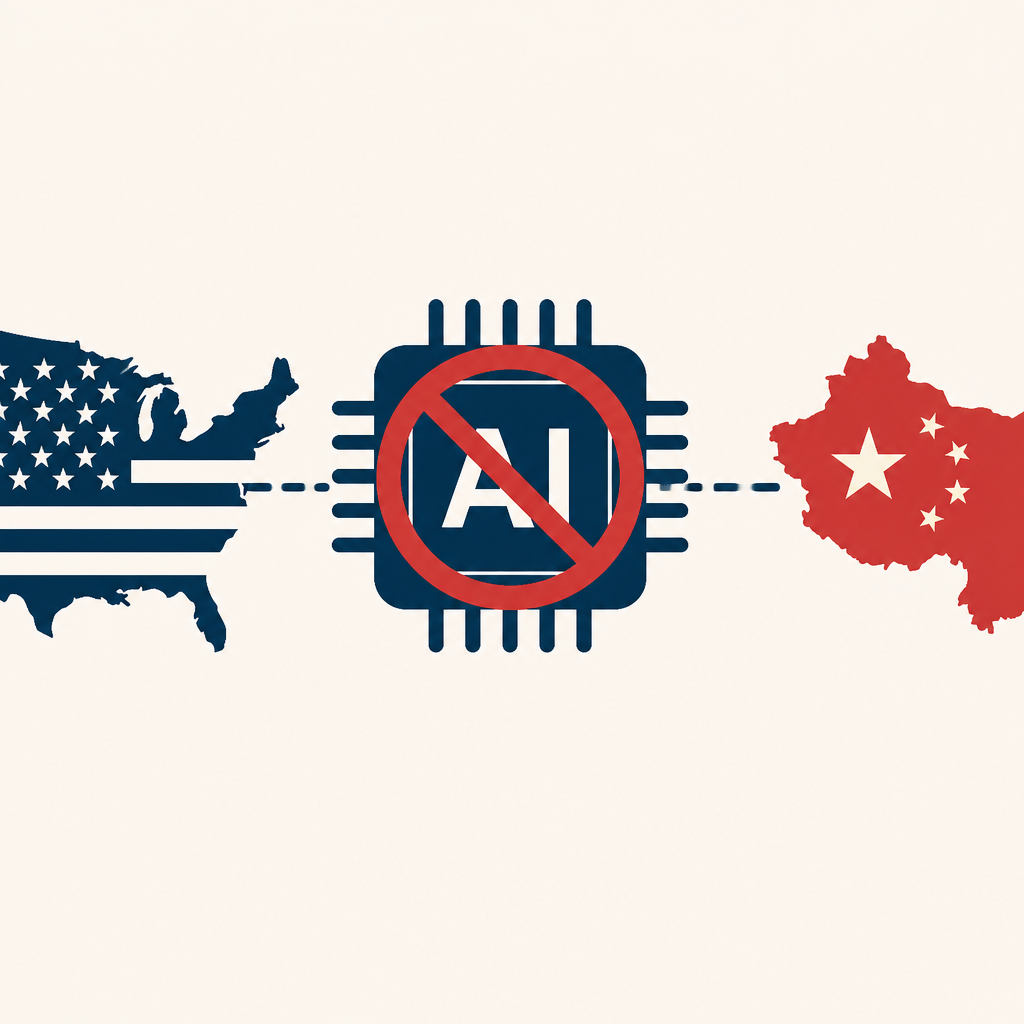
Recognizing this, US policymakers have moved aggressively to bifurcate the global tech ecosystem. The strategy involves building competing blocs, with each side attempting to secure its own supply chains while actively denying critical resources to the adversary [3]. This has led to an unprecedented industrial policy push, characterized by massive subsidies for domestic semiconductor manufacturing and strict export curbs aimed at cutting off China from the most advanced AI accelerators, such as Nvidia's H100 and A100 GPUs. The ultimate goal is to force a strategic vulnerability upon China's AI sector, ensuring that the US retains the upper hand in the AI arms race [3].
 U.S.-China Tech Cold War: AI Export Controls
The Weaponization of Silicon: Mechanics and the CoCOM Illusion
To understand the current export control regime, one must look at the distinction between training and inference compute. Training frontier AI models requires enormous, highly interconnected clusters of specialized chips. Inference--deploying those models to generate outputs--also demands significant hardware, particularly for advanced reasoning models that "think" before answering [4]. US controls have primarily targeted the training phase, seeking to prevent China from building the massive GPU clusters necessary to develop next-generation foundational models.
Some US policymakers view this strategy through the lens of the Coordinating Committee for Multilateral Export Controls (CoCOM), the Cold War-era body that successfully restricted sensitive technologies from reaching the Soviet Union [5]. However, experts warn that this historical analogy is deeply flawed. During the original Cold War, restricted technologies like aircraft engines were physically large, discrete, and slow to evolve. Furthermore, US-Soviet trade was limited, making enforcement relatively straightforward [6]. By contrast, modern semiconductors are microscopic, evolve on a Moore's Law timeline, and exist within supply chains that have been deeply intertwined since the US extended permanent normal trade relations to China in 1992. In today's ecosystem, discerning national origins and preventing diversion is exponentially more difficult [6].
China's Optimization Playbook: DeepSeek and the Efficiency Pivot
Rather than capitulating, China has responded to US export controls by treating sanctions as a catalyst for self-reliance and radical efficiency. Billions of yuan are being redirected into domestic chip design and manufacturing, with the explicit goal of freeing China's AI sector from US control [7]. This has given rise to a new generation of Chinese tech champions that are learning to do more with less.
The most striking example of this adaptation is DeepSeek, a Chinese AI firm that developed advanced techniques to overcome bandwidth limitations in the Nvidia H800 chips--a slightly degraded version of the H100 that was briefly legal to export to China. DeepSeek's engineers achieved this by programming 20 of the 132 processing units on each H800 specifically to manage cross-chip communications, bypassing Nvidia's standard CUDA software platform to work at a lower, more efficient programming level [4]. Such adaptations reflect a broader trend: while Chinese AI models currently lag the US frontier by an average of seven months, the gap is being managed through sheer algorithmic ingenuity rather than raw hardware supremacy [1]. As analysts note, Chinese hardware is closing the gap, but its immediate strategy is to optimize around existing bottlenecks [1].
 The Limits of Chip Export Controls in Meeting the China Challenge
The Global Squeeze: Allies, Adversaries, and the "Player or Playground" Dilemma
The US cannot wage the compute cold war alone; it requires the cooperation of allied nations that control other critical nodes in the semiconductor supply chain, such as the Netherlands (which houses ASML, the monopoly producer of advanced lithography machines) and Japan [8]. This has placed extreme pressure on third countries, forcing them to choose between aligning with US security objectives and preserving their lucrative commercial ties with China.
Europe, in particular, faces what EU High Representative Josep Borrell has termed the choice between being a "player" or a "playground" in the emerging tech order [8]. While the US has aggressively lobbied European allies to restrict chip-making equipment sales to China, European nations view these US export restrictions with a mix of skepticism and concern over lost economic sovereignty [8]. Meanwhile, nations like Canada find themselves caught in the crossfire, facing pressure to align with US curbs while simultaneously trying to protect their own nascent semiconductor autonomy from the volatile swings of US domestic politics--such as the Trump administration's shifting stances on rescinding or modifying Biden-era AI chip curbs [9].
To succeed long-term, analysts suggest the US and its allies must adopt a strategy of "allied scaling"--pooling their comparative advantages across the full AI tech stack to out-produce and out-innovate China [5]. However, maintaining a unified coalition is difficult when the economic blowback is immediate and the long-term efficacy of export controls remains uncertain.

Conclusion
The geopolitics of compute represents a high-stakes, unprecedented experiment in economic statecraft. By restricting the flow of advanced AI chips, the United States has drawn a hard line in the silicon sand, attempting to structurally limit China's AI capabilities. Yet, the early returns of this strategy reveal a complex battleground. Export controls have undeniably slowed China's access to sheer brute-force compute, but they have also acted as a accelerant for Chinese technical innovation, as evidenced by the algorithmic breakthroughs of firms like DeepSeek.
Furthermore, the strategy has exposed the immense difficulty of fracturing deeply globalized supply chains and the strain it places on transatlantic and Pacific alliances. As the US-China Tech Cold War accelerates, the defining question will no longer be simply about who controls the most chips, but whether raw computational scale can ultimately outpace algorithmic efficiency--and at what cost to the unified global technology ecosystem that drove the AI revolution in the first place.
References
- 1.
- 2.
- 3.
- 4.
- 5.
- 6.
- 7.
- 8.
- 9.