Introduction
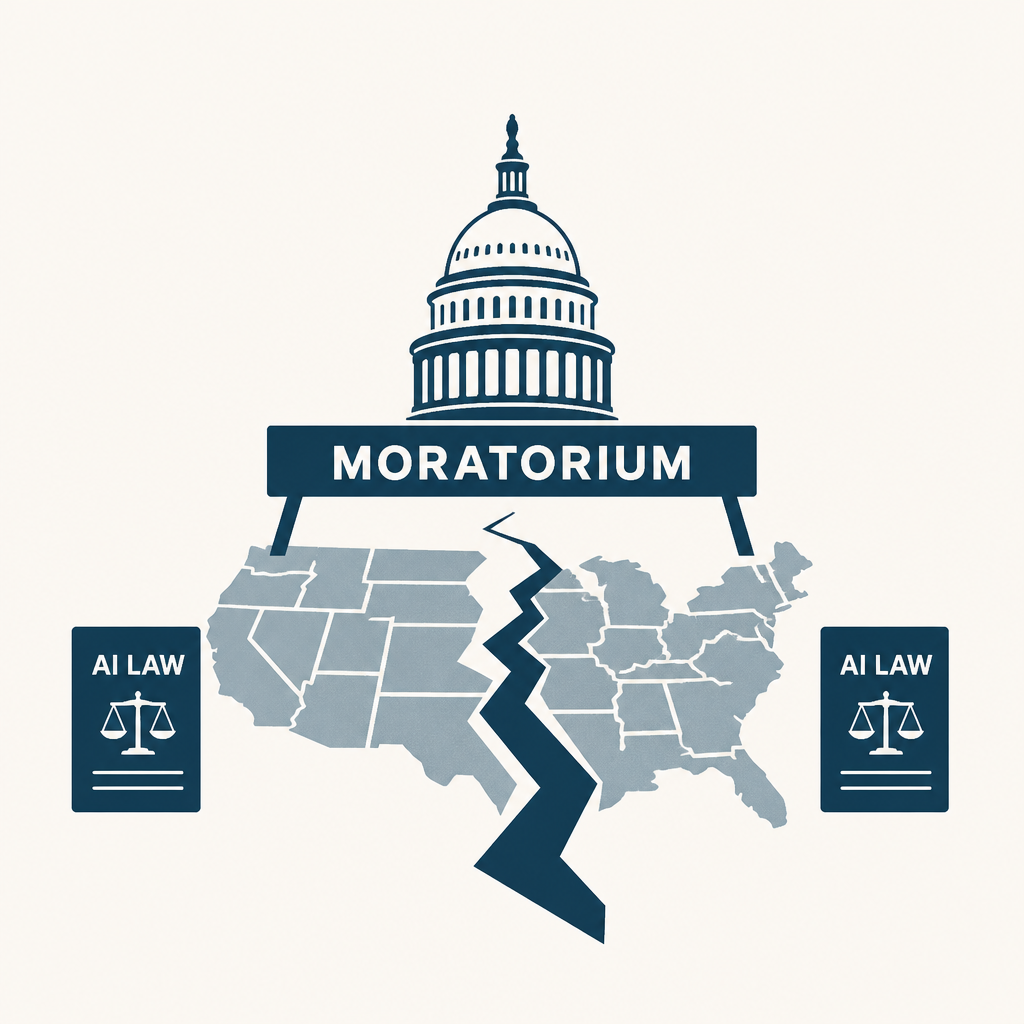
In the spring of 2025, as American state legislatures churned out artificial intelligence legislation at an unprecedented pace, Congress attempted a dramatic intervention. Attached to a sweeping budget reconciliation bill was a provision that would have barred states from enforcing "any law or regulation limiting, restricting, or otherwise regulating AI models, AI systems, or automated decision systems" for a period of ten years [1]. The stated goal was straightforward: halt the proliferation of a complex and fragmented patchwork of state AI laws in order to support AI development and innovation across the country [1].
What followed was a legislative defeat of rare unanimity. The Senate voted 99-1 to strip the moratorium from the bill--a rebuke so total that it transformed the debate from a question of whether to preempt state AI laws into a case study in the limits of federal power when no comprehensive federal alternative exists [2][3]. The proposal's collapse did not end the fight, however. It merely shifted the battlefield: to the National Defense Authorization Act, to draft executive orders, to litigation task forces, and to the leverage embedded in federal broadband funding [2][4][3].
The moratorium fight matters because it crystallized the central dilemma of American AI governance. Thousands of AI bills have been introduced in state legislatures, with hundreds enacted this year alone, creating a regulatory landscape that businesses decry as fragmented and unworkable [5]. Yet the effort to sweep that landscape aside--without putting anything in its place--revealed a Congress unwilling, or unable, to build the national framework that both sides of the debate claim to want.
Anatomy of the Moratorium: What Congress Proposed
Back in May 2025, the U.S. Congress proposed adding the controversial moratorium on state AI laws to its budget reconciliation package--legislation that also included a $500 million investment through the Department of Commerce to modernize federal IT systems using commercial AI and automation technologies [1][6].
The mechanics of the proposal were deceptively simple but sweeping in effect. Although the moratorium would not technically have prevented states from introducing and passing new AI laws, the broad restriction on enforcement of such laws would have rendered doing so pointless, at best [1]. Crucially, the provision targeted not only future legislation but existing laws as well, prohibiting state and local governments from enforcing regulations already on their books for the duration of the ten-year ban [1][2].
The drafting itself became a source of controversy. The reconciliation moratorium attempted to distinguish between state laws that "limit," "restrict," or "regulate" AI--which would be blocked--and those that "facilitate" AI--which would be allowed [2]. According to analysts at the Center for American Progress, this asymmetry made the provision especially difficult to interpret, which in turn would have made consistent enforcement nearly impossible; a blanket moratorium banning all state AI laws, whether restrictive or supportive, would at least have been more straightforward [2].
Supporters framed the provision as a temporary pause rather than permanent preemption--a "regulatory forbearance" that would give federal policymakers time to study the technology, develop appropriate guardrails, and ensure a consistent national regulatory environment [7][6]. Critics saw something quite different: an overbroad handcuffing of state authority that was, in the words of one contemporaneous analysis, "over-broad, unproductive, and likely unconstitutional" [6].
 Proposed Moratorium on US State AI Laws is Short-Sighted and Ill-Conceived | TechPolicy.Press
A 99-1 Rejection: The Legislative Defeat and Its Aftermath
The moratorium's path through Congress was rapid and rocky. After significant media scrutiny and bipartisan opposition mounted, the Senate voted 99-1 to strip the state preemption provision from the bill--now known as the One Big Beautiful Bill Act--which ultimately passed without it [3]. Senator Ted Cruz (R-TX) had championed the moratorium's insertion into the Senate package, but the vote demonstrated that opposition crossed party lines entirely [2].
The opposition was not confined to Washington. On June 3, a letter from 260 state lawmakers captured the philosophical core of the resistance:
"States are laboratories of democracy accountable to their citizens and must maintain the flexibility to respond to new digital concerns. Our deliberation over different approaches to AI and digital governance provides a stronger foundation for effective policymaking across the country." [1]
The main reason the proposal proved so controversial and was ultimately defeated was precisely this philosophical rejection of the federal government constraining and preempting the states in this way. The notion of preemption was viewed unfavorably in a context where there was no comprehensive AI law to take precedence--states' hands were being tied without a proposed alternative on the table [1].
Even high-profile administration advocacy could not salvage the provision. Commerce Secretary Howard Lutnick insisted that such a measure was needed to protect national security and was "required to stay ahead of our adversaries and keep America at the forefront of AI" [4]. The argument failed to move a Senate that, on this issue, found rare bipartisan common ground: AI regulation is remarkably popular across the country, whether in blue states or red states [8].
The defeat did not deter preemption advocates for long. On November 17, 2025, House Republican leaders were reported to be actively considering preemption of state AI laws, with an eye on the National Defense Authorization Act as the possible legislative vehicle. President Donald Trump amplified the message on Truth Social the next day, claiming that AI investment had made the U.S. economy the "hottest" in the world and that state overregulation threatened to derail this growth [2]. But Congress once again declined to act: comprehensive federal preemption language was also rejected in the 2025 NDAA [9][3].
The Case for the Moratorium: Innovation, Uniformity, and the "Patchwork" Problem
To understand why the moratorium kept resurfacing, it is essential to understand the argument for it--one grounded in economics rather than ideology.
The push for state-level AI rules, proponents argue, creates significant economic risk, primarily because AI is not a single, easily defined technology. This definitional ambiguity makes it difficult for regulators to craft effective rules, leading to policies that may be either too broad or too narrow. The resulting compliance burdens function, in effect, as a tax on innovation [7]. Because these costs are largely fixed, they disproportionately harm smaller firms and startups by creating significant entry barriers and reducing market competition [7].
The numbers give this argument empirical weight. Per-company annual AI compliance spend now ranges from $50,000 to $500,000, with initial audit cycles running $25,000-$150,000 and enterprise-scale monitoring systems adding $1.5-3 million annually--burdens that disproportionately affect mid-market and small organizations relative to hyperscalers [9]. The scale of state activity is equally striking: thousands of AI laws have been introduced in state legislatures, with hundreds enacted in a single year [5].
Defenders of the moratorium also invoked history. America's digital technology policy framework at the dawn of the internet succeeded, they contend, precisely because Congress chose not to preemptively solve every hypothetical concern before online innovation could flourish. Neither a federal internet bureau nor 50 different state computer control commissions held innovators back; instead, America's internet policy vision was rooted in "forbearance, flexibility, and freedom" [10]. Congress, after all, has a long history of limiting state interference with interstate markets and commerce in order to foster national uniformity and economic growth [10].
There was also a practical, intra-governmental dimension. A growing patchwork of conflicting state regulations threatens to stall federal efforts to modernize IT systems, forcing agencies to procure AI tools from a much less robust marketplace. The moratorium and the bill's $500 million IT modernization investment were, in this view, tightly linked: without a stable national framework, federal agencies themselves become victims of fragmentation [6]. Proponents also noted that the moratorium did not strip states of their power to enact and enforce broad, generally applicable laws protecting citizens' privacy and security--the default under the proposal was for technology-neutral state safeguards to endure [10].
 Unpacking the 10-year Moratorium on U.S. State AI Laws
The Case Against: Laboratories of Democracy Without a Federal Alternative
Opponents of the moratorium advanced a counterspective that proved politically decisive. The "patchwork" of state laws, they argued, is not a byproduct of overzealous state action but a direct consequence of industry obstruction at the federal level. Industry has long warned about the risks and costs of fragmented state laws--yet those same companies have often been the first to oppose serious federal proposals, particularly comprehensive privacy bills, that would have unified standards and granted them the very preemption they now claim is necessary. In that context, state leadership is not a bug but a feature of the system [2].
The deeper objection was structural: preemption without replacement. The United States has long treated states as laboratories of democracy, giving them the freedom to pilot new solutions [2]. The moratorium inverted that model, freezing state experimentation during a decade in which AI technology itself would evolve dramatically--all while Congress offered no federal framework, no federal privacy law, and no federal AI safety regulator to fill the void [1][3].
This vacuum was not hypothetical. States were actively legislating on the frontier of AI governance: Texas passed one of the most comprehensive AI governance bills in the nation, California continued to assert itself as a de facto national AI policy leader, and Colorado's pioneering AI Act--though later "reset" through legislative revision--demonstrated that states were willing to iterate and refine their approaches in response to feedback [9][4]. Two pending state bills alone--New York's proposed "Responsible AI Safety and Education Act" and Illinois's "Artificial Intelligence Safety and Security Protocol Act"--were cited by moratorium supporters as evidence of fragmentation, but to opponents they exemplified exactly the kind of deliberative experimentation the federalist system was designed to permit [10].
The legal architecture of the moratorium fight also weighed against preemption advocates. As the Ropes & Gray analysis of the subsequent executive actions concluded, the Executive Order itself acknowledges the absence of a federal regulatory framework--which complicates the administration's contention that state AI laws conflict with federal law. Tellingly, Congress's repeated rejection of preemption provisions could suggest that Congress does not intend to foreclose state regulation of AI at all [3].
The Executive End-Run: Executive Orders, Litigation Task Forces, and Funding Leverage
Blocked in Congress, the push to override state AI laws migrated to the executive branch--where its legal footing became considerably shakier.
President Trump's July 2025 AI Action Plan telegraphed a desire to pull grant funding from states that enforce "burdensome" or "unduly restrictive" AI laws [4]. A draft executive order went further, proposing the establishment of an AI Litigation Task Force to challenge state AI statutes and restricting federal funding for states with "onerous" AI laws--naming California and Colorado as prime examples [9][4]. The administration has also promoted a non-binding legislative framework calling for federal preemption of state laws imposing "undue burdens," while preserving narrow state authority over child safety and government procurement--recommendations on which Congress has not acted [9].
When the executive order was ultimately issued, its posture was telling. Rather than simply nullifying state laws--an action beyond any president's power--it directed officials to "prepare a legislative recommendation establishing a uniform Federal policy framework for AI that preempts State AI laws" [8]. Observers were blunt in their assessment: the White House cannot preempt state AI laws; only Congress has this power. Two attempts to preempt state AI laws in Congress had already failed, one with a 99-1 vote against it. The executive order was characterized not as a power move but as a desperation move--one that could actually strengthen California's position as the de facto AI policy leader for the United States [8].
The primary mechanism available to the executive--holding broadband (BEAD) funding hostage and denying it to states with strong AI laws--was seen as legally vulnerable and potentially counterproductive [8]. As Ropes & Gray concluded, an executive order is neither a statute nor a regulation and does not itself have the force of law; it is insufficient on its own to preempt state laws. The viability of the administration's legal theories is uncertain, particularly given the order's own acknowledgment of the absence of a federal regulatory framework and Congress's rejection of recent preemption efforts [3].
 In dramatic reversal, Senate kills AI-law moratorium - The Washington Post
The Road Ahead: New Vehicles and Unresolved Questions
The moratorium's defeat has not produced a truce--it has produced a search for new vehicles and new coalitions.
In Congress, preemption efforts continue to morph. One emerging approach involves bundling AI preemption with child online safety legislation, a pairing that could complicate opposition by attaching the unpopular moratorium concept to broadly popular child-protection bills [4]. Drafts of narrow tech legislation with preemption clauses are already moving out of committees, including a hollowed-out version of the Kids Online Safety Act [8]. Some members of Congress have proposed regulatory flexibility for companies caught in the state patchwork, while the White House continues to outline federal priorities through its AI Action Plan [5].
Meanwhile, the underlying dynamics that produced the state patchwork remain fully intact. States will continue to legislate, and businesses and the public will keep calling for national standards and consistency [5]. The Bipartisan Policy Center has framed the core challenge going forward as designing bipartisan approaches that provide national assurances on privacy, accountability, and transparency while preserving space for states to test, refine, and surface solutions that inform further federal action [5].
What the moratorium fight established is a boundary condition: preempting state authority without a substantive federal replacement is a hard sell [5]. It also established an unusual political fact--Republicans and Democrats in Congress are uniquely united on the underlying question of AI regulation's legitimacy [8]. The question is no longer whether the states' role will be defended, but whether Congress can convert that unity of opposition into unity of construction: an actual national framework rather than a veto over everyone else's.
Conclusion
The moratorium fight was, on its surface, a single legislative provision in a budget bill. In substance, it was a stress test of American federalism applied to the defining technology of the era--and the results were instructive on every side.
The episode demonstrated that the "patchwork" problem is real: compliance costs ranging from tens of thousands to millions of dollars annually fall hardest on smaller firms, and thousands of state bills create genuine uncertainty for businesses operating nationwide [9][5]. It demonstrated, equally, that the solution cannot simply be declared from above: a 99-1 Senate vote confirmed that tying the hands of 50 states for a decade, with no federal framework to take the place of state protections, violates a deep bipartisan intuition about how American governance works [1][2][3]. And it demonstrated the limits of executive improvisation: an AI Litigation Task Force and threatened funding cuts cannot substitute for legislation that Congress has twice declined to pass [4][3].
The unresolved fault lines remain starkly drawn. One camp sees fragmented regulation as an economic hazard demanding a strategic national pause and, ultimately, technology-neutral federal standards [7][10]. The other sees state leadership as the essential engine of democratic responsiveness--laboratories producing the evidence and legitimacy on which any sound national framework must ultimately rest [1][2]. The next chapter of American AI governance will be written by whichever side can move first from obstruction to construction. So far, the only thing Congress has agreed to build is a wall against preemption itself.
References
- 1.
- 2.
- 3.
- 4.
- 5.
- 6.
- 7.
- 8.
- 9.
- 10.