Introduction
For nearly a decade, the trajectory of AI regulation appeared to move in only one direction. The European Union, riding the momentum of its GDPR-era "Brussels Effect," adopted the world's first comprehensive AI law in 2024, while U.S. states like Colorado raced to build their own frameworks and Canada advanced federal legislation. As recently as two years ago, this created "the impression that continued regulatory expansion was inevitable" [1]. Compliance teams at multinational companies organized budgets, headcounts, and roadmaps around a simple assumption: the regulatory tide was coming in.
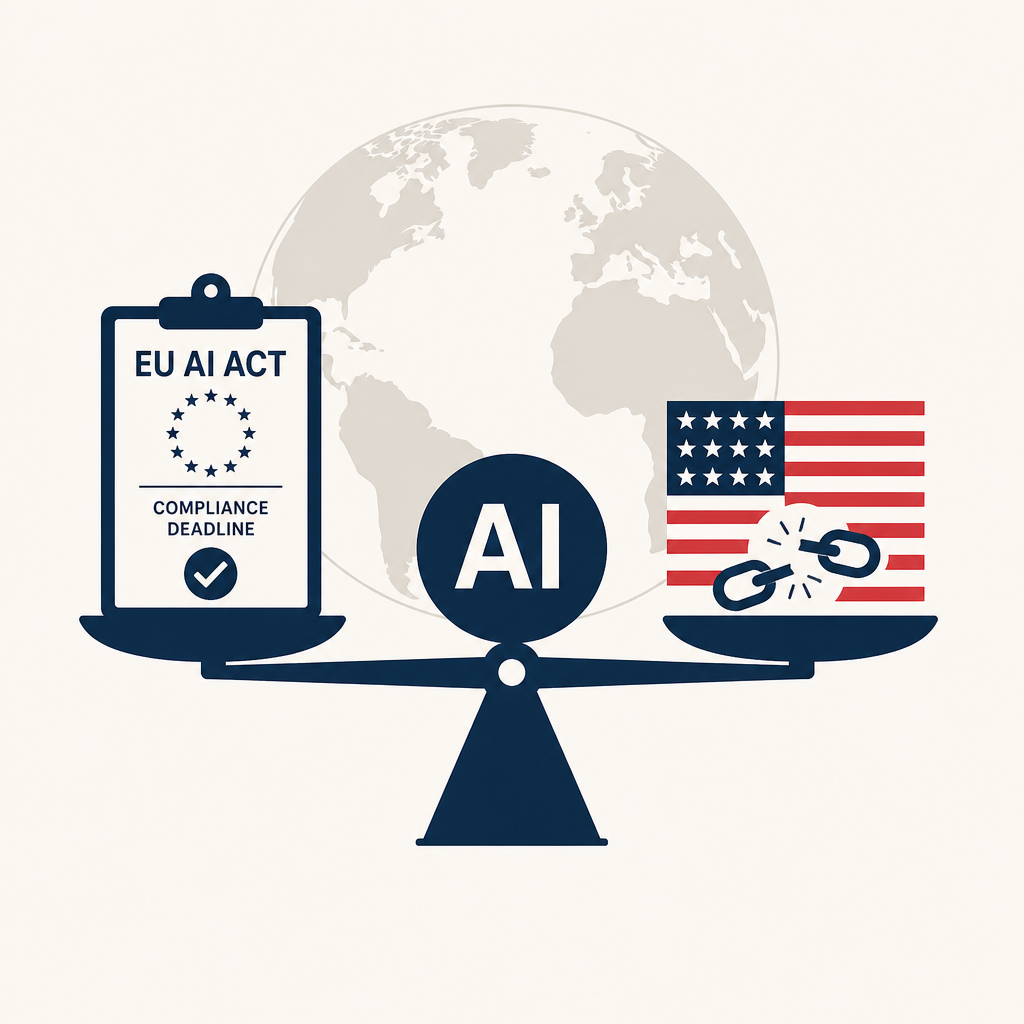
That assumption has now collapsed. In a stunning reversal, EU lawmakers agreed on May 7, 2026, to postpone the AI Act's high-risk system obligations--originally set to bite on August 2, 2026--to December 2027 and August 2028, following a fraught negotiation over the European Commission's Digital Omnibus proposal that nearly broke down in April [1][2]. Meanwhile, across the Atlantic, the U.S. federal government has embraced a "light-touch, innovation-first" posture and is actively working to preempt state AI laws it deems burdensome, while Colorado became the first jurisdiction to stage a major rollback of its own comprehensive AI statute [1][3].
The result is a genuine collision--not simply between enforcement and deregulation, but between competing visions of who will set the standards governing the most transformative technology of the era. This article examines the EU's regulatory retreat, America's about-face, the compliance reality confronting global companies, and the high-stakes contest to define global AI governance.
The EU's Regulatory Retreat: From Brussels Effect to Digital Omnibus
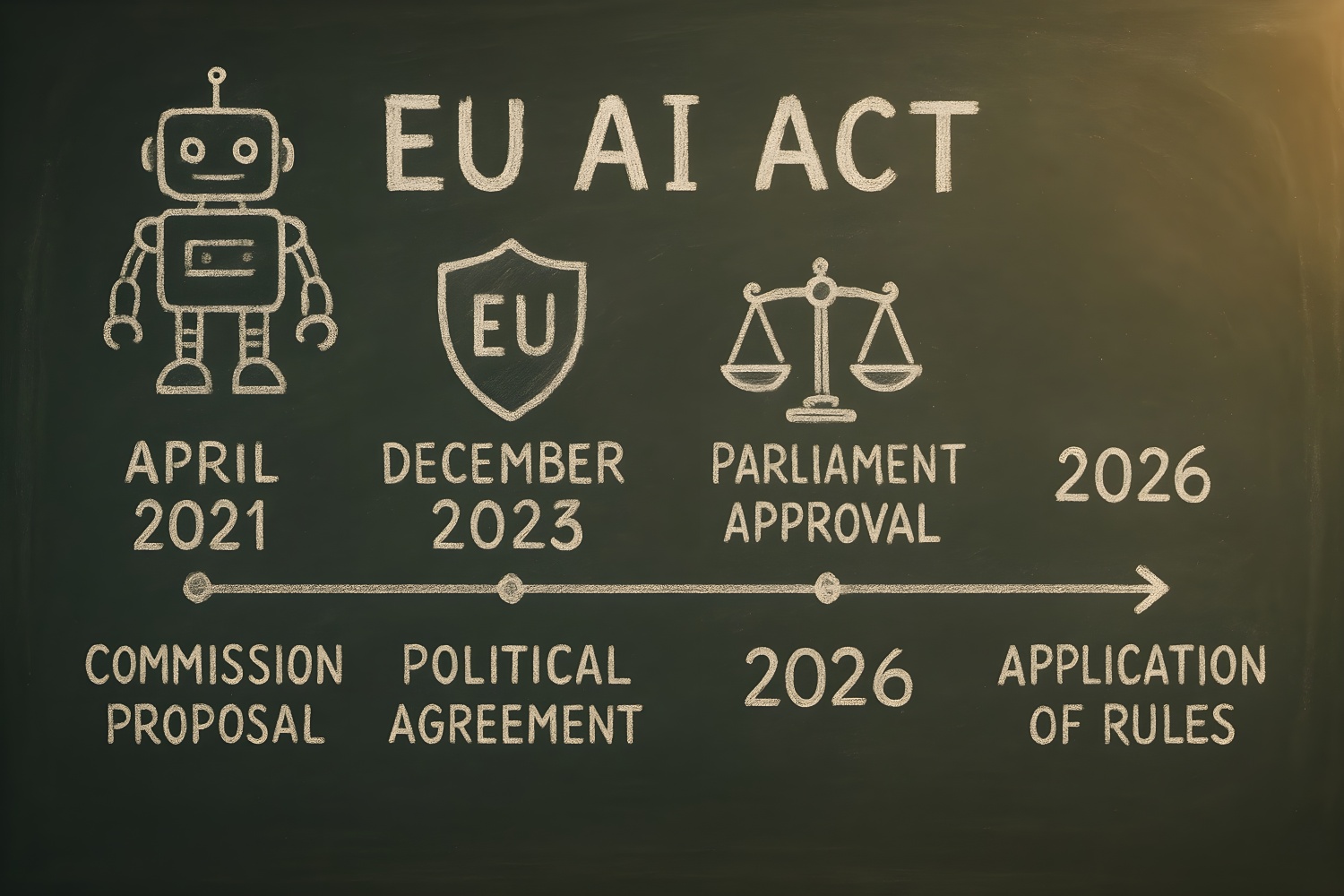
The EU AI Act entered into force on August 1, 2024, with a deliberately phased application--the product of years of preparatory work dating to 2018, when the European Commission first outlined its three-pillar AI strategy of investment, socioeconomic adaptation, and an ethical-legal framework to strengthen European values [4]. The early phases landed on schedule: prohibited AI practices, such as social scoring and certain manipulative systems, became enforceable in February 2025, and transparency obligations for general-purpose AI (GPAI) models followed in August 2025 [5][6]. Regulators have been steadily building enforcement capacity around these provisions ever since [6].
A Timeline Under Pressure
The Act's center of gravity, however, has always been its high-risk regime--the requirements applicable to AI used in critical infrastructure, education, employment, essential services, law enforcement, migration, and justice. Those obligations were slated to apply beginning August 2, 2026 [1][5]. As that deadline approached, it became clear that the ecosystem the Act depends upon was not ready: harmonized technical standards, conformity assessment infrastructure, and regulatory guidance remained unfinished, leaving companies facing the Act's most demanding provisions without the compliance tools needed to meet them [1].
The Commission's answer was the Digital Omnibus, which proposed linking the applicability date to the availability of harmonized standards, with fixed backstop deadlines of December 2, 2027, for standalone high-risk systems and August 2, 2028, for AI embedded in regulated products--a potential 24-month delay for the provisions with the most direct operational impact on deployers [1].
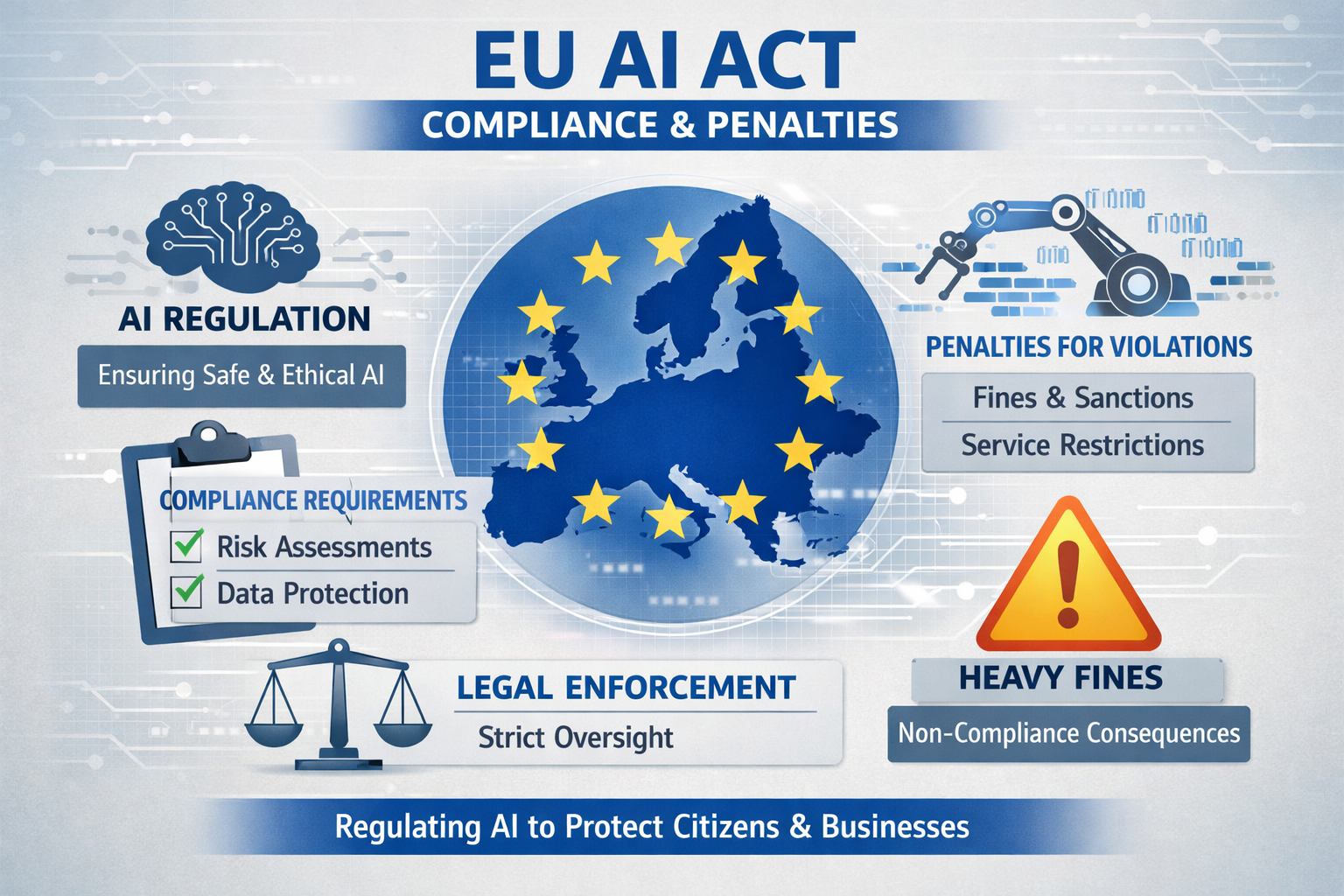 EU AI Act Compliance: What Companies Need to Know About Penalties
The May 2026 Political Agreement
On May 7, 2026, after negotiations that "almost broke down" the previous month, EU lawmakers reached political agreement on the revisions, delivering "some much-needed certainty" though the deal remains subject to formal adoption [2]. The compromise establishes separate fixed deadlines for the Act's two main high-risk categories, granting a 16-month postponement to December 2, 2027, for "Annex III" systems such as those used in employment, education, and essential services [2].
The final deal is notably more textured than a simple delay. It reduces overlap with sectoral rules, provides relief for small and mid-cap companies, and adds a ban on non-consensual intimate content [2]. In two areas, negotiators actually tightened the text relative to earlier drafts: providers seeking exemption from high-risk classification must still register their systems in the EU database, albeit with reduced information requirements, and earlier relaxations on bias screening were rolled back [2]. Some technology and medical device companies remain disappointed that a full exemption for AI embedded in their products was not achieved [2].
America's About-Face: From Patchwork to Preemption
While Brussels recalibrated, Washington executed a genuine reversal. The U.S. federal posture in 2026 "favors a light-touch, innovation-first standard and is actively working to preempt state AI laws it views as burdensome" [3]. There is still no comprehensive federal AI statute; policy is being set through executive action and proposed legislation, and remains hotly contested [3]. This marks a decisive break from the transatlantic convergence that some observers had hoped for, and which analysts at Brookings had mapped in detail, noting how divergent regimes create practical impossibilities--for example, when a European developer must guarantee robustness or explainability of a third-party model accessed remotely from a jurisdiction with an entirely different regulatory regime [7].
Colorado's Reversal and the State Landscape
The most symbolically significant American retreat occurred in the states. Colorado, which had passed the first comprehensive U.S. state AI law, became "the first major rollback" [1]--a move that punctured the assumption that U.S. states would simply replicate the EU model, as they largely did with privacy laws after GDPR [4].
The state landscape is now strikingly heterogeneous, and not uniformly restrictive. Montana enacted the nation's first "Right to Compute Act" in April 2025, affirming citizens' fundamental right to own and use computational resources including AI tools, while still requiring deployers of AI-controlled critical infrastructure to maintain risk management policies aligned with frameworks like the NIST AI Risk Management Framework [8]. Other states have treated AI regulation as experimental: one state AI Policy Act, structured as a "sandbox" pilot with fines up to $2,500 per violation, is set to repeal--essentially sunsetting itself after a bounded test of regulatory approaches [8].
 EU AI Act enforcement begins, reshaping startup compliance landscape | Digital Watch Observatory
The Preemption Push
The practical effect of federal preemption efforts is to compress the space in which state-level experimentation occurs. For companies, the consequence is profound strategic uncertainty: obligations that existed on paper in Colorado may vanish, while federal executive action creates new expectations without a statutory anchor. Organizations attempting to plan compliance programs now face what Jones Walker analysts describe as conditions "more complicated than either 'regulation is coming' or 'regulation is retreating,'" where misreading the direction in either direction "carries real risk" [1].
The Compliance Reality for Multinational Companies
Amid the retrenchment rhetoric, one fact is easily lost: the EU AI Act's extraterritorial reach remains fully intact. Any U.S. company whose AI systems or outputs touch EU users is in scope, regardless of physical presence in Europe, with penalties of up to €35 million or 7% of global annual turnover [5]. Prohibited uses are already banned and actively enforced, and enforcement activity will intensify as each subsequent deadline matures [6].
What the Act Actually Requires
The Act's four-tier risk classification--unacceptable, high, limited, and minimal risk--determines each system's obligations, making classification the critical first step for any affected firm [5]. For high-risk systems, providers must implement a documented risk management system with human oversight, data governance, and record-keeping [5]. Under Article 43, conformity assessment proceeds on two tracks: providers of systems used in critical infrastructure, education, employment, essential services, law enforcement, migration, and justice must self-certify compliance, maintaining the quality management systems required under Article 17 alongside accurate technical documentation [9].
Companies that stumble typically fail in predictable ways: late system inventories that miss in-scope systems, insufficient technical documentation covering data sources and model logic, misaligned oversight between compliance and engineering teams, and weak monitoring that allows model drift and bias to go undetected [5]. Notably, many of the Act's required controls--logging, access control, data governance, monitoring--mirror practices already embedded in mature cybersecurity programs, offering a path to integration rather than duplication [6].
 EU AI Act enforcement date | Sovy
Building Controls Once, Satisfying Regimes Many Times
The most pragmatic response to regulatory volatility is architectural. Leading organizations are consolidating governance around a single AI inventory that classifies and scores every system for risk, enforces policy at the data layer, and captures lineage and audit trails automatically--then mapping one set of controls to the EU AI Act, the NIST AI RMF, and emerging standards like AIUC-1 simultaneously [3]. As one formulation puts it: "When you build the controls once, you can satisfy the regimes many times" [3]. This approach also future-proofs programs for the agentic AI era, where oversight means the ability to intervene in an agent's actions at runtime, and inventories must include agents themselves--precisely the systems "most likely to trigger an obligation and least likely to have evidence behind it" [3].
The Global Battle for AI Governance Standards
Beneath the compliance mechanics lies the deeper contest: whose model of AI governance will the world adopt? The GDPR demonstrated that a single jurisdiction's rules can become a de facto global standard--the celebrated "Brussels Effect" that spawned comparable privacy laws in the U.K., Brazil, and numerous U.S. states [4]. Whether the AI Act can replicate that achievement is now an open question, given "the many different regulatory models emerging" worldwide, even as the Act remains "hugely impactful" [4].
Is the Brussels Effect Dead?
Critics argue that Europe's retreat risks becoming self-defeating. The EU's decision to withdraw its AI liability directive frustrated policymakers and legal experts who contend the move erodes trust in the bloc's broader AI strategy [10]. Combined with regulatory fragmentation across member states and overlapping initiatives--including the Council of Europe AI convention--skeptics warn these dynamics "will weaken the EU's ability to set global AI standards," effectively "ceding influence to industry giants" [10]. The delay of high-risk obligations, whatever its practical merits, hands ammunition to those who argue that comprehensive AI regulation is unimplementable at the pace technology moves.
Yet the retrenchment is not one-sided. Defenders of the Digital Omnibus note that delaying obligations whose compliance tools do not exist is pragmatism, not abandonment--and the final deal actually strengthened certain provisions, reinstating registration requirements and reversing relaxations on bias screening [2]. The Act's already-in-force provisions continue to bind, and its risk-based architecture continues to serve as the reference point against which every other regime is measured [4][6].
The Third Pathway: Regulation Plus Industrial Policy
The most compelling strategic analysis suggests the EU's real dilemma is not regulation versus innovation but whether either alone can secure global relevance. Carnegie analysts argue that Europe must embrace "a dynamic third pathway that blends rigorous regulatory standards with an aggressive industrial policy"--providing targeted support, fostering European AI champions, and investing strategically in infrastructure--because "only by providing targeted support... can Europe credibly uphold its regulatory model while thriving amid global competition" [10]. A regulatory superpower with no competitive technology industry to regulate will find its standards ignored; an industrial policy without credible standards will simply be outspent.
For the United States, the mirror-image risk applies: an innovation-first posture with no federal framework may maximize near-term speed while ceding the norm-setting battlefield by default--and while leaving U.S. companies exposed to EU rules that still apply extraterritorially to anyone serving European users [5][3].
The Enforcement Moment: How the EU AI Act's August 2026 Deadline Is Reshaping Global AI Compliance -- Sovereign Intelligence Hub
What Comes Next: Strategic Implications for Organizations
For organizations navigating this terrain, several practical imperatives emerge from the current moment:
Treat deadlines as floors, not ceilings, on uncertainty. The May 2026 agreement is still subject to formal adoption, and the revised dates--December 2, 2027, for standalone high-risk systems and August 2, 2028, for embedded AI--come with conditions tied to the readiness of standards and guidance [1][2]. Wise programs plan against the original timeline while banking the extra runway.
Inventory first, and include agents. The most common and costly failure mode is not knowing which systems are in scope [5]. As agentic AI proliferates, undocumented autonomous systems become both governance gaps and compliance gaps [3].
Anchor controls to harmonized frameworks. Mapping obligations to the NIST AI RMF, the EU AI Act, and emerging standards allows a single control set to serve multiple regimes--a hedge against whichever direction the political winds blow [8][3].
Monitor the transatlantic file continuously. Preemption efforts in Washington, formal adoption of the Digital Omnibus in Brussels, state legislative sessions, and the Council of Europe convention process will all reshape obligations on timelines measured in months [1][2][10][3].
Conclusion
The collision of 2026 was not supposed to happen this way. The EU AI Act's high-risk provisions were meant to arrive as the world's settled template for AI governance, met by an America gradually accreting state-level equivalents. Instead, the first generation of comprehensive AI frameworks has simultaneously encountered implementation reality, geopolitical competition, and industry resistance--and blinked, at least partially, on all three fronts [1].
But obituaries for AI regulation are premature. The Act's prohibited practices are enforced law, its GPAI transparency regime is live, and its high-risk obligations have been postponed rather than repealed--with some provisions actually strengthened in the bargain [2][6]. The United States may be preempting state laws, but it has no federal statute to preempt them with, and its companies remain fully exposed to Brussels' extraterritorial reach [5][3]. What has genuinely ended is the era of one-way ratchet assumptions. What has replaced it is an open contest--between regulatory models, between economic blocs, and between competing answers to the question of who governs AI--with the outcome to be determined not in communiqués, but in whether any regime can credibly combine enforceable standards, thriving innovation, and the industrial capacity to make both matter [10]. For the organizations building AI systems today, the safest bet is preparation that pays off under every plausible future.
References
- 1.
- 2.
- 3.
- 4.
- 5.
- 6.
- 7.
- 8.
- 9.
- 10.