
Introduction
For most of the cloud-computing era, "digital sovereignty" was a niche concern confined to compliance departments and procurement offices--a matter of where data was stored and which jurisdiction governed it. The generative AI revolution has shattered that framing. As artificial intelligence becomes the general-purpose technology of the century, the physical infrastructure beneath it--data centers, semiconductors, submarine cables, and the power plants that feed them--has been elevated to the status of a critical utility, on par with energy grids and transportation networks [1]. Compute is no longer simply a purchased service; it is the strategic resource over which nations now compete.
The scale of this shift is staggering. In 2024, researchers tracked roughly 40 government-backed sovereign AI projects across approximately 30 countries. By January 2026, that number had more than tripled to nearly 130 projects across more than 50 countries, with governments increasingly framing these efforts in overtly sovereignty-based terms--as explicit alternatives to dependence on foreign technology [2]. What began as scattered national pilots has hardened into a coherent doctrine of statecraft, one that links industrial policy, energy planning, security strategy, and domestic regulation into a single geopolitical project.
This article examines compute sovereignty as it actually operates: as a definitional battleground, a global infrastructure race, an energy challenge, and a new phase of state-building. It explores why nations are pursuing sovereign AI, how they are doing it, and why the underlying trade-offs--the trilemma of control, access, and coherence--will define the strategic choices of governments, firms, and citizens for decades to come.
From Compliance Concern to Strategic Doctrine
The evolution of compute sovereignty from technical afterthought to national priority reflects a structural change in how digital infrastructure is perceived. S&P Global's analysis captures the shift bluntly: dependence on hyperscale cloud providers, frontier AI models, and concentrated semiconductor supply chains now creates "structural sovereignty risks" spanning data, software, hardware, jurisdiction, and operational control [1]. When a handful of firms effectively control the compute layer of the global economy, governments treat access to that layer the way they once treated access to oil or shipping lanes.
Yet "compute sovereignty" remains a contested concept, and the definitional confusion is itself strategically significant. Stanford HAI researchers note that governments invoke the term to describe very different--and often incompatible--ideas. "Harder" notions emphasize self-sufficiency: an AI stack built entirely from domestic components. "Softer" notions frame sovereignty as strategic autonomy, where governments retain limited regulatory leverage over their dependencies. The former is costly and, for most countries, unfeasible; the latter preserves flexibility but risks a false sense of security, since foreign AI vendors ultimately retain strategic leverage [3].
The motivations behind these initiatives are more consistent than the definitions. Across national programs, governments typically respond to six recurring pressures: keeping sensitive data under domestic jurisdiction and limiting exposure to foreign legal compulsion; sustaining continuity of critical AI services amid disruptions; ensuring security and compliance under national law; promoting economic development and domestic capability-building; reducing single-provider dependence and vendor lock-in; and preserving national languages and cultural context [2]. India's Ministry of Electronics and Information Technology captures the spirit of the movement, defining sovereign AI as "a nation's ability to independently develop and manage AI technologies to maintain control over its data, ensure privacy, and address specific local needs" [2].
Crucially, sovereignty is layered. At the infrastructure level alone, it spans control over electricity, submarine cables, data centers, GPUs, and cloud services--and even within a single dimension, governments can pursue anything from full domestic ownership to securing merely enough domestic capacity to ensure continuity in a crisis, or simply steering through incentives and procurement [3]. Sovereignty, in practice, is a dial, not a switch.
 Sovereign AI: Geopolitical Power, Capital, & Compute - debugliesintel
The Global Buildout: National AI Infrastructure Initiatives
Because AI is widely regarded as a winner-take-most opportunity, both technology vendors and sovereignty-minded governments are racing to capture position [1]. The result is an unprecedented global buildout spanning industrial policy, public compute programs, and state-directed investment.
Semiconductors: The Industrial Base
Nowhere is the statecraft dimension clearer than in chips. The United States' CHIPS and Science Act of 2022 authorized $39 billion in grants and loans, alongside tax incentives and research investment, to reshore domestic semiconductor manufacturing. The European Union's 2023 Chips Act committed €43 billion in public investment through 2030 in pursuit of "strategic autonomy" [4]. These are not ordinary subsidy programs; they are attempts to reorganize global supply chains around geopolitical rather than purely economic logic. Academic work on AI compute sovereignty has documented how governments now treat securing domestic control over critical supply-chain components as a first-order policy objective [5].
National Compute Programs
Beyond chips, governments are building sovereign compute capacity directly. The United Kingdom's 2025 AI Opportunities Action Plan established a Sovereign AI Unit within the Department for Science, Innovation and Technology, tasked with leveraging AI for growth and national security in partnership with the private sector. Canada launched a 2025 Sovereign AI Compute Strategy prioritizing domestic high-performance computing, while Japan and South Korea have pursued parallel initiatives--with Korea introducing a notably comprehensive full-stack "sovereign AI" approach that elevates AI investment to a national strategic priority [4]. India, meanwhile, has embedded sovereign AI within its digital public infrastructure agenda, adapting the model to its own developmental needs [2].
The breadth of participation is telling. Comparative research applying a "Generative AI-Making and State-Making" framework to the United States, France, Brazil, and Singapore finds that states across radically different income levels and political systems are converging on the same conclusion: sovereign AI capability is now a prerequisite for effective governance [6]. Even China has entered the diplomatic arena, urging other countries to take active measures to protect their AI sovereignty--an indication that the discourse is no longer a Western preoccupation but a genuinely global one [7].
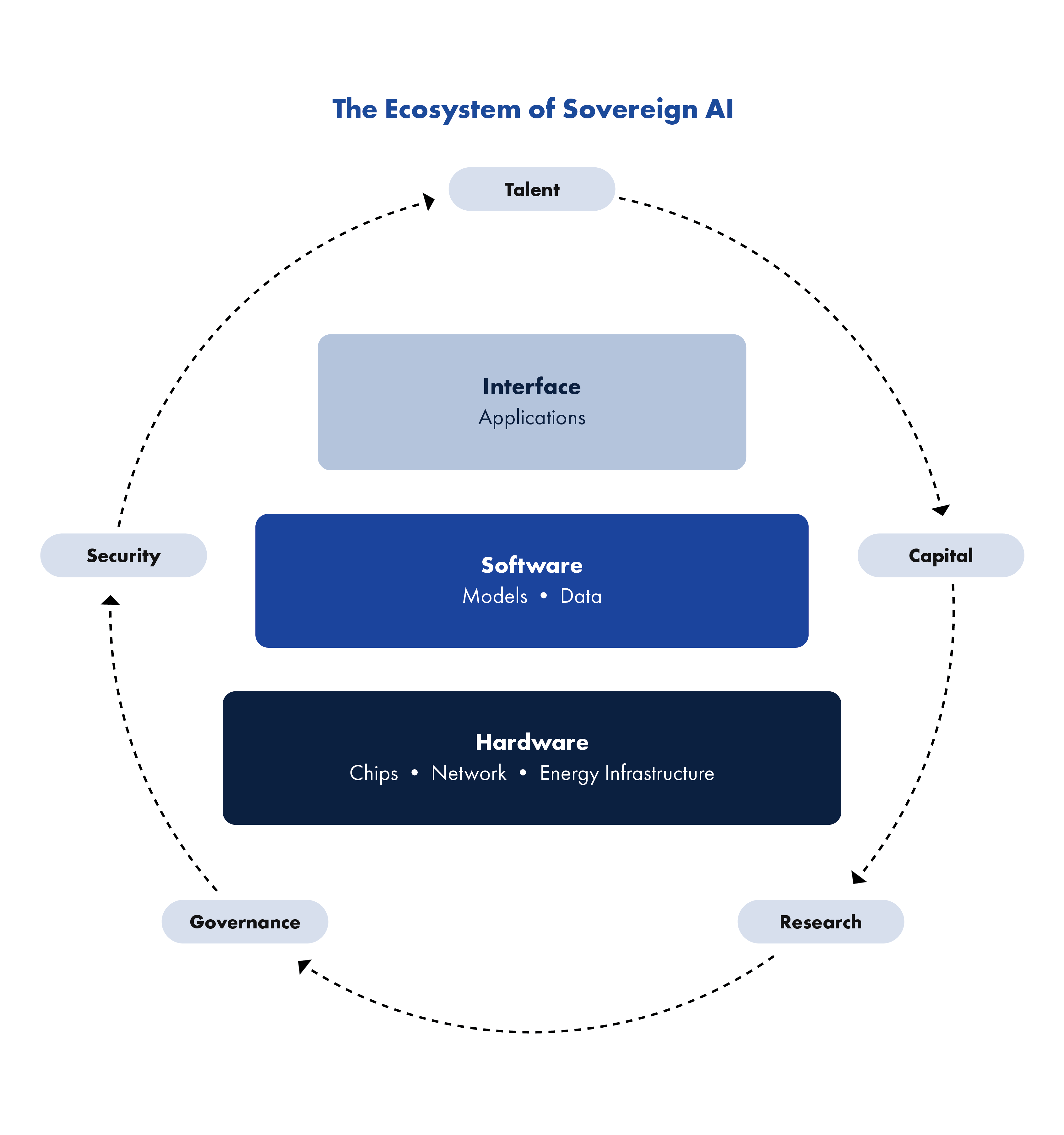 Assessing Sovereign AI: A Two-Pronged Framework | Center for Security and Emerging Technology
Washington's Sovereignty Gap
Perhaps the most striking asymmetry is in the United States itself. Despite hosting the world's leading AI firms and chip designers, the U.S. has been slower than many peers in articulating an explicit sovereign AI strategy of its own--a gap scholars have identified as a distinctive weakness in American AI statecraft, even as U.S. export controls and industrial policy shape everyone else's sovereignty calculations [2]. American power in the AI era currently flows less from domestic state capacity than from the global dominance of its private technology sector--an advantage, but also a vulnerability, as foreign governments' de-Americanization efforts accelerate.
Energy: The Physical Substrate of Digital Power
Behind every AI model lies a vast network of data centers densely packed with computing hardware and consuming enormous volumes of electricity [8]. This physical reality is transforming energy policy into AI policy, and several dynamics deserve attention.
The scale of projected demand is without precedent. Some analysts project that individual AI training clusters could require as much as 100 gigawatts of power by 2030--comparable to the entire electricity generation of a mid-sized industrial nation [9]. Against that benchmark, even wealthy economies look exposed: the United Kingdom imports 12% of its electricity, making its sovereignty ambitions inseparable from infrastructure access [9].
Gulf states, possessing both capital and hydrocarbons, have moved aggressively to convert energy endowments into AI advantage. The United Arab Emirates is pursuing a 5 GW gas power expansion, building what will be the world's largest 1 GW solar-plus-storage project, and has brought 5.6 GW of nuclear capacity online through the region's first civil nuclear program. A national task force is now drafting regulations to balance the data center sector's rising energy footprint against sustainability commitments [8].
The lesson emerging across cases is that AI infrastructure must be aligned with sustainable energy planning from the outset. As the Tony Blair Institute argues, domestic AI infrastructure will place increasing pressure on national power systems, and countries that fail to coordinate grid management, generation capacity, and compute siting will find their sovereignty aspirations physically constrained [10]. In the competition for AI primacy, megawatts may prove as decisive as models.

The Sovereignty Trilemma: Control, Access, and Coherence
If there is a single analytical lens through which to understand national AI strategy, it is the sovereignty trilemma. Sovereignty is shaped by how well countries configure and negotiate their position within an inherently interdependent technological system--and this requires balancing three goals that cannot all be maximized simultaneously: pursuing control through domestic capability investment, accessing frontier capability through global systems, and ensuring coherence across regulatory, industrial, fiscal, and diplomatic strategies [10].
The trilemma appears in various formulations. One board-level framing distills it as trust, speed, or control--organizations and states can optimize for any two but not all three, because each major power is constructing not just different rules but entirely different regulatory games [9]. Stanford HAI's hard-soft distinction reflects the same structure: total self-sufficiency is prohibitively expensive for nearly everyone, while strategic autonomy leaves states exposed to the leverage of foreign vendors [3].
The policy implication is that governments must make deliberate, explicit choices about which workloads genuinely require sovereign handling and which can safely run on external systems. The Tony Blair Institute recommends a national strategy--led from the prime minister's or president's office--that defines frontier model and compute requirements, identifies which workloads must be sovereign, and sets expectations around security, availability, and resilience. Central coordination, it argues, is essential to align planning, energy, procurement, and international negotiations [10]. Compute sovereignty, in this view, is less a fortress to be built than a portfolio to be managed.
Sovereignty as State-Building
There is a deeper historical current beneath the infrastructure race. Drawing on classical theories of state formation, recent scholarship argues that the sovereign AI competition is driving nation-states into a new phase of state-building itself. Analyzing the United States, France, Brazil, and Singapore, researchers find that the intensity of state-building effort is directly driven by elites' perceptions of transboundary competition: the sharper the perceived rivalry, the greater the strategic investment in strengthening four core state capacities--coercive, extractive, delivery, and informational [6].
This framework reframes the sovereign AI race as more than a technological contest. When elites frame AI competition as a zero-sum game, they justify expanded state intervention across the economy--from procurement and industrial subsidies to surveillance and export controls [6]. How different countries respond reflects each nation's distinct state-market-society nexus under geopolitical pressure, not any abstract technological determinism [6]. In this sense, compute sovereignty initiatives are simultaneously instruments of foreign policy and forces remaking the domestic architecture of governance--expanding what states extract, deliver, monitor, and control.
The Regulatory Dimension: Domestic Governance in the Sovereignty Era
Compute sovereignty is also transforming domestic regulation. National AI strategies have gradually shifted from soft coordination toward binding rules, most notably with the European Union's AI Act--though as of mid-2025, very few directly regulating AI laws had actually been implemented worldwide, making the regulatory landscape more aspirational than settled [4].
At the same time, the regulatory environment itself has become a sovereignty variable. Geopolitical fragmentation--including export controls on AI chips, extraterritorial surveillance and data-access laws, and expanding regional regulations--is reshaping what technology can be used, where, and by whom [1]. A chip restriction in one jurisdiction or a cloud-data subpoena under another's law can unilaterally degrade a foreign state's AI capabilities. This is precisely the exposure that sovereignty initiatives are designed to reduce, and it explains why domestic oversight under national law ranks among the core drivers of national programs [2].
For enterprises, regulatory divergence compounds the challenge. Firms operating across jurisdictions increasingly require dual-track governance capabilities--one compliant with, say, the EU's rights-based framework, and another with the security-first regimes of the U.S. or China [9]. Sovereignty-minded regulation, intended to reduce dependence, risks fragmenting the global digital economy into incompatible blocs, with compliance itself becoming a strategic capability.
Conclusion
Compute sovereignty has crossed a threshold: from a compliance talking point to a core organizing principle of national strategy, reshaping everything from semiconductor subsidies and electricity grids to procurement rules and regulatory frameworks. The tripling of sovereign AI initiatives in under two years signals that this is not a passing policy fashion but a durable restructuring of how states relate to technology [2].
Yet the era of sovereign AI will not be an era of self-sufficient AI. No state can simultaneously maximize domestic control, frontier access, and strategic coherence, and the defining skill of twenty-first-century statecraft will be managing that trilemma across the layers of the AI stack [10]. Energy constraints, concentrated supply chains, and vendor dependence ensure that even the most ambitious national programs remain embedded in--rather than insulated from--global interdependence. The task ahead, as the emerging consensus among strategists puts it, is strategic positioning and deliberate interdependence: knowing precisely which capabilities must be held at home, which must be secured through alliances and markets, and how to expand national agency over time within a system no country fully controls [10]. Compute sovereignty, ultimately, is not the end of globalization--it is globalization's next negotiation.
All dollar figures cited as reported in source materials. The sovereign AI project counts derive from a forthcoming Center for a New American Security sovereign AI index [2].
References
- 1.
- 2.
- 3.
- 4.
- 5.
- 6.
- 7.
- 8.
- 9.
- 10.