Introduction
In the first half of 2025 alone, U.S. AI startups raised a staggering $104.3 billion--a figure that nearly matches the entirety of the record-breaking 2024 total [1]. This torrent of cash represents a profound reallocation of resources, pushing AI-related companies to capture over 64% of all U.S. venture funding, up from 49% the previous year [1]. Globally, the trend is similarly pronounced, with AI firms accounting for 61% of all VC investment in 2025, totaling $258.7 billion out of a $427.1 billion global pool [2]. As capital floods into frontier model developers, other technology sectors are being left parched; for instance, U.S. fintech funding plummeted by 42% in the same period, while cloud software and crypto also experienced sharp pullbacks [1].
Yet, as this euphoria peaks, a critical question looms over the startup ecosystem: are we witnessing a generational technological buildout, or a classic valuation bubble propped up by fear of missing out (FOMO) and unsustainable economic mechanics? The most telling sign of a bubble is the decoupling of valuation from traditional financial metrics [1]. While the underlying technological capabilities of generative AI are undeniable, the financial architecture supporting it--characterized by extreme capital concentration, inflated private-market multiples, and fragile application-layer business models--exhibits classic bubble characteristics that demand rigorous scrutiny.
The Capital Squeeze and the "Winner-Take-Most" Dynamic
The sheer volume of capital flowing into AI is the primary driver of the current market dynamics, creating a "winner-take-all" or "winner-take-most" environment [1]. In 2025, AI startups are securing revenue multiples of 25 to 30 times, while non-AI software companies remain stuck in the 6 to 8 times range [3]. This divergence has pushed the bar for what constitutes a viable startup dramatically higher, fundamentally altering the venture capital landscape.
Headline-grabbing mega-rounds exemplify the scale of the bets being placed. OpenAI raised $40 billion at a staggering $300 billion post-money valuation, while Anthropic closed a $13 billion Series F at a $183 billion valuation [1][4]. In Europe, Mistral secured a $2 billion Series C, and application startups like Poolside have raised up to $2 billion at a $12 billion pre-money valuation just two years after founding [3][4]. This intense focus on a select few AI giants stands in stark contrast to the broader market, creating a zero-sum game where capital is ruthlessly diverted from other sectors [3]. Historical parallels, such as the mobile app funding concentration between 2010 and 2012, warn that companies unable to raise capital during these hyper-concentrated phases often do not survive to benefit from subsequent market recoveries [3].
 Market Insight: AI Bubble Risk And Capital Cycles
The Segmented Stack: Where the Bubble Truly Lies
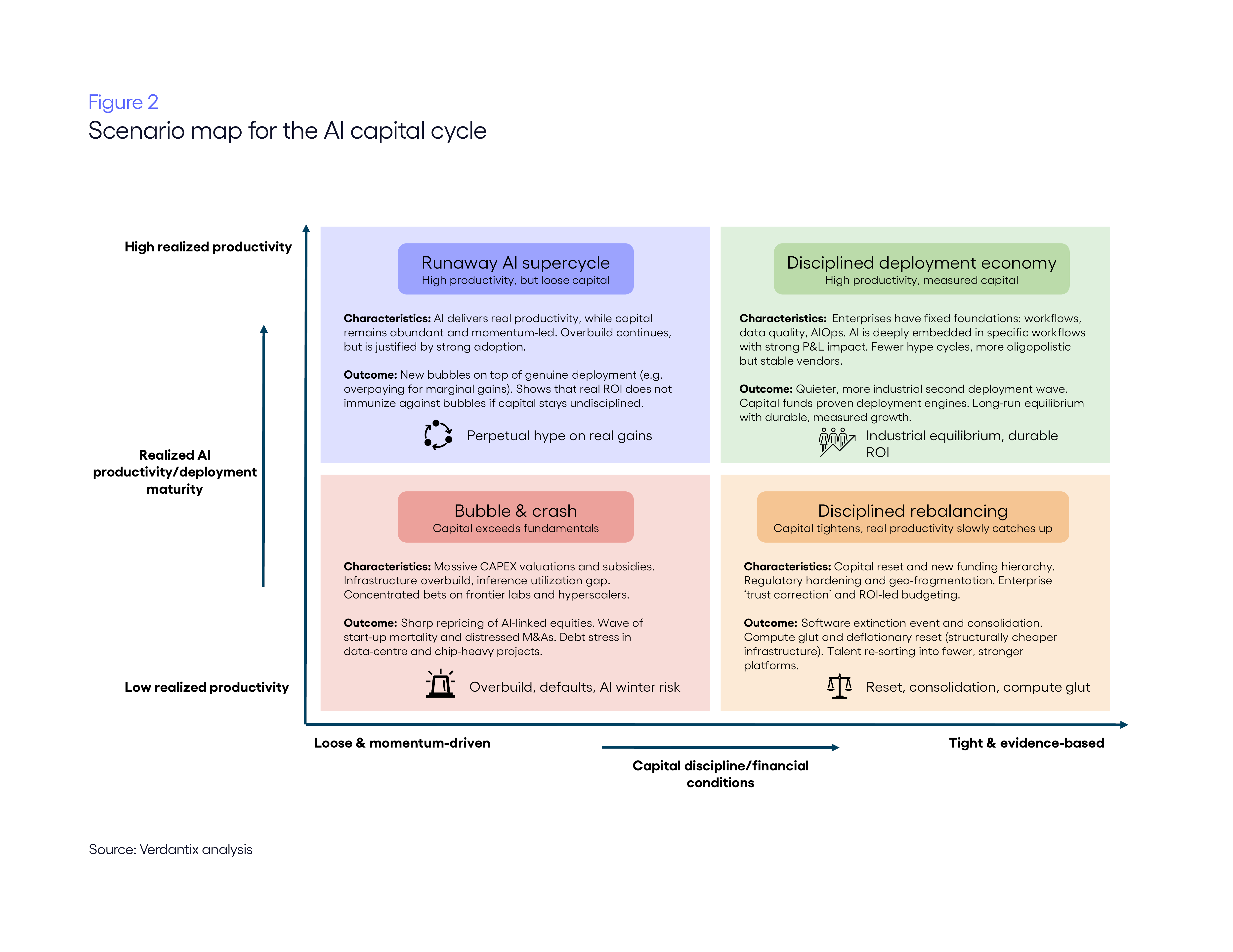
To accurately diagnose bubble risk, the AI ecosystem cannot be treated as a monolithic asset class; rather, it must be evaluated as a segmented financial stack comprising hardware, cloud platforms, data centers, model developers, and applications [5]. Bubble risk varies drastically depending on the layer in question.
Research indicates that bubble evidence is significantly stronger in private AI valuations, application-layer software, and speculative data-center projects than in profitable AI infrastructure leaders [5]. Semiconductor leaders and hyperscalers often generate realized cash flows and maintain strong balance sheets, whereas foundation-model firms may grow revenue rapidly but possess private valuations that embed circular financing and aggressive margin assumptions [5].
A particularly insidious economic risk is the circularity of AI capital expenditure (capex). There is growing concern that massive AI capex is being justified by future demand from firms whose own revenue models depend on continued AI capex elsewhere in the ecosystem [5]. If this circular loop breaks--if enterprise adoption remains broad but fails to translate into scaled, recurring profits--downstream suppliers and infrastructure developers could face severe demand shortfalls.
 AI Startup Valuation | Finro
The Application Layer's Subsidy Trap
While the foundation model developers hoard capital, the application layer--valued at approximately $19 billion in 2025--is showing severe signs of economic stress [4][6]. Startups currently dominate this application space, earning nearly $2 for every $1 incumbents earn across horizontal, vertical, and departmental AI use cases [6]. However, a distinct and troubling pattern has emerged: a large slice of today's AI application activity sits on top of subsidies rather than a robust, proven willingness to pay [4].
Hyperscalers like Amazon, Google, and Microsoft have pledged hundreds of millions of dollars in cloud credits to GenAI startups, which stack with discounted foundation-model pricing and free tiers [4]. Simultaneously, the advent of long context windows, multi-step agents, and heavy tool use is multiplying token consumption, causing variable costs to silently outpace revenue [4].
When the subsidies dry up, the stress manifests immediately. An MIT study claiming that 95% of generative AI initiatives fail to generate ROI rattled markets, exposing the fragility of the current spending spree [6][7]. In the application layer, this results in a shift toward flat and down valuation rounds, an increase in bridge rounds to extend runway, and a quiet wave of shutdowns or "strategic reviews" resulting in fire-sale acqui-hires [4]. The system is brutally exposing how much of the application ecosystem depended on temporary subsidies and easy capital.
 Unlocking funding success for generative AI startups: The crucial role of investor influence - ScienceDirect
Second-Order Effects and the Paradox of AI Signaling
The concentration of capital has profound second-order effects that ripple through the broader startup ecosystem. Technical talent naturally follows funding, and research focus follows talent [3]. When over 50% of venture funding targets generative AI and large language models (LLMs), the entire technological ecosystem tilts in that direction, potentially starvi ng other critical innovations of resources and brainpower [3].
Interestingly, the AI funding frenzy has created a paradox for smaller startups. While adding "AI" to a pitch deck might seem like a surefire way to attract capital, empirical data from the European startup landscape tells a different story. Econometric models reveal that startups explicitly signaling "AI systems" obtain, ceteris paribus, approximately 37% lower funding volume than those that refrain from such signaling [8]. This suggests that outside of the mega-round elite, investors are experiencing signaling fatigue or heightened skepticism regarding undifferentiated AI claims. Startups that combine AI signaling with sustainability goals face even steeper fundraising hurdles [8]. Coupled with the stark statistic that 90% of AI startup projects fail to survive their first year of operation, it is clear that the "AI premium" is heavily reserved for a microscopic fraction of the market [9].
Conclusion
The generative AI valuation bubble is not a myth, but it is highly asymmetric. The technology itself represents a genuine paradigm shift, but the financial architecture surrounding it is deeply fractured. At the apex of the market, a small cadre of foundational model labs and infrastructure giants are absorbing historic sums of capital at unprecedented multiples, largely insulated from immediate monetization pressures.
However, at the application edge, the bubble is already deflating. The reliance on cloud subsidies, the poor conversion of enterprise pilots into recurring revenue, and the crushing weight of variable compute costs are triggering a Darwinian correction. As the market reallocates resources, talent and intellectual property will inevitably migrate from weaker, subsidized players to better-capitalized incumbents and vertically focused vendors [4]. Ultimately, the AI revolution will survive this bubble, but the survival of any individual startup will depend not on the hype of their AI branding, but on their ability to build sustainable, fundamentally sound business models independent of the venture capital subsidy machine.
References
- 1.
- 2.
- 3.
- 4.
- 5.
- 6.
- 7.
- 8.
- 9.