Introduction
The generative AI boom initially mirrored a modern-day gold rush. Startups raised massive seed and Series A rounds based almost entirely on the sheer capability of large language models (LLMs), promising to disrupt every industry from healthcare to legal services. But as the market matures, a harsh reality is setting in: breathtaking AI capability does not automatically translate into viable business economics [1]. We are now entering what industry analysts call the "Great Rationalization" or the "Great Shakeout" [2][3].
This pivot is being driven by a confluence of factors. The pace of core model innovation is beginning to slow or consolidate, the true costs of handling AI "edge cases" are becoming apparent, and new market entrants are proving that frontier model development can be achieved at a fraction of the expected cost. The initial frenzy is giving way to a period of heightened scrutiny where the true challenges of integration, accuracy, and unit economics are coming to the fore [3].
Consequently, the foundational rules of startup formation and venture capital are being rewritten. From the sudden collapse of overhyped valuations to the shockwaves caused by hyper-efficient new models, the foundation model ecosystem is forcing founders and investors to abandon vanity metrics and return to the rigorous business fundamentals that dictate long-term survival.
The End of the Land-Grab: The Great Rationalization
For the past two years, the AI startup market operated on a "land-grab" premise: move fast, wrap an API in a user interface, and stake your claim. That phase has abruptly ended. In the most probable market scenario, core model innovation is becoming more expensive and concentrated, leading to the emergence of just two or three dominant foundational model platforms [2].
For startups, this consolidation triggers a brutal shakeout. Companies that are merely "thin wrappers" around an LLM API--lacking proprietary data, unique workflows, or deep customer relationships--are watching their valuations collapse [2]. The market is no longer rewarding the mere presence of AI in a product pitch deck.
Instead, the valuation cycle is bifurcating. Elite startups demonstrating strong fundamentals, real revenue, and defensible moats continue to raise capital quickly at premium valuations. Meanwhile, the vast majority of mid-tier AI startups are struggling to secure follow-on funding, effectively resetting market expectations across the venture ecosystem [2].
 The Economic Case for Generative AI and Foundation Models | Andreessen Horowitz
The Economics of Foundation Models: Capability vs. Viability
To understand the shakeout, one must understand the historical friction between AI capability and AI economics. As noted by leading venture firms, the issue with AI historically is not that it doesn't work--it frequently produces mind-bending results--but rather that it has been deeply resistant to building attractive pure-play business models [1].
A primary culprit is what developers call "the tail." Many AI products must ensure high accuracy even in rare, unpredictable situations. While any single edge case might be rare, the aggregate volume of rare situations is massive. As instances get rarer, the engineering investment required to handle them skyrockets, creating perverse economies of scale that startups simply cannot rationalize [1].
This economic reality was recently thrust into the global spotlight by DeepSeek, a Chinese AI lab that trained a highly competitive model for just $5.6 million. This achievement defied the prevailing narrative that only tech giants with billion-dollar capital expenditures could compete at the frontier. The revelation triggered a massive sell-off, wiping out over $1 trillion in U.S. tech market value in a single day and contributing to what some analysts have called a $2 trillion Big Tech shakeout [4][5]. The DeepSeek disruption proved that the market is hyper-sensitive to cost-efficiency, permanently altering the risk calculus for startups trying to compete on foundational model training.
Shifting Investment Strategies: From Vanity to Fundamentals
In response to these shifting economics, venture capital investment strategies are undergoing a seismic shift. The prevailing mantra for startup founders has shifted from "move fast and break things" to "build a moat, not just a feature" [3].
For founders, this means stopping the futile effort to out-model the giants [2]. Defensibility now lies in unique, proprietary data sets, frictionless user experiences, and deep domain expertise. Investors are demanding that startups focus on business fundamentals--revenue, gross margins, and customer retention--over vanity metrics like parameter count or theoretical model size [2].
Furthermore, strategy must focus on deep vertical integration and owning the customer relationship. Founders are advised to maintain flexibility in model choice to avoid infrastructure lock-in, while remaining intensely paranoid about unit economics from day one [3]. The ultimate goal for many of these startups is no longer to become the next OpenAI, but to become an indispensable, deeply integrated part of a specific industry workflow--making them highly attractive acquisition targets for their market footprint rather than just their technology [3].
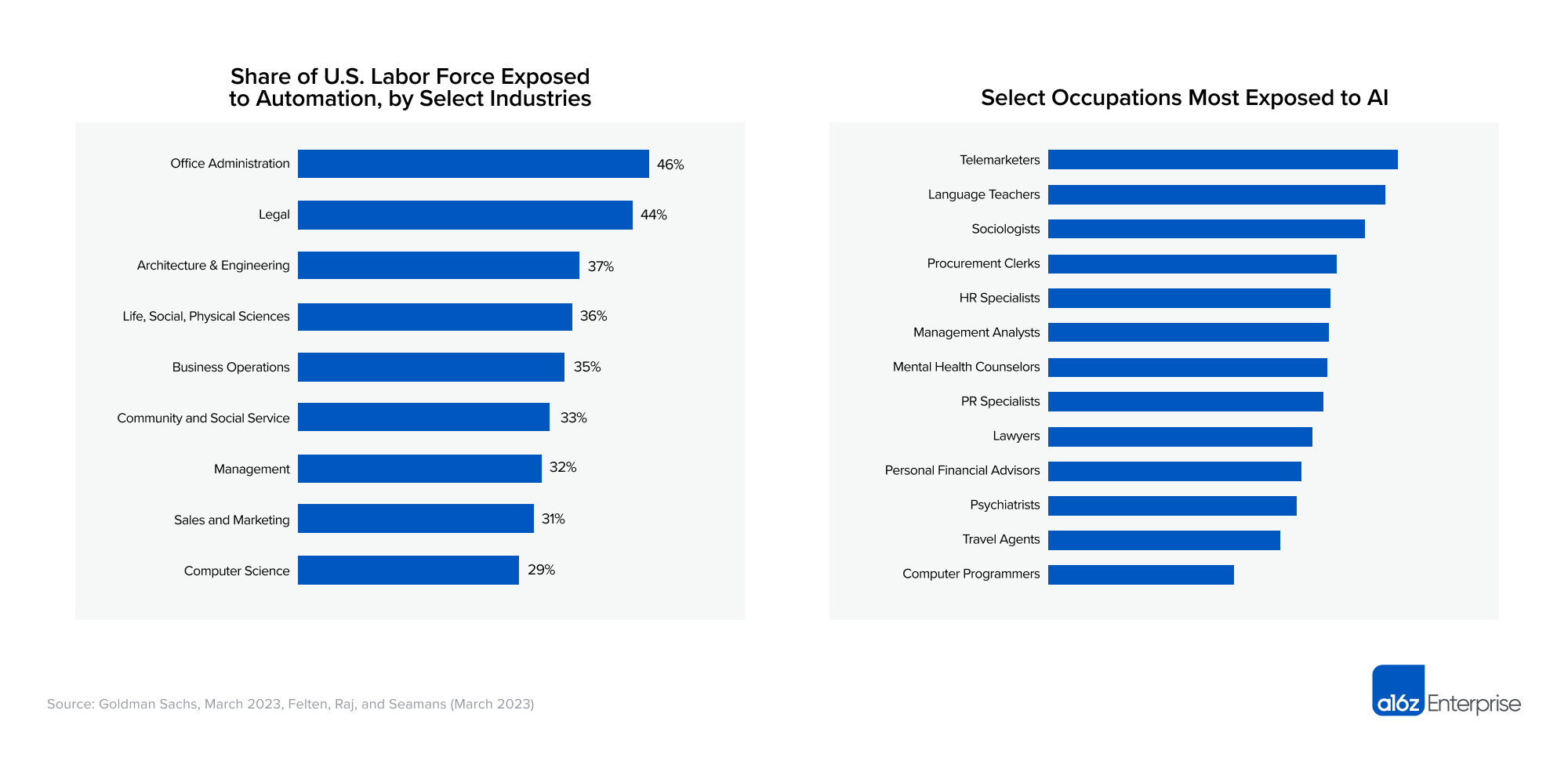 The Economic Case for Generative AI and Foundation Models | Andreessen Horowitz
Redefining Venture Building and Portfolio Construction
Interestingly, while generative AI is causing a valuation shakeout at the application layer, it is simultaneously revolutionizing the economics of how startups are built. Generative AI has the potential to dramatically increase the efficiency of venture building by significantly reducing errors and operational costs across the board [6].
This efficiency gain challenges the traditional venture capital "power law," which dictates that one massive winner in a fund must pay for all the losing bets. If generative AI can lead to a 50% reduction in build costs and a 50% decrease in errors, it fundamentally alters the risk-reward profile of startup financing [6]. This opens the door for new funding models, expanding opportunities from traditional VC all the way to bootstrapping and corporate venture building [6].
However, investors are also acutely aware of historical parallels. State Street analysts note that while the AI investment theme is durable long term, a shakeout followed by consolidation is likely, drawing direct comparisons to the 2000 internet bubble. During that era, the vast majority of early websites failed, even though the underlying technology went on to transform the global economy [7]. Today, hyperscalers and independent LLM companies are pouring capital into an AI arms race, and it is highly likely that not all of them will earn an adequate return to justify their investments [7].
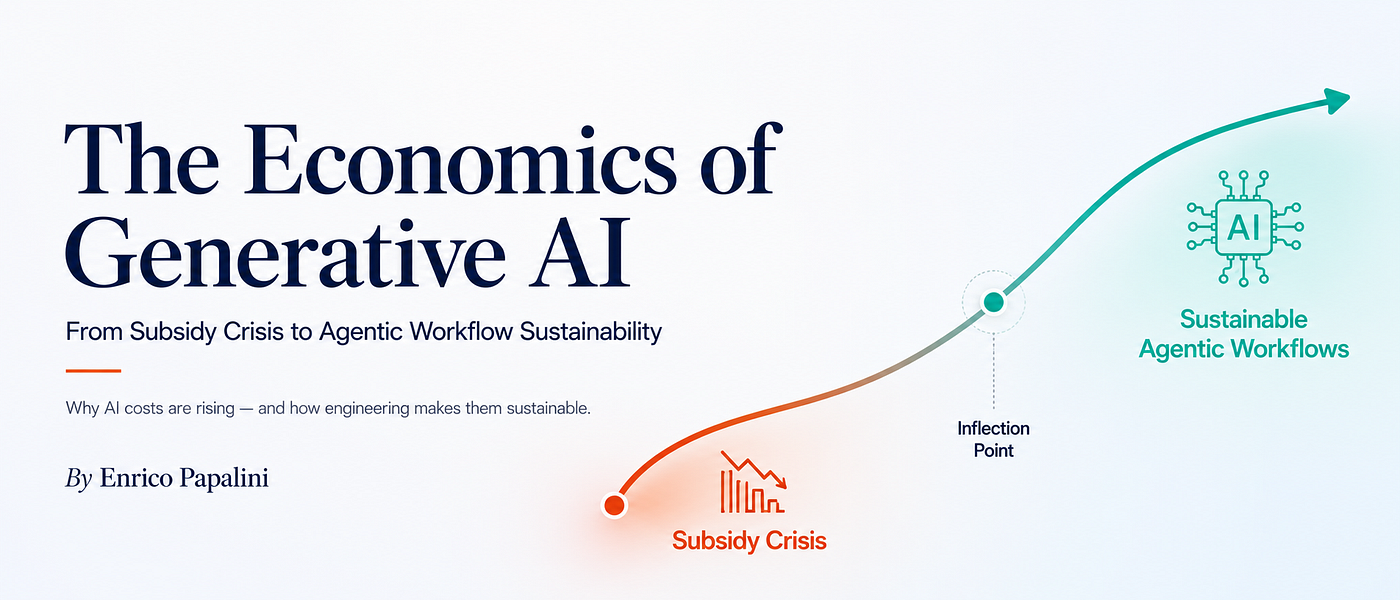 The Economics of Generative AI. From Subsidy Crisis to Agentic Workflow... | by Enrico Papalini | Medium
Conclusion
The generative AI shakeout is not a signal of AI's failure, but a necessary and healthy maturation of the market. The era of easy money for basic LLM wrappers has definitively ended, reset by the harsh realities of unit economics and the surprising democratization of model training costs.
As the market consolidates around a few foundational platforms, the value is migrating upward to the infrastructure giants and downward to the specialized application startups that solve deeply painful, narrow problems. Looking ahead, as the generative AI market projects toward a potential $1 trillion valuation by 2034, the winners will not be those who simply leverage AI, but those who master the delicate balance of cutting-edge capability and ironclad business fundamentals [8]. For founders and investors alike, the new imperative is clear: AI is a profoundly powerful tool, but it is the moat around the business that will ensure its survival.
References
- 1.
- 2.
- 3.
- 4.
- 5.
- 6.
- 7.
- 8.