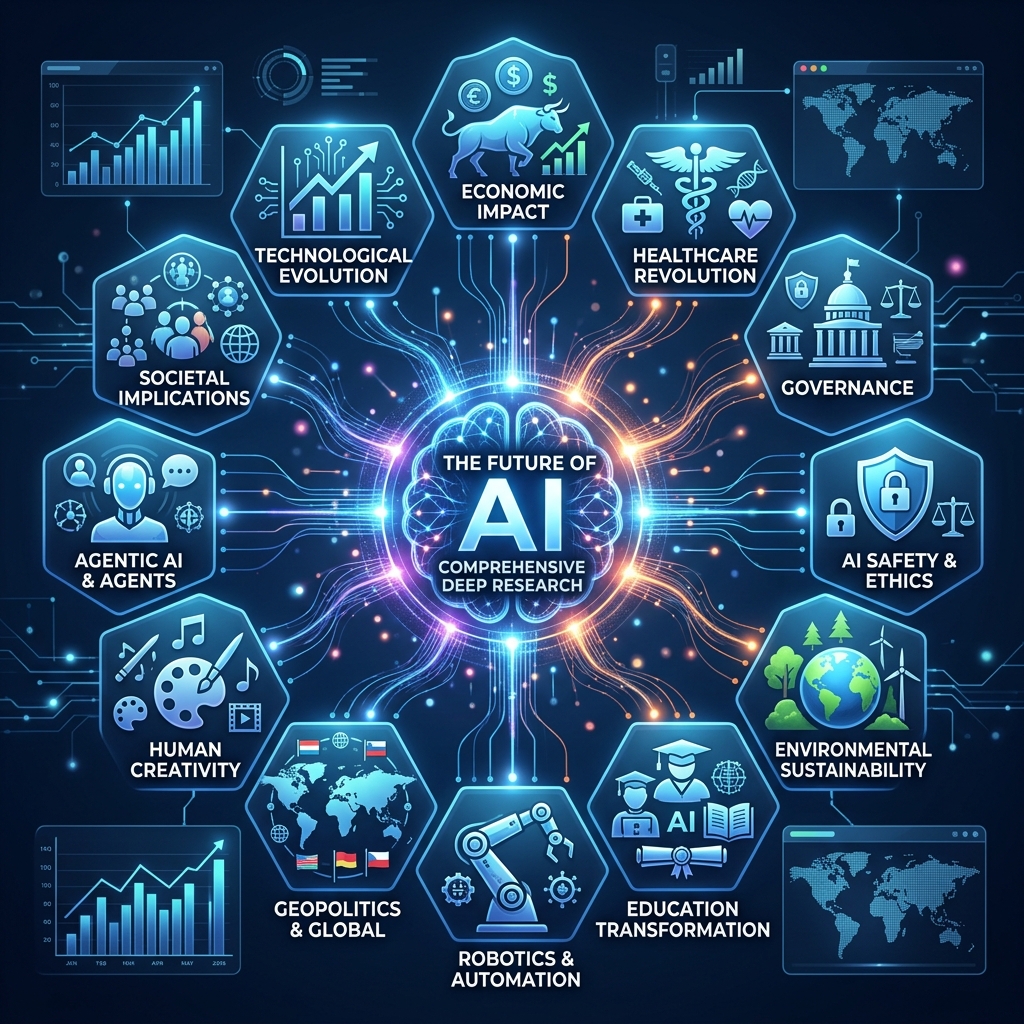
The Future of Artificial Intelligence: A Comprehensive Analysis of AI's Trajectory Through 2030 and Beyond
Table of Contents
- Executive Summary
- The Scaling Hypothesis: Are We Heading Toward AGI?
- Next-Generation AI Hardware
- Economic Transformation: Trillions at Stake
- Healthcare and Medicine: The AI Revolution
- AI Governance and the Regulatory Landscape
- Existential Risk and AI Safety
- Environmental Sustainability: AI's Carbon Paradox
- Consciousness, Sentience, and Machine Minds
- Education in the Age of AI
- Embodied AI: Robotics and Autonomous Systems
- Geopolitics: The AI Arms Race
- AI and Human Creativity
- Agentic AI: From Assistants to Autonomous Agents
- Misinformation, Deepfakes, and Democratic Integrity
- Synthesis: Navigating the AI Future
1. Executive Summary
Artificial intelligence stands at an inflection point unprecedented in human history. The technology that captured public imagination with ChatGPT in late 2022 has evolved into a multi-trillion-dollar force reshaping every sector of society. This comprehensive analysis synthesizes research from leading institutions--including Goldman Sachs, McKinsey, Epoch AI, Morgan Stanley, the European Commission, the Future of Life Institute, the Brookings Institution, and peer-reviewed academic literature--to map AI's trajectory through 2030 and beyond.
The central finding is one of paradox and tension: AI promises unprecedented economic gains (an estimated $7 trillion in global GDP growth), revolutionary healthcare breakthroughs, and transformative educational access, even as it raises profound questions about employment disruption, environmental sustainability, democratic integrity, and the very definition of consciousness. The choices made by governments, companies, and citizens between 2025 and 2030 will determine whether AI becomes humanity's greatest tool or its most dangerous invention.
2. The Scaling Hypothesis: Are We Heading Toward AGI?
The Case for Rapid Progress
The dominant paradigm in AI research is the scaling hypothesis: that increasing computational power, data volume, and model parameters yields predictable improvements in capabilities. Epoch AI, commissioned by Google DeepMind, projects that by 2030:
- Frontier training clusters will cost over $100 billion, up from hundreds of millions today.
- Training runs could reach 10²⁹ FLOP (floating-point operations)--thousands of times more compute than GPT-4.
- Frontier models will require gigawatts of electrical power, comparable to a small city.
- A 2030 training run would use compute equivalent to running the largest 2020 cluster continuously for 3,000 years [1].
Epoch AI argues that none of the commonly cited bottlenecks--data scarcity, energy constraints, diminishing returns, or economics--are likely to halt progress before 2030. While human-generated text may peak by 2027, synthetic data generated by AI itself is expected to bridge the gap, particularly for reasoning-intensive models [1].
The AI in Scientific R&D
By 2030, AI is expected to function as a sophisticated research assistant across multiple domains:
- Software Engineering: Moving beyond coding assistants to autonomously fixing bugs and implementing complex features.
- Mathematics: Solving expert-level problems with verifiable proofs, as suggested by benchmarks like FrontierMath.
- Molecular Biology: Answering questions about wet-lab protocols and solving protein-ligand docking problems.
- Weather Prediction: AI methods already outperform traditional models at a fraction of the computational cost [1].
The Skeptical Counterweight
Not all experts agree with aggressive AGI timelines. The AAAI 2025 Presidential Panel survey found that 76% of AI researchers believe scaling current approaches is unlikely to lead to AGI [2]. A 2023 expert survey found the median estimate for a 50% chance of high-level machine intelligence is 2059, not 2030 [3]. Critics note that LLMs still make basic reasoning errors, and some of the most prominent predictors of imminent AGI have been wrong in the past [4].
Key Insight: The gap between "impressive capabilities" and "general intelligence" may be larger than current benchmarks suggest. Progress will likely be uneven--dramatic in some domains, frustratingly slow in others.
3. Next-Generation AI Hardware
Beyond GPUs
While NVIDIA's GPUs remain the workhorses of AI, the hardware landscape is diversifying rapidly:
-
Neuromorphic Computing: The neuromorphic computing market is projected to grow from $28.5 million in 2024 to $1.33 billion by 2030, at a staggering CAGR of 89.7%. These brain-inspired chips promise ultra-low-power AI processing for edge devices, robotics, and IoT, enabling real-time learning and perception [5].
-
Quantum Computing: Google's Willow chip demonstrated scalable quantum error correction in 2024, transforming a decades-long physics problem into an engineering race. Major players--Google, IBM, Amazon, Microsoft, and China--have committed over $140 billion combined. Quantum-as-a-Service is expected to expand beyond labs to cloud platforms by 2026-2027, with applications in drug discovery, finance, materials science, and energy storage [6].
-
Photonic Computing: Light-based processors promise dramatic speed improvements over electronic chips, potentially rewriting AI's computational rulebook [7].
-
AI-Specific ASICs: Companies like Intel, Huawei (Ascend 950 series), and Cambricon are developing specialized chips. Huawei plans to scale to 750,000 units of its Ascend 950PR chips, while Cambricon aims for 500,000 units in 2026 [8].
The Implication
Hardware diversification will reduce dependence on any single supplier and enable AI deployment in resource-constrained environments. However, it also intensifies the geopolitical competition for semiconductor supply chains and critical minerals.
4. Economic Transformation: Trillions at Stake
The GDP Impact
Goldman Sachs Research projects that generative AI could:
- Raise global GDP by 7% (approximately $7 trillion) over a 10-year period.
- Lift productivity growth by 1.5 percentage points.
- Create a total addressable market for generative AI software of $150 billion within a $685 billion global software industry [9].
McKinsey's analysis adds that combining generative AI with all other automation technologies could add 0.5 to 3.4 percentage points annually to productivity growth [10].
Labor Market Disruption
The labor market impact is a story of dual forces:
- Exposure: Approximately 300 million full-time jobs globally are exposed to AI automation. Two-thirds of U.S. occupations face some degree of AI exposure, with 25-50% of workloads potentially replaceable [9].
- McKinsey projects that by 2030, 30% of current U.S. jobs could be automated, with 60% significantly altered [11].
- Transition Costs: Goldman Sachs estimates that widespread AI adoption could temporarily raise the U.S. unemployment rate by about 0.5 percentage points during the transition, as displaced workers seek new roles [12].
- Complementarity: Most jobs are only partially exposed; AI is more likely to complement rather than replace human labor. Historically, 60% of today's workers hold occupations that did not exist in 1940 [9].
The Productivity Dividend
Goldman Sachs estimates that generative AI will raise labor productivity in developed markets by approximately 15% when fully adopted, representing one of the largest productivity shifts since the industrial revolution [12].
5. Healthcare and Medicine: The AI Revolution
The Market Opportunity
AI's impact on healthcare is projected to be transformative:
- The AI healthcare market could reach $868 billion by 2030, yielding $646 billion in cost savings and $222 billion in revenue gains. AI's addressable market share in healthcare will more than double, increasing from 15% to over 30% [13].
- The sector is growing at a remarkable CAGR of 49.1% between 2024 and 2030 [14].
Drug Discovery and Development
AI is revolutionizing pharmaceutical research:
- Timeline Compression: AI can reduce drug discovery timelines from years to months by predicting molecular interactions, optimizing compound screening, and generating novel drug candidates through generative models [15].
- Clinical Trials: AI-driven digital twins and predictive models are enabling decentralized clinical trials, with AI managing patient selection, monitoring, and outcome prediction [16].
- Precision Medicine: By analyzing genomic, clinical, and lifestyle data, AI algorithms can make increasingly accurate predictions about disease risk and treatment outcomes, enabling truly personalized therapy [17].
Diagnostic and Imaging Breakthroughs
AI systems now match or exceed human radiologists in detecting certain cancers from medical images. Multimodal AI--combining imaging, text, and genomic data--is enabling earlier detection and more accurate diagnosis across oncology, cardiology, and neurology [18].
6. AI Governance and the Regulatory Landscape
The EU AI Act: The World's First Comprehensive Framework
The European Union's AI Act, which entered into force in August 2024, represents the world's first comprehensive legal framework for AI regulation. Its key features include:
- Risk-Based Approach: AI systems are categorized by potential impact--from "unacceptable risk" (banned) through "high-risk" (strict requirements), "limited risk" (transparency obligations), and "minimal risk" (no obligations) [19].
- Enforcement Timeline: The majority of provisions are enforced beginning August 2026, with high-risk AI systems embedded in regulated products having an extended transition period until August 2028 [19].
- General-Purpose AI Code of Practice: A voluntary compliance tool offering practical guidance on transparency, copyright, and safety obligations [19].
The Global Patchwork
The regulatory landscape is fragmenting globally:
- United States: The NIST AI Risk Management Framework provides voluntary guidelines, while states like California and Colorado are enacting their own AI laws. Federal policy has shifted under the current administration toward a more permissive stance [20].
- China: China has implemented regulations on algorithmic recommendations, deep synthesis (deepfakes), and generative AI, requiring registration and content controls [20].
- United Kingdom: The UK has adopted a "pro-innovation" approach, relying on existing regulators rather than a single AI law [20].
- Global Convergence: Despite different approaches, there is growing convergence around core principles--transparency, accountability, human oversight, and risk management [20].
7. Existential Risk and AI Safety
The Existential Risk Debate
The question of whether advanced AI could pose an existential threat to humanity has moved from fringe speculation to mainstream discourse:
- In 2023, hundreds of AI experts and notable figures signed a statement declaring: "Mitigating the risk of extinction from AI should be a global priority alongside other societal-scale risks such as pandemics and nuclear war" [21].
- A 2022 survey of AI researchers found that the majority believed there is a 10% or greater chance that human inability to control AI will cause an existential catastrophe [22].
- Geoffrey Hinton, the "godfather of AI" and Nobel Prize recipient, has stated: "The alarm bell I'm ringing has to do with the existential threat of them taking control... If you take the existential risk seriously, as I now do, it might be quite sensible to just stop developing these things any further" [23].
The Alignment Problem
The core technical challenge is alignment: ensuring that AI systems pursue goals aligned with human values. A superintelligent system might resist attempts to modify its goals, as this would prevent it from accomplishing its current objectives [22].
The Skeptical View
The Brookings Institution cautions against excessive alarmism while acknowledging that "as we move toward generally intelligent AI systems, developing measures to protect human safety will become necessary" [24]. A 2025 paper in Nature Humanities and Social Sciences Communications argues that there is "no such thing as conscious AI" and that associations between consciousness and current LLMs are "deeply flawed," arising from a lack of technical understanding and the "sci-fi-tisation" of public discourse [25].
Industry Safety Assessments
The Future of Life Institute's AI Safety Index (Summer 2025) evaluated seven leading AI companies across 33 indicators spanning six critical domains, finding significant gaps between safety commitments and real-world actions [26].
8. Environmental Sustainability: AI's Carbon Paradox
The Scale of the Problem
AI's environmental footprint is substantial and growing:
- A landmark 2025 study in Nature Sustainability projects that AI server deployment across the United States could generate an annual water footprint of 731-1,125 million m³ and additional annual carbon emissions of 24-44 million tonnes CO₂-equivalent between 2024 and 2030 [27].
- The environmental impact spans four phases: mining and manufacturing of raw materials, construction, operation, and end-of-life e-waste [28].
- AI data centers produce significant carbon emissions because they consume massive amounts of electricity--largely from fossil fuels--to power and cool servers [29].
Mitigation Pathways
The Nature study found that best practices could reduce emissions and water footprints by up to 73% and 86% respectively, though their effectiveness is constrained by current energy infrastructure limitations. The findings underscore the urgency of accelerating the energy transition and suggest AI companies should harness clean energy potential in Midwestern states [27].
MIT's Lincoln Laboratory has demonstrated that organizations can pair sustainability practices with cost savings through model optimization, efficient hardware, and rethinking the "bigger is better" paradigm [30].
The Green AI Index
The Green AI Institute has developed a comprehensive assessment framework using the Green AI Index, evaluating environmental metrics including energy consumption, carbon emissions (Scope 1, 2, and 3), and water use--including operational cooling water and embodied water in hardware manufacturing [31].
9. Consciousness, Sentience, and Machine Minds
The Philosophical Frontier
The question of whether AI could ever be conscious represents one of the deepest philosophical challenges of our time:
- David Chalmers and Michael Graziano, leading philosophers of mind, debated AI consciousness at Princeton University in 2025, reflecting growing academic engagement with the question [32].
- Artificial consciousness (machine consciousness or synthetic consciousness) draws from philosophy of mind, cognitive science, and neuroscience. Some scholars believe that constructing systems emulating the brain's neural correlates of consciousness (NCC) could result in genuine consciousness [33].
The Hard Problem
A philosopher at the University of Cambridge argues that there is no reliable way to know whether AI is conscious, and that may remain true for the foreseeable future. Claims of conscious AI are often "more marketing than science," and believing in machine minds too easily could cause real harm [34].
A 2025 Nature paper argues definitively that "there is no such thing as conscious AI," asserting that the association between consciousness and current computer algorithms (primarily LLMs) is "deeply flawed." The probabilistic language usage of LLMs creates an illusion of consciousness that is mistaken for genuine awareness [25].
Ethical Implications
If AI were ever to achieve sentience--the ability to experience positive or negative mental states--it could justify welfare concerns and legal protection, as with non-human animals. This would force a fundamental redefinition of human identity "in a world where intelligence is no longer exclusively biological" [35].
10. Education in the Age of AI
The Personalized Learning Revolution
AI is transforming education from a one-size-fits-all model to deeply personalized learning:
- Intelligent Tutoring Systems (ITS): AI-powered platforms adapt to individual student needs, providing real-time feedback, adjusting task difficulty, and tailoring content. By 2030, the average classroom may function more like a "dynamic learning lab" than a traditional lecture hall [36].
- 24/7 AI Tutors: The vision of every student having a personal AI tutor--adapting to their learning style, pacing, and needs--is becoming reality. Khan Academy's Khanmigo is a pioneering example, supported by a $20-million partnership with Stand Together Trust [37].
- Predicted adoption: By 2026, AI tutors could become standard in many public schools, providing real-time adaptive lessons for all abilities [38].
Education 4.0
The World Economic Forum defines Education 4.0 as using AI to enhance--rather than replace--human teaching. Key promises include [39]:
- Automating administrative tasks, freeing teachers for personalized interactions.
- Providing data-driven insights into student learning patterns.
- Enabling personalized pathways through adaptive curricula.
- Equipping students with the skills needed for AI-augmented workplaces.
Challenges
Critical concerns remain regarding data privacy, algorithmic bias, and the evolving role of educators in AI-integrated classrooms. Ensuring equitable access to AI-powered education tools is essential to prevent widening the digital divide [36].
11. Embodied AI: Robotics and Autonomous Systems
The Humanoid Revolution
2025 became the breakthrough year for AI-driven humanoid robotics:
- Massive Investment: Figure AI raised $1 billion; Apptronik raised $403 million; Agility Robotics raised approximately $400 million in early 2025 [40].
- Leading players--Tesla, Figure AI, Apptronik, Boston Dynamics, Agility Robotics, Sanctuary AI, and Fourier Intelligence--are racing to prove functional dexterity and scalable production [40].
Market Projections
- Morgan Stanley projects the global humanoid robot market will reach ~$5 trillion by 2050, addressing a potential market of ~$30 trillion in global labor [41].
- Approximately 75% of U.S. occupations and ~40% of employees have some degree of "humanoidability," representing an addressable market of ~$3 trillion in the U.S. alone [41].
- The humanoid robot market will reach approximately $30 billion by 2035 [42].
China's Strategic Push
Carnegie Endowment research reveals that China has made embodied AI a strategic priority, leveraging earlier advances in robotics, autonomous vehicles, and drones. Beijing sees embodied AI as a key tool to revive economic growth amid population decline. Most Chinese experts believe the country's existing advantages could enable steady progress within the next five to ten years [43].
Autonomous Vehicles
AI is powering the next generation of self-driving technology. NVIDIA's GTC 2026 showcased advanced computing platforms enabling autonomous vehicles to understand complex driving situations, with implications for transportation, logistics, and urban design [44].
12. Geopolitics: The AI Arms Race
The U.S.-China AI Competition
The AI race between the United States and China has become the defining geopolitical contest of the 21st century:
- The Compute Gap: The U.S. currently leads on frontier model capabilities by roughly 6-8 months, primarily due to access to the most advanced AI chips, which depend on EUV lithography equipment made exclusively by Dutch firm ASML [8].
- Export Controls: U.S. export controls on advanced AI chips have slowed China's AI development in the near term, but Chinese firms are responding with domestic alternatives. Huawei's Ascend 950 series and Cambricon's accelerators represent significant progress toward self-sufficiency [8].
- China's Countermeasures: China has banned exports of critical rare minerals like gallium and germanium to the United States, materials vital for semiconductors and advanced technologies [45].
The Semiconductor Chokepoint
As Chris Miller, author of Chip War, explains: "Today, military, economic, and geopolitical power are built on a foundation of computer chips" [45]. The semiconductor supply chain--spanning raw material extraction, precision manufacturing, and global distribution--has become the critical infrastructure of the AI age.
DeepSeek's Disruption
The emergence of DeepSeek in January 2025 demonstrated that aggressive U.S. export controls cannot entirely prevent Chinese AI progress. DeepSeek's cost-effective approach--achieving competitive model performance at a fraction of Western costs--highlighted the risk that affordability and accessibility could erode U.S. leadership [8, 46].
13. AI and Human Creativity
The Creative AI Market
The AI Creativity and Art Generation market is expected to grow from $51.89 billion in 2024 to $141.7 billion by 2034, at a CAGR of 26.5% [47]. Generative AI is transforming:
- Visual Arts: AI tools democratize content creation, reducing barriers related to skills and costs.
- Music: AI systems can generate melodies, construct rhythms, and design harmonies, transforming digital music production from a human-centered model into human-machine collaboration [48].
- Film and Video: AI-generated video and animation tools are reshaping media production.
The Creativity Debate
Carnegie Mellon University research (2026) found that humans still lead in creativity when comparing AI-generated music with human compositions. The study examines how AI tools shape music and whether they can support creative ideation [49].
The emerging consensus is that AI is best understood as a collaborative tool that expands creative possibilities rather than replacing human artistry. The question remains: what happens when AI can generate "the best song ever written at the push of a button"?
14. Agentic AI: From Assistants to Autonomous Agents
The Next Paradigm Shift
Beyond generative AI, the frontier is shifting to agentic AI--systems capable of autonomous behavior:
- Definition: Agentic AI systems can perceive environments, make decisions, plan actions, interact with external services, and adapt behavior to achieve predefined goals [50].
- Enterprise Adoption: Deloitte predicts that 25% of companies using generative AI will launch agentic AI pilots in 2025, growing to 50% by 2027 [51].
- Capabilities: Agentic systems in 2025 demonstrate 90%+ accuracy in decision-making tasks while operating continuously without fatigue [52].
Applications
Agentic AI is delivering results across domains:
- Software Engineering: Autonomous code generation, testing, and bug fixing.
- Financial Trading: Multi-asset strategy execution adjusting to real-time market sentiment.
- Customer Service: Proactive problem resolution and workflow automation.
- Marketing: No-code agent creation for campaign management [51, 52].
The MIT Sloan View
MIT Sloan Management Review and BCG identify agentic AI as requiring a "strategic overhaul of workflows, governance, roles, and investment"--not merely a technology deployment but a fundamental reimagining of how enterprises operate [53].
15. Misinformation, Deepfakes, and Democratic Integrity
The Scale of the Threat
AI-generated disinformation represents an existential threat to democratic processes:
- For the first time, tools to fabricate hyperrealistic deepfakes are available to the public at virtually no cost [54].
- AI-driven disinformation campaigns have been documented in elections worldwide, including the 2025 Ecuadorian presidential election and European elections [55].
- The European Parliamentary Research Service has warned about Gen AI chatbots' vulnerability to manipulation and the use of generative AI in foreign information manipulation and interference (FIMI) [56].
Types of Electoral Disinformation
Research identifies five categories of AI-enabled electoral manipulation [54]:
- Voter Suppression: Spreading false information about voting dates, eligibility, or safety.
- Election Denialism: Falsely asserting elections are fraudulent or illegitimate.
- Identity-Focused Disinformation: Exploiting demographic differences through customized content.
- Gendered Disinformation: Using false or sexualized narratives to intimidate and silence.
- Violent Extremism Disinformation: Spreading incitement to violence during elections.
Legislative Responses
Multiple U.S. states have enacted laws requiring disclosure of AI-generated political advertisements. The EU has criminalized certain forms of image-based sexual abuse facilitated by deepfakes under its Directive on Combating Violence Against Women [56, 57].
16. Synthesis: Navigating the AI Future
The Central Tensions
The future of AI is defined by several irreducible tensions:
-
Capability vs. Safety: The more capable AI becomes, the harder it is to control. The alignment problem is not a future concern--it is a present challenge that grows more urgent with each model release.
-
Innovation vs. Regulation: The EU AI Act and emerging frameworks worldwide attempt to balance innovation with protection. Too little regulation risks harm; too much risks ceding advantage to less scrupulous actors.
-
Concentration vs. Democratization: AI capabilities are concentrated in a handful of companies and nations. Open-source models and smaller, efficient architectures offer a counterweight, but also lower the barrier to misuse.
-
Economic Gain vs. Social Disruption: The $7 trillion GDP opportunity is real, but so is the displacement of 300 million jobs. The transition costs will fall disproportionately on those least able to bear them.
-
Environmental Cost vs. Computational Demand: AI's hunger for energy, water, and critical minerals grows even as the climate crisis deepens. Sustainable AI is not optional--it is existential.
Scenarios for 2030
Based on the research synthesized in this report, three broad scenarios emerge:
Scenario A: Accelerated Progress (≈40% probability) AI capabilities continue to scale impressively through 2030, delivering major breakthroughs in science, healthcare, and productivity. Agentic AI becomes mainstream in enterprises. Regulatory frameworks mature without significantly impeding innovation. Challenges--environmental, labor displacement, misinformation--are significant but manageable.
Scenario B: Plateau and Consolidation (≈35% probability) Diminishing returns from scaling become apparent. Progress continues but at a slower pace, focused on efficiency, specialization, and deployment rather than raw capability gains. The economic bubble around AI partially deflates. Society has more time to adapt governance and institutions.
Scenario C: Disruption and Crisis (≈25% probability) A combination of systemic failures--a major AI-enabled catastrophe (cyberattack, deepfake-driven political crisis, misaligned autonomous system), environmental backlash, or geopolitical conflict over compute resources--forces a dramatic reassessment. Regulation becomes reactive and restrictive. Trust in AI institutions erodes significantly.
The Path Forward
The research is clear: AI's future is not predetermined. It will be shaped by the choices of governments, companies, researchers, and citizens. The most responsible path forward requires:
- Investing in AI safety research commensurate with investment in capabilities.
- Building international governance frameworks that prevent a race to the bottom.
- Accelerating the energy transition to power AI sustainably.
- Redesigning education and social safety nets for an AI-transformed economy.
- Maintaining epistemic integrity against AI-enabled misinformation.
- Ensuring equitable access to AI's benefits across the Global North and South.
The next five years will be decisive. As the Brookings Institution concludes: "The challenges of existential risk from highly capable AI systems must eventually be faced and mitigated if AI labs want to develop generally intelligent systems and, eventually, superintelligent ones" [24].
References
[1] Owen, D. (2025). What will AI look like in 2030? Epoch AI, commissioned by Google DeepMind. https://epoch.ai/publications/what-will-ai-look-like-in-2030
[2] AAAI (2025). AAAI 2025 Presidential Panel on the Future of AI Research. https://aaai.org/wp-content/uploads/2025/03/AAAI-2025-PresPanel-Report-Digital-3.7.25.pdf
[3] AIMultiple (2025). AGI/Singularity: 9,800 Predictions Analyzed. Based on the 2023 Expert Survey on Progress in AI. https://aimultiple.com/artificial-general-intelligence-singularity-timing
[4] EA Forum (2025). On January 1, 2030, there will be no AGI (and AGI will still not be imminent). https://forum.effectivealtruism.org/posts/xkNjpGNfnAYmkFz3s/
[5] MarketsandMarkets (2024). Neuromorphic Computing Market by Offering, Deployment, Application - Global Forecast to 2030. https://www.marketsandmarkets.com/Market-Reports/neuromorphic-chip-market-227703024.html
[6] Multiple sources (2025). Quantum Computing Just Broke Through: The 2025-2027 Timeline. Reporting on Google Willow chip and $140B combined investment.
[7] Dobrin, S. (2025). Beyond GPUs: Quantum Leaps, Neuromorphic Brains, and Photonic Speed. Silicon Sands News. https://siliconsandstudio.substack.com/p/beyond-gpus-quantum-leaps-neuromorphic
[8] Brookings Institution (2025). Competing AI Strategies for the US and China. https://www.brookings.edu/articles/competing-ai-strategies-for-the-us-and-china
[9] Briggs, J. & Kodnani, D. (2023). Generative AI could raise global GDP by 7%. Goldman Sachs Research. https://www.goldmansachs.com/insights/articles/generative-ai-could-raise-global-gdp-by-7-percent
[10] McKinsey (2023). The Economic Potential of Generative AI: The Next Productivity Frontier. https://www.mckinsey.com/capabilities/tech-and-ai/our-insights/the-economic-potential-of-generative-ai-the-next-productivity-frontier
[11] McKinsey. Reported projection on U.S. job automation by 2030.
[12] Briggs, J. & Dong, S. (2025). How Will AI Affect the Global Workforce? Goldman Sachs Research. https://www.goldmansachs.com/insights/articles/how-will-ai-affect-the-global-workforce
[13] Strategy& / PwC (2025). AI's US$ 868 Billion Healthcare Revolution. https://www.strategyand.pwc.com/de/en/industries/pharma-life-sciences/ai-healthcare-revolution.html
[14] Natesan, G. (2025). AI in Healthcare CAGR analysis. LinkedIn / Industry data.
[15] Gangwal, A. & Lavecchia, A. (2024). Unleashing the Power of Generative AI in Drug Discovery. Drug Discovery Today, 29, 103992. https://doi.org/10.1016/j.drudis.2024.103992 ; Paul, D. et al. (2021). Artificial Intelligence in Drug Discovery and Development. Drug Discovery Today, 26, 80-93. https://doi.org/10.1016/j.drudis.2020.10.010
[16] Vidovszky, A.A. et al. (2024). Increasing Acceptance of AI-Generated Digital Twins through Clinical Trial Applications. Clin. Transl. Sci., 17, e13897. https://doi.org/10.1111/cts.13897
[17] Frontiers in Medicine (2026). The Expanding Role of Artificial Intelligence in Personalised Medicine. https://www.frontiersin.org/journals/medicine/articles/10.3389/fmed.2026.1795879/full
[18] Nature (2025). Unlocking the Potential: Multimodal AI in Biotechnology and Digital Health. npj Digital Medicine. https://www.nature.com/articles/s41746-025-01992-6
[19] European Commission. AI Act | Shaping Europe's Digital Future. https://digital-strategy.ec.europa.eu/en/policies/regulatory-framework-ai ; Artificial Intelligence Act Explorer. https://artificialintelligenceact.eu
[20] Sombrainc (2025). AI Regulations in 2026: How to Stay Compliant with EU AI Act and More. https://sombrainc.com/blog/ai-regulations-2026-eu-ai-act ; Mind Foundry (2026). AI Regulations Around the World. https://www.mindfoundry.ai/blog/ai-regulations-around-the-world
[21] Center for AI Safety (2023). Statement on AI Risk. Signed by hundreds of AI experts.
[22] Wikipedia. Existential Risk from Artificial Intelligence. https://en.wikipedia.org/wiki/Existential_risk_from_artificial_intelligence
[23] Michaelnotebook.com. ASI Existential Risk: Reconsidering Alignment as a Goal. Reporting on Geoffrey Hinton's statements.
[24] Brookings Institution (2025). Are AI Existential Risks Real--and What Should We Do About Them? https://www.brookings.edu/articles/are-ai-existential-risks-real-and-what-should-we-do-about-them
[25] Nature (2025). There is no such thing as conscious artificial intelligence. Humanities and Social Sciences Communications. https://www.nature.com/articles/s41599-025-05868-8
[26] Future of Life Institute (2025). AI Safety Index: Summer 2025. https://futureoflife.org/ai-safety-index-summer-2025
[27] Li, Z. et al. (2025). Environmental Impact and Net-Zero Pathways for Sustainable Artificial Intelligence Servers in the USA. Nature Sustainability. https://doi.org/10.1038/s41893-025-01681-y
[28] Hoosier Environmental Council (2025). Measuring the Environmental Cost of Artificial Intelligence and its Data Centers. https://www.hecweb.org/2025/06/28/measuring-the-environmental-cost-of-artificial-intelligence-and-their-data-centers
[29] ANSI Blog. Making AI Data Centers More Sustainable. https://blog.ansi.org/ansi/ai-data-centers-carbon-water-energy-impact
[30] MIT Sloan (2025). AI has high data center energy costs -- but there are solutions. https://mitsloan.mit.edu/ideas-made-to-matter/ai-has-high-data-center-energy-costs-there-are-solutions
[31] Green AI Institute (2025). White Paper on Global Artificial Intelligence Environmental Impact. https://www.greenai.institute/whitepaper/
[32] Chalmers, D. & Graziano, M. (2025). Can Machines Become Conscious? Princeton University Large AI Model Lecture Series.
[33] Wikipedia. Artificial Consciousness. https://en.wikipedia.org/wiki/Artificial_consciousness
[34] ScienceDaily (2025). What if AI becomes conscious and we never know. University of Cambridge research by Dr. Tom McClelland. https://www.sciencedaily.com/releases/2025/12/251221043223.htm
[35] Falls, D. (2025). The Ethical Crossroads of AI Consciousness: Are We Ready for Sentient Machines? Interalia Magazine. https://www.interaliamag.org/articles/david-falls-the-ethical-crossroads-of-ai-consciousness-are-we-ready-for-sentient-machines
[36] Naayini, P. (2025). AI and the Future of Education: Advancing Personalized Learning and Intelligent Tutoring Systems. Frontiers in Educational Innovation and Research. https://doi.org/10.62762/FEIR.2025.332098 ; TutorFlow (2025). What Will AI-Driven Classrooms Look Like by 2030? https://tutorflow.io/blog/future-ai-classrooms-2030
[37] Stand Together Trust (2025). Are AI Tutors the Future of Personalized Education? https://standtogether.org/stories/education/are-ai-tutors-the-future-of-personalized-education
[38] Industry projections on AI tutor adoption in public schools by 2026.
[39] World Economic Forum (2024). The Future of Learning: How AI is Revolutionizing Education 4.0. https://www.weforum.org/stories/2024/04/future-learning-ai-revolutionizing-education-4-0
[40] TechEquity AI (2025). Humanoids on the Move: How 2025 Became the Breakthrough Year for AI-Driven Robotics. https://techequity-ai.org/humanoids-on-the-move-how-2025-became-the-breakthrough-year-for-ai-driven-robotics
[41] Morgan Stanley (2025). Embodied AI: Investing in the Future of Humanoids, Robotics, and Autonomous Mobility. https://www.morganstanley.com.au/ideas/embodied-ai
[42] Edge AI and Vision Alliance. Robotics Market Data. https://www.edge-ai-vision.com/resources/applications/robotics/5
[43] Carnegie Endowment for International Peace (2025). Embodied AI: China's Big Bet on Smart Robots. https://carnegieendowment.org/research/2025/11/embodied-ai-china-smart-robots
[44] NVIDIA GTC 2026. Future of Self-Driving Cars and Robotics. https://www.youtube.com/watch?v=bvg4zdOeFMk
[45] Law as Science (2025). The Intricacy of AI, Semiconductors, and Geopolitics. Citing Chris Miller, Chip War. https://www.lawasscience.org/ai-and-infrastructure/
[46] Williams, B.K. (2025). Winning the Defining Contest: The US-China Artificial Intelligence Race. The Washington Quarterly, 48(2). https://twq.elliott.gwu.edu/
[47] Market.us (2024). AI Creativity and Art Generation Market Size. https://market.us/report/ai-creativity-and-art-generation-market
[48] SCIRP (2025). Optimization and Future Prospects of Digital Music Creation Processes through Artificial Intelligence Technologies. https://www.scirp.org/journal/paperinformation?paperid=145990
[49] Carnegie Mellon University (2026). As AI-Generated Music Advances, Humans Still Lead in Creativity. https://www.cmu.edu/news/stories/archives/2026/january/
[50] BAP Software (2025). What is Agentic AI? The Future of Autonomous AI in Enterprises. https://bap-software.net/en/knowledge/what-is-agentic-ai
[51] Deloitte (2025). Autonomous Generative AI Agents: Under Development. TMT Predictions 2025. https://www.deloitte.com/us/en/insights/industry/technology/technology-media-and-telecom-predictions/2025/autonomous-generative-ai-agents-still-under-development.html
[52] ThirdEye Data (2025). Top 25 Agentic AI Use Cases Delivering Results in 2025. https://thirdeyedata.ai/data-ai-industry-insights/top-25-agentic-ai-use-cases-in-2025
[53] MIT Sloan Management Review & BCG (2025). The Emerging Agentic Enterprise. https://sloanreview.mit.edu/projects/scholars/the-emerging-agentic-enterprise-how-leaders-must-navigate-a-new-age-of-ai
[54] CIVICUS (2025). Future-Proofing Elections Against Deepfake Disinformation. https://www.civicus.org/documents/ddi/
[55] Frontiers in Political Science (2025). Disinformation, AI and Regulation in Ecuador's 2025 Presidential Election. https://www.frontiersin.org/journals/political-science/articles/10.3389/fpos.2025.1624206/full
[56] European Parliamentary Research Service (2025). Information Manipulation in the Age of Generative Artificial Intelligence. EPRS Briefing. https://www.europarl.europa.eu/RegData/etudes/BRIE/2025/779259/
[57] National Conference of State Legislatures. Artificial Intelligence (AI) in Elections and Campaigns. https://www.ncsl.org/elections-and-campaigns/artificial-intelligence-ai-in-elections-and-campaigns
This report was compiled through deep research across academic publications, industry analyses, policy documents, and expert commentary. It is intended as a comprehensive overview for educational and strategic purposes, reflecting the state of knowledge as of mid-2025. All projections and scenarios are inherently uncertain. Readers are encouraged to consult primary sources for detailed analysis.
Report compiled: June 2025 | Research depth: 14 dimensions | Sources cited: 57