Introduction
Artificial intelligence is rapidly reshaping the modern classroom. Driven by the promise of personalized education, AI-powered adaptive learning systems are being deployed to tailor educational experiences to individual student needs, analyzing performance data in real time to adjust the pace and difficulty of instructional materials [1]. The theoretical appeal is profound: by functioning as intelligent tutoring systems, these platforms have the potential to identify specific knowledge gaps and provide targeted support, allowing students to progress at their own pace [1]. In many cases, the integration of these tools has yielded significant positive outcomes, with research indicating that well-implemented adaptive systems can reduce learning time by 30 to 50 percent while improving overall learning outcomes by 15 to 25 percent compared to traditional instruction [2].
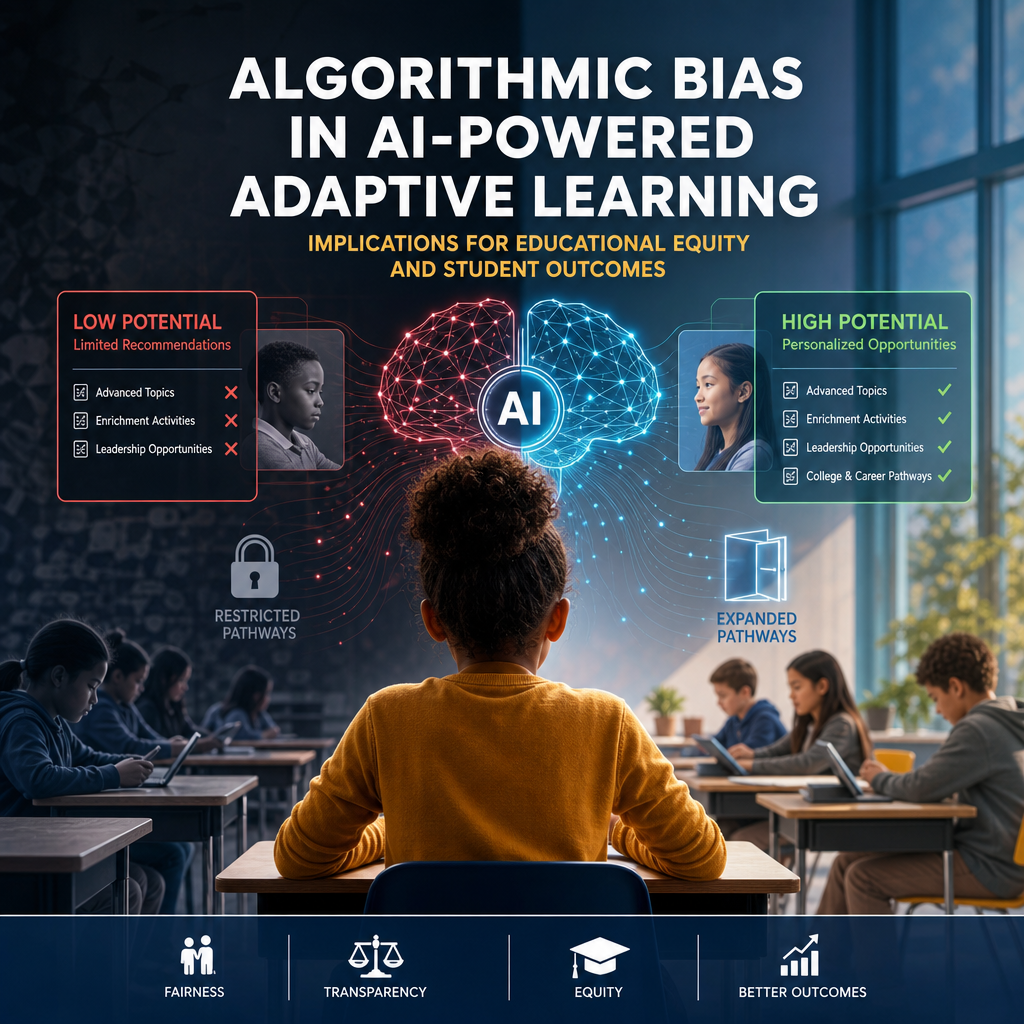
However, beneath the surface of these impressive metrics lies a growing and deeply concerning paradox. The very systems designed to democratize learning are increasingly found to be reproducing--and in some cases, amplifying--existing social and educational inequities [3]. Because these algorithms rely heavily on vast datasets to make pedagogical decisions, they frequently inherit the historical biases and structural inequalities embedded within that data [4]. As algorithmic bias becomes a silent arbitrator of student success, the educational community must confront a critical question: are we creating a more equitable future, or simply automating the disparities of the past?
The Double-Edged Sword of Personalization
To understand the gravity of algorithmic bias, one must first acknowledge why adaptive learning systems are so highly sought after. From a pedagogical perspective, these technologies align with decades of effort to create learner-centered environments, moving away from the one-size-fits-all model of traditional education [1]. A recent meta-analysis of 29 experimental and quasi-experimental studies confirmed that AI-driven adaptive learning has a significant positive effect on students' personalized learning outcomes, particularly in enhancing sustainable adaptive learning abilities [5]. By utilizing machine learning algorithms to continuously evaluate student performance, these systems enable real-time curriculum modifications, freeing up educators' time and potentially increasing overall instructional efficiency [6][7].
Yet, the effectiveness of these systems is inextricably linked to the quality and representativeness of the data upon which they are built [1]. When an adaptive learning platform is trained on datasets that are incomplete, skewed, or demographically unrepresentative, the personalized experience it offers is fundamentally compromised [3]. Certain groups of students may receive less optimal recommendations due to flawed data inputs, inadvertently reinforcing the very inequalities the technology was intended to reduce [1]. This creates a scenario where the promise of personalization becomes a double-edged sword: highly effective for the majority, but potentially detrimental to marginalized outliers whose data profiles do not align with the algorithm's narrow understanding of a "typical" student.
 AI-driven adaptive learning for sustainable educational transformation - Strielkowski - 2025 - Sustainable Development - Wiley Online Library
The Origins of Algorithmic Bias in the Classroom
Algorithmic bias in educational AI is rarely the result of overt malicious intent; rather, it is a systemic issue rooted in the lifecycle of machine learning development. One of the primary culprits is training data inequity. Models trained on historically biased datasets naturally replicate and often amplify those inequities when applied to new, diverse student populations [8]. For example, if an algorithm is trained on historical assessment data from well-resourced school districts, it may establish an inaccurate baseline for "normal" academic progression, unfairly flagging students from under-resourced backgrounds as underperforming or "at-risk" [3][9].
Furthermore, educational algorithms frequently engage in proxy discrimination. Because direct data on race or socioeconomic status is often removed from datasets to comply with privacy regulations, algorithms may rely on seemingly neutral variables--such as zip codes, device types, or internet connection speeds--that act as highly accurate proxies for marginalized identities [8]. Once these biased predictions are made, they trigger a dangerous phenomenon known as feedback loop amplification. A biased prediction might cause a system to route a student into a lower-tier learning track; the student's subsequent performance on that easier track then generates new data that "confirms" the algorithm's original, flawed assumption, creating a self-perpetuating cycle of inequity [8]. Compounding this issue is the pervasive lack of transparency in "black-box" AI models, which makes it exceedingly difficult for educators and students to understand, challenge, or appeal these automated decisions [8].
The Digital Divide and Accessibility Barriers
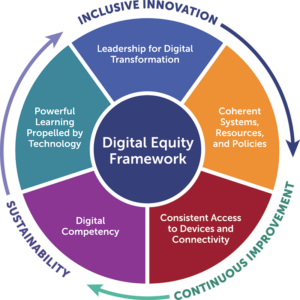
Algorithmic bias extends beyond the mathematical confines of the software; it is deeply intertwined with the physical realities of the digital divide. AI-powered learning tools inherently require robust digital infrastructure, including high-speed internet, up-to-date devices, and a certain level of digital literacy [4]. As noted by Thompson and Harris (2022), not all students benefit equally from AI-driven learning environments, particularly those with limited access to digital infrastructure or lower levels of technological proficiency [1]. For students in low-income or rural areas, limited access to reliable technology means they may be entirely excluded from the AI-driven learning opportunities their peers receive [4].
This infrastructural inequity creates a secondary layer of bias. If an adaptive system tracks student engagement or time spent on a platform, students lacking reliable internet will inevitably score lower on these metrics. The algorithm, unaware of the physical barriers the student faces, may interpret this lack of engagement as a lack of ability or motivation, subsequently adjusting the student's learning path downward [7]. Furthermore, uncontrolled external variables, such as home environment and access to supplementary resources, heavily influence student performance but are entirely invisible to the algorithm [6]. Without accounting for these structural realities, AI systems risk punishing students for their socioeconomic circumstances rather than their academic potential.
 How will AI Impact Racial Disparities in Education? - Stanford Center for Racial Justice - Stanford Law School
Mitigating Bias: Towards Equitable AI in Education
Addressing algorithmic bias in adaptive learning requires a comprehensive, multi-layered approach that moves beyond technical efficiency to actively promote fairness, inclusivity, and social justice [3]. On the technical front, researchers are beginning to develop sophisticated mitigation strategies. Recent studies have demonstrated the potential of using synthetic data generation--such as Conditional Tabular GANs (CTGAN)--alongside data preprocessing techniques like SMOTE to ensure balanced demographic representation in training datasets [9]. Furthermore, the integration of fairness-aware algorithms, including adversarial debiasing techniques, shows promise in reducing disparate impact across gender, ethnicity, and socioeconomic groups before these systems are deployed in live classrooms [9].
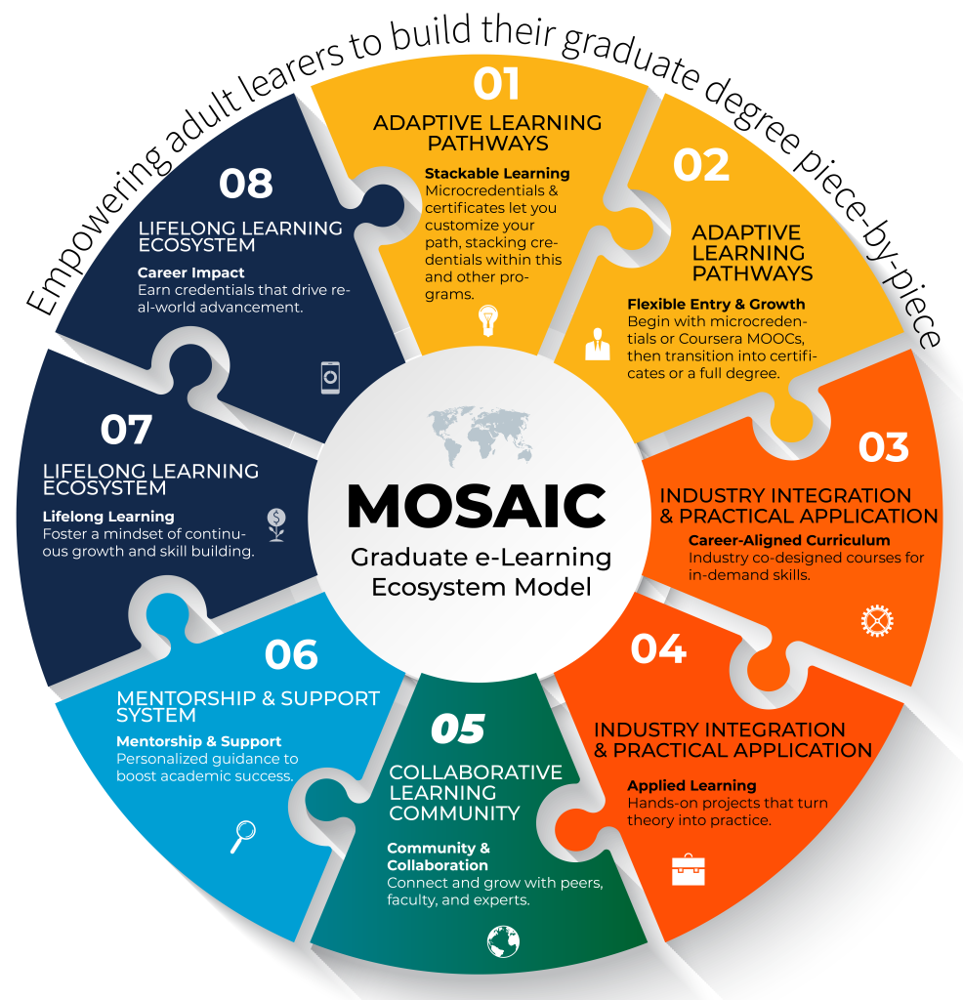
However, technical fixes alone are insufficient. Solving this crisis requires intentional structural and institutional changes. There is an urgent need for best practices and rigorous policy frameworks to guarantee justice and avoid algorithmic bias, particularly when developing AI systems for underprivileged demographic groups [6]. This includes establishing ongoing algorithmic audits, transparent model documentation, and strict governance frameworks that hold educational institutions and tech companies accountable for the AI decisions affecting students [8][7]. Additionally, diverse AI development teams are crucial; varied perspectives help anticipate design flaws and gaps that homogeneous teams might miss [10]. Finally, educators and students themselves must be empowered with the analytical abilities to critically assess AI outputs, ensuring that human pedagogical judgment remains the ultimate authority in the classroom [10].
 AI in the E-Learning Ecosystem: Adaptability, Co-Agents, and Ethical Pathways | Online Grad Innovation | Illinois
Conclusion
AI-powered adaptive learning systems possess transformative potential to enhance student outcomes and personalize education in ways previously unimaginable. Yet, as the research unequivocally demonstrates, without meticulous design, inclusive data practices, and sustained attention to equity, these tools threaten to become engines of institutionalized discrimination. Algorithmic bias--fueled by skewed data, proxy variables, feedback loops, and the digital divide--poses a profound risk to marginalized students, silently widening the achievement gaps educators work so tirelessly to close. The integration of AI into education must not be a passive adoption of technology, but a proactive crusade for educational justice. Only by demanding transparency, enforcing rigorous ethical standards, and keeping human educators at the center of the learning process can we ensure that the AI revolution fulfills its promise of lifting every student, rather than leaving the most vulnerable behind.
References
- 1.
- 2.
- 3.
- 4.
- 5.
- 6.
- 7.
- 8.
- 9.
- 10.