Introduction
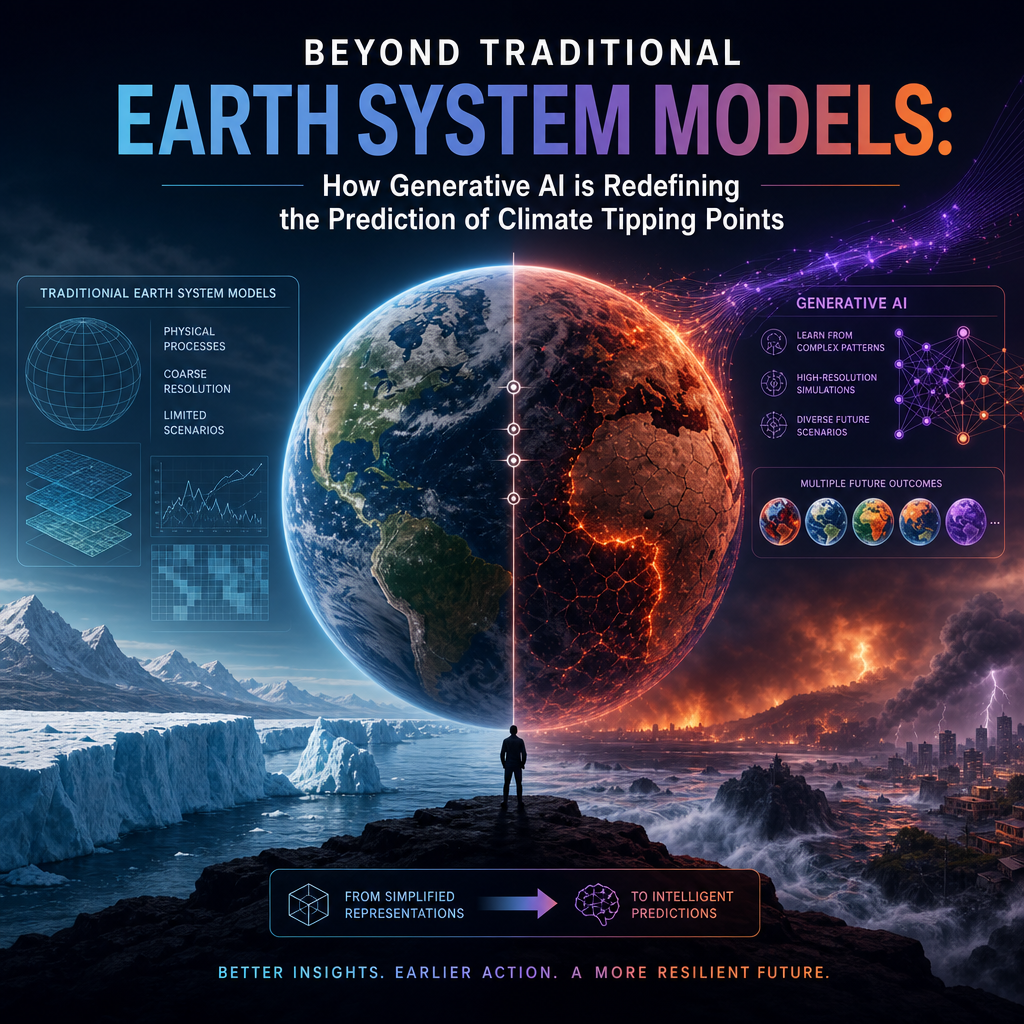
For decades, the global scientific community has relied on General Circulation Models (GCMs) and Earth System Models (ESMs) to project the future of our planet. These traditional models, built on complex numerical equations representing atmospheric and oceanic physics, have been instrumental in understanding anthropogenic warming. However, as climate change accelerates, these models are revealing critical blind spots--particularly when it comes to predicting "tipping points." These are critical thresholds where a tiny perturbation can push the Earth system into an entirely new, often irreversible state, such as the collapse of the Atlantic Meridional Overturning Circulation (AMOC) or the rapid disintegration of polar ice sheets [1].
The fundamental limitation of traditional ESMs lies in their computational intensity and their struggle to capture highly non-linear, noisy, and abrupt shifts in complex systems. Traditional Early Warning Signals (EWS)--akin to tremors before an earthquake--frequently misfire in these chaotic environments, triggering false alarms or, more dangerously, remaining completely silent as a tipping point approaches [1]. Recognizing these profound constraints, the field of climate modeling is undergoing a seismic transformation, moving away from purely physics-based equations toward sophisticated artificial intelligence [2].
Generative AI, a subset of machine learning capable of creating new data and mapping complex multidimensional spaces, is emerging as a powerful complementary tool for climate predictability. By analyzing vast datasets and identifying intricate patterns that traditional models overlook, AI is not just accelerating climate simulations; it is entirely redefining how scientists discover, interrogate, and prepare for the most catastrophic climate scenarios [3].
Generative Adversarial Networks: Mapping the Boundaries of Collapse
At the forefront of this revolution is the application of Generative Adversarial Networks (GANs) to climate tipping point discovery. Funded by DARPA's AI-assisted Climate Tipping-point Modeling (ACTM) program, researchers at the Johns Hopkins Applied Physics Laboratory (APL) and the University of Maryland have developed a novel framework known as the Tipping Point Generative Adversarial Network (TIP-GAN) [4][5].
TIP-GAN operates on a brilliant adversarial premise: one neural network is tasked with generating model parameters that cause a climate system to tip, while a second network attempts to recognize those tipping points and modify conditions to move away from the edge [6]. By battling in this simulated environment, the AI learns the exact contours of a system's state space bifurcations--essentially mapping the invisible boundaries between stability and collapse.
To prove the fidelity of this approach, researchers used TIP-GAN to recreate a landmark 2018 experiment by oceanographer Anand Gnanadesikan, which suggested that global climate models significantly overestimate the stability of the AMOC under anthropogenic warming [6]. TIP-GAN successfully learned the boundaries of the AMOC's fold bifurcation by perturbing three key parameters. Astonishingly, the AI was able to classify whether specific model configurations would result in a collapsed or stable AMOC with an F-Measure score above 90%--all without needing to run the underlying reduced climate model [4].
 New report explores revolutionary environmental AI infrastructure
Neuro-Symbolic AI and the Power of "What-If" Interrogation
One of the most persistent criticisms of deep learning in science is its "black box" nature--AI can provide an answer, but it cannot explain its reasoning. To make AI-generated climate predictions truly useful, scientists must be able to interrogate the models. This has led to the integration of "third-wave AI" techniques, specifically neuro-symbolic hybrid models, which combine the pattern-recognition power of neural networks with the logical reasoning of symbolic AI [5].
In the context of TIP-GAN, researchers developed a bidirectional translation system that maps natural language scientific questions into the neuro-symbolic representations used by the AI [4]. This breakthrough pushes climate modeling into a new era of explainability. Instead of writing complex code to adjust atmospheric parameters, a scientist can ask a "what-if" question in plain English, and the AI translates that query into the parameter space to generate an answer [6].
This capability addresses a core goal of DARPA's ACTM program: moving beyond purely theoretical predictions to provide "actionable guidance to policy makers" on the risks and causes of sudden tipping points, runaway feedback loops, and their strategic implications [5]. By demystifying the AI's internal structure, neuro-symbolic models bridge the gap between raw computational power and human decision-making.
Next-Generation Architectures: Diffusion Models and Dual Networks
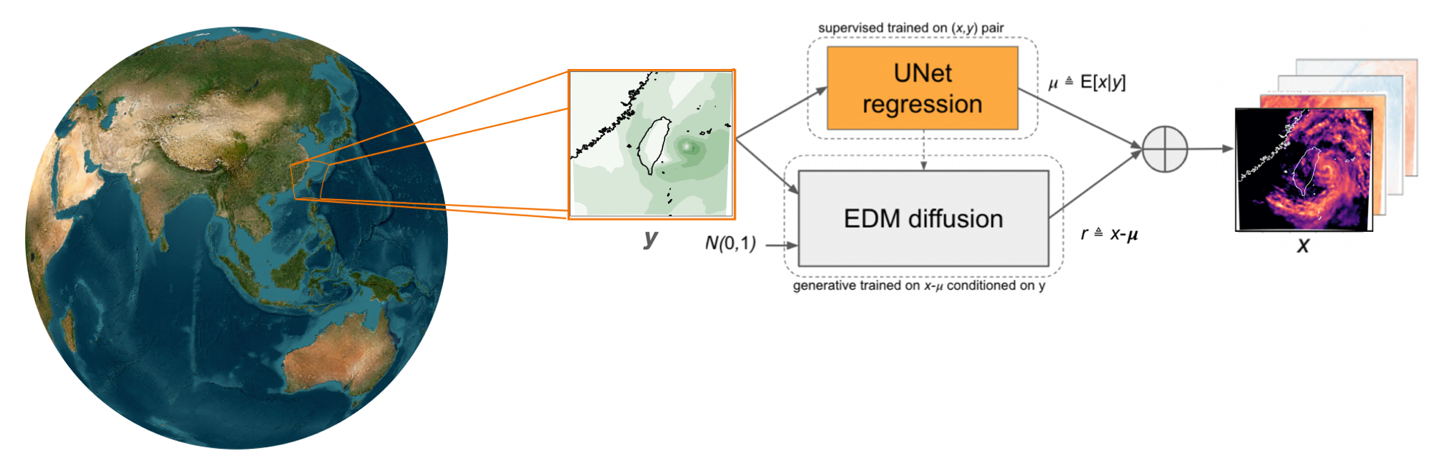
While GANs excel at mapping parameter boundaries, other generative AI architectures are tackling different challenges in climate modeling, such as temporal forecasting and spatial resolution. Traditional models begin to lose accuracy around 10 days due to the chaotic nature of the atmosphere and ocean. To overcome this, scientists at Argonne National Laboratory developed AERIS, an Earth systems model driven purely by data rather than physics equations [7].
AERIS utilizes a diffusion model--the same underlying technology used in advanced image generation tools like Midjourney. Trained on 16 terabytes of high-resolution global weather images from 1979 to 2018, AERIS reads data pixel by pixel to maintain fine details that traditional models often blur. More importantly, it generates "ensembles" of many plausible futures, providing crucial uncertainty estimates for subseasonal-to-seasonal forecasts that energy and agricultural sectors desperately need [7].
Simultaneously, researchers at the University of Washington have challenged assumptions about AI climate forecasting with the Deep Learning Earth SYstem Model (DLESyM). Counterintuitively trained only on one-day forecasts, DLESyM utilizes two distinct neural networks--one for the atmosphere and one for the ocean--to capture seasonal variability over vast timescales. DLESyM proved competitive with the leading CMIP6 models used by the IPCC, yet it can simulate 1,000 years of climate in a single day [8].
 How Generative AI is Empowering Climate Tech with NVIDIA Earth-2
This dramatic speedup has profound implications. Not only does AI offer a much lower carbon footprint than traditional supercomputer-heavy models, but it also democratizes climate science. "Anyone can download it from our website and run complex experiments, even if they don't have supercomputer access," noted UW's Dale Durran [8].
Furthermore, generative AI is actively fixing historical flaws in ESMs. For example, machine learning algorithms have successfully corrected the "double-peaked Intertropical Convergence Zone"--a notorious precipitation bias in traditional models--by enhancing spatial patterns and daily precipitation intermittency using GANs [3].
Toward Actionable Early Warning Signals
The ultimate value of these generative AI models lies in their ability to anticipate the unthinkable. Traditional EWS rely on statistical indicators like increasing variance or autocorrelation, but these often fail when dealing with "Rate-Induced Tipping"--scenarios where the pace of human-driven change outstrips a natural system's ability to adapt, pushing it over the edge without the usual warning signs [1].
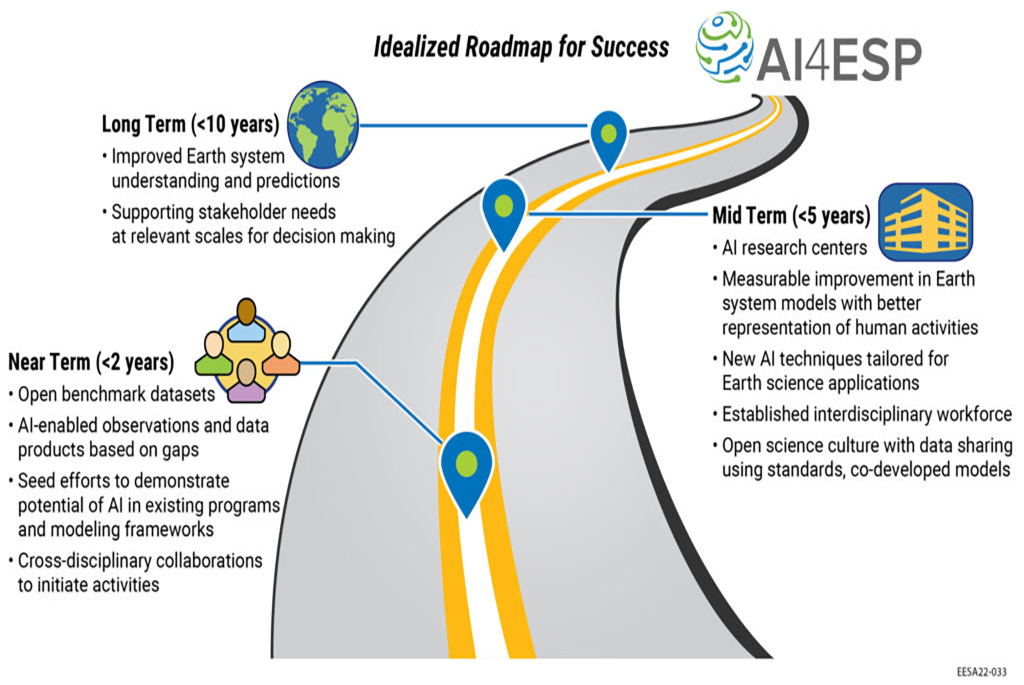
Generative AI offers a way forward. By training on models of specific climate tipping points, AI can move beyond generic indicators to create system-specific EWS [9]. Because AI natively handles non-linear relationships and adapts to changing patterns over time, it is uniquely suited to filter out the "noise" of natural climate oscillations and isolate the true signals of an impending collapse [3][1]. The U.S. Department of Energy's AI4ESP initiative highlights that realizing this potential requires co-designing AI alongside observational capabilities and physical models, ensuring that these fast learned models are anchored in reality [10].
 New Report Explores Revolutionary Environmental Artificial Intelligence Infrastructure - Earth and Environmental Sciences Area
Conclusion
The integration of generative AI into climate science represents a fundamental paradigm shift. We are moving from an era where predicting climate tipping points was a computationally prohibitive, probabilistic guessing game, to one where AI can precisely map the contours of collapse, simulate centuries of dynamic Earth systems overnight, and answer complex scientific queries in plain language.
While AI is not a wholesale replacement for physics-based Earth System Models--rather, it is a powerful hybrid partner--it removes the historical barriers of computational cost and non-linear complexity. As frameworks like TIP-GAN, AERIS, and DLESyM mature, they promise to transform climate predictability from an academic exercise into a highly accessible, actionable toolkit. For policymakers, geopolitical strategists, and communities on the frontlines of climate change, generative AI may finally provide the advanced warning required to steer the planet away from the brink.
References
- 1.
- 2.
- 3.
- 4.
- 5.
- 6.
- 7.
- 8.
-
9.
Global Tipping Points | 1.6.3.3 Applications of AI for predicting tipping points. (n.d.). Retrieved https://report-2023.global-tipping-points.org/section1/1-earth-system-tipping-points/1-6-early-warning-signals-of-earth-system-tipping-points/1-6-3-recommendations-and-looking-ahead/1-6-3-3-applications-of-ai-for-predicting-tipping-points
- 10.