Introduction
Just a few years ago, the artificial intelligence landscape appeared to be a wide-open frontier. Academic labs, independent researchers, and nimble startups routinely published breakthroughs that rivaled or surpassed those of corporate giants. The prevailing narrative was one of democratization: open-source frameworks and accessible cloud computing would allow anyone with a clever algorithm to participate in the AI revolution. Today, that narrative has been upended by a harsh mathematical reality. The transition from traditional machine learning to large-scale foundation models has transformed AI from an algorithm-centric discipline into a brute-force engineering challenge dictated almost entirely by computational power.
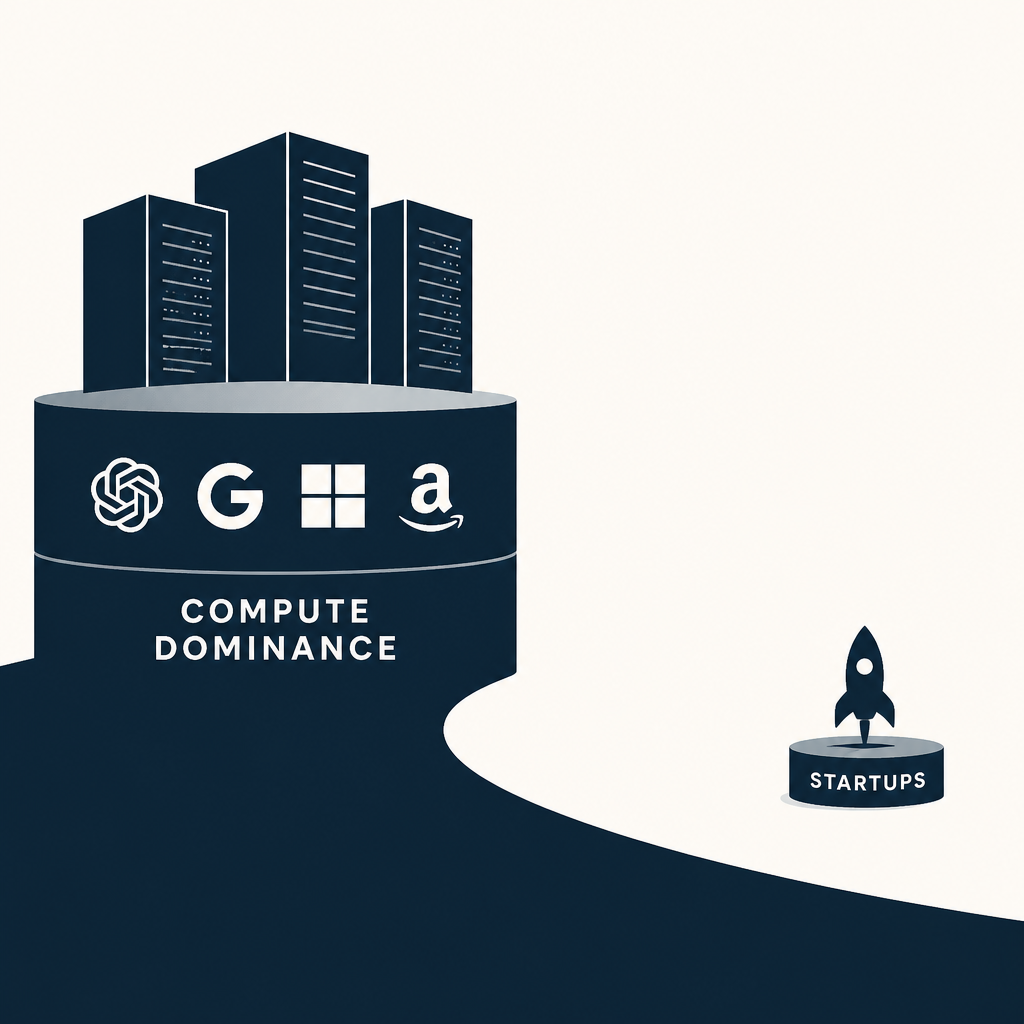
This shift has catalyzed the formation of a foundation model oligopoly. A tiny cluster of technology behemoths--primarily Microsoft, Google, Amazon, and Meta--now control the vast majority of the advanced compute necessary to train state-of-the-art models. By leveraging their massive balance sheets and existing cloud infrastructure, these incumbents have erected a formidable economic moat that is fundamentally reshaping the structure of the AI industry. The era of the garage-built foundation model is effectively over, replaced by an arms race that costs billions of dollars per iteration [1].
Consequently, the startup ecosystem is undergoing a seismic realignment. No longer able to compete at the foundational layer, emerging companies are being forced into a subordinate position, building applications atop proprietary APIs or heavily subsidized open-weight models. This dynamic is not just a temporary market phase; it represents a structural consolidation of power that threatens to centralize the most transformative technology of the 21st century into the hands of a few corporate entities.
The Compute Bottleneck: The New Oil of the AI Era
The current AI boom is governed by "scaling laws"--the empirical observation that a model's capabilities improve predictably as you increase the number of parameters, the size of the training dataset, and the amount of compute applied [2]. This principle has turned graphical processing units (GPUs), particularly advanced chips like Nvidia's H100s, into the most critical and scarce resource in the global economy. Training a frontier model like GPT-4 or Gemini Ultra requires tens of thousands of these chips running continuously for months, resulting in capital expenditures that easily exceed $100 million for a single training run, and billions when accounting for failed runs and research overhead.
This compute requirement has created an insurmountable barrier to entry. In the past, a startup could differentiate itself through architectural innovations, such as the advent of the Transformer itself. Today, architectural differences have yielded diminishing returns compared to the sheer scale of compute thrown at a standard architecture. The competitive edge has moved from "how" the model is built to "how much" can be spent building it.
The Capital Moat
Big Tech's dominance in this space is not accidental; it is the result of an unprecedented concentration of capital. Microsoft's multi-billion-dollar partnership with OpenAI, Google's internal deployment of its custom Tensor Processing Units (TPUs), and Amazon's massive investments in Anthropic are prime examples of incumbents using their financial weight to secure the compute supply chain [3]. Nvidia, the sole provider of the most advanced training chips, physically cannot manufacture enough GPUs to supply a broad, competitive market. Therefore, the limited supply is inevitably swallowed by the few players capable of placing multi-billion-dollar upfront orders.
The Reshaping of the Startup Ecosystem
Faced with the impossibility of raising the billions required to train a frontier model from scratch, the startup ecosystem has been forcibly bifurcated. A small number of well-funded "second-tier" players, such as Mistral in Europe or Inflection AI (before its absorption by Microsoft), have managed to secure hundreds of millions to stay marginally competitive. However, the vast majority of AI startups have had to completely pivot their business models.
Instead of building foundation models, startups are now building thin application layers--often derisively referred to as "wrappers"--on top of the foundation models provided by the oligopoly. These companies rely on APIs from OpenAI, Google, or Anthropic to power their products. While this lowers initial costs and accelerates time-to-market, it leaves these startups entirely at the mercy of the foundation model providers. If a Big Tech company decides to bundle a startup's core feature into its own model's native capabilities, the startup can be rendered obsolete overnight [4].
The Illusion of Open Source
To counter accusations of monopolistic behavior, some members of the oligopoly--most notably Meta--have adopted an aggressive strategy of releasing "open-weight" models, such as the Llama series. While these releases have been celebrated as victories for open-source AI, they represent a nuanced form of market control. Meta does not release the training data, the training code, or the immense compute infrastructure used to build Llama; it only releases the final weights.
This strategy cleverly undercuts the commercial pricing power of closed-API competitors like OpenAI, while ensuring that the broader developer ecosystem remains dependent on Meta's continued philanthropy. Furthermore, while startups can fine-tune these open-weight models for specific tasks, they still lack the compute to train a truly competitive base model. The "open-source" ecosystem is thus thriving on the table scraps of the oligopoly, remaining fundamentally constrained by the compute gap [5].
Regulatory and Economic Implications
The centralization of foundational AI capabilities raises profound antitrust and economic concerns. Traditional antitrust frameworks focus on pricing power and consumer harm in existing markets. However, the foundation model oligopoly represents a "winner-takes-all" dynamic in a market that is still being defined. Big Tech companies are essentially leveraging their dominance in cloud computing (an established market) to capture the foundational layer of AI (the future market), a practice known as tying or bundling [6].
Furthermore, this concentration creates systemic economic risks. By renting access to intelligence via APIs, businesses are effectively transitioning from capital expenditures (owning software) to operational expenditures (renting AI). This shifts massive amounts of recurring revenue into the hands of a few cloud providers. If the oligopoly decides to aggressively raise API pricing once the market is fully locked in, it could extract rents from virtually every sector of the digital economy, from healthcare to finance.
The Cloud Provider Lock-in
The integration of foundation models into cloud ecosystems has deepened vendor lock-in. Enterprises are not just renting Azure, AWS, or Google Cloud; they are building proprietary data pipelines and fine-tuning models that are natively tethered to those specific cloud environments. Migrating an enterprise AI stack from one cloud provider to another is becoming exponentially more difficult than migrating traditional software, effectively cementing the market power of the oligopoly for decades to come [7].
Alternative Paths and Future Horizons
Despite the grim realities of the compute bottleneck, the oligopoly is not entirely unassailable. The most promising avenue for disruption lies in algorithmic efficiency. Just as the Transformer architecture unexpectedly revolutionized natural language processing, a new breakthrough in training efficiency could theoretically reduce the compute required to train a frontier model by orders of magnitude. Research into mixture-of-experts (MoE) architectures, state space models (SSMs) like Mamba, and novel hardware paradigms represents the best hope for breaking the compute monopoly [8].
Another potential counterweight is the rise of decentralized compute networks and sovereign AI initiatives. Governments and consortia in regions like Europe, the Middle East, and Asia are increasingly viewing AI compute as critical national infrastructure. Initiatives to build publicly funded, localized supercomputing clusters aim to create "sovereign" foundation models that operate outside the purview of US-based Big Tech. While these efforts currently lag behind the private sector in absolute capability, they represent a geopolitical pushback against private compute monopolies.
Additionally, the dynamic nature of the semiconductor supply chain could shift the balance. As Nvidia faces increasing competition from AMD, Intel, and custom silicon developed in-house by the tech giants themselves, the GPU shortage may eventually ease. However, even if hardware becomes more abundant, the capital efficiency of massive, centralized training runs may still favor large incumbents over smaller players.
Conclusion
The foundation model era has not democratized artificial intelligence; it has heavily centralized it. By turning compute into the primary currency of innovation, the industry has inadvertently handed the keys of the future to a small cadre of Big Tech corporations with the balance sheets to afford them. This oligopoly is actively reshaping the startup ecosystem, pushing innovators away from fundamental research and toward dependent, application-layer development that risks easy obsolescence.
While technological breakthroughs in efficiency or geopolitical interventions in compute infrastructure could eventually loosen Big Tech's grip, the current trajectory points toward a highly concentrated market. Policymakers, researchers, and entrepreneurs must confront this reality honestly. Without intentional interventions--whether through antitrust enforcement, public compute infrastructure, or a massive paradigm shift in how models are trained--the foundational layer of AI will remain a walled garden, built and governed by a few corporate giants.