Introduction
For roughly three decades, the per-seat subscription has been the golden metric of the software industry. The formula was elegantly simple: a company with 10,000 employees buys 10,000 licenses; headcount rises, software spend rises; headcount falls, spend falls. Procurement teams understood it, CFOs could forecast it, and vendors built predictable revenue models--and extraordinary gross margins--on top of it [1]. This model, often called SaaS 1.0, transformed software from a lumpy capital expenditure into a smooth operational expense and generated the Annual Recurring Revenue (ARR) streams that underpinned a software ecosystem now valued at roughly $1 trillion [2].
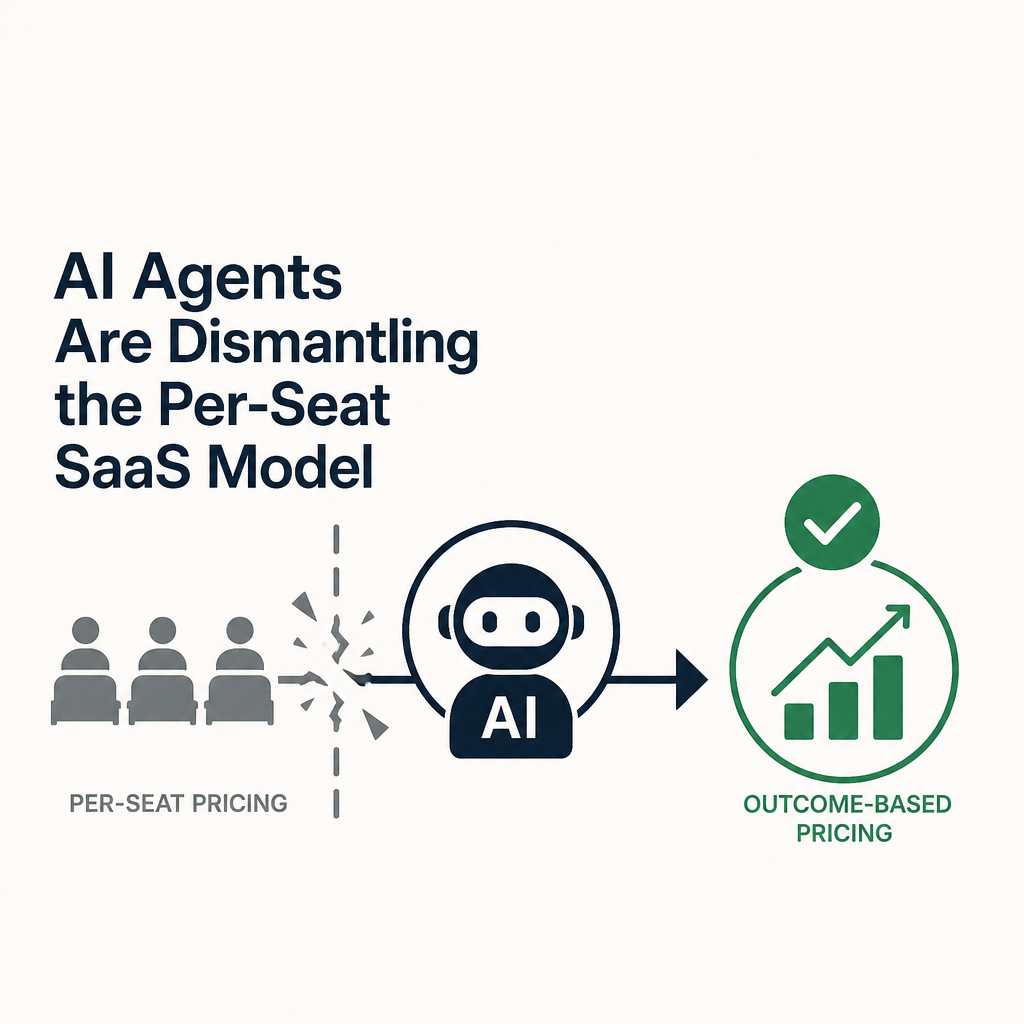
That assumption--software consumption scales with human users--is now obsolete. AI agents don't merely help humans work faster; they execute work end-to-end, handling thousands of customer conversations, qualifying leads, and resolving support tickets without a single human ever logging in [3]. When the unit of software consumption was a human user, the seat made sense. When autonomous agents perform an increasing share of software interactions, the relationship between employee headcount and license count collapses--and with it, the pricing model the entire industry was built upon [4].
The consequences are no longer theoretical. Investors are pricing in the risk, vendors are scrambling to re-architect their billing systems, and enterprise buyers find themselves holding unusual negotiating leverage. This article examines why the per-seat model is breaking, which pricing architectures are competing to replace it, and what the transition means for the future structure of enterprise software.
The Per-Seat Model: How the Seat Became the Industry's Golden Metric
Three Decades of Predictability
The per-seat model's dominance rested on more than convenience--it created genuinely sticky, defensible businesses. Enterprise software is frequently difficult to transition to another provider, and because all team members needed access as part of their roles, seat licenses created reliable, compounding revenue streams with minimal variable cost as seats were added [5]. High operating leverage made companies like Microsoft exceptionally profitable and built formidable moats against new entrants [5].
The model also succeeded because it was legible to everyone in the value chain. From startup founders to enterprise CFOs, the math was universally understood: ten employees needing CRM access meant ten seats [2]. Vendors could forecast revenue, buyers could budget annually, and the incentive to expand became synonymous with the customer's own headcount growth--a rare alignment of interests that fueled two decades of extraordinary SaaS growth.
The Hidden Assumption
Beneath the simplicity, however, sat a critical premise: that humans were the only entities executing work through software systems [4]. The seat was never really a measure of value delivered--it was a proxy, a convenient stand-in that happened to correlate with value because humans were the ones doing the work. As one analysis put it, the per-seat metric is simply too primitive to capture the active value creation of autonomous agents [2]. Once software itself could perform the work, the proxy stopped pointing at anything real.
Why AI Agents Break the Model
Decoupling Value from Headcount
AI agents break per-seat pricing in a way no previous technology shift has [1]. Consider the arithmetic now circulating through boardrooms and investor memos. A company using an AI agent to handle customer support tickets that previously required 50 human agents no longer needs 50 CRM seats. Under per-seat pricing, the vendor's revenue drops as much as 90% while the customer receives the same--or better--output. As one analysis bluntly concluded: no business model survives that math [6].
The scenario scales down to the ordinary enterprise division just as starkly. Imagine 20 employees with 20 seat licenses; now imagine paying for a single seat with an AI agent sitting on top of it, delivering productive value to the other 19 people on the team. Under a pure seat-licensing model, 95% of the revenue disappears [5]. The software is delivering more value than ever--but the billing mechanism registers it as catastrophic contraction.
The Multiplier Effect
Celonis captured the dynamic in a widely discussed March 2026 analysis titled "AI Agents Are Redefining SaaS: Monolithic Apps Lose, Operational Context Wins," arguing that AI agents act as multipliers--two senior knowledge workers equipped with AI agents can perform the work of ten--and that this multiplier effect breaks the per-seat pricing model on which the SaaS industry built its growth [7]. The direction of the pressure is structural, not cyclical: the very technology vendors are racing to embed in their products is the technology that decouples software value from seat count [7].
The disruption is already visible in specific functions. Gartner has reported that AI could reduce call center staffing by a staggering amount, translating directly into revenue loss for SaaS companies dependent on per-seat pricing in customer support categories [8]. Sierra co-founder Clay Bavor told CNBC in July 2026 that the shift is already underway as AI agents move out of demos and into real customer service, sales, and support workflows [3].
The Contenders: Pricing Models for the Agent Era
Outcome-Based Pricing: Paying for Results, Not Access
The most philosophically ambitious replacement is outcome-based pricing: charging for a specific, successful result the AI delivers--such as a resolved support ticket, a booked appointment, or a completed workflow--rather than for access or usage volume [3]. OpenAI is reportedly testing outcome-based models with select enterprise customers, enabling organizations to pay based on the successful completion of tasks performed by AI agents. Salesforce is advancing a parallel strategy through its Agentforce platform, combining traditional SaaS licensing with outcome-based economics [9].
For enterprise buyers under pressure to demonstrate measurable AI ROI, the appeal is obvious: vendor revenue aligns directly with customer results, shifting the conversation from access and consumption to value delivered [9]. Subscription models often leave licenses underutilized; usage-based models create cost uncertainty. Outcome pricing promises to resolve both [9].
Consumption, Tokens, and Compute
The most immediately practical alternative is consumption-based pricing. Token-based models--popularized by AI infrastructure providers--charge for each unit of processing performed by the underlying model, offering granular alignment between cost and value but demanding sophisticated metering infrastructure. Vendors must track token consumption across millions of agent interactions while maintaining transparent billing for enterprise customers [10]. Compute-based pricing, charging for GPU hours or inference requests, favors vendors with proprietary infrastructure and penalizes those relying on expensive third-party compute [10].
These models carry their own tension: token economics can conflict with the goal of encouraging agent adoption, since every unit of customer success generates a bill--and unpredictable bills breed procurement resistance [10].
The Pricing Paradox: Why Pure Value-Based Pricing Struggles
Value-based pricing sounds like the logical endpoint--charge exactly what the software is worth--but it fails under the weight of attribution, measurement, adversarial dynamics, and unpredictability [1]. In a traditional per-seat or consumption arrangement, vendor and buyer focus their energy on making the software work better. Under value-based pricing, they spend their time arguing about how much value was actually delivered. The pricing model itself consumes management attention and legal review cycles that could be directed toward improving the deployment [1].
This is why hybrid models are emerging as the practical middle ground--offering reasonable alignment between vendor and customer without requiring both parties to agree, contract by contract, on precisely how much value was created [1]. Most analysts expect hybrids to dominate the transition period, with per-seat persisting only in segments where human judgment remains the core unit of work: executives, specialized practitioners, and compliance reviewers [10][4].
Market Fallout: Investors, Vendors, and the Structural Re-Rating
The "DeepSeek moment" of early 2025 crystallized investor awareness that autonomous AI agents and vibe coding are not merely features but a systematic threat to the economics of the $1 trillion software ecosystem--triggering what some describe as a structural re-rating of the entire sector [2]. Markets are already pricing in the risk: vendors with heavy per-seat enterprise exposure are seeing valuation multiple compression and net revenue retention (NRR) pressure [4].
The strategic implications split the vendor landscape into early movers and defenders. Companies that began transitioning their pricing models early--Salesforce and ServiceNow are frequently cited--are demonstrably better positioned than those still defending per-seat economics [4]. Successful navigation, analysts argue, requires more than a new price list: vendors must restructure product portfolios and engineer their systems for metering and measurement, building the infrastructure to track agent activity at granular levels [10].
Not everyone believes the disruption is total. The likely outcome, per multiple analyses, is evolution rather than extinction: a "SaaS Apocalypse" that culls companies with poor UX and generic code, while vendors who successfully align their revenue with customer success build the dominant business models of the next decade [2][7].
The Buyer's Playbook: Unusual Leverage in a Transition Market
For enterprise buyers, the pricing model transition represents a rare inversion of negotiating power. Seat-heavy contracts covering functions where AI agents are already competent--customer support, lead qualification, routine service workflows--carry immediate repricing risk in the buyer's favor [4][3]. Practitioners recommend a structured approach [6]:
- Audit all SaaS contracts renewing in the next 18 months. Identify which are per-seat, what actual utilization looks like, and where AI agents will reduce seat needs.
- Model the financial impact of AI agents on each contract. Quantify projected seat reductions department by department.
- Request proposals from at least two vendors for every major renewal. Competition is the strongest negotiation tool during a pricing model transition.
- Push for hybrid pricing on all renewals. Even buyers not ready to go fully outcome-based should secure contractual provisions for AI pricing that can be activated later.
Buyers should also be realistic about the destination. Per-seat pricing will not vanish entirely--it will likely survive as a minority model in categories with low agent exposure and in roles where human seat counts grow alongside agent deployment [4]. The goal is not to predict the final pricing architecture, but to avoid being locked into contracts priced for a world that is disappearing.
Conclusion: Evolution, Not Extinction
The per-seat model served the software industry faithfully for three decades because its hidden assumption--that human headcount drives software consumption--held true. AI agents have broken that assumption permanently. Agents execute work at scale without creating a user footprint, and no quantity of logins can capture what they actually deliver [4][3].
What follows is not the death of software but the death of a specific business model--one that, critics argue, prioritized value extraction over utility [2]. The pricing models that replace it will define the economic structure of enterprise software for the next decade: consumption-based models offer immediacy, outcome-based models offer alignment, and hybrids will almost certainly dominate the messy transition in between [7][1]. None is perfect. All are better suited to the agent era than the status quo.
The vendors that navigate this transition successfully will be those that stop asking "how many people logged in?" and start asking "how much value did we create?"--aligning their revenue with their customers' success in an AI-augmented world. Those that cling to the seat will watch their revenue decline even as their software becomes more valuable [7]. The seat, as the industry's unit of account, is dying. What replaces it will be harder to meter, harder to negotiate, and far more honest about what software is actually for: getting work done.
References
- 1.
- 2.
- 3.
- 4.
- 5.
- 6.
- 7.
- 8.
- 9.
- 10.