Introduction
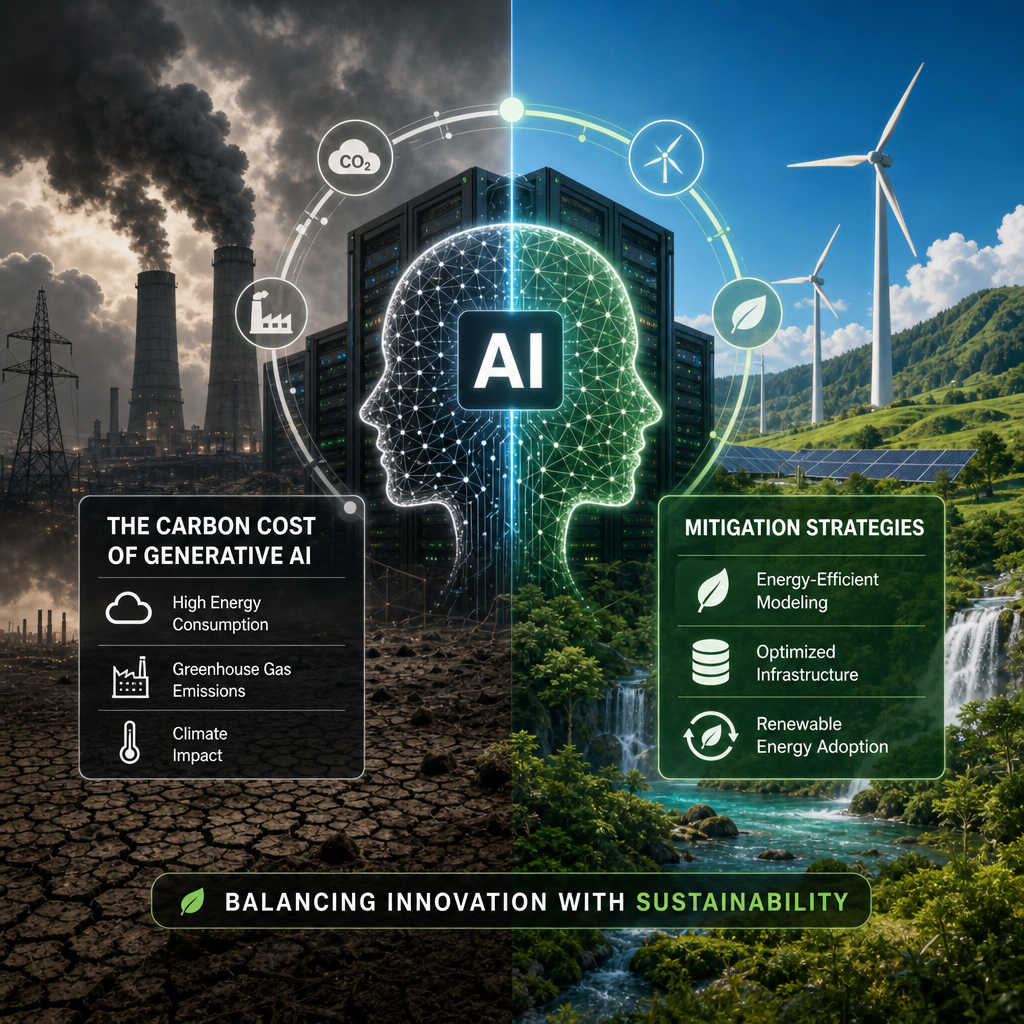
The generative AI revolution has ushered in an era of unprecedented technological capability, transforming industries from healthcare to creative arts. However, behind the seamless conversational abilities of models like GPT-4 lies a hidden, deeply resource-intensive reality. Like cryptocurrency before it, generative AI is so computationally demanding that it threatens to accelerate the depletion of critical resources--including electricity, water, and land--at a pivotal moment in the fight against climate change [1].
As the "gold rush" for artificial intelligence intensifies, the environmental consequences are becoming impossible to ignore. Every query processed, every parameter tuned, and every model trained leaves an indelible mark on the environment. To ensure that the future of AI is sustainable, the technology sector must urgently reframe its research and development paradigms, shifting carbon and resource considerations from the margins to the very center of the AI lifecycle [1].
The Scale of the Problem: Quantifying Training Emissions
The most glaring environmental cost of generative AI occurs during the initial training phase. Large language models require massive clusters of graphics processing units (GPUs) or tensor processing units (TPUs) to run continuously for weeks or even months [2]. This staggering computational throughput translates directly into profound energy consumption. For instance, training a single large model like GPT-3 consumed an estimated 1,287 megawatt-hours (MWh) of electricity--enough to power approximately 120 average U.S. homes for a year [3][4].
To put these figures into more tangible terms, a landmark study by researchers at the University of Massachusetts Amherst found that training a single, earlier-generation transformer model emitted 626,155 kg of CO2 equivalent. This is roughly equal to the lifetime emissions of five average American cars, or 300 round-trip flights between New York and San Francisco [5][6]. Furthermore, research indicates that the carbon footprint of modern LLMs can range from 10 to 100 times that of smaller, more traditional machine learning models [7]. As models grow in size to achieve new state-of-the-art results, this energy demand is skyrocketing, making the carbon impact an existential challenge for the industry [8].
 The mounting human and environmental costs of generative AI - Ars Technica
Beyond Training: Inference, "Thinking" AI, and the Supply Chain
A common misconception is that once an LLM is trained, its environmental impact flatlines. In reality, deploying these models in real-world applications--and enabling millions of users to interact with them daily--draws massive amounts of energy long after the initial development is complete [4]. Recent research reveals a stark disparity in the carbon cost of these interactions based on the model's reasoning approach. A 2025 study evaluating various LLMs found that "reasoning-enabled" models--those designed to "think" through problems step-by-step--can produce up to 50 times more CO2 emissions per prompt than concise response models [9].
Moreover, focusing solely on the electricity used during training and inference provides an incomplete picture. Researchers at Hugging Face have championed a holistic lifecycle analysis, emphasizing that the true impact of AI is inextricably linked to broader supply chains [1]. This includes the environmental degradation and poor working conditions associated with mining the metals required for hardware, the water consumed by data centers for cooling, and the land impacted by sprawling tech infrastructure. The physical footprint of this digital boom is so severe that data centers are increasingly being found to create localized "heat islands," warming surrounding land by up to 16 degrees Fahrenheit and exacerbating living conditions for hundreds of millions of people [6].
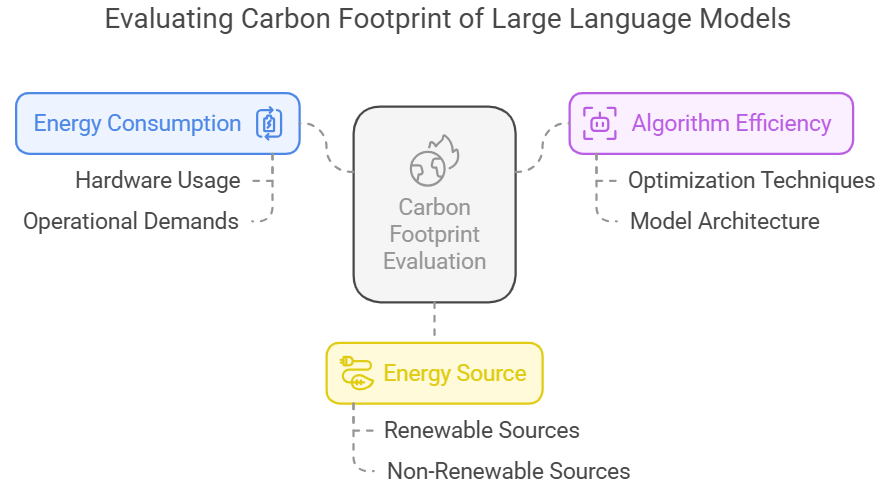 Evaluating the Carbon Footprint of Language Models | by Ashutosh | Generative AI
The Geography of Emissions: Why Energy Source Matters
When evaluating the carbon footprint of AI, it is vital to distinguish between energy consumption and carbon emissions--a difference largely dictated by geography. A model trained on a grid powered by coal will have a drastically higher carbon footprint than one trained on a grid powered by renewables or nuclear energy.
A compelling case study highlighting this dynamic involves the comparison between the BLOOM and OPT language models. Interestingly, BLOOM consumed more total energy during its training process than OPT, yet its overall carbon impact was significantly smaller. This anomaly occurred because BLOOM was trained on a French supercomputer predominantly powered by nuclear energy, whereas OPT relied on a more carbon-heavy energy mix [8].
Despite these localized successes, the broader trend is concerning. Industry experts warn that the breakneck pace at which companies are building new data centers to support AI simply cannot be met sustainably. Consequently, the bulk of the electricity powering these new facilities is currently forced to come from fossil fuel-based power plants [4]. This reality has not gone unnoticed by the legal system; the escalating spread of data centers is rapidly moving to the forefront of global environmental litigation, with a soaring number of climate-related lawsuits challenging the energy sources, emissions, and water consumption of tech giants [6].

Emerging Mitigation Strategies: The Push for "Green AI"
Acknowledging the severity of the crisis, researchers and tech organizations are actively exploring strategies to mitigate the carbon footprint of LLMs. These approaches can be broadly categorized into hardware innovations, algorithmic efficiency, and decentralized computing.
Hardware and Infrastructure: The physical layer is seeing rapid innovation. Chips designed specifically for AI are becoming increasingly energy-efficient, and data centers are accelerating their shift toward renewable energy [3]. Innovations in cooling and energy storage are also making these facilities more sustainable, moving away from traditional, power-hungry air conditioning systems [3].
Algorithmic Efficiency: Software advancements offer some of the most immediate relief. Researchers are exploring streamlined LLMs that require less training data to achieve high performance [3]. Model distillation--where a smaller, faster model is trained to replicate the behavior of a larger one (e.g., DistilBERT mimicking BERT)--has proven effective at maintaining proficiency while slashing computational demands [10]. Furthermore, careful selection of hardware for specific tasks, such as optimizing the balance between older T4 GPUs and newer A100 GPUs, can significantly reduce emissions without catastrophic losses in model performance [10].
Decentralized Computing: Moving away from monolithic, energy-hungry centralized data centers is another promising avenue. Federated learning involves training models locally on user devices rather than centralizing the process, thereby reducing the carbon footprint associated with massive data transmission [2]. Similarly, edge computing runs AI inference closer to the data source--such as directly on a smartphone or local server--eliminating the need to ping a distant data center for every single query, drastically reducing the energy consumed per operation [2].
Looking further ahead, quantum computing, though still in its infancy, promises a potential leap in efficiency for certain computational problems that could revolutionize AI's energy profile [3].
Conclusion
The generative AI revolution stands at a critical crossroads. While industry proponents argue that AI could eventually help reduce global emissions by up to 5.4 billion tonnes annually by 2035 through optimized policies and climate monitoring, a reality check reveals that there is currently no evidence that popular generative AI tools are leading to material, verifiable reductions in planet-heating emissions [6]. In fact, conflating the theoretical benefits of traditional AI with the massive resource demands of modern LLMs is actively muddling the climate debate [6].
Addressing the carbon cost of generative AI requires more than just shifting data centers to renewable energy--it demands a fundamental cultural shift within the tech industry. Carbon impact can no longer be treated as an afterthought. There is an urgent need for standardized methods to report the carbon impact of models and greater transparency provided to the public [8]. By balancing the pursuit of state-of-the-art performance with ecological responsibility, the AI sector can ensure that its most transformative creations do not come at the expense of the planet itself.
References
- 1.
- 2.
- 3.
- 4.
-
5.
3.3: Case Study- The Carbon Cost of Training Large Language Models - Social Sci LibreTexts. (n.d.). Retrieved https://socialsci.libretexts.org/Bookshelves/Education_and_Professional_Development/Teaching_AI_Ethics%3A_Practical_Strategies_for_Discussing_AI_Ethics_in_K-12_and_Tertiary_Education_(Furze)/03%3A_Teaching_AI_Ethics-_Environment/3.03%3A_Case_Study-_The_Carbon_Cost_of_Training_Large_Language_Models
- 6.
- 7.
- 8.
- 9.
- 10.