Introduction
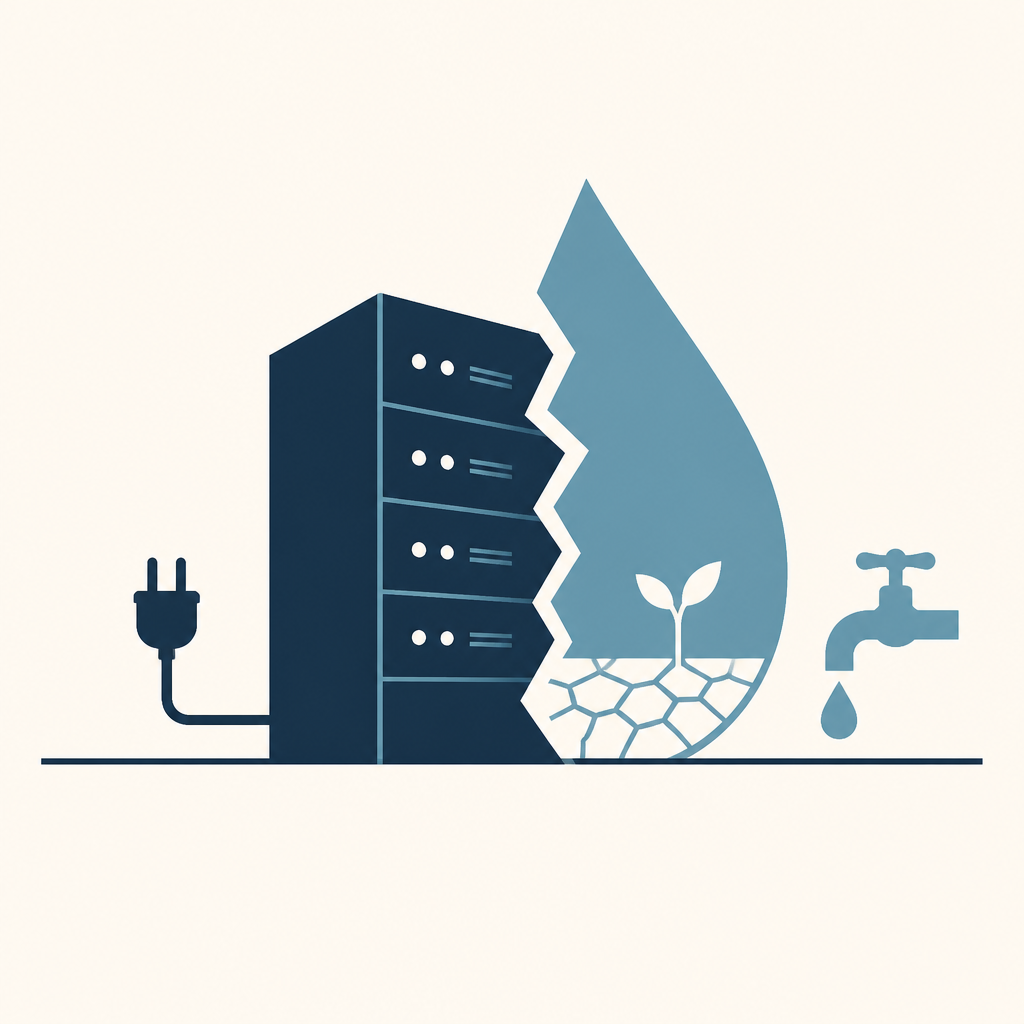
The artificial intelligence boom has a hidden dependency that rarely appears in product launches or earnings calls: water. Every query, every generated image, and every training run relies on physical infrastructure that must be kept cool around the clock--and that infrastructure is increasingly being built in the places least able to afford the additional demand. According to a Bloomberg News analysis, roughly two-thirds of U.S. data centers built since 2022 are located in high water-stress areas [1][2]. The pattern is global: MSCI's geospatial analysis of approximately 14,000 data-center assets worldwide found that about one in four existing facilities may experience more frequent water scarcity days by 2050, with rapid digital expansion intersecting dangerously with rising climate stress in Chile, Brazil, Mexico, Turkey, and Australia [3].
The stakes are enormous. UN University researchers warn that by 2030, AI's water consumption could match the daily needs of 1.3 billion people, while its power consumption would triple that of 650 million [4]. Yet the paradox runs deeper than raw consumption figures suggest. The technologies that reduce a data center's water use typically increase its electricity demand--and in regions where grids still depend on fossil fuels and thermoelectric generation, saving water onsite can mean consuming more of it offsite at power plants. Data center operators are thus forced to navigate competing imperatives: global climate goals that demand lower carbon emissions, and local adaptation realities that demand lower water withdrawals [1][3].
This article examines the anatomy of this collision: the scale and structure of AI's water footprint, the engineering trade-offs at its core, the communities bearing the costs, and the emerging solutions that might reconcile an AI-driven economy with the realities of a water-constrained, climate-stressed world.
The Scale of the Problem: AI's Hidden Water Footprint
Direct Use Versus Indirect Use
Public debate about data center water consumption tends to focus on what is visible--the cooling towers and evaporative systems at the facility itself. But this direct use is only part of the picture. The International Energy Agency estimates that roughly 60% of data center water consumption is indirect, embodied in the electricity generation that powers the servers [2]. A 2021 study found that nearly half of U.S. data center servers are fully or partially powered by water-hungry thermoelectric power plants located within water-stressed regions [2].
The proportions are striking. One analysis estimated that in 2023, generating a single 150-to-300-word output with GPT-3 consumed a total of 16.9 milliliters of water in an average U.S. data center--just 2.2 milliliters for onsite cooling, and 14.7 milliliters for electricity generation [1]. Later model efficiencies have likely reduced these figures, but the structural insight holds: for most U.S. data centers, the largest water impact is invisible, occurring at power plants that draw from rivers and aquifers far from the server racks [1]. While power plant water is typically not potable and not drawn from municipal systems, it still places real stress on freshwater ecosystems, particularly where those systems are already depleted [1].
Concentration Where Water Is Scarcest
On a national level, data center water use appears modest. The problem is geographic concentration. In Newton County, Georgia, some proposed data centers have reportedly requested more water per day than the entire county currently uses daily, forcing officials to choose between rejecting projects, mandating water-efficient cooling, funding costly infrastructure upgrades, or risking water rationing for residents [1].
The mismatch between digital demand and hydrological reality is global in scope. In Querétaro, Mexico, expanding compute infrastructure is drawing on water supplies amid prolonged drought. In Uruguay, plans for a water-intensive data center coincided with a 2023 drought so severe that it depleted Montevideo's freshwater reserves and made tap water unsafe to drink [4]. Meanwhile, arid Gulf states like Saudi Arabia and the United Arab Emirates are welcoming data centers at a record pace, and in China and India, an even greater proportion of facilities are located in drier areas than in the United States [2].
 The Data Center Water Footprint: 2026 AI Impact & Statistics
The Core Dilemma: Trading Water Against Energy
Why Cooling Choices Involve Painful Trade-Offs
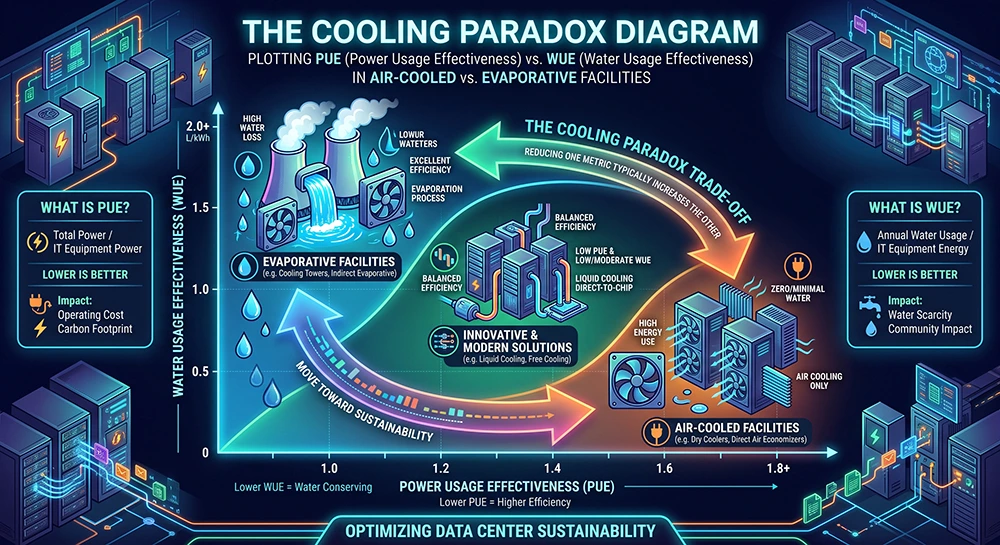
At the heart of the paradox lies a fundamental engineering tension. Cooling typically accounts for 20% to 40% of total data center energy use, and water-based and air-based cooling systems pull efficiency goals in opposite directions: water-based cooling is more energy-efficient but consumes more water, while air-based systems conserve water but require significantly more electricity [3].
There is no universally optimal design--the right answer is intensely location-specific. In water-stressed regions, operators may favor air-based or dry cooling systems that minimize water withdrawals even at higher energy cost. In areas with constrained power capacity or carbon-intensive grids, evaporative or liquid cooling may be more defensible precisely because they are more energy-efficient [3]. IEEE Spectrum's analysis of the problem offers a clear heuristic: in water-stressed regions, the priority should be low- to zero-water cooling paired with investment in local renewable generation; in wetter regions with carbon-intensive grids, the priority should be reducing power use--even if that means continuing to use evaporative cooling with its higher onsite water consumption [1].
Why There Is No Easy Answer
These trade-offs would be manageable if operators had unlimited freedom to optimize. In practice, they are hemmed in by grid realities. "A lot of these projects have been announced, but it's not clear what can come on fast enough to power them," notes Kelly T. Sanders, associate professor of engineering at the University of Southern California [5]. Air cooling, the water-conserving option, increases electricity demand on grids that are already straining--and depending on the generation mix, may simply relocate the water consumption to power stations [5]. Until renewables dominate electricity grids, IEEE Spectrum concludes, these choices may be unavoidable [1].
Technological innovation is helping, but not resolving, the dilemma. Closed-loop cooling systems can reduce freshwater use by up to 70%, and designs such as immersion cooling can remove heat with minimal water input [6]. Yet even as facilities adopt water reuse technologies and onsite water sources, water stress continues to hit different regions with greater frequency and intensity [6].
 How AI Growth Is Intensifying Data Center Water Consumption
Communities on the Front Lines
The American West and Southwest
Nowhere is the collision more acute than in the arid American West. Western Resource Advocates projects that if current utility growth forecasts materialize, new data centers in Arizona, Colorado, Nevada, New Mexico, and Utah could consume 4.5 billion gallons of water annually by 2030, rising to 7 billion gallons by 2035--with "water we simply don't have to spare in the arid West" [7].
The financial burden on communities is equally staggering. One study found that meeting data centers' demand will require U.S. communities to invest up to $58 billion in new water infrastructure [8]. Brookings researchers note that individual water systems--the utilities responsible for service--are increasingly grappling with significant ongoing water use, expanded infrastructure costs such as new distribution lines to reach exurban facilities, and mounting regulatory and financial pressures [6].
The scale of individual projects compounds the strain. In Abilene, Texas--the site of OpenAI's massive 1.2-gigawatt data center campus anchoring its $100 billion Stargate AI infrastructure venture--hydrologist Amy Bush of RMBJ Geo Inc. observed that "every part of the state is facing this water-energy nexus crisis" [2].
Global Flashpoints and the Environmental Justice Dimension
Public resistance is mounting worldwide. Water-related protests against data centers have erupted in the Netherlands, Uruguay, and Chile--the latter of which temporarily revoked Google's authorization for a planned $200 million facility after residents took to the streets [2]. In the United States, the concerns have reached mainstream consciousness, with environmental advocate Erin Brockovich among the prominent voices highlighting the concentration of proposed AI data centers in drought-prone areas [9].
UN University researchers argue that the deepest problem is distributive. "If you map where data centres are getting built against where water stress is worst, you tend to see the same regions in some instances," says Dr. Mir Matin, Manager of UNU-INWEH's Geospatial, Climate and Infrastructure Analytics Programme. "And the communities living near these sites are not necessarily the ones using the AI being run there. That asymmetry is the issue. Without fixing it, we'll just be repeating older patterns, where some places carry the costs and other places capture the benefits" [4]. AI computing capacity, the UN analysis notes, remains roughly 90% concentrated in just two countries [4].
The hydrology is unforgiving. As water policy expert Colohan describes it, a data center placed in a basin functions "like a giant soda straw sucking water out of that basin"--and once water is withdrawn, the only solutions are to reduce local demand or replenish the water in the same place [5].
When Water Goals and Climate Goals Collide
The paradox extends beyond water into the very climate objectives that data center operators and governments have pledged to uphold. The load growth projected for the American West in just the next five years surpasses electricity output capacity that took even the largest utilities a century or more to build--and because of this growth, some utilities are proposing to burn even more fossil fuels to meet demand, directly threatening regional climate goals [7].
This creates a genuine circular dilemma. Choosing air cooling to protect local water supplies raises electricity demand, which on a carbon-intensive grid increases both emissions and indirect water consumption at power plants. Choosing evaporative cooling to save energy and emissions increases pressure on depleted aquifers and municipal systems. Data center operators, in the words of IEEE Spectrum's analysis, are forced to navigate "tough trade-offs between global climate goals and local water needs"--choices that are often not simple, and that until grids decarbonize, may lack a clean resolution [1].
The broader environmental footprint adds further layers. UN University researchers project that AI infrastructure could generate up to 2.5 million tonnes of electronic waste annually by 2030, much of it processed in low-income economies with limited safeguards, while the critical minerals feeding the buildout are extracted in jurisdictions with weak environmental oversight [4].
Pathways Forward
Technology and Design Innovation
The toolkit for reducing impact is expanding rapidly. Closed-loop cooling systems, air cooling, and immersion cooling can dramatically cut onsite freshwater withdrawals, while onsite solar installations and other renewable energy sources can shrink both the carbon and indirect water footprints simultaneously [6]. Locating facilities in cooler, wetter climates can also substantially reduce evaporative losses, though market forces have so far pushed development in the opposite direction [5].
Encouragingly, some major developers have begun to internalize the hydrological logic, actively engaging in water replenishment projects in the basins where they operate--recognizing that withdrawals must ultimately be balanced by reductions or returns in the same watershed [5].
Policy, Planning, and Governance
Technology alone cannot resolve a siting problem. Colohan argues that "integrated land use planning, with sustainable land, water, and energy practices, is the only way we can sustainably achieve the virtuous circle needed to reap the benefits of AI and the economic growth associated with it" [5]. In the American West, Western Resource Advocates is pressing for policies that advance clean energy deployment while explicitly accounting for data centers' water demands in state and utility planning [7].
Investors, too, are being drawn into the calculus. MSCI analysts suggest that capital allocation decisions now require assessing location-specific climate risks, regulatory shifts, and resource constraints--treating water stress not as an externality but as a material operational and reputational risk for operators [3]. For communities weighing proposals, the menu is difficult but real: reject projects, require alternative water-efficient cooling systems, invest in infrastructure upgrades, or accept rationing risk [1]. The healthiest outcome--matching compute demand to regions with abundant water and clean power--requires treating siting as a first-order strategic decision rather than an afterthought to land costs and tax incentives [5].
 Thirsty for power and water, AI-crunching data centers sprout across the West - & the West
Conclusion
The water-energy paradox of AI expansion is not a story of inevitable tragedy, but it is a story of genuinely hard choices. The same facility that conserves water in one region may increase carbon emissions and indirect water use in another; the grid constraints that push utilities toward fossil fuels in the short term undermine the clean energy transition that would ultimately ease the trade-off [1][7]. Roughly a quarter of the world's existing data centers face intensifying scarcity by mid-century, and the communities hosting them are frequently not the ones capturing the technology's benefits [3][4].
Resolving the paradox will require simultaneous progress on multiple fronts: deployment of zero-water and closed-loop cooling where water is scarce, accelerated renewable generation wherever compute clusters form, integrated land-use and water planning before projects are approved, and corporate water replenishment that puts back what is taken from the same stressed basins [1][6][5]. Until renewables dominate electricity grids and water-aware siting becomes standard practice, the trade-offs between global climate goals and local water security will remain unavoidable--but they are far from unmanageable. The measure of success will be whether the AI economy can grow without repeating the oldest pattern in resource extraction: concentrating the costs in the places least equipped to bear them.
References
- 1.
- 2.
- 3.
- 4.
- 5.
- 6.
- 7.
- 8.
- 9.