Introduction
In the span of a few years, generative artificial intelligence has vaulted from research curiosity to planetary infrastructure. The GPU clusters that power large language models and image generators have become the defining industrial buildout of the decade, with hyperscalers announcing tens of billions of dollars in quarterly capital expenditure and utilities scrambling to connect "AI campuses" to overstressed grids. The International Energy Agency estimates that data centers consumed roughly 415 terawatt-hours of electricity in 2024 -- about 1.5% of global demand -- and projects that figure could approach double that by 2030, driven overwhelmingly by AI-optimized servers [2]. At the same time, technology giants that once advertised falling carbon footprints now report the opposite: Google disclosed in 2024 that its greenhouse gas emissions had risen 48% since 2019, while Microsoft reported a 29% increase since its 2020 baseline, with data center energy and supply-chain growth as the primary culprits [3][4].
Yet the very same technology is being deployed against climate change itself. Machine learning systems now forecast wind farm output, discover novel battery materials, predict extreme weather faster than traditional supercomputer models, and detect methane leaks from orbit. Researchers argue that AI-enabled applications could plausibly avert emissions on the order of gigatonnes per year -- a potential upside that, by most estimates, dwarfs the direct footprint of the technology [12][13].
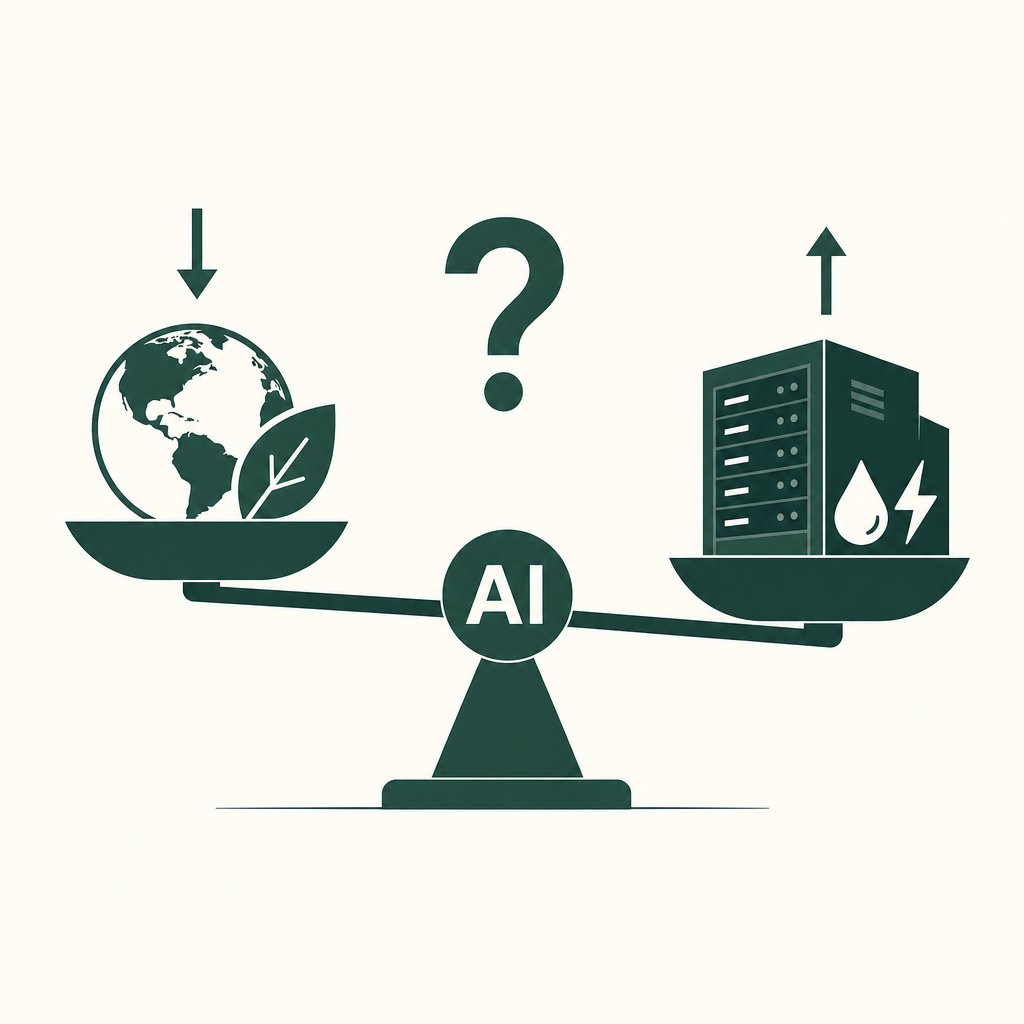
This is the AI climate paradox: a technology whose electricity and water demands are compounding at extraordinary rates, marketed simultaneously as a indispensable climate solution. Whether the emission-cutting potential of machine learning can actually outpace the environmental cost of building and running it is one of the most consequential -- and least settled -- questions in climate technology. This article examines the scale of the footprint, the substance of the climate promise, the difficulty of comparing the two, and the emerging strategies for tipping the balance.
The Footprint: Generative AI's Thirst for Power and Water
Training Is the Sizzle; Inference Is the Steak
Concern about AI's energy use is not new. In 2019, researchers at the University of Massachusetts famously estimated that training a single large NLP model with neural architecture search could emit as much carbon as five cars over their lifetimes [1]. Those figures shocked the field -- but they now look almost quaint. The training run for GPT-3 was estimated at roughly 1,300 megawatt-hours [6], while GPT-4-scale training runs are believed to have consumed tens of gigawatt-hours, with compute requirements for frontier models growing several-fold per year [14].
Training, however, is only the visible tip of the iceberg. The dominant and fastest-growing share of AI's energy use is inference: the billions of daily queries, completions, code generations, and image renders served to users worldwide. Unlike training, which is a discrete event, inference scales with adoption and never stops. It is the compounding, always-on consumption of hundreds of millions of users -- not the dramatic one-off training run -- that utilities and grid operators are now planning around.
Data Centers Meet the Grid
The macro numbers are stark. Goldman Sachs Research projects that data center power demand will grow roughly 160% by 2030 relative to 2023 levels [8]. In the United States, the Electric Power Research Institute estimates data centers could account for between 4.6% and 9.1% of national electricity consumption by 2030, up from around 4% today [7]. The strain is not evenly distributed: in Ireland, data centers already consume roughly a fifth of the nation's electricity, and in Northern Virginia -- the world's largest data center market -- new connections face multi-year waits. Because grids still lean heavily on fossil fuels in many regions, rising data center demand has translated directly into rising emissions for the companies behind it, as Google's and Microsoft's own disclosures make clear [3][4].
The Overlooked Water Bill
Energy dominates headlines, but water may be the more politically fraught resource. Data centers evaporate water in cooling towers, and the power plants feeding them consume water as well. Researchers at UC Riverside and UT Arlington estimated that training GPT-3 in Microsoft's U.S. data centers could have evaporated on the order of 700,000 liters of freshwater, and that a typical conversation of roughly 20-50 queries consumes about 500 milliliters [5]. Scaling that arithmetic out, the same research group projects global AI-related water withdrawal could reach 4.2 to 6.6 billion cubic meters annually by 2027 -- more than several countries use in a year [5][13].
The consequences are already local and tangible: data center proposals have met resistance in drought-prone Chile and Uruguay, and municipalities such as The Dalles, Oregon have faced legal fights over disclosed water use. As fleets concentrate in regions chosen for cheap power rather than abundant water, the resource conflict is set to intensify.
The Counterweight: Machine Learning as a Climate Tool
Optimizing Energy Systems
The strongest near-term case for AI as an emissions-cutting technology lies in energy systems, which account for roughly three-quarters of global greenhouse gas emissions. Google DeepMind famously demonstrated that machine learning forecasts of wind output 36 hours in advance boosted the economic value of wind energy by roughly 20%, because better predictability allows more intermittent renewable generation to displace baseload fossil power [9]. Similar techniques now underpin demand forecasting, grid congestion management, virtual power plants, and smart building controls -- applications where marginal compute buys outsized efficiency gains.
Accelerating Clean-Tech Discovery
AI is also compressing decades of materials science into years. Microsoft and Pacific Northwest National Laboratory used AI screening to sift tens of millions of candidate compounds and identify a promising solid-state battery electrolyte in weeks rather than the customary years [11]. DeepMind's GNoME system predicted some 2.2 million previously unknown crystal structures, a significant fraction of which are predicted to be stable -- a potential goldmine for batteries, solar cells, and catalysts [10][11]. Machine learning is likewise being applied to nuclear fusion plasma control, electrolyzer design, and low-carbon cement chemistry, each a slow, expensive search problem that AI happens to be good at.
Seeing the Planet More Clearly
Perhaps most striking is AI's leap in weather and Earth observation. DeepMind's GraphCast model generates 10-day global forecasts in under a minute on a single accelerator, outperforming the traditional physics-based ECMWF model on the large majority of verification targets [10]. Better and cheaper forecasting directly saves lives in extreme weather and improves renewable energy dispatch. Satellite-based AI systems now detect methane super-emitters, monitor deforestation in near real time, and power flood early-warning systems across vulnerable regions -- capabilities that translate into measurable avoided emissions and improved adaptation [12].
Aggregating these effects, researchers estimate that AI-enabled mitigation could avoid somewhere between roughly 0.03 and 5.4 gigatonnes of CO2-equivalent per year, depending heavily on adoption rates and application mix [13]. Even at the cautious end, that potential exceeds the technology's own direct footprint today.
The Hard Arithmetic of Net Impact
If the potential upside is so large, why isn't the debate settled? Because comparing the two sides of the ledger is genuinely difficult, and the comparison is vulnerable to several traps.
Attribution and counterfactuals. When an AI system helps a wind farm sell more power, the avoided emissions are relatively easy to estimate. But many claimed benefits rest on soft counterfactuals -- would the efficiency gain have happened anyway? Would the discovered battery material have been found by conventional means? A 1% efficiency improvement in grid operations sounds trivial until scaled globally; a "breakthrough" material discovery may take a decade to reach gigafactory scale. Meanwhile, AI's footprint is immediate and countable, while its climate benefits are deferred and probabilistic.
Rebound effects. Efficiency gains in information technology have historically been swallowed by increased consumption -- the Jevons paradox dressed in silicon. Cheaper inference does not simply mean cheaper climate modeling; it means cheap AI everywhere, including applications that increase emissions. Notably, machine learning is actively marketed to oil and gas companies to accelerate reservoir mapping and extraction. An AI-assisted barrel of oil is still a barrel of oil, and such applications count on the debit side of the ledger, not the credit side [13].
Asymmetric time horizons. Data centers are being built now, powered now, and cooled now. Many of the most consequential AI climate applications -- new battery chemistries, redesigned grids, transformed industrial processes -- mature over decades. In the critical window to 2030, AI is more plausibly a net source of emissions than a net sink, even if the long-run equation flips.
Self-interested accounting. The companies best positioned to quantify AI's benefits are also the companies burning the fuel. Microsoft's sustainability reports tout AI-enabled efficiencies even as the same documents report rising emissions [4]. Independent, standardized measurement -- not vendor arithmetic -- will be required to know whether the paradox resolves in the climate's favor.
Engineering the Way Out: Efficiency, Clean Power, and Policy
Chasing Efficiency
The optimistic case rests partly on the technology's demonstrated capacity for self-improvement. Epoch AI analyses suggest the compute required to reach GPT-4-level performance has been halving roughly every eight months through algorithmic progress alone [14]. Model distillation, mixture-of-experts architectures, quantization, and speculative decoding are slashing per-query energy costs, while each hardware generation delivers more computations per watt. Some industry leaders claim the cost of a given level of AI capability is falling by an order of magnitude per year. If those curves hold, total AI energy use could grow far more slowly than raw demand -- though history counsels skepticism that efficiency alone will cap consumption.
Clean Energy and Water Stewardship
The more decisive lever is what powers the data centers. Hyperscalers are signing record clean-energy deals, but the most telling shift is toward additionality: rather than purchasing renewable certificates, they are financing new supply. Microsoft has agreed to a 20-year deal to restart a reactor at Three Mile Island; Google has contracted small modular nuclear reactors from Kairos Power; Amazon is investing in small-reactor developers [3][4]. Firms are also pairing campuses with geothermal and storage, and pursuing hourly "24/7 carbon-free energy" matching rather than annual averages. On water, Google and Microsoft have both pledged to become "water positive" by 2030, and engineers are deploying closed-loop and liquid cooling systems that dramatically cut evaporative losses -- with siting decisions increasingly weighed against regional water stress [5][3].
Transparency and Rules
Voluntary reporting is giving way to regulation. The EU AI Act requires providers of general-purpose models to document energy consumption, and the EU's energy efficiency directive now obliges large data centers to report energy and water metrics publicly [15]. Similar disclosure regimes are under discussion in the United States and Asia. Standardized tools for estimating model-level carbon and water footprints -- building on earlier academic work quantifying training emissions [1][6] -- are maturing from hobby projects into procurement requirements. What gets measured, as the saying goes, gets managed; today, AI's water use in particular remains poorly measured outside a handful of jurisdictions.
Conclusion
The AI climate paradox has no automatic resolution. On one side sits an infrastructure buildout of historic scale -- electricity demand doubling projections, water withdrawals measured in cubic kilometers, and rising emissions at the very companies staking their brands on sustainability. On the other side sits a genuinely powerful toolset for decarbonizing grids, reinventing materials science, and forecasting a destabilizing climate -- with modeled benefits that plausibly exceed the technology's own footprint by a wide margin [13].
The honest answer to the title's question is that the race is real, and the outcome depends on choices, not inevitability. It depends on whether efficiency gains are banked rather than consumed by rebound; whether data centers catalyze new clean generation or merely crowd out other users on dirty grids; whether AI's climate applications are prioritized over fossil-fuel extraction use cases; and whether regulators force the transparency needed to audit the whole equation. Machine learning's emission-cutting potential is large enough to outpace its demands -- but only if the industry and its regulators run that race deliberately, on a deadline, and with honest arithmetic. The window in which AI could be remembered as a climate solution rather than a complicating burden is open now, and it will not stay open indefinitely.