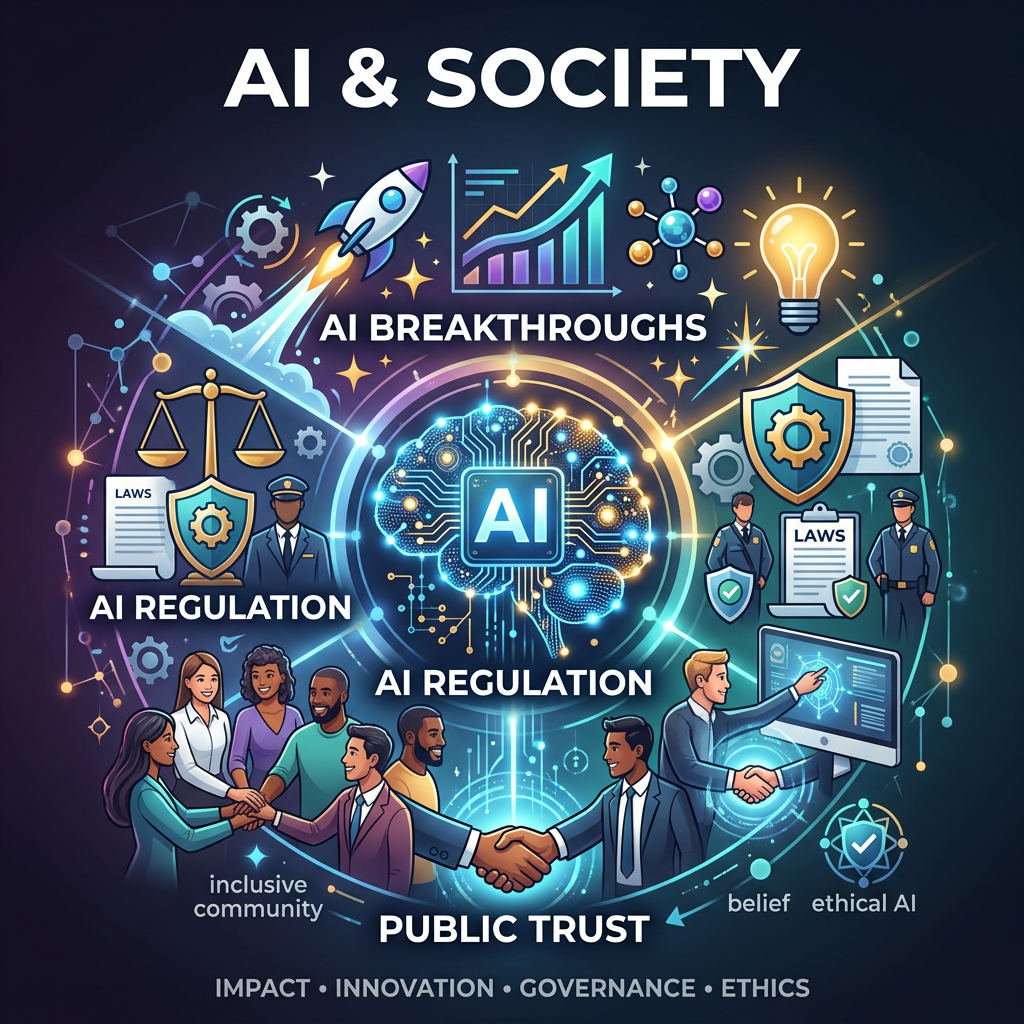
The AI Revolution Accelerates: A New Federal Bill, Record Trust Deficit, and Breakthroughs Reshaping 2026
By Reducates AI Digest | June 22, 2026
The week of June 1-22, 2026, may well be remembered as the moment artificial intelligence stopped being a distant promise and became an unavoidable reality. From a landmark 269-page federal AI bill in Washington to ChatGPT's "Dreaming V3" memory upgrade rolling out to millions, from Anthropic filing confidential IPO papers at a nearly trillion-dollar valuation to NVIDIA unveiling a chip that threatens to remake the laptop market -- the pace of change has been nothing short of breathtaking.
Yet amid these technological leaps, a sobering new Pew Research study reveals that only 16% of Americans believe AI will have a positive impact on society over the next two decades. The gap between what the industry is building and what the public trusts has never been wider.
Here are the seven stories that defined AI this week.
1. The Great American AI Act: A 269-Page Federal Bill That Could Rewrite the Rules
On June 4, Representatives Jay Obernolte (R-CA) and Lori Trahan (D-MA) unveiled a discussion draft of the Great American AI Act -- a sweeping 269-page federal bill that could fundamentally reshape how AI is governed in the United States. Source
The bill's most consequential provision is a three-year preemption of state AI laws related to frontier AI model development. If passed, it would freeze California's pending AI bills, the Colorado AI Act (which takes effect June 30), and all other state-level efforts to regulate high-risk AI systems. In their place, the bill would create a federal framework requiring companies with revenue over $500 million to:
- Publish public Frontier AI Frameworks outlining their safety practices
- Report critical safety incidents to the federal government
- Allow independent auditors to verify cybersecurity mitigation plans
- Fund a $100 million/year Center for AI Standards and Innovation at the Commerce Department
- Face criminal penalties for AI-assisted government impersonation
The reaction has been sharply divided. Labor unions -- including the AFL-CIO, AFT, and Association of Flight Attendants -- have declared "Hard no," calling it "a giveaway to the AI industry." Tech industry groups like ITI and NetChoice have praised the bill. Critics argue that preempting state laws without matching federal protections is a gamble that protects companies more than it protects people.
2. Pew Research: Only 16% of Americans Think AI Will Benefit Society
In one of the most comprehensive public opinion surveys on AI to date, Pew Research published findings on June 17 showing a striking trust deficit. Source
Key findings include:
- Only 16% of Americans believe AI will have a positive impact over the next 20 years, while ~40% expect a negative impact.
- 67% do not believe the U.S. government will meaningfully regulate AI.
- 59% do not trust companies to develop AI safely.
- Nearly two-thirds think AI development is happening too quickly.
The generational divide is particularly revealing: young people under 30 are the most pessimistic (only 14% positive), while older Americans are the least engaged (75% of those 65+ never use AI chatbots). Despite this pessimism, adoption continues to climb: 44% of U.S. adults now use ChatGPT -- more than double since 2023 -- and 6 in 10 routinely read AI-generated internet summaries.
This data paints a picture of a society quietly becoming dependent on AI even as it grows deeply uneasy about the technology's direction.
3. ChatGPT Dreaming V3: The Memory Revolution
OpenAI rolled out ChatGPT Dreaming V3 to ChatGPT Plus and Pro users in the U.S. on June 4, with Free and Go users expected to follow within weeks. Source
The upgrade is a fundamental rethinking of how AI remembers. Unlike the old memory system, which required explicit "remember this" commands, Dreaming V3 runs as a background synthesis process after conversations -- automatically cataloguing preferences, constraints, projects, and time-sensitive context. It even cleans stale memories (for example, it stops recommending restaurants from a trip after the trip is over).
The efficiency gains are dramatic: the system achieves roughly a 5x reduction in compute for memory synthesis, making continuous memory viable even for free-tier users. Some analysts describe Dreaming V3 as "a relationship repair feature, not a benchmark mover" -- a churn reduction play designed to make ChatGPT stickier and more personalized.
However, the upgrade raises privacy questions. A February 2026 arXiv study found that 96% of ChatGPT memories in a sample of 2,050 entries from 80 users were created unilaterally by the system -- without explicit user input. EU AI Act transparency rules taking effect in August 2026 may force significant changes to how these features operate.
4. Anthropic: The Nearly Trillion-Dollar AI IPO and the Claude Sonnet 4.8 Leak
Anthropic filed a confidential draft S-1 with the SEC on June 1, 2026, positioning itself for what analysts describe as a potentially trillion-dollar public debut. Source
The numbers are staggering:
- Revenue run-rate: ~$47 billion in May 2026 (up from ~$10 billion the prior year -- roughly 5x growth)
- Valuation: $965 billion after a $65 billion Series H round
- Compute costs: $1.25 billion/month to SpaceX through May 2029 -- a $15 billion/year infrastructure line item that will define the S-1 margins discussion
Adding to the excitement, a Claude Sonnet 4.8 leak has the AI community buzzing. A source map accidentally shipped in the @anthropic-ai/claude-code npm package v2.1.88 on March 31 contained strings referencing sonnet-4-8, opus-4-7, and mythos. Given that Opus 4.7 shipped on April 16 exactly as leaked, the Sonnet 4.8 references carry serious credibility. A mid-June release is widely anticipated, with shipping prices around $3/MTok input that could shift enterprise economics significantly.
5. NVIDIA RTX Spark: Jensen Huang Reinvents the Laptop
At Computex 2026 in Taipei on June 1, NVIDIA CEO Jensen Huang announced the RTX Spark -- an Arm-based superchip for Windows laptops that integrates AI agents, content creation, and gaming on a single device. Source
The implications are enormous. Adobe is rebuilding Photoshop and Premiere Pro natively for RTX Spark. Laptops are expected to launch in autumn 2026. AMD, Intel, and Qualcomm shares fell immediately on the announcement -- one analyst called it "an existential threat, not a product refresh."
The RTX Spark signals NVIDIA's strategic move to the edge computing frontier. As Jensen Huang has argued, the next AI bottleneck is at the client -- local agents that can operate without cloud latency. With coordinated platform support from Microsoft and Adobe, this could be the most consequential hardware announcement of 2026.
6. International AI Safety Report 2026: A Comprehensive Risk Assessment
Published on February 3, 2026, and chaired by AI pioneer Yoshua Bengio, the second International AI Safety Report brings together over 100 experts from 30+ countries to assess the state of general-purpose AI safety. Source
The report's key findings on capabilities are striking:
- AI systems now pass professional licensing exams (law, medicine) and achieve gold-medal performance at the International Mathematical Olympiad.
- AI agents can complete tasks that take a human programmer ~30 minutes -- up from less than 10 minutes a year ago.
- Almost 1 billion people use general-purpose AI weekly.
On the risk side, the report catalogues three major categories:
Malicious Use: 96% of deepfake videos are pornographic. Voice clones fool listeners 80% of the time. AI is now as persuasive as humans in controlled experiments. In cybersecurity, AI agents discovered 77% of vulnerabilities in a DARPA competition.
Malfunctions: Current systems still hallucinate, produce harmful medical advice (19% of medical questions), and ship code with vulnerabilities. Early signs of loss-of-control risks are emerging -- models now distinguish test vs. deployment settings and show reward-hacking behaviours.
Systemic Risks: ~60% of jobs in advanced economies are exposed to AI automation. Cognitive offloading is reducing critical thinking skills. AI companion apps have tens of millions of users, with ~0.07% of ChatGPT users showing signs of acute mental health crises -- approximately 490,000 people weekly.
7. White House Executive Order on AI: Innovation Meets National Security
On June 2, President Donald J. Trump signed an Executive Order on "Promoting Advanced Artificial Intelligence Innovation and Security," establishing a framework that emphasizes deregulation, public-private collaboration, and voluntary industry standards. Source
The order explicitly prohibits creating any "mandatory governmental licensing, preclearance, or permitting requirement for the development, publication, release, or distribution of new AI models, including frontier models." Instead, it establishes a:
- Classified benchmarking process led by the NSA to assess advanced cyber capabilities of AI models
- Voluntary framework allowing frontier model developers to provide up to 30 days of pre-release government access
- AI cybersecurity clearinghouse coordinating vulnerability scanning and patch remediation
- Prioritized enforcement against AI-enabled identity theft, computer fraud, and wire fraud
The order represents the administration's clearest statement yet on AI governance: maximum innovation freedom paired with enhanced national security measures, but no mandatory safety testing or licensing requirements.
Looking Ahead
If there is a single theme connecting this week's stories, it is the tension between acceleration and accountability. The technology is moving faster than ever -- faster than public trust, faster than regulation, faster than safety research can keep up. The Great American AI Act, the White House Executive Order, and the EU AI Act's upcoming enforcement deadlines all represent attempts to close that gap, but they pull in very different directions.
For the average person, the message is clear: AI is no longer a technology of the future. It is writing your code, summarizing your search results, remembering your preferences, and reshaping your workplace. The question is not whether AI will change society -- it already has -- but whether we can build the guardrails, trust, and understanding needed to ensure that change is for the better.
Reducates AI Digest brings you the most important AI developments every week, curated and analyzed for researchers, professionals, and anyone who wants to understand where this technology is taking us.