Introduction
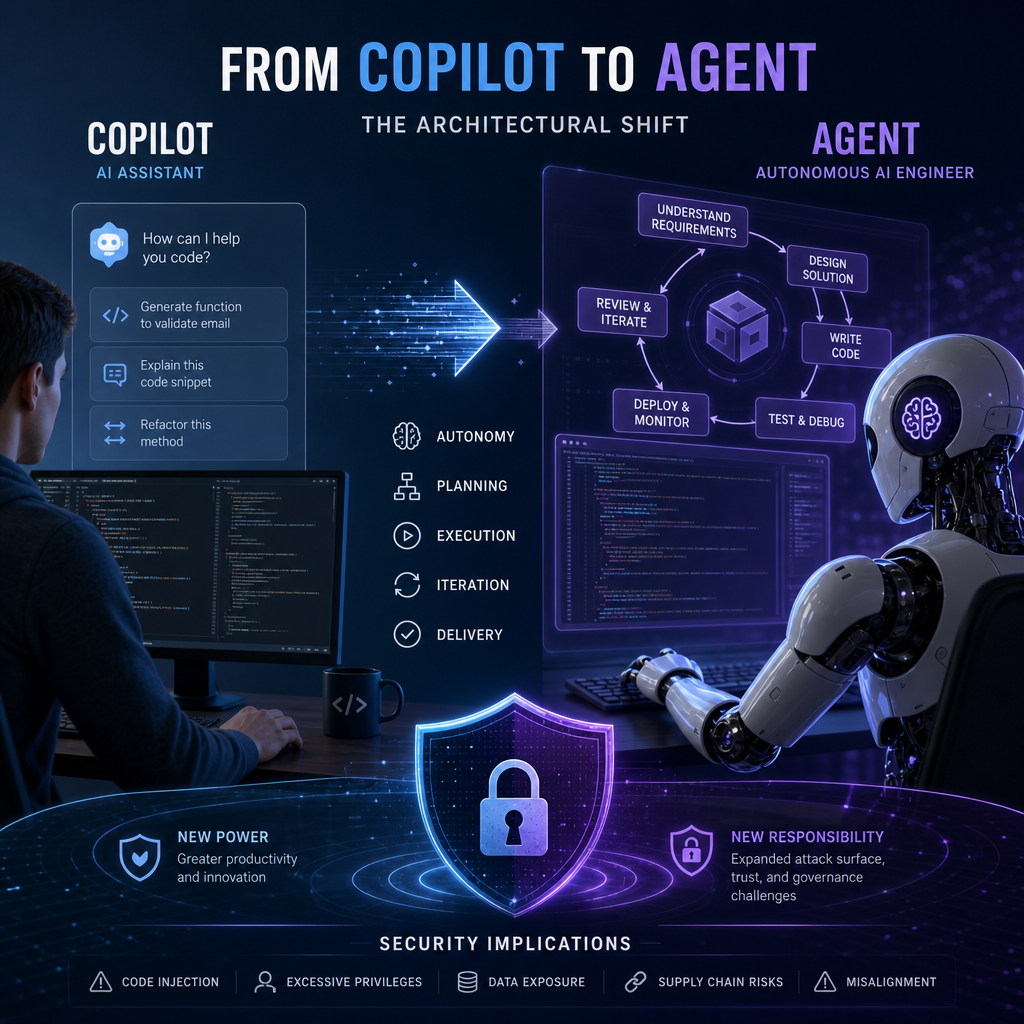
Over the past two years, the definition of artificial intelligence in software development has undergone a radical transformation. What began in 2022 as intelligent "autocomplete" engines--epitomized by early iterations of GitHub Copilot--has rapidly evolved into a sophisticated ecosystem of autonomous software engineers. By 2025 and into 2026, the industry is defined by "Agentic AI," a paradigm shift where systems are no longer reactive tools, but proactive digital workers capable of performing labor, navigating complex codebases, and resolving high-level tickets with minimal human intervention [1][2].
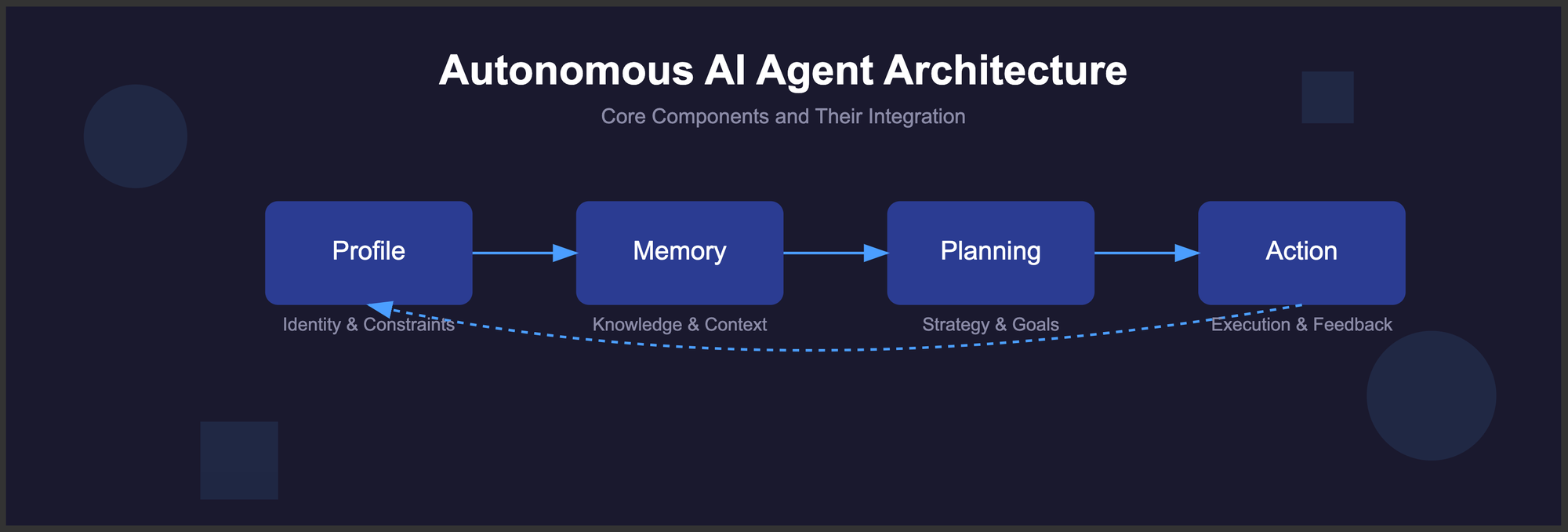
The fundamental differentiator between a traditional Large Language Model (LLM) and an autonomous agent lies in the execution of an "OODA Loop"--Observe, Orient, Decide, and Act. While standard LLMs are stateless and rely on human prompts to initiate each action, autonomous agents possess memory, reasoning capabilities, and the ability to self-correct. They can independently manage terminal environments, read documentation, and execute multi-step development strategies [2]. This transition from "auto-complete" to "auto-engineer" is not merely a tool upgrade; it represents a paradigm shift that eliminates the static software artifact as a necessary intermediary, moving directly from "Agent → Result" [3].
As these autonomous agents transition from assistive interfaces to operational execution engines, they are triggering a massive rearchitecture of enterprise software. With capital expenditure on AI-ready infrastructure projected to reach $6.7 trillion by 2030 to support these digital workers, understanding the architectural nuances and severe security implications of this shift is no longer theoretical--it is an immediate imperative for the software engineering profession [2].
 Autonomous Agents in Microsoft Copilot: The Future of Enterprise AI | Flexmind
The Architectural Pivot: From Assistive UI to Execution Engines
The architecture of software development is experiencing a fundamental inversion. Historically, applications featured thick, logic-heavy backends with relatively thin user interfaces. Later, tool-integrated AI maintained this paradigm, simply placing an AI helper inside the existing user interface to suggest code or documentation [4]. Today, a new architectural pattern is emerging: the traditional application backend is retreating to a role focused purely on governance, permission management, and security, while the AI agent itself assumes the role of the execution engine [5].
This shift is accelerating rapidly across sectors like banking, healthcare, and retail, with industry estimates suggesting that 40% of enterprise applications will include autonomous agents by 2026 [5]. Instead of relying on rigid, hardcoded backend logic to execute business rules, systems are now built on "plug-and-play" agentic architectures. Modern autonomous agents like Devin, Devika, and Replit's Ghostwriter leverage foundation models (such as GPT-4o, Claude 3.5, and Llama 3) combined with Retrieval-Augmented Generation (RAG) to interface directly with existing engineering infrastructure [4][6].
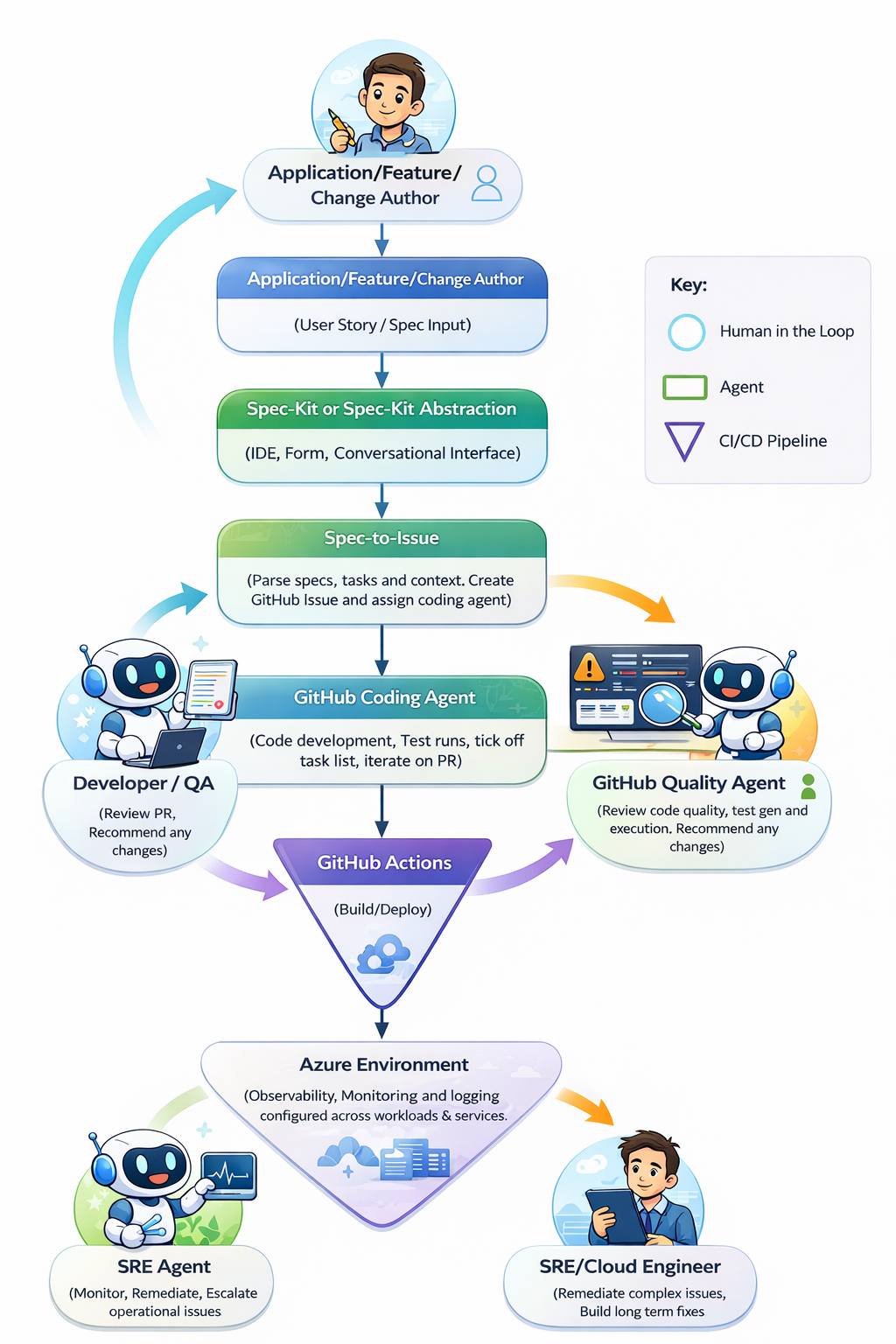
These agents do not exist in a vacuum; they are becoming full-stack engineers by integrating natively with tools like GitHub for code management, Jenkins or GitLab for CI/CD, Docker and Kubernetes for deployment, and Prometheus and Grafana for monitoring [6]. This architecture allows agents to seamlessly transition from writing code to testing, deploying, and observing its performance in production, fundamentally reshaping how software is built, tested, and scaled [4].
 The Rise of Autonomous AI Agents: A Comprehensive Guide to Their Architecture, Applications, and Impact - Security Boulevard
The Reimagined Engineer: From Coder to Agent Architect
Perhaps the most consequential shift in this transition is the redefinition of human value in the software development lifecycle. In the traditional paradigm, a software engineer's worth was measured by their ability to produce correct, efficient syntax. In the agentic paradigm, code-generation skill becomes commoditized. By 2027, forecasts indicate that 80% of software engineers will need to reskill as generative AI assumes more programming functions [7].
The industry is projected to undergo a fundamental bifurcation: routine coding, testing, and maintenance will be delegated to autonomous agents, while human engineers will evolve into "AI Orchestrators," "System Architects," and "Agent Architects" [1][2]. Instead of writing syntax, senior engineers are now spending their time designing system prompts, auditing agentic plans, and managing the orchestration of multiple AI agents working in parallel [1].
The new human differentiators rely on higher-order cognitive skills:
- Intent Articulation: Specifying goals with sufficient clarity and constraint that agents can operate autonomously without producing unintended outcomes.
- Architectural Oversight: Understanding at a system level how multiple agents should coordinate, what memory should be shared, and where human judgment must intervene.
- Quality Calibration: Defining what "good" looks like and building evaluation frameworks that agents can use for self-correction [3].
This abstraction layer moving upward is reminiscent of the historical shift from assembly language to high-level programming languages. However, it has also led to the democratization of high-level software creation, where non-technical founders are now using "vibe coding" to build functional minimum viable products (MVPs) in days--a process that previously took months [1]. The primary concern among industry experts is "skill atrophy": the fear that the next generation of developers may lack the fundamental understanding of how systems work if they rely entirely on agents to do the heavy lifting [1].
The Security Frontier: Governance, Hallucinations, and Attack Surfaces
While the productivity gains of autonomous agents are staggering, the acceleration of the software development life cycle introduces severe security vulnerabilities. Development is shifting toward greater autonomy, meaning AI agents now influence not only how code is written, but which dependencies are selected, how applications are assembled, and how quickly software moves from idea to production [8]. That acceleration is real, but so is the risk.
AI-generated code is not inherently secure. Because agents operate at high velocity, they can introduce vulnerabilities without realizing it, utilize outdated libraries, expose sensitive data, or misconfigure critical services [6]. A persistent and highly dangerous threat is the generation of "hallucinated" security flaws--code that looks functionally correct but contains subtle, fabricated vulnerabilities that a human reviewer might easily miss [1]. While tools like GitHub's "CVE Remediator" can automatically patch known vulnerabilities, they cannot protect against novel, AI-invented security anti-patterns [1].
Furthermore, as agents gain access to sensitive systems and extensive tool-use capabilities, they become lucrative targets for adversarial manipulation. Security risks include unauthorized access through agent interfaces, prompt injection attacks that alter agent behavior, and the exploitation of agent capabilities for malicious purposes [9]. Mitigating these vulnerabilities requires robust authentication and authorization frameworks, regular security auditing, adversarial testing, and architectural designs that strictly minimize attack surfaces [9].
Designing for Autonomy: Quality Gates and Operational Constraints
To harness the power of autonomous software engineers without inviting systemic failure, the industry is developing new frameworks for agent constraint and governance. Leading open-source and enterprise agent frameworks are beginning to enforce strict "Design Principles" and "Quality Gates" that agents must auto-apply [10].
For instance, advanced agent architectures mandate adherence to SOLID principles, recognized design patterns, and Clean Code principles (DRY, YAGNI, KISS). Crucially, they enforce secure-by-design principles, requiring the agent to autonomously document a basic threat model for any new features or services it creates [10].
However, balancing autonomy with safety requires carefully defined operational constraints. Modern agents are instructed to be AUTONOMOUS (never requesting confirmation), CONTINUOUS (completing phases in a seamless loop), and DECISIVE (executing immediately without waiting for external validation) [10]. Yet, this absolute autonomy is bounded by strict "Hard Block" escalation triggers. An agent is programmed to stop and escalate to a human operator only when an external dependency (like a third-party API) fails entirely, required permissions are unavailable, fundamental requirements remain critically ambiguous, or technical impossibilities are encountered [10]. This creates a highly efficient system where agents run freely within a heavily fortified architectural playground.
Conclusion
The transition from Copilot to autonomous Agent represents the most profound transformation in software engineering since the invention of high-level programming languages. By shifting from assistive autocomplete to stateful, OODA-loop-driven execution engines, AI agents are fundamentally rewriting the rules of enterprise architecture, pushing traditional backends into governance roles and redefining the human engineer as an orchestrator of intelligent systems.
Looking ahead to the late 2020s, the industry is moving toward Stage IV autonomous ecosystems, where agents will improve their own architectures, spawn specialized sub-agents, and adapt to environmental changes continuously. At this stage, the distinction between "software" and "agent" will dissolve entirely--the agent will be the system [3]. As this future unfolds, human involvement will shift entirely to meta-level governance: setting ethical boundaries, defining value functions, and ensuring alignment. The age of the autonomous software engineer is not arriving; it is already here, and our capacity to securely architect, govern, and orchestrate these digital workers will define the next era of technological progress.
References
-
1.
FinancialContent - The End of the Copilot Era: How Autonomous AI Agents Are Rewriting the Rules of Software Engineering. (n.d.). Retrieved https://markets.financialcontent.com/stocks/article/tokenring-2026-1-14-the-end-of-the-copilot-era-how-autonomous-ai-agents-are-rewriting-the-rules-of-software-engineering?Language=english%252F1000
- 2.
- 3.
- 4.
- 5.
- 6.
- 7.
- 8.
- 9.
- 10.