Introduction
For centuries, the discovery of new inorganic materials has relied on a combination of chemical intuition, tedious experimentation, and, more recently, rigorous but computationally expensive quantum mechanical simulations. The periodic table, while an indispensable organizing principle, represents a combinatorial explosion of possible chemical compounds that no human team or traditional computational method could ever hope to fully map. Modern technologies--from advanced computer chips to next-generation batteries and solar panels--depend entirely on the discovery of stable inorganic crystals, a process that historically requires months of painstaking trial and error for even a single candidate [1].
Today, a profound paradigm shift is underway. Artificial intelligence--specifically Graph Neural Networks (GNNs)--is transforming the periodic table from a static wall chart into a highly navigable, predictive landscape. By representing atoms as nodes and chemical bonds as edges, GNNs can inherently "understand" the structural and electronic nuances of materials. This architectural breakthrough allows AI to learn the underlying physics of atomic interactions, bypassing the traditional bottlenecks of materials science and opening the floodgates to high-throughput discovery [2][3].
The impact of this shift cannot be overstated. Recent breakthroughs, such as the development of universal interatomic potentials and the prediction of millions of previously unknown stable crystals, signal a new era of research. AI is no longer just assisting materials scientists; it is leading the charge, drastically redefining the speed and scope at which the building blocks of future technologies are uncovered [4][1].
The Architecture of Matter: Why Graph Neural Networks Excel
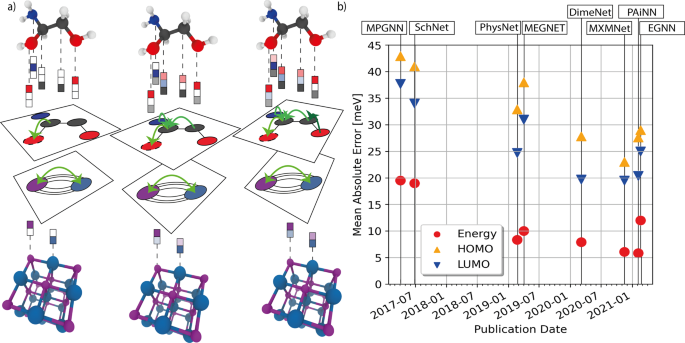
To understand why GNNs are so successful in materials science, one must look at how they process data. Traditional machine learning models often require manually engineered features--such as atomic radii or electronegativity--derived from the periodic table to make predictions [5][6]. GNNs, however, bypass this limitation by operating directly on graphical representations of matter. In a crystal graph, atoms serve as nodes, and the spatial proximity or chemical bonding between them serves as edges. This allows the network to learn the hierarchical structure of a material from the ground up [2].
Message Passing and Elemental Embeddings
At the heart of modern GNNs is the "message passing" framework, where nodes continuously exchange information with their neighbors to update their internal states [2]. Through successive layers of message passing, an atom "learns" about its broader chemical environment. Crucially, models like the MatErials Graph Network (MEGNet) have introduced the concept of universal elemental embeddings. By training on diverse crystal data, these models map the fundamental properties of elements into a continuous mathematical space, enabling transfer learning where knowledge gained from one property or dataset can accelerate the training of models for another [7].
This graphical approach naturally accommodates the periodic nature of crystals. Researchers have developed specialized periodic graph generation techniques that allow GNNs to understand boundary conditions--how a crystal lattice repeats infinitely in 3D space--rather than treating a material as an isolated, finite cluster of atoms [3].
 Scaling deep learning for materials discovery | Nature
Universal Interatomic Potentials
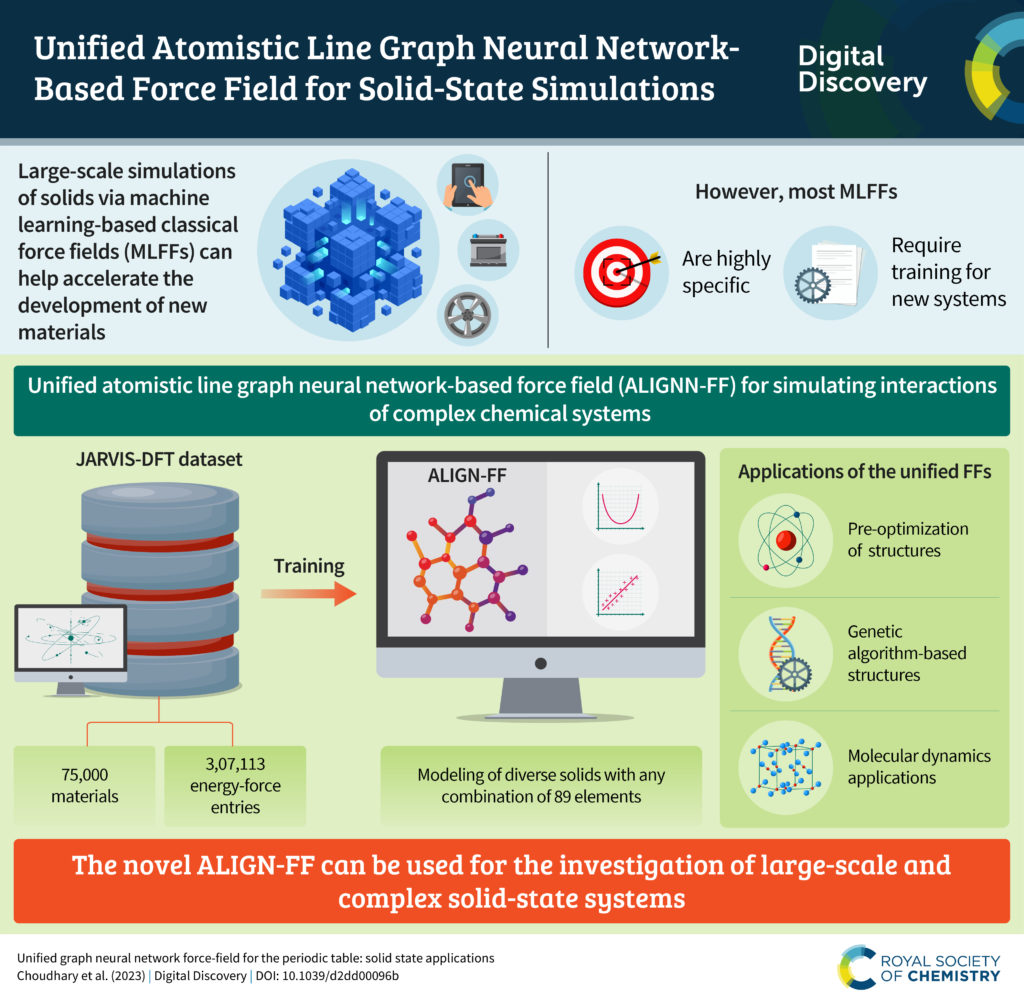
The true power of these architectures culminated in the creation of M3GNet, a universal graph deep learning interatomic potential. Developed by training on the energies and interatomic forces of 140,000 known and hypothetical structures from the Materials Project, M3GNet taught itself to infer how a given atom of a particular element is likely to behave across vastly different configurations [8]. The result is a single, unified model governing the interactions between 89 different elements across the periodic table, eliminating the need to train bespoke models for every individual chemical system [8][4].
Scaling to Unprecedented Depths: The GNoME Breakthrough
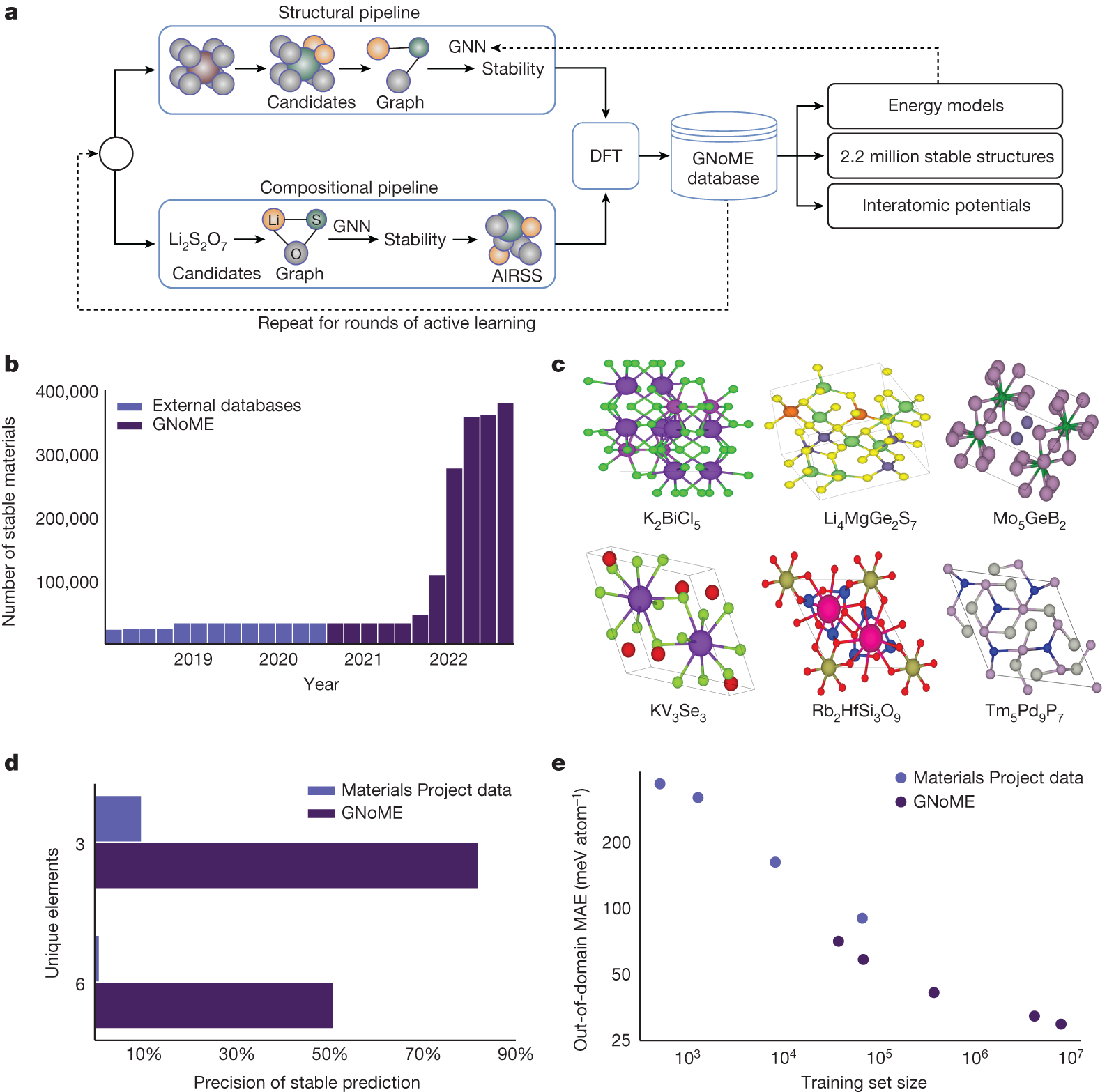
With robust architectures like M3GNet laying the groundwork, the stage was set for an unprecedented scaling effort. Enter Graph Networks for Materials Exploration (GNoME), a deep learning tool developed by Google DeepMind that pushed the boundaries of automated materials discovery to a staggering new level [1].
An Order-of-Magnitude Expansion
GNoME was designed to predict the thermodynamic stability of new materials--specifically, whether a hypothetical crystal would fall below the "convex hull" of known phases, a mathematical construct that dictates whether a material is energetically stable enough to exist without decomposing into other substances [4]. By scaling deep learning to a dataset far larger than any previous approach, GNoME achieved high-accuracy, zero-shot prediction of material properties at an extraordinary scale [4].
The results were breathtaking: GNoME discovered 2.2 million new crystal structures, including 380,000 that are predicted to be highly stable. To put that into perspective, this volume of discovery is equivalent to nearly 800 years' worth of human knowledge acquisition [1].
 Research infographic - Unified graph neural network force-field for the periodic table: solid state applications - Digital Discovery Blog
Navigating the Nuances of the Periodic Table
However, this massive expansion requires careful contextualization. As critics and researchers have pointed out, these predictions apply strictly to crystalline inorganic compounds. Vast and vital classes of materials--such as polymers, glasses, metal-organic frameworks (MOFs), and composites--are excluded from this specific milestone, and chemical compounds only truly become "materials" when they demonstrate real-world utility [9].
Yet, even within the realm of inorganic crystals, AI predictions still benefit from human periodic table intuition. For example, when analyzing highly complex AI-predicted structures like Hf4Ir8N4NbZr11, researchers still rely on fundamental chemical knowledge--such as knowing that Hafnium (Hf) and Zirconium (Zr) are two of the most similar elements in the periodic table and are almost certain to disorder on the same crystallographic sites--to trace these predictions back to known, synthesizable analogs [9].
Bridging AI and Physics: From Prediction to Practicality
The leap from a mathematical prediction to a physical material in a laboratory requires bridging the gap between pure machine learning and established physics. The most successful frameworks in modern materials science do not replace traditional physics; they hybridize it.
First-Principles Integration and High-Throughput Screening
While GNNs are fast, they are ultimately approximations. Density Functional Theory (DFT), the gold standard of first-principles quantum mechanical calculations, remains the crucial benchmark for validating AI predictions [8]. The modern workflow utilizes a synergistic loop: machine learning models rapidly scour the vast dataset of the periodic table to identify promising candidates, effectively acting as highly efficient pre-filters for high-throughput DFT screening [5][7]. This integration dramatically reduces the computational cost of DFT while maintaining its high accuracy and reliability [5].
The Synthesis Frontier
The immediate practical applications of these scaled GNNs are vast. Because universal potentials like M3GNet can simulate any combination of elements in the periodic table, they can be directly applied to pressing technological challenges, such as rapidly simulating potential lithium-ion battery materials to find those with optimal ionic conductivity [8].
However, the ultimate bottleneck remains physical synthesis. As Shyue Ping Ong, the co-creator of M3GNet, candidly notes regarding these massive databases of stable structures: "There is no synthesis in this work... But it is my hope that some of these predictions will eventually be experimentally verified" [8]. The transition from theoretical stability to experimental reality requires real-time integration between AI prediction, automated synthesis robotics, and experimental feedback loops--a frontier that the field is only just beginning to explore [5].
 Graph neural networks for materials science and chemistry | Communications Materials
Conclusion
Graph Neural Networks have effectively unlocked a hidden dimension of the periodic table, transforming it from a finite chart of known elements into a near-infinite playground of discoverable materials. By mastering the graphical language of atomic structures, models like M3GNet and GNoME have achieved an order-of-magnitude expansion in our knowledge of stable inorganic crystals, compressing centuries of potential human labor into a matter of computational hours.
Yet, this AI-driven renaissance is still in its early chapters. As the field moves forward, the focus must shift from merely predicting stability to actively guiding experimental synthesis. By continuing to fuse the pattern-recognizing power of deep learning with the rigorous physics of first-principles calculations, researchers are laying the digital groundwork for the next generation of clean energy technologies, advanced semiconductors, and transformative materials that have yet to exist outside the mind of a machine.
References
- 1.
- 2.
- 3.
- 4.
- 5.
- 6.
- 7.
- 8.
- 9.