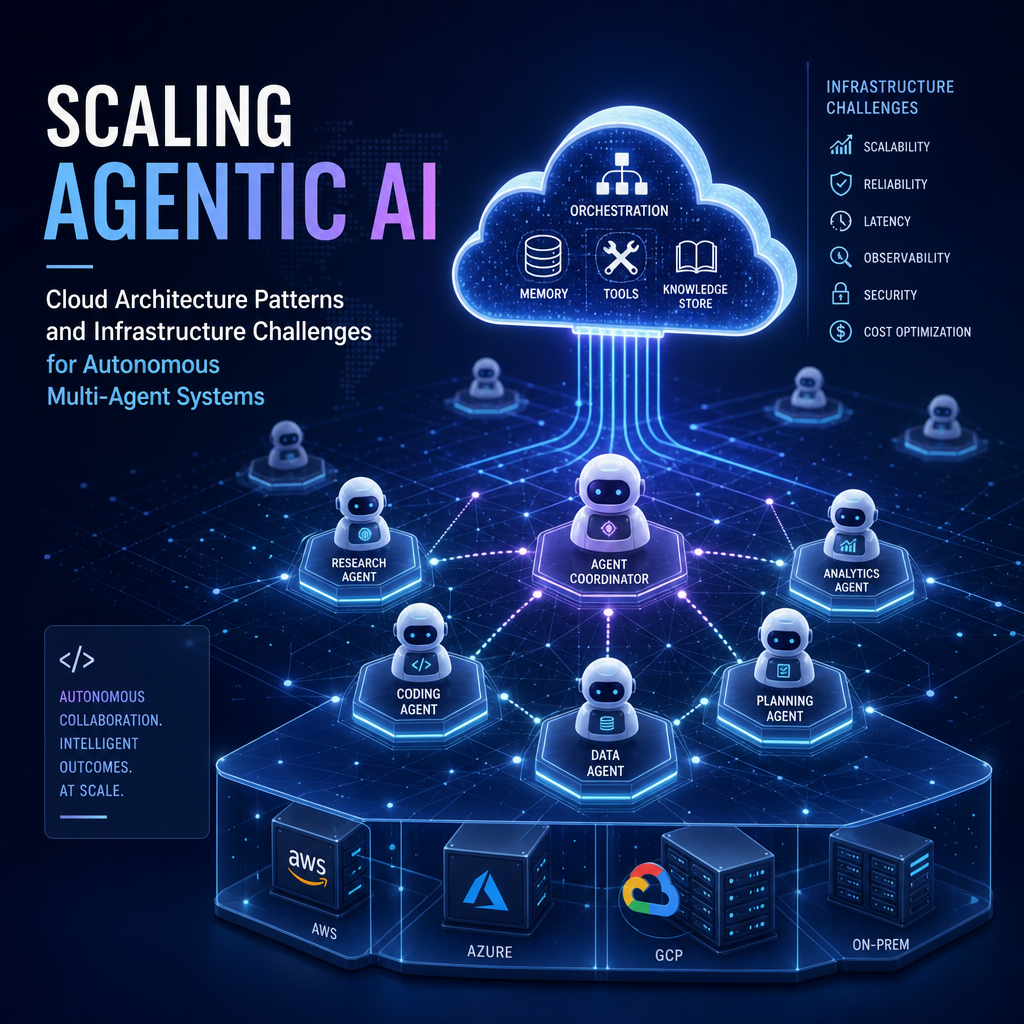
Introduction
The AI ecosystem has crossed a critical threshold, moving beyond standalone models and reactive prediction systems into the era of agentic AI. These are autonomous, goal-driven systems that do not merely respond to prompts, but actively plan, reason, and orchestrate complex workflows across distributed infrastructure [1]. For technical leadership navigating this landscape, the shift represents a profound strategic imperative, promising productivity gains of 30% in application modernization and a 13x reduction in token usage through intelligent memory management [1].
However, the stark reality of enterprise deployment often undermines this promise. A recent RAND Corporation study found that over 80% of AI projects fail to reach production--a rate nearly double that of typical IT projects [2]. While building a multi-agent swarm on a local laptop using frameworks like LangGraph, AutoGen, or CrewAI is incredibly easy, deploying these autonomous systems into enterprise production is an entirely different reality [3]. The friction does not occur at the model level; rather, the AI model rarely breaks, but the underdeveloped infrastructure, strategy, and data management processes around it buckle under real-world scenarios [2].
Consequently, agentic AI in 2026 is fundamentally an architecture problem. The models are good enough, and the tools are maturing, but what separates production deployments from eternal pilots is whether an organization has the right structural patterns to support them [4]. The limiting factor in these deployments is rarely the model itself--it is the surrounding infrastructure: orchestration, retrieval latency, observability, tenant isolation, rollback, identity management, and cost control under sustained load [5].
From Monolithic Models to Multi-Agent Orchestration
As AI applications scale beyond simple use cases, the limitations of monolithic single-agent architectures become readily apparent. A single general-purpose agent struggles to maintain context and accuracy when workflows span multiple tools, systems, or complex skill domains. The solution mirrors traditional distributed systems design: replacing one generalist with a team of specialized agents coordinated through an orchestration layer [1][4].
The Puppeteer Pattern
The most prominent architectural solution is Multi-Agent Orchestration, often referred to as the "Puppeteer Pattern." In this setup, an orchestrator acts as a central coordinator that decides who does what, routes information between agents, and manages shared state, while individual agents handle narrow, specific tasks [4]. For example, a complex coding task might utilize a planner, a coder, a tester, and a reviewer, while a customer service flow might require intent classification, knowledge retrieval, action execution, and response generation [4].
In an enterprise setting, agentic AI platforms rely on these multi-agent systems (MAS) to safely coordinate work across data, applications, and workflows. Without MAS, agentic AI cannot scale, govern, or operate reliably across a business [6]. They provide the structural foundation for agentic behavior, enabling coordination, delegation, and context-sharing across specialized agents, all grounded in human-defined intent [6].
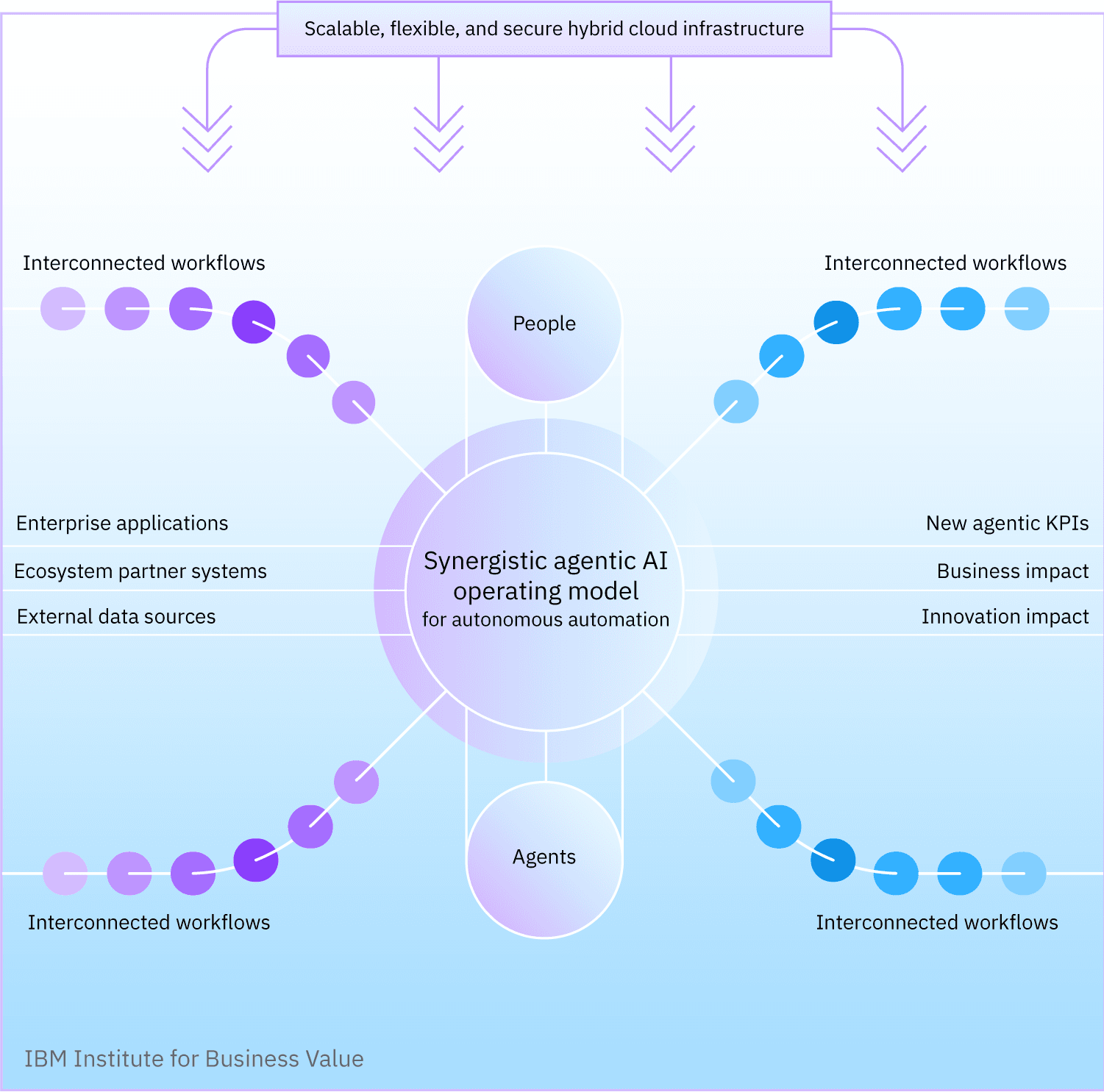 The essential guide to scaling agentic AI | IBM
However, orchestration complexity should not be applied indiscriminately. Best practices dictate scaling to multi-agent architectures only when a single agent genuinely cannot handle the workflow breadth, as the overhead of orchestration can exceed the benefit for simple, single-step tasks [4].
Cloud Architecture Patterns for Autonomous Systems
Coordinating multiple autonomous agents presents challenges familiar to any distributed systems engineer: miscommunication, overlapping responsibilities, and difficulty aligning toward a common objective. Scaling this to dozens or hundreds of agents requires proven cloud architecture patterns.
Event-Driven Decoupling
To address the chaos of multi-agent collaboration, engineering teams are increasingly adopting event-driven design--a proven approach in microservices. By treating agent actions and state changes as events, systems can achieve the decoupling necessary for scalable, efficient multi-agent workflows [7]. This asynchronous decoupling ensures that agents can operate independently, reacting to triggers without creating tight dependencies that lead to cascading failures.
Standardizing Tool Access via MCP
A critical component of the orchestration and service layers is how agents interact with external tools and data. Standardizing tool access through protocols like the Model Context Protocol (MCP) is emerging as a vital pattern. MCP enforces least privilege across the network, ensuring each agent can only access the exact data and tools required for its specific role [8]. This converts autonomous AI models into governed, auditable, and secure software components, creating strict identity and access management boundaries [8].
The Compute and Integration Bottleneck
Deploying agentic AI at scale introduces infrastructure challenges that are distinct from traditional machine learning systems. The very nature of autonomous workflows defies standard cloud provisioning models.
Navigating Bursty Compute Demands
Unlike traditional web applications or batch processing ML, agentic workflows generate bursty, unpredictable compute demands characterized by long idle periods punctuated by intensive multi-agent collaborations [1]. Infrastructure must support elastic scaling--typically through container orchestration like Kubernetes--with autoscaling policies precisely sized to agent workload patterns. Overprovisioning wastes resources, while underprovisioning causes severe latency spikes during critical decision windows [1]. Furthermore, different agents require different compute profiles, necessitating heterogeneous hardware environments [1].
The Legacy Integration Tax
Most enterprises do not operate on greenfield infrastructure. Agentic systems must connect to legacy databases, SOAP APIs, authentication systems, and data pipelines that were never designed for autonomous agent access [5]. Interoperability challenges are immense, as multiple agent systems frequently interact with diverse data sources and APIs [9]. MIT Sloan's research on cancer patient monitoring found that "80% of the work was consumed by unglamorous tasks associated with data engineering, stakeholder alignment, governance, and workflow integration" [5]. Starting where APIs are well-documented and data is structured is the only way to make this integration overhead manageable.
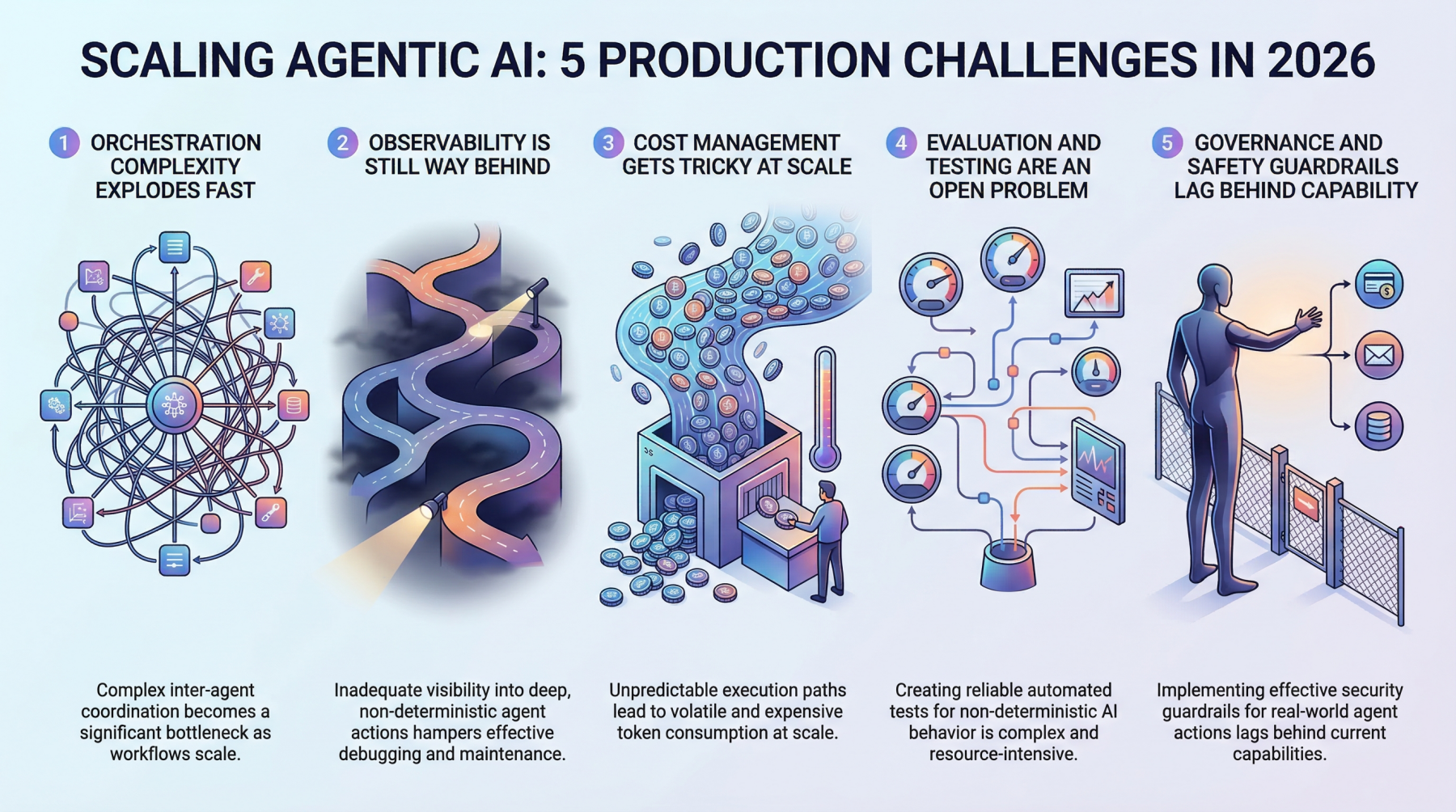 5 Production Scaling Challenges for Agentic AI in 2026 - MachineLearningMastery.com
The Shift to Edge and Hybrid Models
Interestingly, the traditional reliance on massive, centralized cloud processing may be shifting. Agentic AI systems often require far less centralized cloud compute than previously thought [9]. There is a growing trend toward edge deployment models where agents operate with minimal cloud connectivity, reducing costs and latency while improving data privacy [9]. High-stakes environments, like the autonomous additive manufacturing workflow at Oak Ridge National Laboratory, utilize an edge-cloud HPC continuum. In this architecture, physical hardware sensors at the edge stream live data into high-performance cloud simulations in near real-time, with an AI multi-agent control loop continually analyzing telemetry to optimize physical movements [8].
Governance, Observability, and the Path to Production
The gap between a compelling demo and a production-ready enterprise system almost always comes down to state management, credential governance, and end-to-end observability [3]. Behavior without architecture does not scale; without an operating model, autonomy becomes chaos [6].
The Distributed Systems Dilemma
Multi-agent systems introduce classic distributed systems challenges: agent dependencies, shared state, network partitions, and version mismatches create failure modes that are notoriously difficult to reproduce and debug [5]. Deployment orchestration for agentic systems requires sophisticated tooling that supports staged rollouts, agent-level health checks, and rollback capabilities that account for shared state [5]. Organizations also face identity sprawl, where managing credentials for dozens of autonomous agents becomes a security nightmare [10].
Uncompromising Observability
Standard system observability tools are often blind to the nuanced failures of agentic AI. If an agent hallucinates a control decision in a physical system, standard metrics cannot explain why the failure occurred [8]. Production systems require interconnected graphs that link physical hardware telemetry, system scheduling, and LLM reasoning into one unified framework to prove causality. Organizations must guarantee debuggability by tracking provenance from the initial prompt to the final physical output [8].
Graduated Autonomy
To mitigate these risks, organizations must phase autonomy by risk profile. There is a critical distinction between agents that gather information and agents that actively alter system states. Multi-agent systems excel at read-heavy workloads, such as running concurrent research tasks and parallel data exploration [8]. Enterprises should only deploy state-altering agents if they enforce strict architectural boundaries and prove reliability and oversight at lower risk tiers [10]. Furthermore, implementing an agent registry becomes essential when scaling to five or more agents, providing the governance structure necessary to manage the growing ecosystem [4].
 Agentic AI Architecture for Enterprises in 2026
Conclusion
The narrative surrounding artificial intelligence often focuses on the sheer power of foundational models, but the frontier of agentic AI tells a different story. As organizations attempt to deploy autonomous, goal-driven systems, they are discovering that the models are merely the engine--the true challenge lies in building the vehicle.
Scaling agentic AI requires a disciplined approach to distributed systems architecture. It demands the implementation of multi-agent orchestration patterns like the Puppeteer model, event-driven decoupling to handle complexity, and strict governance protocols like MCP to secure tool access. It requires solving the bursty compute problem, bridging the gap to legacy infrastructure, and establishing uncompromising observability to track agent reasoning from prompt to execution.
Ultimately, the gap between an AI pilot and a production-grade autonomous system is infrastructure, not intelligence [3]. Enterprises that recognize this reality--investing heavily in agent-ready infrastructure, phasing autonomy by risk, and treating agentic AI as an architectural discipline rather than a model deployment--will be the ones that unlock the transformative potential of autonomous multi-agent systems.
References
- 1.
- 2.
- 3.
- 4.
- 5.
- 6.
- 7.
- 8.
- 9.
- 10.