Introduction
For the past two decades, the software-as-a-service (SaaS) industry operated on a nearly flawless economic equation: build a product once, and serve it to the thousandth user for roughly the same marginal cost as the tenth. This dynamic fueled the era of per-seat pricing, yielding the legendary 80-90% gross margins that made SaaS the darling of Wall Street. However, the integration of Generative AI is fundamentally breaking this equation. By injecting real, variable inference costs into every software interaction, AI is dismantling the per-seat pricing model and forcing a wholesale reimagining of how enterprise software is bought, sold, and monetized [1].
This is not merely a superficial pricing tweak; it is a paradigm shift. Generative AI scales not by the number of humans logging into a system, but by tokens, compute minutes, and model complexity [2]. As a result, the foundational economic logic that made standardized, one-size-fits-all enterprise software the default is rapidly unraveling [3]. The transition is already underway, bringing both immense opportunities and complex new economic realities for software vendors and buyers alike.
 Why AI Is Breaking Seat-Based SaaS Pricing
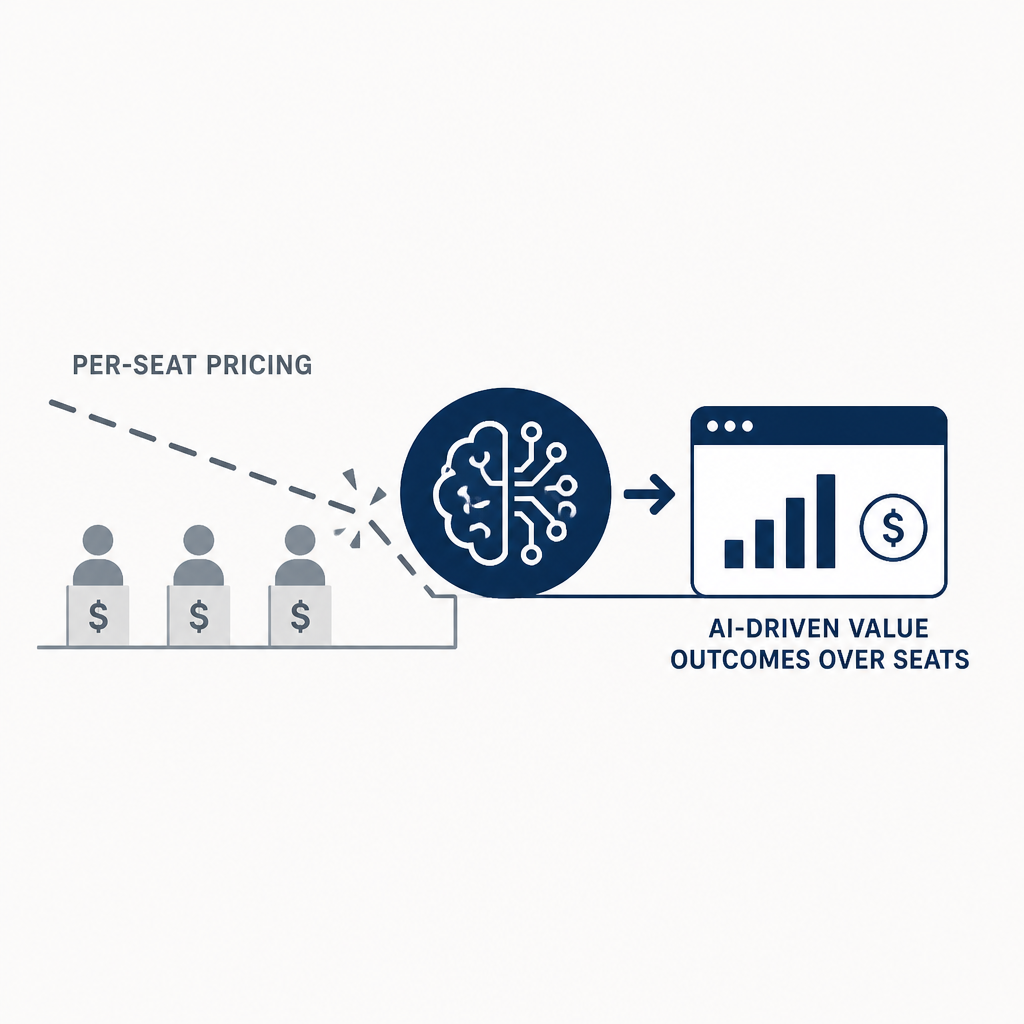
The Death of the Per-Seat Paradigm
The per-seat pricing model thrived on predictable, human-bound usage. Organizations purchased licenses based on headcount, often overprovisioning to accommodate fluctuating team structures, hybrid work environments, and project-based staffing [2]. This led to immense software waste, but vendors largely ignored it because idle seats cost virtually nothing to maintain.
Generative AI has turned idle seats from a benign byproduct into a direct cost liability [4]. Because AI-driven features require backend compute and inference for every query, the assumption that an unused seat costs nothing is dead. Seat-based pricing is now only defensible in scenarios where user engagement is exceptionally high, ensuring the consumer surplus exceeds the vendor's incremental AI serving costs [4]. Where organizations pay for seats that go largely unused, the model collapses under the weight of unrecouped compute expenses.
The market data reflects this rapid disillusionment. According to Growth Unhinged's 2025 State of B2B Monetization report, the adoption of seat-based pricing among software companies plummeted from 21% to just 15% in a single twelve-month period, while hybrid pricing models surged from 27% to 41% [5]. Companies that stubbornly cling to traditional per-seat pricing for AI products are already paying the price, experiencing 40% lower gross margins and 2.3 times higher customer churn than those adopting modern usage or outcome-based models [5].
The Margin Compression Equation
To understand why pricing models must change, one must look at the underlying unit economics of AI. The defining feature of traditional SaaS--a near-zero marginal cost of goods sold (COGS)--does not apply to Generative AI [1]. Every time a user prompts an AI agent, real compute cycles are consumed, and API calls to large language models (LLMs) are made.
This fundamental shift has severe implications for enterprise software margins. Industry analyses from Bessemer Venture Partners, a16z, and ICONIQ indicate that AI-native gross margins currently land in the 50-60% range, a steep drop from the 80-90% benchmarks of legacy SaaS [1]. While AI margins are improving--rising from an average of 41% in 2024 to 52% in 2026--they are structurally lower than traditional software [1].
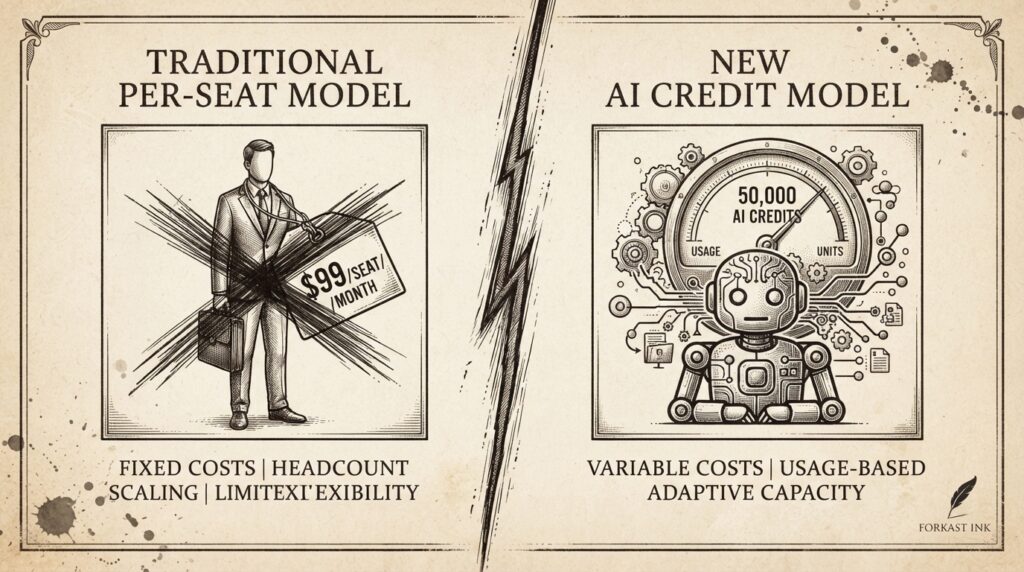 Monday.com Just Changed How Enterprise SaaS Gets Priced. The Per-Seat Model Is Not Coming Back. - Forkast
To survive this margin compression, vendors are aggressively hunting for COGS levers. The most significant lever discovered so far is intelligent model routing. Within a single vendor's ecosystem, the price spread between AI models can run five times or more--for instance, routing routine queries to Claude Haiku 4.5 at $1 per million tokens, while reserving Claude Opus 4.8 at $25 per million tokens for complex tasks [1]. This hidden compute economics are reshaping corporate IT budgets, requiring leaders to demand radical value clarity for every dollar spent on AI infrastructure [6][2].
The Rise of Hybrid and Outcome-Based Models
As vendors scramble to align their new cost structures with customer expectations, the market is converging on three primary pricing alternatives: pure usage-based, hybrid base-plus-usage, and outcome-based pricing [5].
Pure usage models, championed by infrastructure players like OpenAI and Anthropic, charge per API call or per token. While this offers perfect cost-to-value alignment, it introduces severe revenue unpredictability that makes investors nervous [5]. To counter this, enterprise platforms like Databricks and Snowflake have popularized hybrid models, combining a predictable monthly platform fee with variable consumption charges [5].
However, the most radical departure from the SaaS norm is outcome-based pricing, where customers pay strictly for results achieved. Zendesk is leading this charge with a hybrid approach, charging a per-seat fee for human agents but billing per resolved ticket for AI agents [7]. Intercom executed an even bolder pivot with its Fin AI product in 2023, abandoning its traditional $39-per-seat model for a $0.99-per-AI-resolved-conversation model. The results were staggering: within six months, Intercom saw 40% higher adoption rates, maintained healthy margins despite variable costs, and empowered one enterprise customer to cut support costs by 60% while handling three times the ticket volume [5].
Some providers are attempting a compromise, redefining what a "seat" means by licensing an AI agent as if it were a user at a premium price point [8]. While this preserves the familiarity of the seat model for buyers, it risks leaving massive value on the table for the vendor if an AI agent ends up producing ten times the output of a human worker [8].
 The Death of Per-Seat Pricing: What It Means for Your SaaS P&L - The SaaS CFO
The End of One-Size-Fits-All Software
This economic upheaval is not just changing spreadsheets; it is changing the very nature of enterprise software. Historically, standardized software required users to learn rigid workflows--knowing exactly where to click, which fields to complete, and where to navigate [9]. Generative AI introduces a conversational, dynamic layer that dismantles these rigid interfaces. Instead of forcing employees to learn complex systems, AI acts as an intelligent assistant, bringing relevant capabilities to the user via natural language when needed [9].
Because AI makes software highly adaptable, it is fast becoming feasible for companies to build or customize systems tailored exactly to how they actually work, rather than forcing their operations into a standardized box [3]. This spells the end of one-size-fits-all enterprise software. As AI becomes an embedded layer within CRM, HR, and analytics platforms, the software itself becomes less of a static tool and more of a dynamic, intelligent partner [9].
Conclusion
The integration of Generative AI into enterprise software represents a once-in-a-generation reset of the industry's economic foundations. The traditional per-seat SaaS model is not evolving; it is dying, rendered obsolete by token-based compute costs and the reality of AI agents that do not map neatly to human headcounts. As gross margins compress into the 50-60% range, vendors can no longer rely on the zero-marginal-cost magic of the past [1].
The future belongs to outcome-driven and hybrid pricing models that align vendor revenue directly with the tangible value delivered to the customer [7][5]. As organizations increasingly demand fairness, predictability, and clear ROI from their AI investments, the companies that succeed will be those that transform from mere software providers into AI-enabled, outcome-driven business partners [10]. Ultimately, the long arc of this technological progress bends toward greater value for the customer's dollar--an inevitable outcome that will continue to redefine the economics of software for years to come [8].
References
- 1.
- 2.
- 3.
- 4.
- 5.
- 6.
- 7.
- 8.
- 9.
- 10.