Introduction
"The era of global warming has ended; the era of global boiling has arrived," warned United Nations Secretary-General António Guterres, a stark backdrop against which the rapid rise of generative artificial intelligence must now be evaluated [1]. As Large Language Models (LLMs) integrate into the fabric of modern digital infrastructure, they bring with them a hidden, yet rapidly expanding, environmental cost. The immense computational resources required to train and deploy these models--ranging from processing colossal datasets to running thousands of specialized GPUs--have elevated AI sustainability from a niche academic concern to a pressing global imperative [2].
Understanding the true carbon footprint of machine learning, particularly LLMs, requires looking beyond the electricity meter. It encompasses not only the emissions from the energy used to run computing hardware but also the power required to cool data centers, alongside the indirect emissions from the manufacturing, maintenance, and disposal of the physical infrastructure itself [2]. Without a holistic view of these operational and embodied emissions, efforts to mitigate the environmental impact of AI will remain fundamentally incomplete.
As the AI industry accelerates, a critical knowledge gap persists. Quantifying the emissions engendered by the entire lifecycle of an LLM is fraught with data scarcity, methodological inconsistencies, and a lack of standardized reporting. This article examines the anatomy of LLM carbon footprints, explores the challenges of accurately measuring them, and highlights the emerging strategies and frameworks that offer a roadmap toward sustainable, carbon-efficient AI.
The Anatomy of an LLM's Carbon Footprint
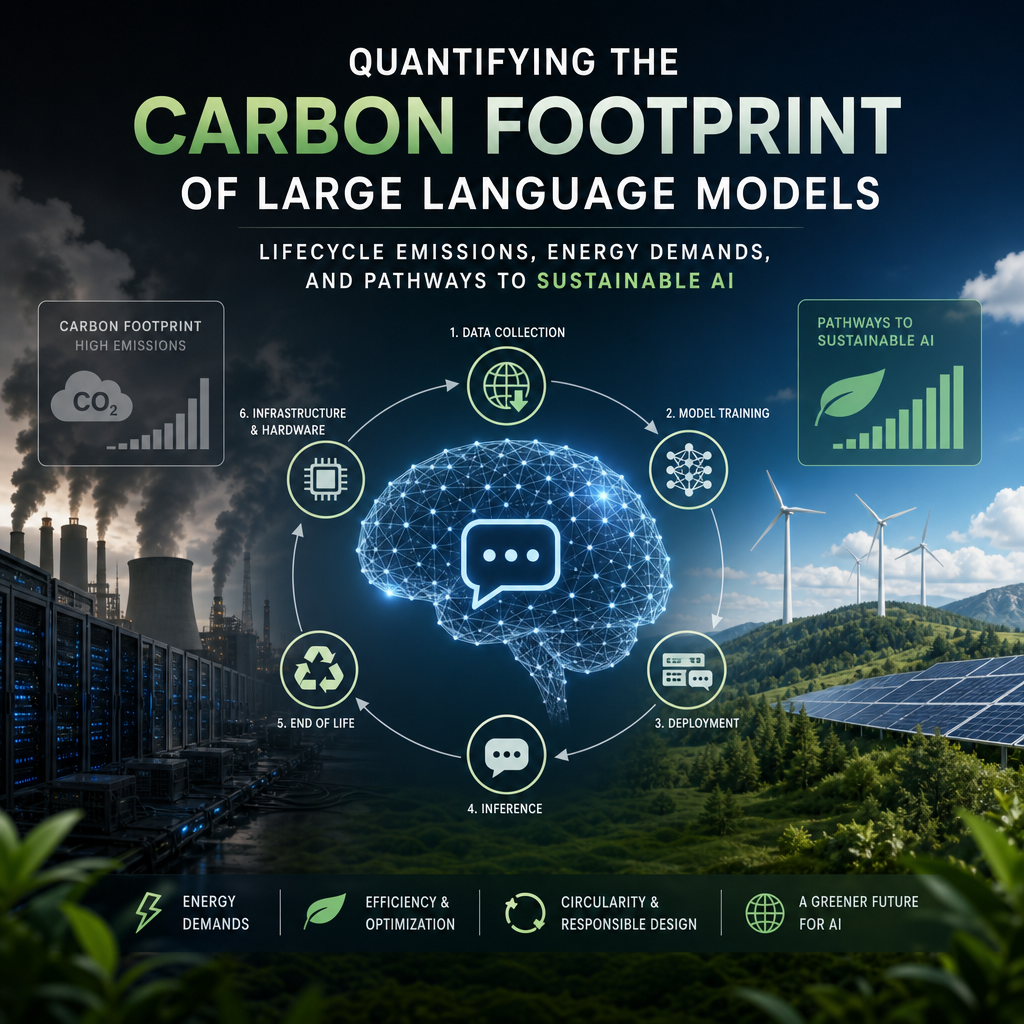
To truly grasp the environmental impact of LLMs, one must deconstruct their lifecycle into distinct phases, each contributing uniquely to the total carbon dioxide equivalent (CO2e) emitted. The carbon footprint of an LLM is broadly divided into two primary categories: the upfront costs of building the model, and the ongoing costs of operating it [1].
The Upfront Cost: Training and Embodied Carbon
The training phase of an LLM is notoriously energy-intensive. To put this into perspective, the best estimate of the dynamic computing cost for training GPT-3--the model behind the original ChatGPT--is approximately 1,287,000 kilowatt-hours (kWh), translating to roughly 552 metric tons of CO2e [1]. This figure represents the power consumed while the machines are operating at full capacity, but it is only a fraction of the upfront carbon cost. Training runs can take weeks or months, during which hardware draws significant power even during idle computing states [1].
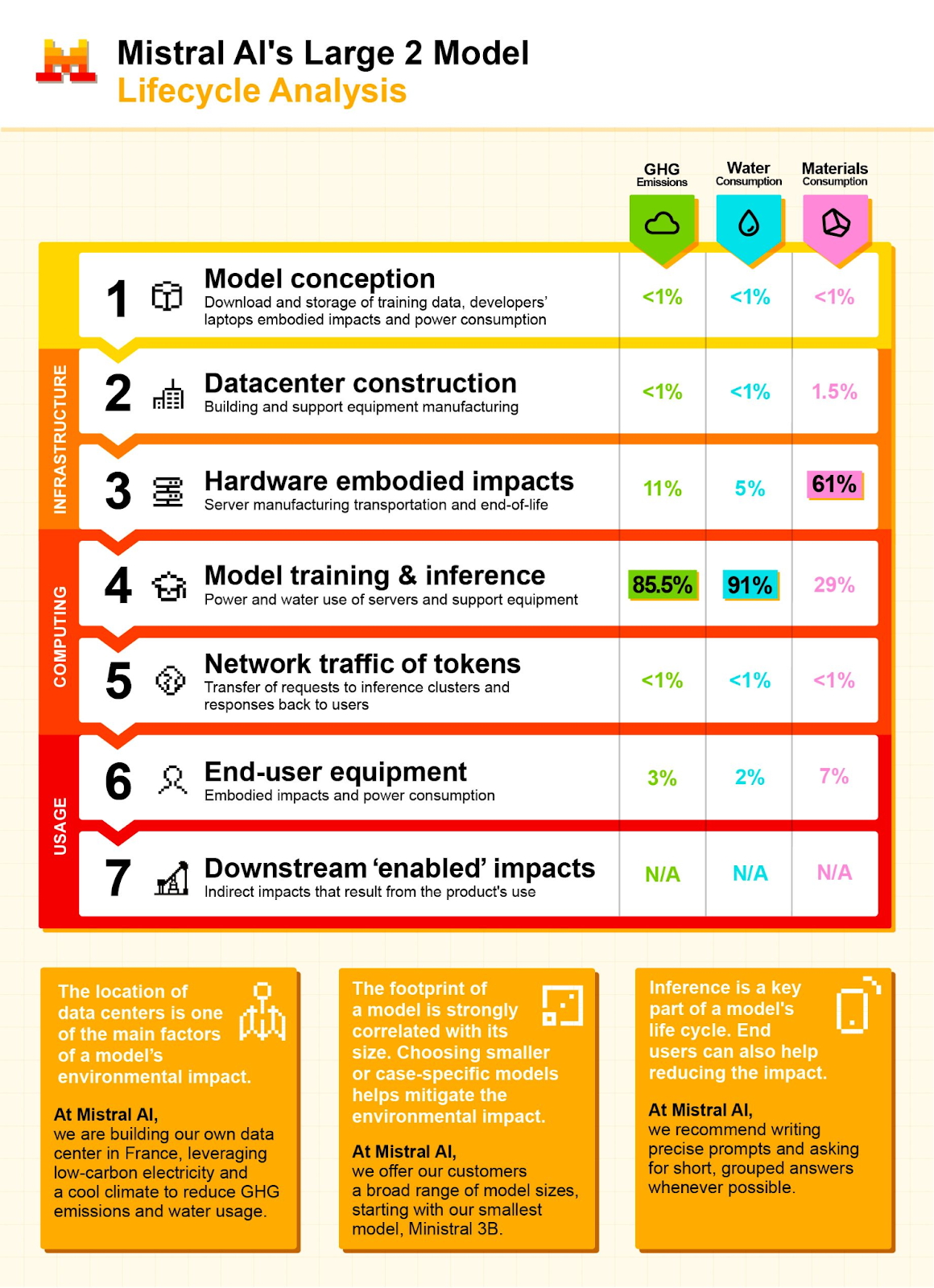
Beyond operational energy, the upfront cost includes "embodied carbon"--the emissions generated from the manufacturing of the necessary hardware, such as GPUs, servers, and data center infrastructure [1]. Gathering accurate data on these Scope 3 emissions is notoriously difficult, as it requires AI developers to trace supply chains back to hardware designers, who must in turn gather information from their raw material suppliers [3]. The BLOOM model carbon estimation stands out as a pioneering effort in this space, being one of the first of its kind to attempt to quantify these hard-to-reach manufacturing emissions [3].
 Assessing the carbon footprint of language models: Towards sustainability in AI - ScienceDirect
The Tailpipe Emissions: The Growing Weight of Inference
While the training phase often makes headlines for its carbon intensity, the everyday use of these models--by millions of users across the world--has become an increasingly significant, and arguably dominant, source of emissions [4]. Inference, the process of running a trained model to generate predictions or answers, was once considered marginal. Today, as models transition from lab experiments to everyday tools serving billions of page views monthly, inference represents the "tailpipe" emissions of generative AI [4][5].
Furthermore, the environmental impact of inference extends beyond carbon. Many data centers rely on water-based cooling systems to manage the heat generated by continuous GPU workloads, consuming millions of liters of water per day and raising socio-ecological concerns around local water depletion [4]. Like all information and communication technologies (ICT), LLMs leave an indelible impact on the environment, from the metals mined for hardware to the water and land consumed by data centers [5].
The Data Deficit: Challenges in Measurement and Standardization
A major hurdle in achieving sustainable AI is the lack of transparency and standardized methodologies for measuring carbon footprints. Currently, there is no single framework or universally accepted methodology used for calculating the carbon emissions of LLMs, making it incredibly difficult to meaningfully compare the environmental impact of different models [3].
While initiatives like the Green Software Foundation aim to develop standards for general computing, there are no specific frameworks tailored to the unique particularities of AI and LLMs [3]. This lack of fine-grained carbon modeling means there remain significant blind spots in understanding how different variables interact, preventing the kind of model-system-hardware co-design necessary for a sustainable ML life cycle [6].
To bridge this gap, researchers and developers are beginning to build dedicated tools. For example, tools like Code Carbon are being utilized to provide consistent and quantifiable measurements of CO2 output during training, allowing for the benchmarking of emissions across various models and hardware setups [7]. Similarly, tools like EcoLogits have been developed to estimate the carbon footprint of a single prompt at the inference level, combining operational and amortized embodied emissions to empower developers to bring transparency to their AI usage [4]. Projects such as the AI Energy Star are also emerging as vital steps in bringing energy impact data to the forefront, helping users demand efficient models and nudging developers toward climate-conscious decisions [8].
 What's the carbon footprint of using ChatGPT or Gemini? [August 2025 update]
Pathways to Sustainable AI: Mitigation Strategies
Despite the daunting scale of the challenge, the research community and industry are identifying actionable pathways to reduce the carbon footprint of LLMs without sacrificing their transformative capabilities. These strategies span algorithmic optimization, hardware selection, and infrastructural shifts.
Algorithmic Efficiency and Fit-for-Purpose Models
One of the most effective ways to reduce emissions is to simply use smaller, more efficient models. Not all generative AI tasks require massive, generalized models. Leading AI companies are increasingly focusing on using appropriately-sized, fit-for-purpose models to perform specific tasks, achieving nearly equivalent quality for a fraction of the energy consumption [1][9]. Furthermore, techniques like strategic quantization and local inference can substantially lower carbon footprints. Experimental results demonstrate that post-quantization methods can reduce energy consumption and carbon emissions by up to 55%, making LLMs particularly suitable for resource-constrained environments [10].
Hardware Choices and Co-Design
The hardware upon which an LLM runs plays a critical role in its sustainability. Selecting state-of-the-art, energy-efficient hardware is crucial for reducing the carbon footprint of AI operations [2]. Studies comparing hardware configurations, such as T4 versus A100 GPUs, highlight the significant carbon footprint variations associated with different setups, offering insights into more sustainable practices [7]. Looking forward, researchers advocate for a full-stack, life-cycle-aware characterization that enables model-system-hardware co-design, moving away from treating hardware as a static variable [6].
Carbon-Aware Computing and Open Source Ecosystems
Because LLM training tasks are generally not location-dependent, they represent a massive opportunity for carbon-aware computing. Training and inference tasks can be routed to regions with abundant, low-cost, low-carbon electricity. While routing inference requests through greener grids may add only a few milliseconds of latency, it can substantially reduce potential emissions [9].
Additionally, the push for open-source AI weights plays an overlooked role in sustainability. If LLMs and their weights are open-sourced, the community can build upon existing models rather than expending the massive energy costs of pre-training from scratch, ensuring these models only need to be pre-trained once by the developers [8]. It is important to note, however, that carbon awareness is not a silver bullet. With larger models, the absolute energy demand remains quite high even when powered by renewable energy, meaning efficiency must accompany green energy initiatives [5].
 Artificial intelligence and carbon neutrality: A dual role in emissions forecasting, energy consumption, and sustainable strategies - ScienceDirect
Conclusion
The narrative surrounding the environmental impact of Large Language Models is evolving from a singular focus on training costs to a comprehensive understanding of lifecycle emissions. The staggering energy demands of models like GPT-3, combined with the invisible toll of embodied carbon and the escalating impact of inference, paint a picture of an industry that must urgently mature its sustainability practices.
Addressing this challenge requires a multi-pronged approach. The AI community must rally behind standardized reporting frameworks to eliminate the current data deficit, enabling developers and corporations to make informed, climate-conscious decisions. Technologically, the path forward lies in rejecting the "bigger is always better" paradigm in favor of fit-for-purpose models, aggressive algorithmic optimization like quantization, and full-stack hardware co-design.
Sustainable AI does not stop at training; it is an ongoing commitment that spans every prompt generated and every server manufactured. By integrating carbon-aware computing, demanding transparency, and prioritizing efficiency, the tech industry can ensure that the generative AI revolution powers human progress without accelerating the degradation of the planet.
References
- 1.
- 2.
- 3.
- 4.
- 5.
- 6.
- 7.
- 8.
- 9.
- 10.