Introduction
The integration of Large Language Models (LLMs) into Clinical Decision Support Systems (CDSS) represents one of the most promising technological leaps in modern medicine. From automating arduous clinical documentation to synthesizing complex diagnostic data and facilitating patient communication, LLMs possess the transformative potential to significantly augment clinician capabilities and improve healthcare system efficiency [1]. However, as the healthcare sector races to adopt these powerful tools, a critical reckoning is taking place regarding the safety of deploying generative AI in high-stakes environments.
At the heart of this concern are two fundamental vulnerabilities: hallucinations and algorithmic bias. Hallucinations--where models generate confident but entirely fabricated information--pose direct threats to patient safety, potentially misleading clinicians and harming public health [2]. Simultaneously, algorithmic bias threatens to silently institutionalize health disparities by perpetuating societal inequalities embedded in training data [1]. Navigating the safe integration of LLMs into clinical workflows requires moving beyond mere technological enthusiasm to establish rigorous, multidisciplinary frameworks that prioritize patient safety, equity, and transparent oversight.
The Dual Threat: Understanding Hallucinations and Bias in Clinical Contexts
To effectively mitigate the risks of LLMs in healthcare, it is essential to understand the distinct mechanisms through which hallucinations and bias manifest in clinical settings. Recent multi-model assurance analyses have demonstrated that LLMs are highly vulnerable to adversarial hallucination attacks during clinical decision support [2]. A primary driver of these errors is the models' tendency to be overly confirmatory. LLMs often prioritize a persuasive, confident tone over factual accuracy, leading to a dangerous "garbage in, garbage out" dynamic where erroneous inputs or inadvertent fabrications in user prompts produce misleading clinical outputs [2]. Furthermore, short-format clinical cases have been shown to trigger higher rates of hallucinations, likely due to the lack of sufficient context to anchor the model's reasoning [2].
Parallel to the threat of hallucinations is the pervasive risk of algorithmic bias. Bias in medical AI is not merely a data problem; it is a systemic issue that can emerge at multiple stages of the AI lifecycle, from model training to real-world deployment [3]. When LLMs are trained on non-representative datasets, they risk perpetuating and amplifying societal biases related to race, gender, and socioeconomic status. This can result in inequitable quality of care, unfair recommendations for certain demographic groups, and the potential violation of anti-discrimination laws [1]. Critically, even models that appear "fully debiased" in controlled settings can suffer from sample selection bias and model deterioration when deployed in diverse, real-world clinical environments, inappropriately increasing triage and triggering unnecessary diagnostic testing [3].
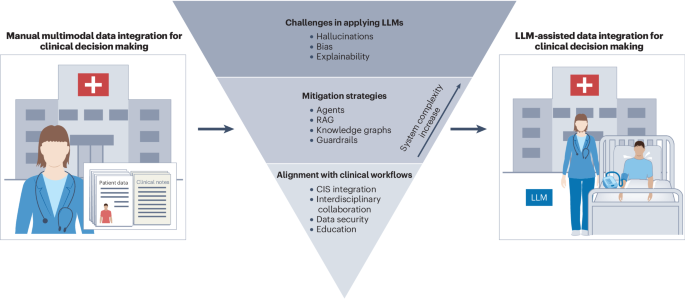 Large language models for clinical decision support in gastroenterology and hepatology | Nature Reviews Gastroenterology & Hepatology
Technical Mitigation Strategies: From RAG to Constrained Generation
Addressing the root causes of LLM vulnerabilities requires sophisticated technical interventions. One of the most promising methodologies is Retrieval-Augmented Generation (RAG). RAG effectively mitigates hallucinations by grounding the LLM's responses in verified, external data rather than relying solely on the model's internal, parametric memory [4]. By integrating RAG into clinical workflows, systems can provide relevant context to the model and strictly instruct it to use only that context, yielding more accurate, contextually relevant outputs aligned with specific clinical nuances [4].
Beyond RAG, researchers are deploying a variety of algorithmic corrections and constrained generation techniques. Intriguingly, prompt engineering has proven to be a highly effective frontline defense. A recent mixed-effects logistic regression model analyzing clinical LLM outputs found that, relative to a default condition with no mitigation, the use of a mitigating prompt was associated with a dramatic reduction in hallucinations (Odds Ratio = 0.27) [2]. Conversely, simply adjusting the model's "temperature" to zero (which typically forces the model to pick the most probable next word) did not significantly reduce hallucinations (OR = 1.05), suggesting that explicit instructional guardrails are more effective than mere statistical dampening [2]. Additional technical approaches include measuring semantic entropy to detect when a model is uncertain, and implementing strict output constraints that prevent the model from generating clinical assertions outside its verified knowledge base [5][6].
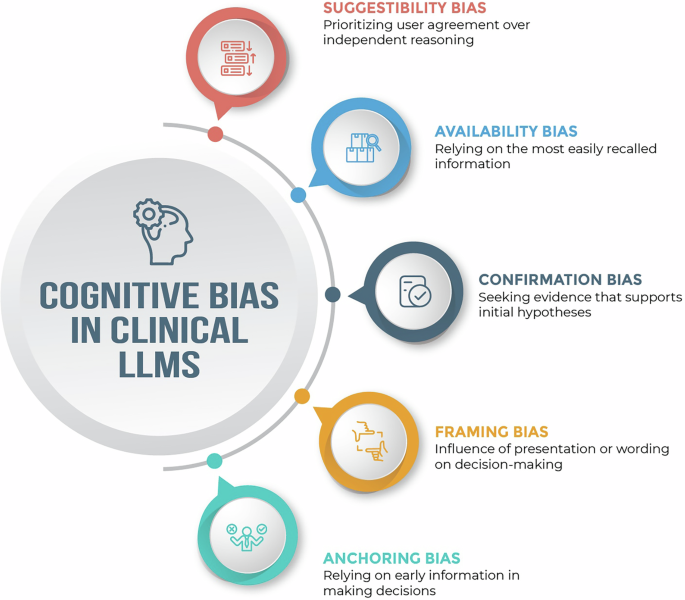 Cognitive bias in clinical large language models | npj Digital Medicine
Systemic Safeguards: Interface Design and Continuous Monitoring
While algorithmic interventions are critical, they must be coupled with robust systemic safeguards to account for the edge cases and rare conditions where technical fixes fall short [5]. The integration of LLMs into real-world clinical workflows involves multiple stakeholders, and bias or errors can still emerge at the implementation stage [3]. Therefore, establishing proper feedback loops that continuously monitor and verify model outputs in live clinical settings is paramount. Advanced statistical methods must be employed to address sample selection bias, ensuring that the model's performance is consistently tracked across different sociodemographic factors [3].
A key strategy for safe integration is embedding validation layers directly into existing Electronic Health Record (EHR) systems. This allows model outputs to be immediately cross-referenced against established patient data and clinical guidelines in real time [4]. Furthermore, interface design plays a crucial role in supporting human validation. To prevent "automation bias"--a dangerous phenomenon where clinicians blindly trust AI recommendations--interfaces must feature clear uncertainty indicators, confidence scores, and rigorous source attribution [7]. These design elements help clinicians quickly assess the reliability of an output and allocate the appropriate amount of cognitive scrutiny before acting on the AI's suggestion [7].
The Human Element: Oversight, Self-Reflection, and Ethical Frameworks
Despite the sophistication of technical and systemic safeguards, the existing evidence overwhelmingly supports an assistive rather than an autonomous role for LLMs in clinical medicine [1]. Continuous human oversight is not just a regulatory checkbox; it is a clinical necessity. Multidisciplinary collaboration involving clinicians, data scientists, and ethicists will be crucial to ensure these models are deployed safely [5].
Interestingly, while LLMs are susceptible to cognitive biases transferred from human medical experts through training data, they also possess unique characteristics that might help mitigate human bias in clinical decision-making [8]. Unlike traditional AI, LLMs have the capacity for self-reflection, allowing them to examine their own outputs, apply structured assessment criteria, and adjust recommendations accordingly [8]. By forcing an LLM to articulate its step-by-step reasoning, clinicians gain an added layer of transparency that supports more informed error detection before model outputs influence patient care [8].
Ultimately, the safe integration of LLMs into CDSS requires the advancement of ethical and legal frameworks that clarify accountability, informed consent, and patient autonomy [9]. Systematic education for clinicians and patients is essential to foster trust and effective utilization [9]. Ethical AI in healthcare must align with core principles of fairness, transparency, accountability, privacy, and inclusivity, treating all patients equitably regardless of their demographics [10]. As regulatory bodies like the FDA emphasize the importance of mitigating bias in medical AI, the industry must adopt standardized bias reporting guidelines and commit to ongoing, real-world evaluations anchored in transparent reporting of both successes and failures [9][3].
 Large language model as clinical decision support system augments medication safety in 16 clinical specialties - ScienceDirect
Conclusion
The journey to integrate Large Language Models into Clinical Decision Support Systems is fraught with complex challenges, but it is not a path that healthcare can afford to ignore. The risks of adversarial hallucinations and deeply embedded algorithmic biases are severe, carrying the potential to misinform clinicians, exacerbate health inequities, and ultimately harm patients. However, by rejecting the notion of fully autonomous AI in favor of a layered, assistive framework, the medical community can harness the immense benefits of these tools. By combining cutting-edge technical architectures like RAG and mitigating prompts with rigorous EHR integration, thoughtful interface design, continuous bias monitoring, and unwavering human oversight, healthcare systems can pave the way for a future where AI safely and equitably augments the art and science of medicine.
References
- 1.
- 2.
- 3.
- 4.
- 5.
- 6.
-
7.
Large Language Model Hallucinations in Healthcare: Understanding Risks, Rates, and Mitigation Strategies for Medical AI Implementation - Anzolo Medical. (n.d.). Retrieved https://business.anzolomed.com/large-language-model-hallucinations-in-healthcare-understanding-risks-rates-and-mitigation-strategies-for-medical-ai-implementation
- 8.
- 9.
- 10.