Introduction
The quest for a room-temperature superconductor represents one of the most profound challenges in modern physics and materials science. Superconductors--materials that can conduct electricity with zero resistance below a critical temperature--promise to revolutionize global energy infrastructure, enable magnetic levitation transport, and unlock the full potential of quantum computing. However, the historical bottleneck in this field has been the sheer complexity of discovering new superconducting phases, a process that has traditionally relied on serendipity, intuition, and painstaking trial-and-error experimentation in the laboratory.
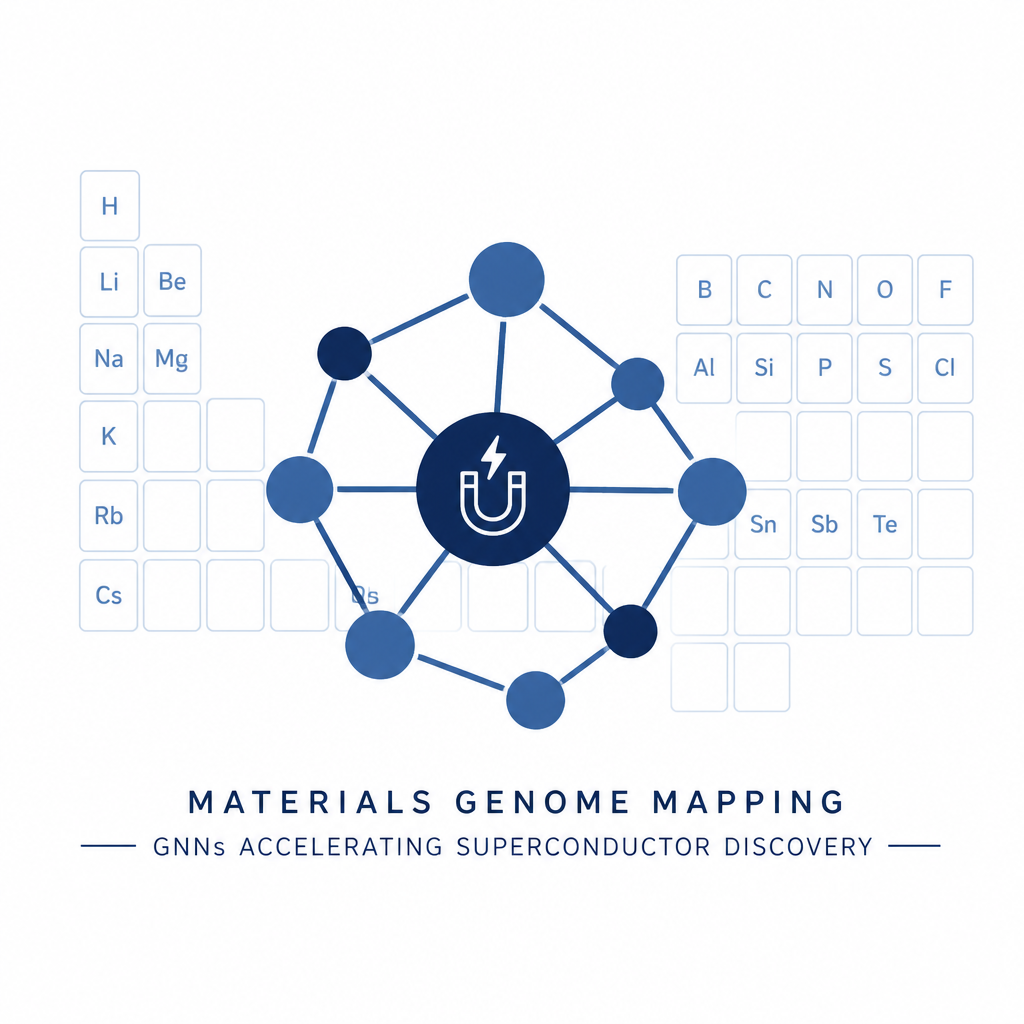
To overcome this inefficiency, the scientific community has embraced the concept of the "Materials Genome Initiative," a paradigm that treats the vast space of possible atomic combinations as a genomic landscape waiting to be mapped and decoded [1]. Just as biologists use computational tools to sequence DNA and predict protein structures, materials scientists are now turning to artificial intelligence to navigate the combinatorial explosion of chemical compounds. By leveraging massive databases of known crystal structures and their properties, researchers can train algorithms to predict the behavior of materials that have not yet been synthesized.
At the forefront of this computational revolution are Graph Neural Networks (GNNs). Unlike traditional machine learning models that struggle with the irregular, non-Euclidean nature of atomic structures, GNNs are uniquely designed to process data represented as graphs. This architectural breakthrough is enabling researchers to screen millions of hypothetical materials in a matter of hours, identifying highly promising superconducting candidates and fundamentally accelerating the pace of next-generation materials discovery.
The Materials Genome and the Graph Representation
To understand the power of GNNs, one must first understand how a material is translated into data. A crystal structure is fundamentally a periodic arrangement of atoms in three-dimensional space. Traditional machine learning approaches often required researchers to manually engineer "features" from these structures--such as atomic radii, electronegativities, or lattice parameters--and flatten them into a one-dimensional array. This process not only discarded critical spatial and topological information but also introduced human bias, limiting the model's ability to uncover novel, unintuitive mechanisms of superconductivity [2].
Graph representation solves this problem by mapping the materials genome directly. In this framework, atoms are represented as "nodes," and the chemical bonds or spatial proximities between them are represented as "edges." Each node contains a feature vector describing the properties of the specific atom (e.g., its element type, valence electrons), while each edge encodes the distance and relative orientation between atoms. This mathematical construct perfectly preserves the local coordination environment and the global periodic symmetry of the crystal lattice, allowing an AI to "see" the material exactly as a physicist does, but in a computationally tractable format [2].
Graph Neural Networks: The Architecture of Discovery
Graph Neural Networks operate on these graph representations through a mechanism known as "message passing." During the training phase, each node (atom) gathers information from its immediate neighbors (connected atoms). Through multiple layers of the neural network, this information propagates outward, allowing an atom to implicitly understand its broader structural environment. For example, after several passes, a copper atom in a lattice "knows" not just that it is bonded to oxygen, but that it is part of a specific two-dimensional plane surrounded by specific spacer layers--a structural motif highly relevant to high-temperature superconductivity [3].
Once the message passing is complete, a "readout" function aggregates the information from all the nodes and edges into a single, fixed-size vector that represents the entire crystal structure. This graph embedding is then passed through a feed-forward neural network to predict a specific property, such as the superconducting critical temperature ($T_c$). Because GNNs learn to extract relevant spatial features autonomously, they have proven vastly superior to traditional models, successfully capturing complex, many-body quantum interactions that dictate superconducting behavior without requiring explicit physical equations [3].
Predicting Critical Temperatures at Scale
The most immediate application of GNNs in superconductor research is the high-throughput screening of materials databases, such as the Materials Project or the SuperCon repository. Predicting the critical temperature of a superconductor traditionally requires solving the computationally exhausting Eliashberg equations or performing highly complex Density Functional Theory (DFT) calculations to determine electron-phonon coupling strengths. These calculations can take days for a single material, making them utterly unscalable for screening millions of candidates [4].
GNNs, once trained on a few thousand known superconductors, can predict $T_c$ for a new compound in milliseconds. Recent models have demonstrated remarkable accuracy, successfully reproducing known superconducting trends, such as the peaks in $T_c$ associated with specific structural phases in hydrogen-rich compounds under high pressure. By applying these models to unexplored regions of the materials genome, researchers have already identified thousands of theoretically stable, previously unconsidered compounds with predicted critical temperatures rivaling or exceeding current high-$T_c$ records [4].
Beyond Prediction: Inverse Design and Generative Models
While screening existing databases is powerful, it limits discovery to combinations humans have already conceptualized. The true paradigm shift lies in "inverse design"--the ability to specify a desired property (e.g., $T_c > 300$ K at ambient pressure) and have an AI generate a completely novel crystal structure that satisfies that criterion. This is achieved by combining GNNs with generative AI models, such as Variational Autoencoders (VAEs) or Diffusion Models, which operate directly in graph space [5].
These generative models can traverse the continuous latent space of crystal graphs to propose exotic, non-intuitive atomic arrangements. For instance, an AI might suggest a metastable layered structure incorporating unusual element combinations that a human chemist would likely never test. Once a candidate is generated, the GNN acts as the discriminator or property predictor, evaluating the proposed structure's superconducting potential. This closed-loop system of generation and evaluation effectively automates the scientific hypothesis generation process, pointing experimentalists directly toward the most fertile synthetic targets [5].
Conclusion
The integration of Graph Neural Networks into materials science represents a fundamental evolution in how we discover and design superconductors. By elegantly translating the complex topologies of the materials genome into actionable mathematical representations, GNNs have shattered the computational bottlenecks that historically plagued the field. They offer an unprecedented ability to predict critical temperatures with high fidelity and, when paired with generative models, to autonomously invent entirely new classes of superconducting materials.
While computational prediction is only the first step--synthesizing these AI-discovered materials and verifying their properties in the laboratory remains a formidable challenge--the pipeline from algorithm to lab bench has never been shorter or more direct. As these AI models continue to improve and are trained on increasingly diverse and physically accurate datasets, the centuries-old dream of a room-temperature, ambient-pressure superconductor moves from the realm of science fiction into an engineering reality. In mapping the materials genome, Graph Neural Networks are not just accelerating discovery; they are fundamentally rewriting the rules of materials invention.