Introduction
For roughly two decades, the SaaS business model ran on a deceptively simple equation: charge $30-100 per user per month, optimize for seat expansion, and deliver the predictable, recurring revenue that public markets rewarded handsomely [1]. The formula underwrote gross margins of 75-85% and made SaaS one of the most lucrative categories in the software industry. The underlying assumption was equally simple: work was done by people, so the number of people using the software was a reliable proxy for the value it delivered [2].
That assumption is now collapsing. AI agents have begun performing the work once tied to human seats--resolving support tickets, generating qualified leads, completing workflows end-to-end--without ever logging into a license dashboard. As Microsoft CEO Satya Nadella framed it, seats are becoming "just entitlement to some consumption" [3]. Deloitte's 2026 TMT Predictions flagged the same rupture, noting that AI agents don't appear in an admin's license view at all, and their work doesn't map to the pricing unit whatsoever [3]. When one agent can do the work of ten employees, the per-user model loses its relationship to value entirely.
The consequences are already visible in the market. The PricingSaaS 500 Index tracked more than 1,800 pricing and packaging changes among the top 500 B2B and AI companies in 2025 alone--an average of 3.6 changes per company in a single year [3]. This is not incremental price adjustment; it is a systemic repricing of enterprise software, forcing vendors to rebuild their unit economics from the ground up. What follows is an examination of why per-seat pricing is breaking, what is replacing it, and how both vendors and buyers must adapt.
 Death of Per-Seat Pricing: 73% of SaaS Rebuilding
Why Per-Seat Pricing Worked -- and Why It No Longer Does
The Three Structural Pillars of Seat Economics
Per-seat pricing was never lazy; it succeeded for three structural reasons. Each additional user represented more work executed inside the product, seat counts grew naturally as customers' businesses grew, and usage remained roughly proportional across users, keeping costs predictable for vendors [2]. Critically, the model also solved a revenue problem: SaaS companies promised Wall Street "predictable, recurring, per-seat revenue," and delivered it for years [4].
The model aligned incentives beautifully--until agents arrived. AI agents are not just another feature layered onto a pricing page. They represent a fundamental inversion: once work is no longer done by humans, pricing based on humans stops making sense [2]. A user is no longer a unit of output. One human augmented by AI agents can now produce the output of an entire team.
The Seat Paradox: Punished for Building a Better Product
The contradiction at the heart of the transition has been called the "Seat Paradox." Consider a customer support platform whose AI agents allow a company to shrink its support staff from 50 people to 5. If the vendor prices per seat, it has just punished itself for building a better product--the more successful its AI, the less revenue it collects [5]. Industry analysts put the inversion even more starkly: under per-seat pricing, revenue now inversely correlates with customer success. More automation means fewer seats means less revenue [6].
This creates a perverse dynamic in which the vendor's best customers become its most price-sensitive ones. The better a customer uses AI to consolidate work, the more "unfair" the per-seat bill feels, and the harder the customer pushes back at renewal [2]. Per-seat pricing monetizes presence--bodies at desks--while AI creates value through execution. Seat-based pricing, in other words, now answers the wrong question.
The Margin Collapse: Inference Costs Eat the Playbook
The second rupture is on the cost side. For two decades, SaaS founders built fortunes on near-zero marginal cost per customer: scaling meant adding seats without breaking gross margins. That era is over. Every time a user--or an agent--prompts an AI model, it burns compute, and AI inference costs are eating into revenue the way cost of goods sold did in the 1990s [7] [5].
Vendors now face an unpalatable choice between razor-thin margins, unpredictable usage-based pricing, or exiting the category altogether [7]. This is why offering "unlimited generative AI on a flat plan" has become widely recognized as a business model suicide note--founders are being explicitly warned to protect their margins by metering AI consumption [5]. The old playbook of charging a flat fee and absorbing compute costs simply cannot survive agents that run thousands of inference-heavy operations per day.
The New Pricing Playbook: Five Emerging Models
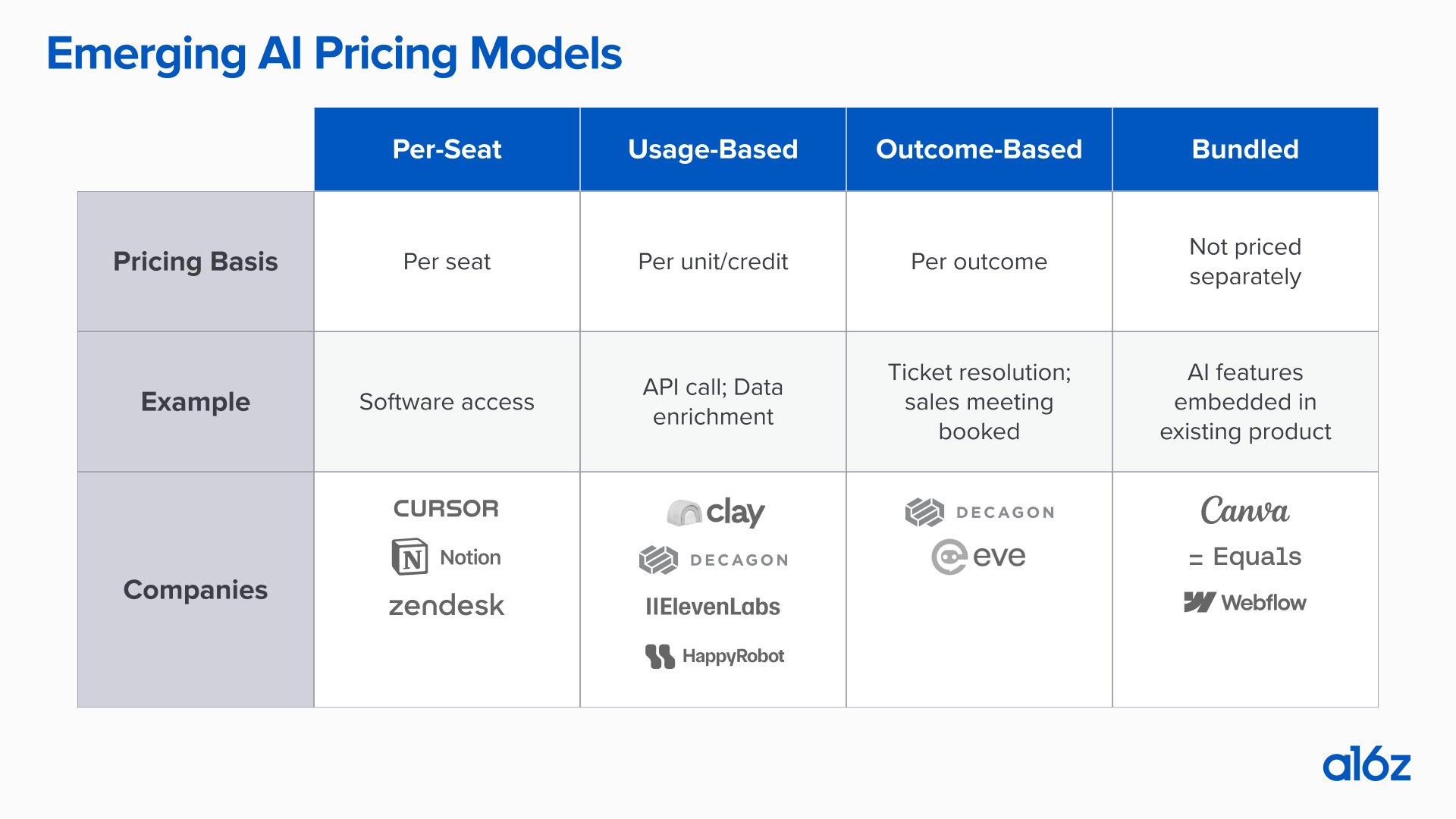
Usage-Based Pricing: Pay for What You Consume
The most established alternative is usage-based pricing--also called consumption-based or pay-as-you-go pricing--charging for API calls, data processed, messages sent, or transactions completed. Stripe's per-transaction fee and Twilio's cost per message are canonical examples [3]. The appeal is direct alignment with value delivered: customers pay only for what they use, lowering adoption barriers and eliminating the annual-contract standoff.
Token-based pricing follows the OpenAI model, charging for computational resources consumed. Jasper AI now charges per content piece generated, while Writesonic prices by articles, ads, or copy created [1]. For AI-native products, this is the natural baseline, because compute is the dominant marginal cost.
The Rise of the Credit Model: 2025's Defining Innovation
Between pure seats and pure outcomes sits the credit model--the standout pricing innovation of 2025. Companies using credit models grew 126% year-on-year, from 35 to 79 [3]. Credits work because they bridge the gap: they offer more transparency than legacy licenses while remaining more feasible than charging for results, since defining and measuring outcomes is still impossible for most products.
The adoption list reads like a who's-who of modern software: HubSpot, Figma, Adobe, Cursor, and Lovable all added credit models without killing seats, and Notion, ClickUp, and Dialpad followed in subsequent quarters [3]. The typical structure pairs a high platform fee--which covers R&D and base features--with metered credits for AI usage, protecting vendors from margin bleed while preserving predictability for buyers [5].
 Death of Per-Seat Pricing: 73% of SaaS Rebuilding
Outcome-Based Pricing: Agents as Digital Workers
The most radical departure is outcome-based pricing, in which companies pay for results rather than seats or consumption. If an AI agent generates 500 qualified leads per month, the vendor charges for those leads--not for the seats once occupied by the SDRs who did the work manually [4]. Copy.ai's GTM AI platform now prices based on pipeline generated rather than team size [1].
Incumbents are following. ServiceNow is hybridizing its traditional seat model with outcome-based pricing for AI workflow automations, charging based on process completions rather than administrator seats. UiPath has evolved from classic RPA seat licensing to pricing based on automation volume and bot utilization, explicitly recognizing that one bot can replace multiple human seats [1].
Some startups have abandoned software framing altogether, positioning their AI agents as "digital workers" with price tags anchored to labor: "Hire our AI SDR for $1,000/month" [5]. Analysts describe this as software transitioning from a fixed-cost expenditure--paying for seats regardless of use--into a dynamic "Agentic Wage," where customers pay for the specific computational tasks and outcomes delivered by a digital workforce [4]. When selling against this framing, the smart comparison is not a competitor's software price but the cost of the human intern or freelancer being replaced [5].
Hybrid Models: The Pragmatic Middle Ground
Because most products cannot cleanly measure outcomes, hybrids are proliferating. One emerging structure reintroduces per-user licensing caps on monthly compute--for example, 1 million tokens per seat per month, with overage billed at $0.50 per 100K tokens. Vendors like Notion and Figma are testing variants. This preserves predictability while containing margin erosion, though critics note it reintroduces the per-user friction SaaS was designed to eliminate--and in a world where one AI-augmented employee replaces five, selling seat licenses risks looking tone-deaf [7].
Microsoft 365 Copilot's $30/month per-user add-on represents a similar "Band-Aid approach"--maintaining seat-based economics while delivering AI value on top [1]. The math can still work spectacularly: if AI makes software 10x more valuable at 3x the price, the net expansion is 30x. But whether seat-anchored hybrids can hold as agent deployments scale remains an open question.
Winners, Losers, and the Great SaaS Unbundling
Systems of Record Survive; Thin Interfaces Die
The disruption is not uniform across the software landscape. The roughly $2 trillion SaaS market is not dying--it's being triaged. Gartner's prediction that 35% of point-product SaaS will be replaced by AI agents by 2030 is less a death sentence than a sorting mechanism: weak products churn first, while deeply embedded suites expand [7].
Accounting platforms, CRM systems, and data warehouses--the systems of record--continue to add seats because they are not threatened by agents; agents need somewhere authoritative to read from and write to [7]. What is threatened is the thin, horizontal, feature-light tool sitting between a user and a workflow. When application-layer features become easy for AI to replicate, buyers increasingly ask why they should pay a per-seat tax for an all-in-one suite when a lean, specialized agent can interface directly with the backend via API [4]. This dynamic--dubbed the "Great SaaS Unbundling"--means the interface layer is dying even as the record layer persists [8] [4].
The Investor Problem: Predictable Revenue Becomes Variable Revenue
The transition carries a painful consequence for public SaaS companies: they promised Wall Street predictable, recurring, per-seat revenue, and must now shift toward variable, outcome-based revenue--harder to model, but far more sustainable in an agentic world [4]. The shift also pressures net revenue retention, long a central SaaS KPI, because the old growth model relied on expansion through user count and cross-functional standardization--assumptions that agentic workflows weaken on all three fronts [8]. Winners will be AI-native platforms that never adopted per-seat pricing, plus incumbents that successfully transition to outcome-based models; losers will be traditional SaaS companies trapped in per-seat economics with shareholders still expecting consistent seat expansion [1].
The Buyer's Reckoning: From Licenses to Unit Economics
The repricing is transforming buyers as much as vendors. Procurement teams are increasingly translating aggregate SaaS contracts into granular unit metrics--cost per employee, cost per ticket, cost per transaction--to normalize data across vendors and align IT spending with business outcomes rather than mere access [9]. Organizations that track these unit economics report reducing SaaS waste by an average of 24% within the first 12 months, largely by surfacing outliers that aggregate budgets hide [9].
The waste is substantial: industry data suggests 25-40% of enterprise SaaS seats are underutilized, and buyers are now auditing what percentage of paid seats logged in within 30 days, which seats are daily high-usage users, and--most consequentially--which seats could be replaced by AI agents in the next 12 to 24 months [6]. Cleaning up this waste creates immediate savings and strengthens negotiation positions against vendors clinging to legacy pricing.
There is a paradox on the buyer side too: AI generally increases software cost per employee due to high subscription and consumption costs, even as it should decrease labor costs per outcome by making employees dramatically more productive [9]. Counterintuitively, enterprise SaaS spend per company is projected to increase even as seat counts fall--the value captured shifts from licensing bodies to purchasing executed work [6].
 AI Is Driving A Shift Towards Outcome-Based Pricing (December 2024 Enterprise Newsletter) | Andreessen Horowitz
What Comes Next: Predictions and Strategic Implications
The trajectory over the next two to three years is coming into focus. Analyst forecasts include the following milestones [6]:
| Prediction | Timeframe | Confidence |
|---|---|---|
| 60% of enterprise SaaS vendors will offer non-per-seat pricing options | End of 2027 | High |
| At least one major SaaS vendor will abandon per-seat pricing entirely | 2027 | High |
| Outcome-based pricing will account for 20%+ of new enterprise contracts | End of 2027 | Medium |
| Per-seat pricing will decline from 78% of SaaS revenue to under 50% | End of 2028 | Medium |
For founders and product leaders navigating this transition, a practical checklist has emerged. First, audit your "seat exposure": if your product works perfectly and your customer needs fewer human employees, you must move off seat-based pricing immediately [5]. Second, project how AI agent deployments will reshape your customers' seat needs over the next 12-24 months, and ask what your system actually does--because the winners will monetize work, not users [6] [2]. Third, protect margins by never metering AI against a flat plan, and anchor your pricing conversation to the labor you replace rather than the software you compete with [5].
The deeper strategic point is that pricing must follow the nature of work. If your roadmap includes agents, orchestration, autonomy, or background execution, your pricing model must evolve--because seat-based pricing will increasingly slow down your best customers and punish exactly the behavior you want to encourage [2].
Conclusion
The seat is not dead yet, but it is clearly no longer the natural unit of software value. Per-user pricing will persist for collaboration tools and systems of record where human usage still roughly tracks value, but for any category where AI agents execute work, the future is consumption, credits, and outcomes. The transition will be messy: revenue predictability--the very thing that made SaaS a market darling--becomes the first casualty, and companies that move too slowly will watch their best customers demand pricing that reflects results rather than logins.
What is emerging is a more honest economic contract. Software is shifting from paying for presence to paying for performance, from fixed licenses to an "agentic wage" for digital workers [4]. Vendors that crack the code on measuring and pricing AI-driven outcomes--rather than clinging to the comfortable predictability of seat revenue--will own the next decade of enterprise software. The rest will discover that in an agentic world, charging by the body is a business model whose time has passed.
References
- 1.
- 2.
- 3.
- 4.
- 5.
- 6.
- 7.
- 8.
- 9.