Introduction
For the past two years, enterprise AI has been defined by the copilot: a reactive, prompt-driven assistant that acts as a sophisticated autocomplete engine, increasing accessibility and reducing friction for human workers [1][2]. However, as AI migrates from experimental interfaces into the operational core of enterprises, the industry is hitting a hard architectural ceiling. The true business value of generative AI is no longer found in answering queries, but in proactively performing complex, multi-step workflows [3].
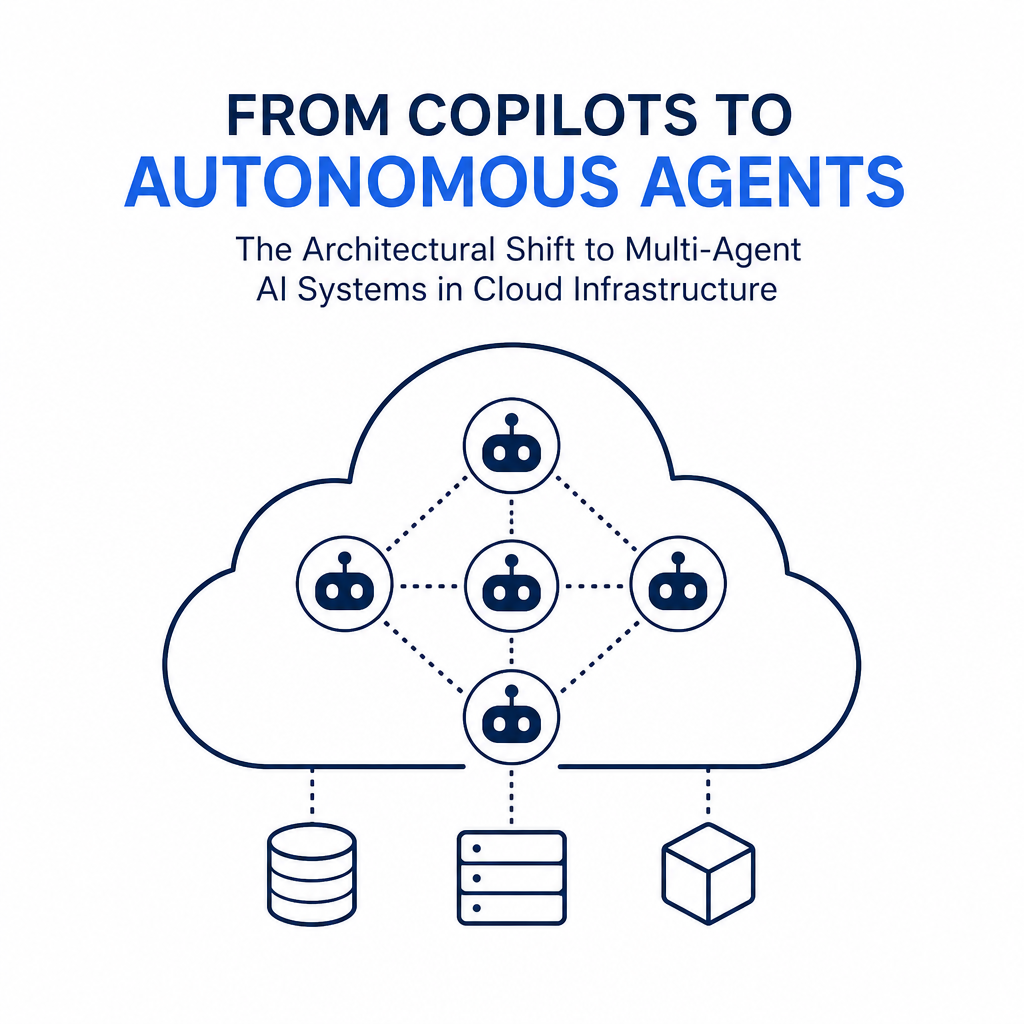
This marks a structural shift in enterprise execution. Autonomous AI agents--and the multi-agent systems (MAS) they form--are not merely smarter copilots; they represent a fundamental change in how work is owned, executed, and governed [1]. Moving from solo copilots to autonomous swarms requires tearing down the monolithic AI architectures of the past and building a new foundation of cloud infrastructure designed specifically for persistent, context-driven, and autonomous action [4][5].
The Architectural Discontinuity: From Reactive to Proactive
The transition from copilots to autonomous agents is not an incremental feature upgrade; it is an architectural discontinuity that demands fundamental changes in tooling, processes, and organizational structure [6]. Traditional copilots are inherently reactive. They respond to a prompt, return a single answer, and cease activity once the interaction concludes [5][1].
Autonomous agents, by contrast, are persistent and adaptive. They plan multi-step actions, call external tools, integrate with organizational systems, and continue working based on environmental feedback [5]. In operational environments, this shifts the paradigm from human-driven troubleshooting to end-to-end autonomous resolution. According to a recent maturity model tracing the evolution of AI operations (AIOps) in cloud network infrastructure, fully autonomous systems resolve qualified incidents in seconds to minutes, maintaining safety through architectural constraints rather than human oversight [6].
Consequently, the human role is fundamentally redefined. Instead of serving as the operator--and acting as the implicit audit trail for AI reasoning--humans are transitioning into roles as auditors and policy designers [6][7]. Work simply stops getting stuck where it used to pause, normalizing agentic behavior not through bold announcements, but through the quiet removal of friction [1].
Why Multi-Agent Systems Are the Enterprise Standard
As organizations deploy AI across procurement, customer service, financial operations, and compliance, a fundamental limitation has been exposed: single agents cannot handle enterprise complexity at scale [8]. The shift from experimental AI to operational AI necessitates moving from individual, point-based solutions to scalable multi-agent architectures [4][9].
In a multi-agent system, different agents assume distinct roles--some planning, others executing, and still others reviewing--creating a distributed intelligence capable of compositional reasoning [6][9]. Recognizing this necessity, major enterprise software vendors are changing their strategies. Custom-built agents proved too time-consuming and complex for most organizations to develop in-house, shifting the responsibility back to vendors to deliver pre-configured, role-based agents embedded directly into software [10].
For example, enterprise giants like SAP and Oracle are taking different architectural paths to embed these autonomous agents directly into their ecosystems, moving away from standalone copilot interfaces to deeply integrated, event-driven automation [10]. This transition eliminates silos, allowing organizations to handle complex workflows that require coordination across multiple domains and data sources [9].
The Cloud Infrastructure Imperative
Because autonomous agents operate continuously and adapt in real time, they impose entirely new demands on cloud infrastructure. Traditional inference--where a model receives an input and returns an output--stops there. AI agents require GPU-powered, elastic infrastructure capable of handling continuous, stateful, context-driven workloads [5].
Hyperscalers are rapidly redesigning their platforms to meet these execution demands. At AWS re:Invent 2025, the strategic pivot toward the "Agent Economy" was evident in the infrastructure released. To ensure reliability, AWS introduced Nova Act for high-success-rate UI automation, alongside Lambda Durable Functions to ensure multi-day agent workflows never fail [3]. To make running millions of agentic iterations daily economically viable, aggressive pricing on models like the Nova 2 family was paired with Trainium3 UltraServers for training and S3 Vectors for scalable Retrieval-Augmented Generation (RAG) [3].
Furthermore, because humans are no longer in the loop to observe agent reasoning, the infrastructure itself must capture the audit trail. Research out of Oracle Cloud Infrastructure highlights the urgent need for "reasoning provenance"--structured behavioral analytics that go beyond simple state checkpoints and execution traces to record why an autonomous agent made a specific decision during an event-triggered investigation [7].
Governance, Security, and the Threat of Authority Creep
The architectural advantages of multi-agent systems come with a steep cost: unprecedented complexity that introduces new risk surfaces. Every agent added to a system introduces new trust boundaries, privilege escalation risks, and points of failure [8]. In single-agent deployments, governance is straightforward--one agent to monitor, one set of permissions, one audit trail. In multi-agent architectures, those assumptions break down completely [8].
Without proper boundaries, autonomous systems face a unique failure mode known as "authority creep." This occurs when autonomous systems gradually take actions beyond their validated scope, potentially causing cascading failures in areas where their reasoning has not been verified [6]. As agentic AI architecture becomes standard, enterprises that lack governance infrastructure will face the same issues that plagued early cloud adoption: sprawl, shadow IT, and unmanaged risk [8].
To combat this, cloud infrastructure must be built with security for autonomy at its core. This involves new threat detection mechanisms--such as AWS's GuardDuty Extended Threat Detection for EC2 and ECS, designed specifically as a prerequisite for letting autonomous entities operate with high-level permissions [3]. Additionally, organizations must implement an enterprise AI management layer to track which agents are active, what tools they can access, how data flows between them, and whether policies are consistently enforced at every interaction [8][9].
Conclusion
The migration from copilots to autonomous multi-agent systems represents the next great source of enterprise value, but it requires a paradigm shift in how we build, secure, and manage cloud infrastructure. We are moving from a world where AI assists human operators to one where AI runs the business, constrained only by the architectural boundaries and policies we design [3][6].
For technology leaders, this creates an urgent strategic imperative. Aligning infrastructure with the unique demands of AI agents--elastic scaling, durable execution, reasoning provenance, and stringent multi-agent governance--is no longer a future consideration. It is the defining benchmark for reliability, efficiency, and user experience in the agent-driven era [5][7]. The question is no longer whether to adopt AI agents, but whether your organization is still budgeting for copilots, or building the infrastructure for autonomous agents [3].
References
- 1.
- 2.
- 3.
- 4.
- 5.
- 6.
- 7.
- 8.
- 9.
- 10.