
Introduction
For decades, the electronic health record (EHR) has been a double-edged sword in modern medicine. While it revolutionized data storage and interoperability, it inadvertently spawned a secondary crisis: physician burnout driven by excessive administrative burden. In 2026, clinical documentation remains a primary driver of this exhaustion, prompting a massive industry pivot toward AI-powered note-taking tools designed to reclaim lost time [1]. At the forefront of this movement is ambient clinical voice AI--a technology that passively listens to physician-patient conversations and automatically structures them into EHR-compatible notes.
Unlike traditional dictation, where a clinician speaks directly into a microphone after an encounter, ambient AI captures the entire dialogue, including the patient's voice. This fundamental shift in data capture promises to pull physicians out from behind their screens, allowing them to foster deeper human connections with their patients. However, the very mechanism that makes ambient AI so powerful--its continuous, passive recording of protected health information (PHI)--also introduces a vastly expanded "blast radius" for potential privacy violations and security breaches [2].
As healthcare systems rush to deploy these tools, IT leaders, compliance officers, and clinicians must jointly evaluate whether ambient voice AI actually delivers on its burnout-reduction promises without compromising patient privacy. Evaluating these platforms requires looking past marketing claims to scrutinize workflow integration, security architectures, and the ethical implications of algorithmic eavesdropping.
The Burnout Equation: Does Ambient AI Actually Deliver?
The core value proposition of ambient clinical documentation is simple: if the AI writes the note, the physician can focus entirely on the patient. Properly utilized, these tools promise to increase the quality and efficiency of documentation, reduce clinician burnout, and ultimately improve the quality of care [3]. By removing the barrier of the keyboard, physicians may be better equipped to understand, relate to, and empathize with their patients on a personal level [3].
However, the American Medical Association's Journal of Ethics warns that the efficacy of these tools is not guaranteed. If ambient AI fails to deliver on its mission, physicians risk facing three interrelated problems: decreasing patient trust, flatlining or increasing burnout, and potentially worse patient outcomes [3]. A poorly implemented system that requires extensive manual correction could paradoxically increase cognitive load, defeating its original purpose.
To truly evaluate efficacy, healthcare facilities cannot rely on anecdotal evidence. Providers must implement systems to measure the tangible effects of these tools by comparing baseline measurements of the time physicians spent interacting with patients and completing paperwork before adoption, against the post-implementation metrics [3]. Only through rigorous, data-driven evaluation can organizations determine if an ambient tool is a genuine cure for burnout or just another technological band-aid.
 Transforming clinical documentation with ambient artificial intelligence (AI) scribes: a narrative review of technology, impact, and implementation - PMC
The Ambient Distinction: Expanded Data Flows and Security Risks
When assessing security, compliance teams must draw a hard line between AI dictation and ambient AI. Clinicians often use the terms loosely, but in 2026, they represent fundamentally different data flows [2]. Dictation captures only the clinician's speech, usually after the encounter, giving the physician control over when the microphone is active. Ambient capture records the patient, raising distinct consent questions, complex retention requirements, and a significantly larger blast radius if the vendor is breached [2].
Consequently, organizations must treat these as separate line items in their risk analysis. There is no such thing as a "HIPAA certified" product--compliance is a property of the vendor relationship combined with the buyer's own safeguards [2]. The floor for compliance requires a signed Business Associate Agreement (BAA), but enterprise buyers must ask deeper questions. For instance, is the BAA available without an enterprise-only contract gate? What is the platform's encryption posture on the "write-back" leg, when post-call API calls carry PHI back into the EHR? [4] Furthermore, has the vendor completed a SOC 2 Type II audit, providing third-party attestation as the minimum verifiable proof of security controls? [4][1]
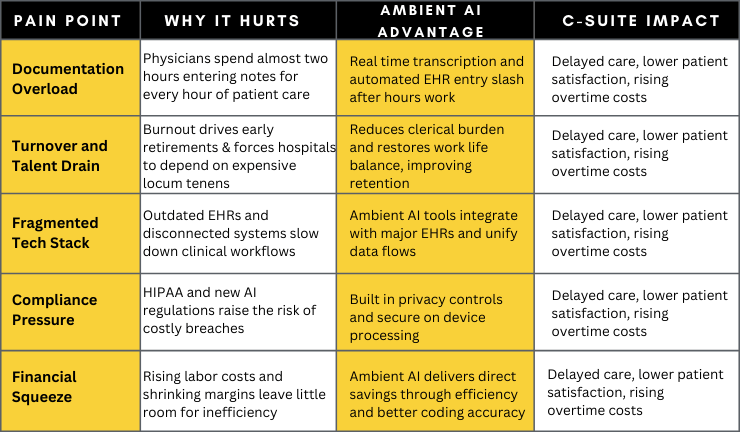 Ambient AI & Voice Agents in Healthcare: The Secret Weapon to Crush Clinician Burnout - Security Boulevard
Architecting Trust: Vendor Security Postures in Practice
The leading ambient voice platforms have built their architectures around these exact HIPAA requirements, though their approaches vary. Nuance DAX Copilot, backed by Microsoft, runs on Azure with HITRUST and HIPAA controls, encrypting data in transit and at rest, with Epic recordings stored for 30 days before mandatory deletion [5]. Similarly, Suki AI, a purpose-built ambient assistant, operates under a BAA with SOC 2 Type 2 certification, utilizing TLS 1.2 for transit and AES-256 for rest encryption, while also automatically deleting audio and transcripts after 30 days [4][5].
For highly regulated health systems, the architectural design matters immensely. Some platforms, like Smallest.ai, position themselves around lightweight, low-latency voice AI that can be deployed on-premises or in a private cloud, offering a compelling data-sovereignty story for buyers with strict network boundary requirements [4]. However, the trade-off for on-premises or niche solutions is often ecosystem maturity. Buyers must critically evaluate whether a vendor has the integration depth with major EHR systems and the documented compliance audit trails required for enterprise scale [4].
Regardless of the vendor, organizations must guard against the "consumer voice-to-text trap" [2]. As the January 2025 Security Rule NPRM proposes making encryption and Multi-Factor Authentication (MFA) mandatory rather than merely "addressable," healthcare buyers are advised to hold AI documentation vendors to this proposed baseline immediately [2]. Furthermore, trust dies in fine print; vendors must explicitly guarantee that they do not use uploaded clinical audio or transcripts to train their foundational AI models without explicit, separated consent [6].
The Human Element: Consent, Oversight, and Clinical Safety
Even the most secure architecture cannot fully address the ethical and human-centric challenges of ambient AI. Recording a clinical encounter introduces friction into the patient-clinician relationship. While the legal doctrine of informed consent provides weak incentives for robust patient education, ethically, patients must be informed and given the opportunity to decline [3].
Moreover, compliance does not automatically equal trust. Patients may remain deeply uncomfortable sharing sensitive symptoms with an AI eavesdropping in the room, even if the technology is perfectly HIPAA-compliant [7]. Building patient trust in voice AI is a user experience (UX) challenge that extends far beyond regulatory checklists. There is also a delicate tension between clinical safety and privacy: an AI system that aggressively verifies patient identity at every step is more HIPAA-compliant, but it may severely frustrate patients in crisis situations who need immediate help [7].
To mitigate clinical and legal liability, human oversight remains the ultimate safeguard. AI-generated clinical documentation carries severe risks, including transcription errors that lead to inaccurate medical records or the unintentional inclusion of sensitive PHI [8]. To counter this, organizations must adopt a hard rule: never commit AI-generated documentation to the EHR automatically [8]. The AI draft must always be subject to human oversight, and systems should limit which parts of a draft can be auto-inserted, ensuring the physician acts as the final gatekeeper of the medical record [8].
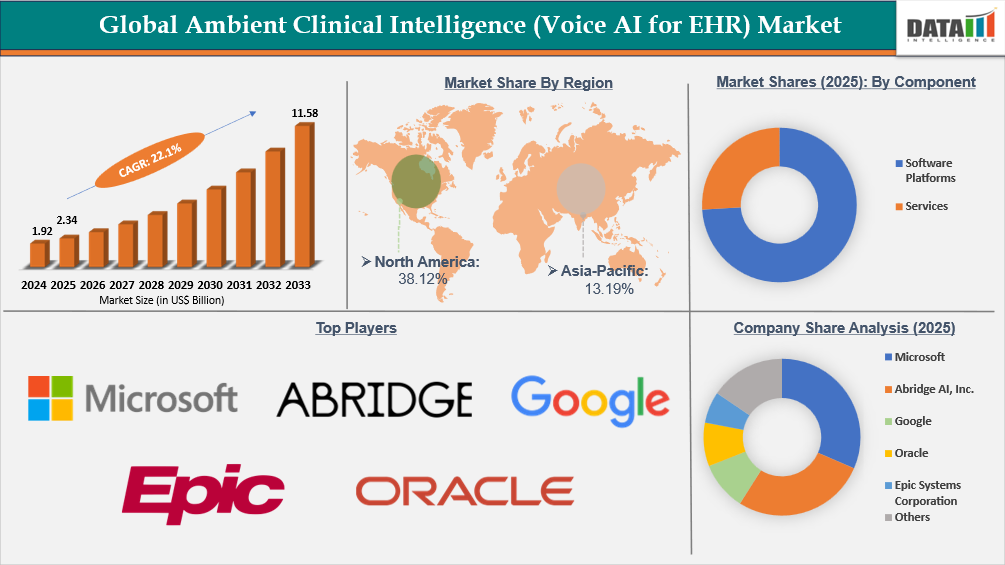 Ambient Clinical Intelligence Voice AI for EHR Market Forecast 2035
Conclusion
Ambient clinical voice AI stands at the vanguard of a much-needed paradigm shift in healthcare, offering a tangible pathway out of the documentation quagmire that has plagued modern medicine. By transforming passive conversations into structured EHR data, tools like Suki, Nuance DAX Copilot, and emerging secure platforms hold the potential to fundamentally restore the physician-patient relationship.
However, the efficacy of these tools in mitigating burnout is inextricably linked to their security and ethical implementation. The transition from traditional dictation to ambient listening represents a massive expansion in PHI exposure, demanding rigorous vendor evaluations, stringent BAA enforcement, and architectures capable of surviving the coming era of mandatory encryption standards. Ultimately, ambient AI will only transform EHR documentation if healthcare organizations treat it not as a passive utility, but as a high-stakes clinical instrument requiring continuous measurement, strict human-in-the-loop oversight, and an unwavering commitment to patient privacy.
References
- 1.
- 2.
-
3.
How Should We Think About Ambient Listening and Transcription Technologies’ Influences on EHR Documentation and Patient-Clinician Conversations? | Journal of Ethics | American Medical Association. (n.d.). Retrieved https://journalofethics.ama-assn.org/article/how-should-we-think-about-ambient-listening-and-transcription-technologies-influences-ehr/2025-11
- 4.
- 5.
- 6.
- 7.
- 8.