Introduction
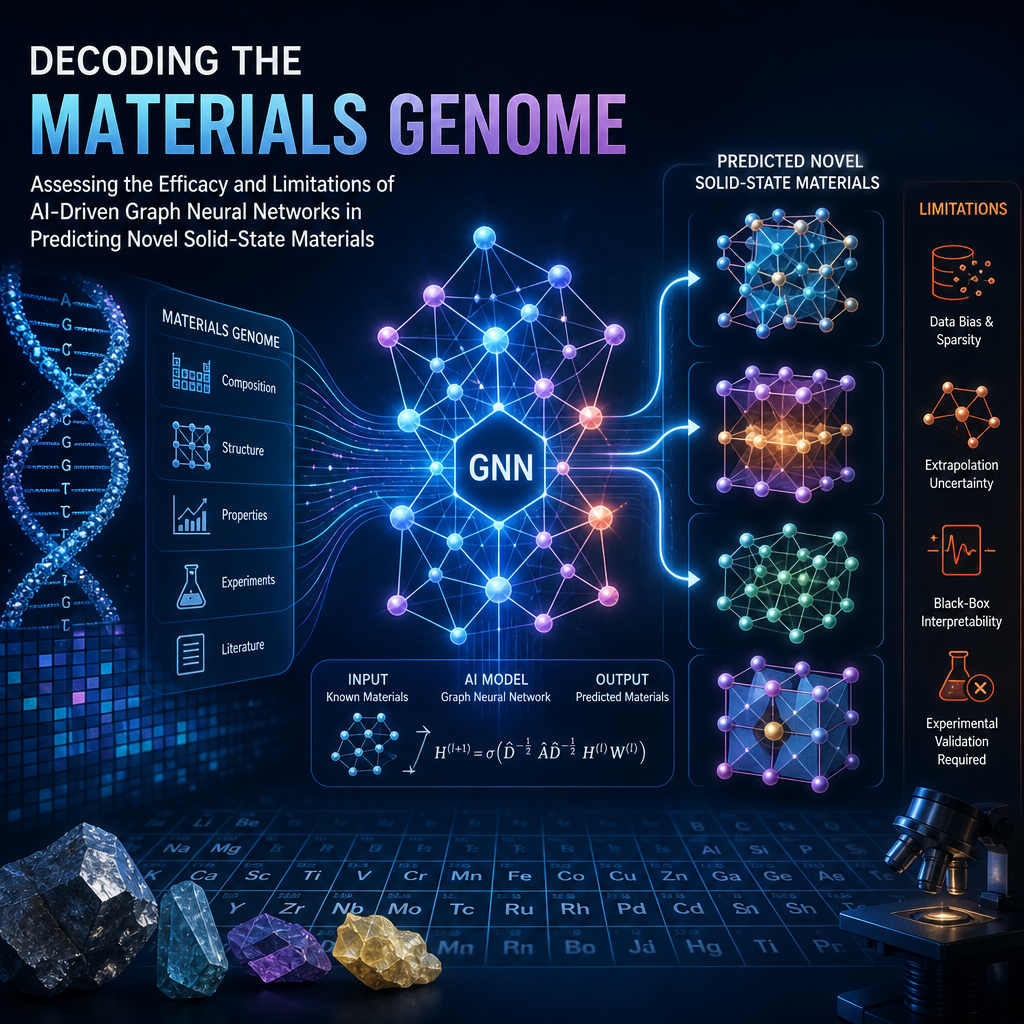
The quest to discover novel solid-state materials has historically been defined by serendipity, constrained by the exhaustive trial-and-error of traditional laboratory experimentation. The theoretical space of possible materials is staggering, estimated to be as high as a googol ($10^{100}$) [1]. To navigate this vast chemical cosmos, the scientific community has increasingly turned to the "Materials Genome Initiative" and data-intensive paradigms, seeking to engineer properties at the atomic level before a material ever exists in the physical world [1]. At the forefront of this second computational revolution are Graph Neural Networks (GNNs)--a class of artificial intelligence uniquely suited to decode the complex, relational geometry of solid-state matter.
Unlike traditional neural networks that process rigid grid-like data such as images, GNNs operate on graph-structured data, representing materials as networks where atoms serve as nodes and chemical bonds act as edges [2][3]. This architecture naturally captures the structural relationships that dictate a material's macroscopic properties, allowing researchers to simulate and predict behaviors ranging from electronic band gaps to ionic conductivity with remarkable speed [3]. By leveraging massive databases like the Materials Project, these models are transforming materials discovery from a slow, empirical process into a rapid, iterative engineering discipline [4][5].
Yet, as GNNs transition from academic proof-of-concept to industrial workhorses, a critical assessment of their capabilities is urgently needed. While headline-grabbing achievements have demonstrated unprecedented scale, the intricacies of solid-state physics--such as periodic boundary conditions, long-range disorder, and non-local electron interactions--expose fundamental blind spots in current graph-based methodologies. Understanding both the extraordinary efficacy and the structural limitations of GNNs is essential for the future of AI-driven materials science.
The Architecture of Efficacy: Why GNNs Excel in Materials Science
The core mechanism driving the success of GNNs in materials science is "message passing." In this framework, a crystal structure is mathematically represented as a graph $\mathcal{G} \coloneqq (\mathbf{A}, \mathbf{H})$, defined by an adjacency matrix ($\mathbf{A}$) mapping the connections between atoms, and a node feature matrix ($\mathbf{H}$) encoding the intrinsic properties of each atom [6]. As information propagates forward through the network, the feature vector of a given atom is iteratively updated based on the features of its immediate neighbors. This allows the model to build a holistic understanding of the local atomic environment, which is the primary determinant of many material properties [6].
State-of-the-art architectures have pushed this basic premise to impressive extremes. The Atomistic Line Graph Neural Network (ALIGNN), for instance, introduces a dual-graph message-passing mechanism that alternates between atomic bond graphs and line graphs [6]. This architectural twist allows the GNN to explicitly incorporate bond angles--critical geometric information that traditional models, which rely solely on interatomic distances, often miss. Consequently, ALIGNN and similar advanced GNNs have demonstrated the ability to predict continuous properties, such as formation energies, band gaps, and bulk moduli, with an accuracy comparable to Density Functional Theory (DFT) calculations--the gold standard of computational physics [6][1].
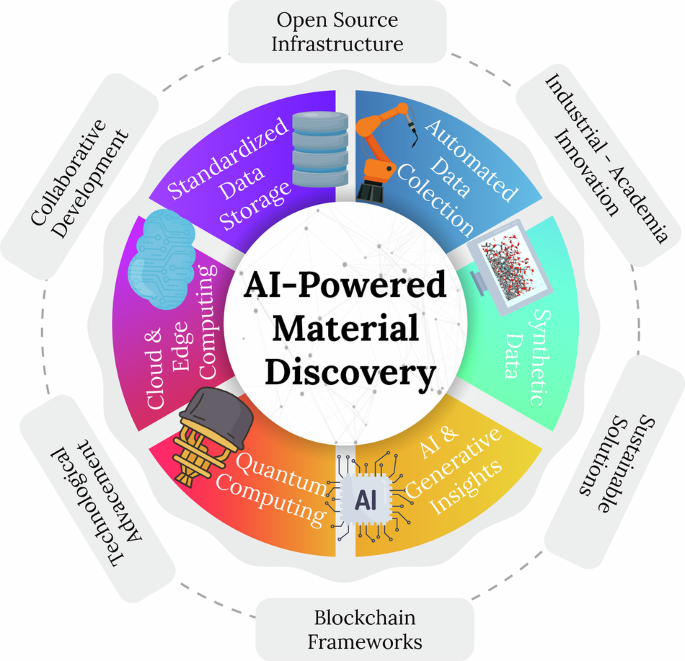 AI-powered open-source infrastructure for accelerating materials discovery and advanced manufacturing | Communications Materials
Scaling Discovery: From Active Learning to Millions of Novel Structures
The true power of GNNs becomes apparent when they are integrated into active learning loops, shifting their use from mere property prediction to large-scale autonomous discovery. The Graph Networks for Materials Exploration (GNoME) project by DeepMind represents a watershed moment in this regard [6][4]. Historically, computational approaches over the last decade yielded about 28,000 new materials. GNoME shattered this paradigm by discovering 2.2 million potentially stable novel crystal structures--a feat equivalent to roughly 800 years of human knowledge accumulation [4].
GNoME achieved this by challenging the assumption that newly generated materials must strictly adhere to the data distribution of existing training sets [6]. Using an active learning framework, the model generated predictions for novel crystal structures, which were subsequently filtered and validated using high-throughput DFT calculations. This high-quality DFT data was then fed back into the model, creating a continuous loop of improvement [4]. Through this methodology, GNoME dramatically boosted the discovery rate of stable materials from roughly 50% to over 80%, while simultaneously improving computational efficiency from under 10% to over 80% [4]. Of these discoveries, 381,000 materials have been integrated into established materials databases, with hundreds already experimentally validated for stability [6].
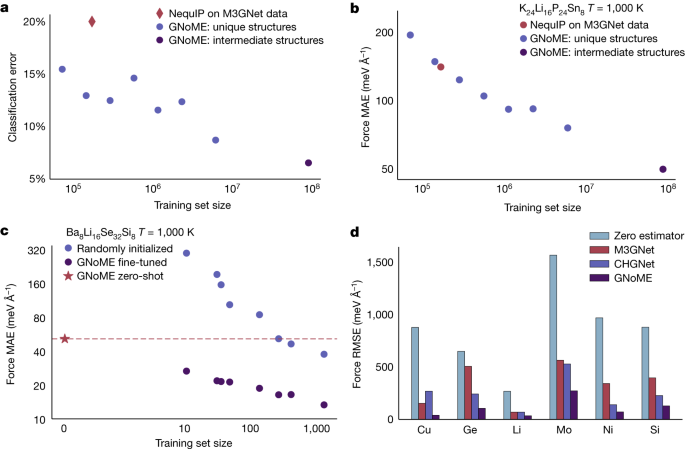 Scaling deep learning for materials discovery | Nature
The Achilles' Heel: Limitations and Structural Blind Spots
Despite their unprecedented predictive power, GNN-based pipelines suffer from severe structural limitations that practitioners must carefully weigh against their headline metrics [7]. The most fundamental of these is the challenge of capturing periodicity. Crystals are defined by their repeating unit cells, but standard GNNs often struggle to distinguish between different periodic arrangements if their local atomic environments look identical. For example, researchers have demonstrated that standard GNNs cannot differentiate between zigzag and armchair crystal chains if they share the same bond lengths and boundary angles, even when connecting second-nearest neighbors [8]. This reveals a critical failure to understand "local periodicity," necessitating a future requirement for "supercell invariance"--the guarantee that a material's predicted properties do not arbitrarily change if the input unit cell size is altered [8].
Furthermore, GNNs are inherently limited by "physics beyond locality." Because message passing is highly local, phenomena that rely on long-range interactions--such as charge transfer, excitons, and phonon-electron coupling--elude purely standard graph architectures [7]. A model might perfectly predict the local bonding energy but fail entirely to capture a delocalized electron state that dictates the material's actual macroscopic behavior.
Data scarcity and bias present another grand challenge. While models like GNoME thrive on massive datasets, many technologically critical chemistries--such as solid electrolytes, metastable perovskites, and multivalent ion hosts--lack the millions of high-quality, labeled data points required to train robust models [7]. In these sparse data regimes, GNNs are prone to overfitting and may produce highly confident but entirely erroneous predictions for novel chemical spaces.
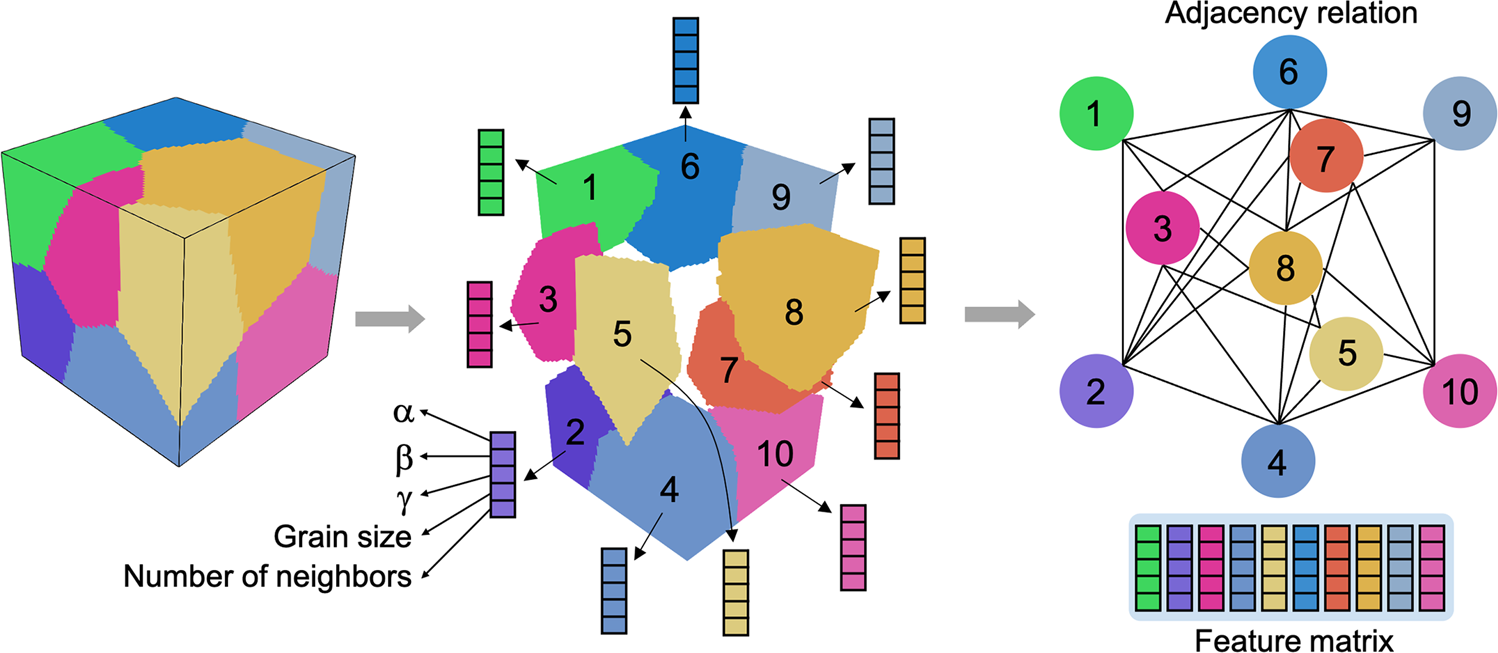 Graph neural networks for an accurate and interpretable prediction of the properties of polycrystalline materials | npj Computational Materials
Bridging the Gap: From Computational Stability to Experimental Synthesizability
Perhaps the most daunting hurdle in AI-driven materials science is the gap between predicting a stable crystal structure and actually knowing how to synthesize it in a laboratory. Predicting the products of solid-state reactions is notoriously difficult due to the complex thermodynamic and kinetic pathways involved [9].
To address this, researchers are developing specialized GNN pipelines, such as those created by Malik et al., which represent reaction precursors as dense, set-like graphs while utilizing Long Short-Term Memory (LSTM) layers to process the sequence of processing actions (like heating or grinding) [9]. However, progress in synthesis prediction is severely bottlenecked by the lack of systematic experimental data regarding reaction conditions [9].
Inverse design further complicates this landscape. Unlike property prediction (a one-to-one mapping), inverse design is a "one-to-many" problem: multiple entirely different materials can exhibit the same target property [2]. Generative AI models paired with GNNs are beginning to explore these diverse solutions rather than converging on a single answer [2]. Additionally, solid-state materials introduce complexities that molecular AI models avoid, including multiple forms of disorder--ranging from slight structural perturbations to a complete lack of long-range ordering, as seen in amorphous solids or porous frameworks [9]. Current GNN design for these diverse classes of materials remains in its infancy, requiring significant methodological breakthroughs to achieve wide applicability and transferability [9].
Conclusion
Graph Neural Networks have undeniably initiated a new epoch in materials science, democratizing access to high-fidelity property predictions and expanding the known universe of stable solid-state materials by orders of magnitude. By elegantly mapping the materials genome into actionable graph topologies, architectures like ALIGNN and GNoME have proven that AI can accelerate discovery at a previously unimaginable scale.
However, the current generation of GNNs is not a panacea. Their foundational reliance on local message passing leaves them blind to the nuances of periodicity, long-range physical phenomena, and the chaotic disorder inherent in real-world solid-state synthesis. As the field matures, the focus must shift from merely generating millions of hypothetical structures to developing hybrid GNN-field solvers, physics-aware architectures, and automated closed-loop laboratories capable of testing AI "recipes" in the physical world. Only by confronting these limitations head-on can the promise of the Materials Genome Initiative be fully realized.
References
- 1.
- 2.
- 3.
- 4.
- 5.
- 6.
- 7.
- 8.
- 9.