Introduction
The integration of artificial intelligence into oncology has historically been synonymous with computer vision--specifically, the application of deep learning to detect tumors in radiological scans or analyze histopathology slides. While these unimodal approaches have undeniably enhanced diagnostic speed and accuracy, they offer only a fragmented view of a highly complex disease. Cancer is not merely an anatomical anomaly; it is a systemic, molecularly driven condition influenced by a patient's unique genetic landscape, immune microenvironment, and clinical history.
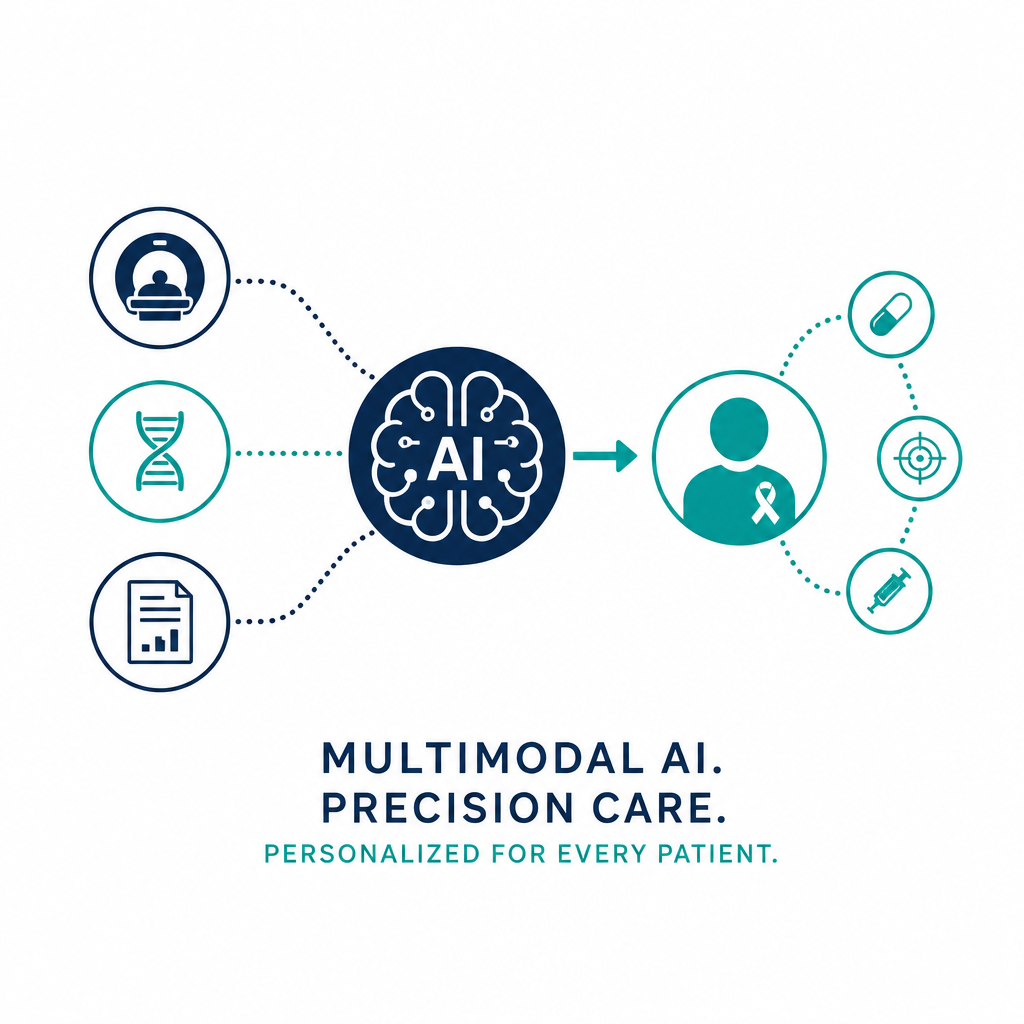
To capture this intricate biological reality, the field is rapidly pivoting toward multimodal AI. By architecting models capable of ingesting and fusing disparate data types--ranging from next-generation sequencing (NGS) and whole-slide pathology images to electronic health records (EHRs) and longitudinal lab results--researchers are constructing a holistic, multidimensional portrait of a patient's malignancy [1]. This approach mirrors the way human tumor boards operate, synthesizing diverse clinical evidence to reach a consensus, but at a scale and speed unattainable by human cognition alone.
This evolution marks a critical transition from descriptive AI, which simply identifies a tumor, to prescriptive AI, which actively informs and redefines personalized treatment pathways. As these multimodal systems mature, they are accelerating the core promises of precision oncology, turning vast, siloed medical data into targeted, life-saving interventions.
The Anatomy of Multimodal AI in Oncology
To understand the impact of multimodal AI, one must first understand the data streams it unifies. In oncology, the most consequential modalities are radiology (MRI, CT, PET scans), digital pathology (whole-slide images of tissue biopsies), genomics (DNA and RNA sequencing), and clinical data (patient demographics, comorbidities, and treatment histories). Individually, each modality reveals a different facet of the tumor. Radiology shows the tumor's size, location, and vascularization; pathology exposes cellular morphology and microenvironment composition; and genomics uncovers the specific driver mutations and molecular alterations [2].
Decoding the Data Streams
Historically, an oncologist had to mentally synthesize these distinct reports. A radiologist might note an aggressive growth pattern, while a pathologist identifies high-grade cells, and a molecular biologist discovers a targetable EGFR mutation. Multimodal AI ingests all these raw data types simultaneously, treating them as complementary pieces of a single biological puzzle. For instance, spatial transcriptomics can be overlaid directly onto histopathology slides, allowing AI models to visualize exactly where specific genetic mutations are expressing themselves within the physical architecture of the tumor [3].
The Mechanics of Modal Fusion
The technical magic behind this synthesis lies in "fusion architectures." AI researchers typically employ early, late, or intermediate fusion techniques to combine data. In late fusion, separate unimodal models make independent predictions that are then averaged. However, the most promising oncological models utilize intermediate fusion, where raw data from different modalities is processed by specialized neural networks and merged at an intermediate layer. This allows the model to learn cross-modal relationships--for example, recognizing that a specific radiomic texture on a CT scan consistently correlates with a specific genomic mutation, a concept known as "radiogenomics" [1].
Translating Multimodal Data into Actionable Treatment Pathways
The true value of multimodal AI lies not in data organization, but in its ability to directly influence clinical decision-making. By capturing the full biological context of a tumor, these models can predict treatment efficacy, anticipate resistance, and match patients with optimal therapies with a high degree of precision.
Predicting Immunotherapy Response
One of the most challenging aspects of modern oncology is determining which patients will respond to immune checkpoint inhibitors (ICIs). Unimodal approaches, such as relying solely on PD-L1 expression levels or tumor mutational burden (TMB), frequently yield false positives and negatives. Multimodal AI dramatically improves predictive accuracy by combining these genomic markers with radiomic features (assessing tumor heterogeneity on a baseline scan) and pathomic features (quantifying the density of tumor-infiltrating lymphocytes). Studies have demonstrated that multimodal models can predict non-small cell lung cancer (NSCLC) response to ICIs with significantly higher area-under-the-curve (AUC) metrics than any single data source alone [4].
Anticipating Therapeutic Resistance
Cancer cells are notoriously adaptive, often mutating to evade targeted therapies. Multimodal AI is increasingly being used to model tumor evolution and predict resistance before it becomes clinically apparent. By tracking subtle changes in a patient's serial CT scans alongside liquid biopsy genomic data, AI can detect the early emergence of resistant clones. If a model detects a shift in radiomic texture that historically precedes a specific KRAS mutation causing resistance to a targeted therapy, oncologists can proactively switch treatments, sparing the patient weeks or months of ineffective, toxic medication [5].
Overcoming the Integration Hurdle
Despite its immense potential, the clinical deployment of multimodal AI in oncology faces significant infrastructural and algorithmic hurdles. The most immediate challenge is data interoperability. Medical data is notoriously siloed; imaging data sits in PACS (Picture Archiving and Communication Systems), genomic data in laboratory information systems, and clinical data in EHRs. Harmonizing these disparate formats--aligning the temporal and spatial dimensions of a blood test taken on Tuesday with an MRI scanned on Thursday--requires robust data engineering and standardized ontologies like FHIR (Fast Healthcare Interoperability Resources) [2].
Furthermore, the "black box" nature of deep learning is exponentially complicated in multimodal models. When an AI recommends a specific chemotherapy regimen based on an MRI, a biopsy, and a genomic panel, explaining why it made that recommendation becomes a monumental task. Explainability in multimodal AI requires developing sophisticated attention mechanisms that can highlight which specific features across which modalities drove the final output. Without this transparency, oncologists remain hesitant to trust AI-generated treatment pathways for high-stakes decisions [6].
Regulatory bodies like the FDA also face novel challenges in evaluating these systems. Traditional software as a medical device (SaMD) is validated on a specific input-output pair. Multimodal AI, particularly if it utilizes continuous learning to adapt to new data, requires a fundamentally new regulatory framework that focuses on ongoing monitoring rather than static pre-market approval [5].
The Future Landscape: From Reactive to Predictive Oncology
As multimodal AI models overcome current integration hurdles, the future of precision oncology points toward the creation of "digital twins"--virtual, computational replicas of a patient's tumor that are continuously updated with real-world data. Oncologists will be able to simulate the administration of various chemotherapeutic cocktails or targeted therapies on the digital twin, observing the predicted tumor response and systemic toxicity before administering a single drop of medication to the actual patient [6].
This shift will fundamentally redefine personalized treatment pathways. Instead of the current reactive model--where treatments are changed only after a tumor progresses or a patient suffers severe side effects--oncology will become predictive and preemptive. Multimodal AI will continuously monitor a patient's multidimensional data stream, identifying the optimal window for intervention and dynamically adjusting treatment pathways as the patient's biology evolves.
Conclusion
The era of AI in oncology as merely a sophisticated pair of eyes for reading scans is rapidly drawing to a close. By breaking down the data silos that separate radiology, pathology, genomics, and clinical care, multimodal AI models are constructing the comprehensive biological context necessary for true precision medicine. While significant challenges in data integration, algorithmic explainability, and clinical validation remain, the trajectory is clear. As these systems evolve from experimental tools into standard clinical infrastructure, they will not just accelerate the pace of oncology--they will fundamentally redefine what it means to deliver personalized, patient-centric cancer care.